Hello friends!
Today I am going to tell you about Finnish sauna magic and sauna shamanism.
Enjoy!
Much like lakes,
Sea and ponds,
Saunas have been viewed as liminal spaces and portals between the human world and the spirit realm.
The traditional Finnish sauna served as a bathhouse that featured a fireplace,
Where stones were heated to extremely high temperatures.
Water was poured over the hot stones to create steam and increase the heat.
The earliest Finnish saunas were known as savusaunas,
Smoke saunas.
Unlike modern saunas that work with electricity,
These older versions were heated by burning large amounts of wood for six to eight hours in order to warm the pile of rocks called the kiuas.
After the heating process,
The smoke would be vented out,
Allowing people to enter to enjoy the löyly,
A Finnish term that refers to both the steam and the heat of the sauna.
This same term is also used in Estonian,
Where it is known as leili.
The symbolic and historical significance of the sauna in Finland is closely linked to shamanism.
The oldest Finnish sauna date back to the Stone Age and were constructed as bits dug into the ground.
When a person was building a house,
They would first construct the sauna and live in it while completing the house.
Saunas were often situated next to water sources such as lakes,
Sea,
Wells or rivers,
From which people would carry water by hand.
Additionally,
Saunas served multiple purposes.
People washed clothes,
Dried meat,
Brewed ale and dried herbs in them,
Among other activities.
Also,
When the sauna was close to the water area,
It was easy to go swim and cool off after the heat.
In the past,
Many generations of a family typically lived together and took turns going to the sauna.
Usually men and women went separately.
The masters,
Helpers and young men would go to the sauna as one group,
Followed by the women,
Maids and smaller children.
Sometimes the servants had their own saunas where they went together,
Or as separate groups.
It was common for boys under 10 years old to go to the sauna with their mothers,
And once they were old enough,
They began to join the men.
It was also customary for all family members to enjoy the sauna together,
A practice that remains quite common in modern-day Finland.
Women would attend a bridal sauna together,
As would men with the groom.
In contemporary Finland,
Groups of friends and colleagues often go to the sauna as well.
In public saunas,
Such as those at public beaches,
Everyone is welcome,
But swimsuits are mandatory.
Swimming halls usually have separate saunas for men and women.
Overall,
Finnish sauna traditions have been non-sexual in nature.
The older smoke saunas were often dark and filled with steam,
So people did not see each other anyway.
Today,
Most Finns enjoy sauna because of its health benefits,
And for many it is a place for meditation and relaxing.
Saunas were considered shamanistic spaces in ancient times.
Women gave birth in the sauna,
And when someone passed away,
Their body was kept in the sauna before burial.
It served as a liminal space,
Bridging the human world and the other world.
The traditional sauna culture can be compared to temples or places of meditation.
Saunas were places of peace,
Relaxation and serenity.
The spirit of the sauna had many names,
Such as Löylytär and Autareinen.
When entering the sauna,
It was customary to greet the spirit and show great respect.
The sauna was sacred.
It was forbidden to curse,
Spit,
Be rude,
Speak loudly or behave improperly inside.
People also practiced magic in the sauna.
Illnesses were healed there,
Particularly during winter,
When frostbites were treated.
Saunas that were heated during kekri,
The harvest festival,
And juhannus,
The mid-summer festival,
Were particularly special because they were connected to the well-being of the land and livestock,
And many spells were associated with these occasions.
Four elements.
The sauna is a unique place because it combines all four elements.
Water,
Fire,
Earth and air.
In Finnish folklore,
These elements,
Along with the väki,
Are the fundamental components of mythology.
The warmth in the sauna is connected to fire,
While water comes from the lake,
Complemented by the coolness provided by Vellamo.
Earth is represented by the old ground floors and the stones in the kiuas,
The stove.
Air is created as steam rises from the kiuas,
And one might feel a pleasant breeze by slightly opening a window.
Water is always present when it is thrown into the kiuas,
And when people wash themselves.
Spirits.
Steam has often been regarded as mysterious and magical.
The steam,
Known as löyly,
Was believed to be a living entity,
Representing the spirit of the sauna.
In some legends and folk songs,
Löyly is referred to as the mother figure of Autaretar,
The goddess of mist,
While in other tales,
Her counterpart is Autarinen,
The father figure.
Another name for löyly was löylytär,
Which is more of a feminine version.
The names Autaretar and Autarinen are derived from the word autere,
Which means sun mist.
This connection to mist is quite fitting,
As the earliest saunas were smoke saunas.
Magic bundles.
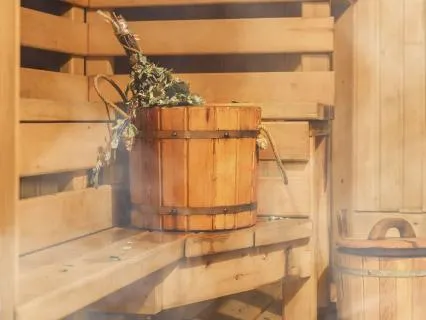
One of the unique aspects of Finnish saunas that often surprises non-Finnish visitors is the use of sauna bundles.
A sauna bundle is a collection of leafy tree branches that are tied together.
In the sauna,
People gently use these bundles to swish themselves.
This tradition is as old as the sauna itself,
And bundle has two names.
Vasta is used in eastern Finland,
While vihta is common in western Finland.
The most common sauna bundles are made from birch branches.
Historically,
These bundles were used in healing rituals,
With different trees chosen for their specific healing properties.
Additionally,
They were involved in spells related to love and fertility.
For instance,
If someone wanted to attract a love interest,
They might use branches from a birch,
Roven,
And apple trees,
Which were associated with beauty and love.
Today,
Sauna bundles remain popular in Finland,
Although they no longer carry the same symbolic meanings.
Using them is believed to improve circulation,
And they create pleasant scents.
Here are some trees which branches were used in the sauna.
Birch,
Koivu,
Element water,
Deity,
Veloma and mielikki,
Symbolism,
Protection,
Love,
Beauty,
And keeps evil spirits away.
Roven,
Pihlaja,
Element,
Fire and earth,
Deity,
Akka,
Symbolism,
Healing,
Divination,
Psychic powers,
Strength and success.
Aspen,
Haapa,
Element,
Air,
Deity,
Auteretar and ilmatar,
Symbolism,
Protection from robberies,
Increased conversational skills and self-expression.
Oak,
Tammi,
Element,
Fire,
Deity,
Ukku and tapio,
Symbolism,
Health,
Wealth,
Healing,
Fertility and abundance.
Poplar,
Poppeli,
Element,
Water,
Deity,
Veloma and loviatar,
Symbolism,
Wealth and flying.
Ash,
Saarni,
Element,
Fire,
Deity,
Ahti and ukko,
Symbolism,
Health,
Protection,
Rituals connected with the sea and wealth.
Junipera,
Kataja,
Element,
Fire,
Deity,
Mielikki,
Symbolism,
Protection against theft,
Love,
Health and protection from evil eye.
Pine,
Mandu,
Element,
Air,
Deity,
Ukko,
Symbolism,
Healing,
Fertility and wealth.
Sauna of birth.
Before modern hospitals,
Women gave birth in saunas.
In the past,
Sauna was the most hygienic place for childbirth.
It provided comfort for the mother,
Was easy to heat even in winter and made it simple to warm water.
Prior to giving birth,
The sauna would be cleaned and the benches were covered with sheets.
The midwife would be present with the mother,
Often accompanied by other women,
Such as a sister,
Mother,
Maid or friends.
According to folklore,
Wooden logs were to be placed in the oven with ticker end first,
As this was believed to help ensure that the child was born with its head facing forward.
After birth,
It was easy to wash the baby right away and then hand the newborn to the mother.
In Eastern Finland,
There was a custom that involved a special sauna session after a baby was born,
Which the men attended.
The father would go into the sauna with other men,
Followed by a celebration with food and drinks.
Meanwhile,
The woman who assisted the mother during the childbirth would also have their own sauna gathering after the event.
They would enjoy a small party where they drank and ate together.
One particular ritual for the woman involved sitting together underneath the benches of the sauna.
Each woman would take turns sipping coffee and taking a bite of bread.
This ritual was meant to protect the child from growing up to be greedy or envious.
The mother could also participate in this ritual if she felt strong enough.
Superstitions The newborn daughter will marry into wealth at later age if the sauna is heated with firewood chopped from the rye barn's beams.
The girl will grow up beautiful if the sauna is heated with firewood chopped solely from hardwood.
The newborn would find a more suitable spouse at a later age if the sauna was heated by placing the logs in pairs,
That is,
Two at a time,
Into the sauna stove.
Bridal sauna The bridal sauna tradition was practiced in Eastern Finland,
Specifically in Karelia.
During this ritual,
Any bad memories from the past,
Such as odd grudges and feelings of jealousy,
Were symbolically washed away along with the bath water.
The bridal sauna was organized by the bride's family members,
Friends or older relatives,
And took place in the night before the wedding.
One of the traditions invoked a practice called itkettäminen,
Which aimed to make the bride cry a little.
It was believed that if the bride didn't cry before the wedding,
She would become cold-hearted and unattached,
Leaning to an unfulfilling marriage.
To evoke tears,
Participants would share sentimental stories and memories while in the sauna.
Bridal sauna traditions Woman made a lot of noise by beating pans and ringing bells as they walked to the sauna.
This was done to drive away evil spirits.
Upon arriving at the sauna,
The woman tapped the walls,
Doors,
And windows to ward off any malevolent forces.
The bride did not have to do anything herself.
The bridal party washed her,
Stylized her hair,
And dressed her.
The bride's back was washed with flour and salt.
Salt was used to symbolize the washing away of old loss,
While flour represented bread and fertility.
Honey was also used to sweeten the future.
After being washed and dried,
The bride wore the groom's shirt for a time,
As this was believed to strengthen the marriage.
It was customary to sing to the bride in the sauna.
If the bride encounters a frog on the day of the bridal sauna,
It is considered a sign of good luck for the marriage.
Hearing a dog bark during the bridal sauna is believed to bring bad luck to the marriage.
If items are lost in the forest or accidentally dropped into the lake,
It is seen as a sign of losing money.
Sauna,
The last stop When a person passed away,
The body was placed on a specific board taken to the sauna.
With the feet pointing toward the door,
The board was part of Christian tradition.
Previously,
The body was positioned on a stretcher and covered with a sheet.
The body was washed,
Dressed in clean clothes,
And the hair was combed.
For a woman,
The hair was often braided.
When a body was placed in the sauna,
It marked a period of mourning,
During which a funeral was prepared.
This process typically lasted for three to five days.
However,
Winter was an exception.
If the ground was too frozen for digging a grave,
The body could remain in the sauna for up to a couple of weeks.
Eventually,
The ground would be tarred with fire,
Allowing for the grave to be dug.
When the board was not in use,
It was kept hidden,
Usually stored in one of the outside buildings.
Having the board in sight was considered an omen of death.
It was also believed that when the body was kept in the sauna,
There was a possibility the person could return as a ghost.
In this state,
They might wake up during the night and perform the same task they did when they were alive,
Such as chopping firewood and milking cows.
Along with the body,
Evil spirits and other spirits from the underworld were thought to roam freely in the sauna.
The body was usually washed in a cold sauna,
And only the water was warmed.
The washer was often chanting spells during the washing ritual,
But water was thrown to the ground in a crossroad.
It was believed that the items that were used to wash the body had the wacky of the dead attached to them,
And a skillful witch might learn a thing or two of hidden knowledge if they secretly washed themselves with these items.
If the witch was not careful,
The deceased returned.
Folk tells the stories how in the funeral strange hair was found inside the wrist of the deceased.
The washer was usually someone close to the deceased,
Or a professional washer.
Sometimes healers and midwives also worked as washers.
Saunatonttu.
Saunatonttu,
Also known as the sauna gnome or sauna elf,
Is the protective spirit of the sauna.
The term tonttu refers to a guardian of property,
With tontti meaning property in Finnish.
Different types of tonttu watch over various buildings,
Such as houses,
Stables and barns.
They are typically quite friendly and treated with respect.
However,
If humans are mean or disrespectful,
The tonttu can create difficulties for them.
When humans are present,
The tonttu makes itself invisible,
Otherwise it appears as an old man or woman,
Roughly the same size as a three to four year old child.
Often the first person to bathe in the sauna,
Or the individual who built the becomes its guardian after passing away.
In his book Tonttu,
Tarua ja totta,
Tonttu,
True and false,
Writer Heikki Saure reflects on the neglect of minor spirits in Finnish folklore during the 19th century folk tale collecting.
While there are numerous stories about elves,
These tales were often considered less significant than those about gods or mythical heroes.
However,
It was these minor spirits that ordinary people interacted with the most.
Sauna folk tales The Forest Sauna It was Easter Saturday,
And a man was hunting in the woods when he got lost.
As the sun began to set,
He struggled to find the path home.
Eventually he stumbled upon an old forest sauna,
And decided to spend the night there.
He built a fire in front of the sauna to keep warm.
Suddenly the door opened by itself,
Startling the man so much,
That he nearly fell into the fire.
Angered,
He closed the door,
And addressed the spirit of the sauna,
Saying,
If you do that again,
I'll show you how hot it can be.
A cheeky sauna spirit opened the door again,
Infuriating the man.
In his rage,
He set the sauna on fire.
Just as the ceiling was about to collapse,
A little man emerged from the flames,
His face covered in soot.
He exclaimed,
Oh,
What have you done?
You burned my beard!
This next story comes from the village of Fransila,
Which is located in northwestern Finland.
Fun fact,
My grandma was born in this village.
Old man Selkamaa.
Two men had been picking berries in the woods when they got lost.
They stumbled upon an old sauna that once belonged to a man named Selkamaa,
Who had passed away many years ago.
Not much remained of the other buildings.
What was once a farm,
Had been reclaimed by the forest.
Deciding to spend the night in the sauna,
They lit a fire in the oven.
During the night they heard the door opening and closing by itself,
And it sounded like someone was walking on the roof.
The men were tired,
And one of them said,
I don't care even if Selkamaa himself comes here,
I am going to sleep now.
Just then something fell from the roof,
And hot stones scattered all over the sauna,
Filling the room with grey dust.
This was too much for the men,
And they ran out in panic.
It was known that old man Selkamaa never liked outsiders.
When my father was young,
He visited the site where the sauna used to stand,
But there were only some old planks left.
Sauna is life.
In Finland,
Most saunas are so-called dry saunas,
Where the air is rather dry and the temperature rises between 70 and 100 degrees Celsius,
Which is around 158 to 212 Fahrenheit.
This is different to Russian sauna Banya.
Banya temperatures range from 60 to 70 Celsius,
Which is 140 between 158 Fahrenheit,
But the humidity is often between 40 and 70 percent,
Creating a steamier environment.
Different to Finnish sauna,
Where humidity is usually between 5 and 10 percent.
Russian sauna is more of a wet sauna.
I personally prefer the Russian type of that has a more mild temperature.
I cannot cope with too much heat.
Saunas are also common in Estonia and Latvia.
Some also exist in the Swedish countryside.
There are 3.
2 million saunas in Finland.
There are more saunas than there are cars.