Black Beauty The Autobiography of a Horse by Anne Sewell To my dear and honored mother,
Whose life,
No less than her pen,
Has been devoted to the welfare of others,
This little book is affectionately dedicated.
Part 1 Chapter 1 My Early Home The first place that I can well remember was a large,
Pleasant meadow with a pond of clear water in it.
Some shady trees leaned over it,
And rushes and water lilies grew at the deep end.
Over the hedge on one side,
We looked into a plowed field,
And on the other,
We looked over a gate at our master's house.
We stood by the roadside.
At the top of the meadow was a grove of fir trees,
And at the bottom,
A running brook overhung by a steep bank.
While I was young,
I lived upon my mother's milk,
As I could not eat grass.
In the daytime I ran by her side,
And at night I lay down close to her.
When it was hot,
We used to stand by the pond in the shade of the trees,
And when it was cold,
We had a nice,
Warm shed near the grove.
As soon as I was old enough to eat grass,
My mother used to go out to work in the daytime and come back in the evening.
There were six young colts in the meadow besides me.
They were older than I was.
Some were nearly as large as grown-up horses.
I used to run with them and had great fun.
We used to gallop all together round and round the field,
As hard as we could go.
Sometimes we had rather rough play,
For they would frequently bite and kick,
As well as gallop.
One day,
When there was a good deal of kicking,
My mother whinnied to me to come to her,
And then she said,
I wish you to pay attention to what I'm going to say to you.
The colts who live here are very good colts,
But they are cart-horse colts,
And of course they have not learned manners.
You have been well-bred and well-born.
Your father has a great name in these parts,
And your grandfather won the cup two years at the New Market races.
Your grandmother had the sweetest temper of any horse I've ever known,
And I think you have never seen me kick or bite.
I hope you will grow up gentle and good and never learn bad ways.
Do your work with a good will.
Lift your feet up well when you trot and never bite or kick,
Even in play.
I have never forgotten my mother's advice.
I knew she was a wise old horse,
And our master thought a great deal of her.
Her name was Duchess,
But he often called her Pet.
Our master was a good,
Kind man.
He gave us good food,
Good lodging,
And kind words.
He spoke as kindly to us as he did to his little children.
We were all fond of him,
And my mother loved him very much.
When she saw him at the gate,
She would neigh with joy and trot up to him.
He would pat and stroke her and say,
Well,
Old pet,
And how is your little Darkie?
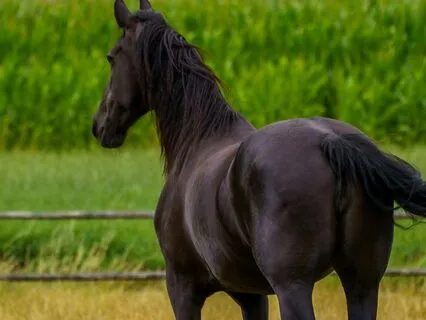
I was a dull black,
So he called me Darkie.
Then he would give me a piece of bread,
Which was very good,
And sometimes he brought a carrot for my mother.
All the horses would come to him,
But I think we were his favorites.
My mother always took him to the town on a market day in a light gig.
There was a plowboy Dick who sometimes came into our field to pluck blackberries from the hedge.
When he had eaten all he wanted,
He would have what he called fun with the colts,
Throwing stones and sticks at them to make them gallop.
We did not much mind him,
For we would gallop off,
But sometimes a stone would hit and hurt us.
One day he was at this gate and did not know that the master was in the next field,
But he was there,
Watching what was going on.
Over the hedge he jumped in a snap,
And catching Dick by the arm,
He gave him such a box on the ear as made him roar with the pain and surprise.
As soon as we saw the master,
We trotted up nearer to see what went on.
Bad boy,
He said.
Bad boy?
To chase the colts?
This is not the first time,
Nor the second,
But it shall be the last.
There,
Take your money and go home.
I shall not want you on my farm again.
So we never saw Dick any more.
Old Daniel,
The man who looked after the horses,
Was just as gentle as our master,
So we were well off.
Chapter Two The Hunt Before I was two years old,
A circumstance happened which I have never forgotten.
It was early in the spring.
There had been a little frost in the night,
And a light mist still hung over the woods and meadows.
I and the other colts were feeding at the lower part of the field when we heard quite in the distance what sounded like the cry of dogs.
The oldest of the colts raised his head,
Pricked his ears,
And said,
There are the hounds,
And immediately cantered off,
Followed by the rest of us to the upper part of the field where we could look over the hedge and see several fields beyond.
My mother and an old riding horse of our master's were also standing near and seemed to know all about it.
They have found a hare,
Said my mother,
And if they come this way we shall see the hunt.
And soon the dogs were all tearing down the field of young wheat next to ours.
I have never heard such a noise as they made.
They did not bark,
Nor howl,
Nor whine,
But kept on a yo-yo-yo,
Yo-yo-yo at the top of their voices.
After them came a number of men on horseback,
Some of them in green coats,
All galloping as fast as they could.
The old horse snorted and looked eagerly after them,
And we young colts wanted to be galloping with them,
But they were soon away into the fields lower down.
Here it seemed as if they had come to a stand.
The dogs left off barking and ran about every which way with their noses to the ground.
They have lost the scent,
Said the old horse.
Perhaps the hare will get out.
What hare?
I said.
Oh,
I don't know what hare.
Likely enough it may be one of our own hares out of the woods.
Any hare they can find will do for the dogs and men to run after.
And before long the dogs began their yo-yo again,
And back they came all together at full speed,
Making straight for our meadow at the part where the high bank and hedge overhang the brook.
Now we shall see the hare,
Said my mother.
And just then a hare,
Wild with fright,
Rushed by and made for the woods.
On came the dogs.
They burst over the bank,
Leaped the stream,
And came dashing across the field followed by the huntsman.
Six or eight men leaped their horses clean over,
Close upon the dogs.
The hare tried to get through the fence.
It was too thick,
And she turned sharp round to make for the road.
But it was too late.
The dogs were upon her with their wild cries.
All the gentlemen seemed well pleased.
As for me,
I was so astonished that I did not at first see what was going on by the brook.
But when I did look there was a sad sight.
Two fine horses were down.
One was struggling in the stream,
And the other was on the grass.
One of the riders were getting out of the water covered with mud,
And the other lay quite still.
His neck is broke,
Said my mother.
And serve him right too,
Said one of the colts.
I thought the same,
But my mother did not join with us.
Well,
No,
She said,
You must not say that.
But though I am an old horse and have seen and heard a great deal,
I never yet could make out why men are so fond of this sport.
They often hurt themselves,
Often spoil good horses,
And tear up fields,
And all for a hair or a fox or a stag that they could get more easily some other way.
But we are only horses and don't know.
While my mother was saying this we stood and looked on.
Many of the riders had gone to the old man,
But my master,
Who had been watching what was going on,
Was the first to raise him.
Everyone looked very serious.
There was no noise now.
Even the dogs were quiet,
And they seemed to know that something was wrong.
They carried him to our master's house.
I heard afterward that it was young George Gordon,
The squire's only son,
A fine,
Tall young man,
And the pride of the family.
There was now riding off in all directions to the doctors,
To the farriers,
And no doubt to Squire Gordon's to let him know about his son.
When Mr.
Bond,
The farrier,
Came to look at the black horse that lay on the grass,
He felt him all over and shook his head.
My mother seemed much troubled.
She said she had known that horse for years and that his name was Rob Roy.
He was a good horse,
And there was no vice in him.
She would never go to that part of the field afterward.
Not many days after we heard the church bell tolling for a long time,
And looking over the gate we saw a long,
Strange,
Black coach that was covered with black cloth and drawn by black horses.
After that came another,
And another,
And another,
And all were black,
While the bell kept tolling and tolling.
They were carrying young Gordon to the churchyard to bury him.
He would never ride again.
What they did with Rob Roy I never knew,
But was all for one little hair.
Chapter Three My Breaking In I was now beginning to grow handsome.
My coat had grown fine and soft and was bright black.
I had one white foot and a pretty white star on my forehead.
I was thought very handsome.
My master would not tell me till I was four years old.
He said lads ought not to work like men and colts ought not to work like horses till they were quite grown up.
When I was four years old,
Squire Gordon came to look at me.
He examined my eyes,
My mouth,
And my legs.
He felt them all down,
And then I had to walk and trot and gallop before him.
He seemed to like me and said,
When he has been well broken in,
He will do very well.
My master said he would break me in himself,
As he should not like me to be frightened or hurt,
And he lost no time about it,
For the next day he began.
Everyone may not know what breaking in is,
Therefore I will describe it.
It means to teach a horse to wear a saddle and bridle and to carry on his back a man,
Woman,
Or child,
To go just the way they wish and to go quietly.
Besides this,
He has to learn to wear a collar,
A crupper,
And a breaching,
And to stand still while they put it on.
Then they have a cart behind them,
So that he cannot walk or trot without dragging it after him,
And he must go fast or slow,
Just as the driver wishes.
He must never start at what he sees,
Nor speak to other horses,
Nor bite,
Nor kick,
Nor have any will of his own,
But always do his master's will,
Even though he may be very tired or hungry.
But the worst of all is,
When his harness is once on,
He may neither jump for joy nor lie down for weariness.
So you see,
This breaking in is a great thing.
I had,
Of course,
Long been used to a halter and a headstall,
And to be led about the fields and lanes quietly,
But now I was to have a bit and bridle.
My master gave me some oats as usual,
And after a good deal of coaxing,
He got the bit into my mouth,
And the bridle fixed,
But it was a nasty thing.
Those who have never had a bit in their mouth cannot think how bad it feels.
A great piece of cold hard steel,
As thick as a man's finger,
To be pushed into one's mouth,
Between one's teeth,
And over one's tongue,
With the ends coming out of the corner of your mouth,
And held fast there by straps over your head,
Under your throat,
Round your nose,
And under your chin,
So that no way in the world can you get rid of the nasty hard thing.
It is very bad,
Yes,
Very bad.
At least I thought so.
But I knew my mother always wore one when she went out,
And all the horses did when they were grown up.
And so,
With the nice oats,
And what with my master's pats,
Kind words,
And gentle ways,
I got to wear my bit and bridle.
Next came the saddle,
But that was not half so bad.
My master put it on my back very gently,
While old Daniel held my head.
He then made the girths fast under my body,
Patting and talking to me all the time.
Then I had a few oats,
Then a little leading about,
And this he did every day till I began to look for the oats and the saddle.
At length,
One morning,
My master got on my back and rode me round the meadow on the soft grass.
It certainly did feel queer,
But I must say I felt rather proud to carry my master,
And as he continued to ride me a little every day,
I soon became accustomed to it.
The next unpleasant business was putting on the iron shoes.
That too was hard at first.
My master went with me to the smith's forge to see that I was not hurt or got any fright.
The blacksmith took my feet in his hand,
One after the other,
Cut away some of the hoof.
It did not pain me,
So I stood still on three legs till he'd done them all.
Then he took a piece of iron the shape of my foot and clapped it on,
And put some nails through the shoe quite into the hoof,
So the shoe was firmly on.
My feet felt very stiff and heavy,
But in time I got used to it.
And now,
Having got so far,
My master went on to break me to harness.
There were more new things to wear.
First,
A stiff,
Heavy collar,
Just on my neck,
And a bridle with great side pieces against my eyes,
Called blinkers,
And blinkers indeed they were,
For I could not see on either side,
But only straight in front of me.
Next,
There was a small saddle with a nasty stiff strap that went right under my tail.
That was the crupper.
I hated the crupper.
To have my long tail doubled up and poked through the strap was almost as bad as the bit.
I never felt more like kicking,
But of course I could not kick such a good master,
And so in time I got used to everything and could do my work as well as my mother.
I must not forget to mention one part of my training which I have always considered a very great advantage.
My master sent me for a fortnight to a neighboring farmer's who had a meadow which was skirted on one side by the railway.
Here were some sheep and cows,
And I was turned in among them.
I shall never forget the first train that ran by.
I was feeding quietly near the pails that separated the meadow from the railway when I heard a strange sound at a distance,
And before I knew whence it came,
With a rush and a clatter and a puffing out of smoke,
A long black train of something flew by.
It was gone almost before I could draw my breath.
I turned and galloped to the farther side of the meadow as fast as I could go,
And there I stood snorting with astonishment and fear.
In the course of the day,
Many other trains went by.
Some more slowly.
These drew up the station close by and sometimes made an awful shriek and groan before they stopped.
I thought it very dreadful,
But the cows went on eating very quietly and hardly raised their heads as the black,
Frightful thing came puffing and grinding past.
For the first few days I could not feed in peace,
But as I found this terrible creature never came into the field or did me any harm,
I began to disregard it,
And very soon I cared as little about the passing of a train as the sheeps and the cows did.
Since then I have seen many horses much alarmed and restive at sight or sound of a steam engine,
But thanks to my good master's care I am as fearless at railway stations as in my own stable.
Now if anyone wants to break in a young horse,
Well,
That is the way.
My master often drove me in double harness with my mother because she was steady and could teach me how to do better than a strange horse.
She told me the better I behaved,
The better I would be treated,
And that it was wisest always to do my best to please my master.
But,
She said,
There are a great many kinds of men,
There are good,
Thoughtful men like our master,
That any horse may be proud to serve,
And there are bad,
Cruel men who never ought to have a horse or dog to call their own.
Besides,
There are a great many foolish men,
Vain,
Ignorant,
And careless,
Who never trouble themselves to think.
These spoil more horses than all,
Just for the want of sense.
They don't mean it,
But they do it for all that.
I hope you will fall into good hands,
But a horse never knows who may buy him or who may drive him.
It is all a chance for us,
But still I say,
Do your best,
Wherever it is,
And keep up your good name.
And that is the end of our story this evening.
Until next time,
Sweet dreams.