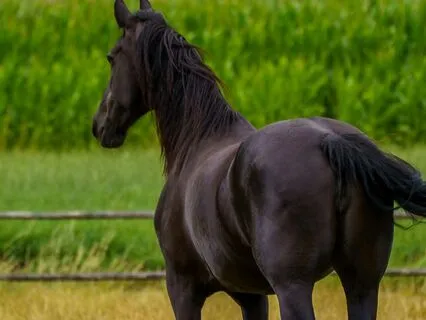
Chapter 4 Burt Wick Park At this time I used to stand in the stable and my coat was brushed every day till it shone like a rook's wing.
It was early in May when there came a man from Squire Gordon's who took me away to the hall.
My master said,
Goodbye Darkie,
Be a good horse and always do your best.
I could not say goodbye so I put my nose into his hand.
He patted me kindly and I left my first home.
As I lived some years with Squire Gordon,
I may as well tell something about the place.
Squire Gordon's park skirted the village of Burt Wick.
It was entered by a large iron gate,
At which stood the first lodge,
And then you trotted along on a smooth road between clumps of large old trees,
Then another lodge and another gate which brought you to the house and the gardens.
Beyond this lay the home paddock,
The old orchard and the stables.
There was accommodation for many horses and carriages,
But I need only describe the stable into which I was taken.
This was very roomy,
With four good stalls,
A large swinging window opened into the yard,
Which made it pleasant and airy.
The first stall was a large square one,
Shut in behind with a wooden gate.
The others were common stalls,
Good stalls,
But not nearly so large.
It had a low rack for hay and a low manger for corn.
It was called a loose box because the horse that was put into it was not tied up but let loose to do as he liked.
It was a great thing to have a loose box.
Into this fine box the groom put me.
It was clean,
Sweet and airy.
I never was in a better box than that,
And the sides were not so high but that I could see all that went on through the iron rails that were at the top.
He gave me some nice oats,
He patted me,
Spoke kindly,
And then went away.
When I had eaten my corn,
I looked around.
In the stall next to mine stood a fat grey pony with a thick mane and tail,
A very pretty head and a pert little nose.
I put my head up to the iron rails at the top of the box and said,
How do you do?
What is your name?
He turned round as far as his halter would allow,
Held up his head and said,
My name is Merry Legs.
I am very handsome.
I carry the young ladies on my back,
And sometimes I take our mistress out in the low chair.
They think a great deal of me,
And so does James.
Are you going to live next door to me in that box?
I said yes.
Well then,
He said,
I hope you are good-tempered.
I do not like anyone next door who bites.
Just then a horse's head looked over from the stall beyond.
The ears were laid back,
And the eye looked rather ill-tempered.
This was a tall chestnut mare with a long handsome neck.
She looked across to me and said,
So it is you who have turned me out of my box.
It is a very strange thing for a colt like you to come and turn a lady out of her own home.
I beg your pardon,
I said.
I have turned no one out.
The man who brought me here put me here,
And I had nothing to do with it.
And as to me being a colt,
I am turned four years old and am a grown-up horse.
I never had words yet with horse or mare,
And it is my wish to live at peace.
Well,
She said,
We shall see.
Of course I do not want to have words with a young thing like you.
I said no more.
In the afternoon when she went out,
Mary Leggs told me all about it.
The thing is,
Said Mary Leggs,
Ginger has a bad habit of biting and snapping.
That is why they call her Ginger.
And when she was in the loose box,
She used to snap very much.
One day she bit James in the arm and made it bleed,
And so Miss Flora and Miss Jessie,
Who are very fond of me,
Were afraid to come into the stable.
They used to bring me nice things to eat,
An apple or a carrot or a piece of bread.
But after Ginger stood in that box,
They dared not come.
And I miss them very much.
I hope they will now come again,
If you do not bite or snap.
I told them I had never bit anything but grass,
Hay,
And corn,
And could not think what pleasure Ginger found in it.
Well,
I don't think she finds pleasure,
Said Mary Leggs.
It's just a bad habit.
She says no one has ever been kind to her.
And why should she not bite?
Of course,
It is a very bad habit.
But I am sure,
If all she says to be true,
She must have been very ill-used before she came here.
John does all he can to please her,
And James does all he can,
And our master never uses a whip if a horse acts right.
So I think she might be good-tempered here.
You see,
He said with a wise look.
I am twelve years old.
I know a great deal.
And I can tell you there is not a better place for a horse all around the country than this.
John is the best groom that ever was.
He has been here fourteen years.
And you never saw such a kind boy as James is.
So that is all Ginger's fault that she did not stay in that box.
Chapter 5.
A Fair Start The name of the coachman was John Manley.
He had a wife and one little child,
And they lived in the coachman's cottage,
Very near the stables.
The next morning he took me into the yard and gave me a good grooming.
And just as I was going into my box with my coat soft and bright,
The squire came in to look at me and seem pleased.
John,
He said,
I meant to have tried the new horse this morning,
But I have other business.
You may as well take him around after breakfast.
Go by the common in the highwood and back by the watermill in the river.
That will show his paces.
I will,
Sir,
Said John.
After breakfast he came and fitted me with a bridle.
He was very particular in letting out and taking in the straps to fit my head comfortably.
Then he brought a saddle,
But it was not broad enough for my back.
He saw it in a minute and went for another,
Which fitted nicely.
He rode me first slowly,
Then a trot,
Then a canter.
And when we were on the common he gave me a light touch with his whip,
And we had a splendid gallop.
Oh,
My boy,
He said as he pulled me up.
You would like to follow the hounds,
I think.
As we came back through the park we met the squire and Miss Gordon walking.
They stopped and John jumped off.
Well,
John,
How does he go?
First rate,
Sir,
Answered John.
He is as fleet as a deer and has a fine spirit too,
But the lightest touch of the rain will guide him.
Down at the end of the common we met one of those traveling carts hung all over with baskets run.
Like,
You know,
Sir,
Many horses will not pass those carts quietly.
He just took a good look at it and then went on as quiet and pleasant as ever.
They were shooting rabbits near the highwood and a gun went off close by.
He pulled up a little and looked,
But did not stir a step to right or left.
I just held the rain steady and did not hurry him.
And it's my opinion he has not been frightened or ill used while he was young.
That's well,
Said the squire.
I will try him myself tomorrow.
The next day I was brought up for my master.
I remembered my mother's counsel and my good old master's and I tried to do exactly what he wanted me to do.
I found he was a very good rider and thoughtful for his horse too.
When he came home the lady was at the hall door as he rode up.
Well,
My dear,
She said.
How do you like him?
He is exactly what John said,
He replied.
A pleasanter creature I never wish to mount.
What shall we call him?
Would you like Ebony,
She said.
He is as black as Ebony.
No,
Not Ebony.
Will you call him Blackbird,
Like your uncle's old horse?
No,
He is far handsomer than old Blackbird ever was.
Yes,
She said.
He is really quite a beauty.
And he has such a sweet,
Good-tempered face and such a fine,
Intelligent eye.
What do you say to calling him Black Beauty?
Black Beauty?
Why,
Yes.
I think that is a very good name.
If you like,
It shall be his name.
And so it was.
When John went into the stable he told James that master and mistress had chosen a good,
Sensible English name for him.
That meant something.
Not like Marengo or Pegasus.
They both laughed and James said,
If it was not for bringing back the past,
I should have named him Rob Roy,
For I never saw two horses more alike.
That's no wonder,
Said John.
Didn't you know that Farmer Grey's old duchess was the mother of them both?
I had never heard that before.
And so poor Rob Roy,
Who was killed at the hunt,
Was my brother.
I did not wonder that my mother was so troubled.
It seems that horses have no relations.
At least,
They never know each other after they are sold.
John seemed very proud of me.
He used to make my mane and tail almost as smooth as ladies' hair.
And he would talk to me a great deal.
Of course,
I did not understand all he said.
But I learned more and more to know what he meant and what he wanted me to do.
I grew very fond of him.
He was so gentle and kind.
He seemed to know just how a horse feels.
And when he cleaned me,
He knew the tender places and the ticklish places.
When he brushed my head,
He went as carefully over my eyes as if they were his own and never stirred up any ill temper.
James Howard,
The stable boy,
Was just as gentle and pleasant in his way.
So I thought myself well off.
There was another man who helped in the yard.
But he had very little to do with Ginger and me.
A few days after this,
I had to go out with Ginger in the carriage.
I wondered how we would get along together.
But except laying her ears back when I was led up to her,
She behaved very well.
She did her work honestly and did her full share.
And I never wished to have a better partner in double hardness.
When we came to a hill,
Instead of slackening her pace,
She would throw her weight right into her collar and pull away straight up.
We had both the same sort of courage at our work.
And John had oftener to hold us and then urge us forward.
He never had to use the whip with either of us.
Then our paces were much the same.
And I found it very easy to keep step with her when trotting,
Which made it pleasant.
And Master always liked it when we kept step well.
And so did John.
After we had been out two or three times together,
We grew quite friendly and sociable,
Which made me feel much at home.
As for Merrylegs,
He and I soon became great friends.
He was such a cheerful,
Plucky,
Good-tempered little fellow that he was a favorite with everyone.
And especially with Miss Jessie and Flora,
Who used to ride him about in the orchard and have fine games with him and their little dog Frisky.
Our master had two other horses that stood in another stable.
One was Justice,
A roan-cob used for riding or for the luggage cart.
The other was an old brown hunter named Sir Oliver.
He was past work now,
But was a great favorite with the master who gave him the run of the park.
He sometimes did a little light carting on the estate or carried one of the young ladies when they rode out with their father.
For he was very gentle and could be trusted with the child,
As well as Merrylegs.
The cob was a strong,
Well-made,
Good-tempered horse,
And we sometimes had a little chat in the paddock.
But of course,
I could not be so intimate with him as Ginger,
Who stood in the same stable.
Chapter Six,
Liberty I was quite happy in my new place,
And if there is one thing that I missed,
It must not be thought I was discontented.
All who had to do with me were very good,
And I had a light,
Airy stable and the best of food.
What more could I want?
Why,
Liberty.
For three and a half of my life,
I had all the liberty I could wish for.
But for now,
Week after week,
Month after month,
And no doubt year after year,
I must stand up in a stable,
Night and day,
Except when I am wanted.
And then I must be just as steady and quiet as any old horse who has worked twenty years.
Straps here and straps there,
A bit in my mouth and blinkers over my eyes.
Now,
I am not complaining,
For I know it must be so.
I only mean to say that for a young horse,
Full of strength and spirits,
Who has been used to some large fields or plain where he can fling up his head and toss up his tail and gallop away at full speed,
Then round and back again with a snort to his companions,
I say it is hard never to have a bit more liberty to do as you like.
Sometimes,
When I have had less exercise than usual,
I have felt so full of life in spring that when John has taken me out to exercise,
I really could not keep quiet.
Do what I would,
It seemed as if I must jump or dance or prance,
And many a good shake I know I must have given him,
Especially at first.
But he was always good and patient.
Steady,
Steady,
My boy,
He would say.
Wait a bit and we will have a good swing and soon get the tickle out of your feet.
Then as soon as we were out of the village,
He would give me a few miles at a spanking trot and then bring me back as fresh as before,
Only clear of the fidgets,
As he called them.
Sprinted horses,
When not enough exercised,
Are often called skittish,
When it is only play,
And some grooms will punish them,
But our John did not.
He knew it was only high spirits.
Still,
He had his own ways of making me understand by the tone of his voice or the touch of the rein.
If he was very serious and quite determined,
I always knew it by his voice,
And that had more power with me than anything else,
For I was very fond of him.
I ought to say that sometimes we had our liberty for a few hours.
This used to be on fine Sundays in the summertime.
The carriage never went out on Sundays because the church was not far off.
It was a great treat to us to be turned out into the home paddock or the old orchard.
The grass was so cool and soft to our feet,
The air so sweet,
And the freedom to do as we liked was so pleasant.
To gallop,
To lie down,
And roll over on our backs,
Or to nibble the sweet grass.
Then it was a very good time for talking as we stood together under the shade of the large chestnut tree.
And that is the end of our story this evening.
Until next time,
Sweet dreams.