So we are reading the Bhagavad Gita.
I'm reading specifically from Stephen Mitchell's version of it,
But you can read from any version.
Here's the Maharishi Mahesh Yogi's version.
He only did the first six chapters.
Not sure what happened after that,
But there are many,
Many,
Many versions of the Bhagavad Gita.
All of them are beautiful.
So whatever one really clicks with you is perfect.
You don't need to have a specific book for our journey together.
I just really like Stephen Mitchell's interpretations of everything.
He did a beautiful interpretation of the Dao De Ching,
Which I actually have a recording here on Insight Timer that I read the whole thing recorded,
And I had a friend who was having trouble sleeping,
So I read this out so he could listen to it at night.
The Bhagavad Gita is a story that lives within the great Mahabharata.
Now I'm sitting over here by my bookshelf.
This is one volume of the Mahabharata,
And it's a very,
Very,
Very big book.
If you are listening to this later,
I am holding a book that is probably two inches thick,
And there are four of these over here on my bookshelf.
This is the Mahabharata.
It is a massive story coming out of India,
And the Bhagavad Gita is a very,
Very small book inside this great story.
And there's a lot of people who question,
You know,
Was it a historical event,
Or was it a metaphysical allegory that is meant as a spiritual teaching?
Most people err on the side that this is a metaphysical teaching.
This is a teaching,
It's a spiritual document for people on a spiritual path,
More than a historical document.
But,
You know,
There are all opinions out there.
The Bhagavad Gita is a point in the middle of this huge story of the Mahabharata,
And the Mahabharata is all these stories of how these two kingdoms that come out of Arjuna,
Who is our hero,
He and his four brothers are supposed to be the rightful heirs to the throne,
But their dad dies when he's young,
And it goes off to their dad's brother,
Who's blind,
Who has a hundred evil sons,
And the evil sons have just done a horrible job in the kingdom,
And there's been all kinds of suffering and death because their father is blind.
But of course,
Metaphorically,
These are the blind senses.
These are the things inside of us that drive us crazy,
That harm us in life,
And all these kind of things.
And so the Mahabharata is this great epic of this story of the kingdom.
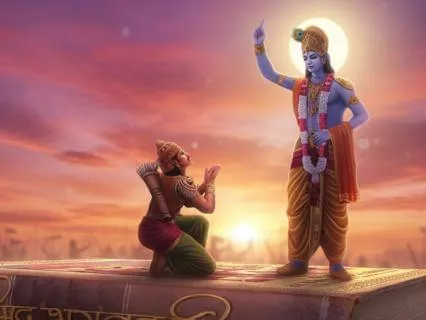
The Bhagavad Gita is one particular scene where Arjuna is in his chariot,
Krishna is his charioteer,
And they are in the middle of the great battle between the hundred evil sons and those who are loyal to them,
And then Arjuna and his four brothers and all who are loyal to them.
Arjuna asks Krishna,
Take me out into the battlefield,
Let me see everything that's there.
And all of a sudden he looks around and realizes he has family on all sides.
He has friends on all sides.
How can I possibly kill these people?
How can I possibly go to war?
Suddenly this hmm,
I will kill,
I am a great warrior,
Fell flat as soon as he saw that his grandfather was on the side of the evil brothers,
The evil cousins.
And so we've had,
We've done a lot of talks already.
I think we actually only have 11 talks we've done in the Bhagavad Gita.
So we've talked about all of these very individual things about that the grandfather actually in your soul represents your history,
Your ancestral history that often is very hard to let go of,
You know.
And so there's interesting analogies all the way along.
But for today's reading,
One of Arjuna's great challenges is I just,
I don't want to kill these people,
Like I just don't want to.
And he kind of falls and he's just like,
I can't do it.
He slumps into the chariot and he just gives up.
So this portion of the book,
And actually the rest of the book,
This is Krishna telling Arjuna all about life.
You know,
Sometimes you get to that point in your life where you're like,
You know,
I don't think anything I've ever known is true.
I think everything I ever learned about life from my family and the church and school and the news and everything,
I think it's all nonsense.
And I'm saying it in a very light way,
But these are the dark nights of the soul.
These are the moments where you're sitting there and you think,
I don't even know what to think anymore.
And this is where Arjuna is.
So Krishna is essentially for the entire Gita,
Helping him understand an entirely different way of looking at the world.
And his primary discussion at this part of the book is,
You must fight Arjuna.
And there are many ways of looking at this,
And especially because you have sort of the brothers of the good on the one side who Arjuna is a part of.
And inside of each of us,
This is courage,
Love,
Intention,
Duty.
And I don't mean duty by like family.
I mean,
Like your dharma.
Like what is your purpose here?
What is your mission here on earth?
And they are facing off against everything inside of you that seems to take you off course.
Whether it's the perpetual desire for pleasure that keeps us playing video games for three hours when we actually would love to have gone for a walk,
Or read a book,
Or had hung out with a friend.
Or it might be the absolute aversion to pain,
Which causes us to be terrified of doing anything,
Because what if it doesn't work,
Or what if it hurts?
And so it's this great battle.
So this is where we are in the story.
So today we are looking at chapter two,
Verse 21.
I'm just going to read back a little bit.
And so when I say the word self,
It is capitalized,
Just so you know,
It is capitalized.
So this is Krishna talking to Arjuna.
If you think that this self can kill or think that it can be killed,
You do not well understand reality's subtle ways.
It was never born,
Coming to be,
It will never not be.
Birthless,
Primordial,
It does not die when the body dies.
So this coming verse is what we're going to look at today.
Knowing that it is eternal,
Unborn,
Beyond destruction,
How could you ever kill?
And whom could you kill,
Arjuna?
Knowing that it is eternal,
Unborn,
Beyond destruction,
How could you ever kill?
And whom could you kill,
Arjuna?
I'm going to read you another version of it.
This is the Maharishi Mahesh Yogi's version of that.
And just so you know,
There's a million names for Arjuna,
And one of them is Partha.
So that's why it says it here.
One who knows him to be indestructible,
Everlasting,
Unborn,
Undying,
How can that man,
Oh Partha,
Slay or cause anyone else to slay?
So when you hear that,
Really honestly,
What do we imagine that the teaching is?
Because we're going to talk about the confusion of this particular stanza.
I'm curious to know what you guys hear when you hear that.
Take responsibility for your own actions.
We are beyond what happens to us in the world.
We are more than this life.
So in our talk today,
As always,
We're going to look at how we apply this to our lives.
But I do want to address something that is really important.
That there are many places in the Gita that they talk a lot about killing,
And how it's okay to kill.
They're immortal too,
You know,
And it has nothing to do with you.
You just have to do your duty.
You just have to do your dharma.
Now,
I'm in the middle of writing a book called Healing from a Sociopathic World.
And part of the research is about our history,
And one of the pieces is the caste system in India.
And a lot of people in the world have argued that it's verses like this that were actually used to condition soldiers to kill within the caste system.
Because in the caste system,
The top level are the Brahmin.
The next level are called Kshatriya.
And then the other so and so this is the warrior caste.
Okay,
So the top are the priests.
And then these are warriors.
Now Arjuna was a warrior.
He was part of the Kshatriya caste.
And as I was reading this,
And don't get me wrong,
We're going to dive into how we apply this to life,
That it isn't about this.
But I really feel it's important for us to see the whole possible picture here.
Because what we're talking about here is a huge criticism of the Gita.
So I just,
I really want to talk about it.
I don't personally approve of any kind of caste system,
Class system,
Anything like that.
And when these kinds of systems are being installed in a society,
There will be teachings that come out.
And almost all class systems,
Caste systems,
All about all over the world,
Were always justified in what they were saying,
Through religion.
And in,
In India,
The Brahmins use the Vedas.
And they use a lot of teachings to justify this caste system.
So it is possible.
So this,
This taught this book was written,
They say,
Somewhere between 400 and 200 BCE.
And this is around the time that the caste system really got its teeth in.
Before that,
It was sort of,
It was considered the Varna system,
It was a little looser.
But this is where in history,
It really started clamping down and saying,
You cannot intermarry outside of your caste.
Women are nothing,
The untouchables,
You can't take all this,
They get really,
This was the time.
So it is a curious thing that it is possible that this was edited.
It's possible that there are different voices in here.
You know,
It's not clear who wrote the Gita.
So just if there's something in you,
As we're reading the Gita,
You're like,
I don't know,
It kind of sounds like they're justifying killing.
If that's,
If you have that thought in your mind,
It's possible you're true,
You're right.
I just want to call it out like as an elephant in the room kind of thing,
Because the Gita is beautiful.
And it is one of the most loved spiritual texts,
Not a text that is all about justifying killing,
Because it's your duty,
Because that's the caste you're a part of.
So I do want to just call that out.
I don't know why,
Because we've never talked about this before.
We've always looked at it as an internal battle.
For some reason today,
I just thought,
You know,
Let's just make sure that it is possible that not only this was put in there for that intention,
But that people will interpret it that way.
And kind of to Geneva's point,
You know,
I doubt it would hold up as solid defense in court,
In the court.
But 3,
000 years ago,
You know,
Maybe it was a different time.
Now,
All that being said,
So I just want to,
I just want to say that just to kind of say,
Some people could use it that way.
But as in all things,
All technology can be used for good,
And it can be used for bad.
For example,
There are also amazing teachers who took this exact phrase,
This exact stanza,
And said,
See,
The caste system is wrong.
The people you deem untouchables or shudras,
Which is the lower caste,
The lowest caste,
They are also eternal inside.
See,
You can't do that.
You can't separate people into classes.
You can't do that because everyone is divine inside.
So it's interesting how many,
Many,
Many,
Many teachers say,
That's not what it is.
You know,
When Gandhi,
He created a whole interpretation of this,
He was like,
This entire book is within you.
It's all a discussion in your mind.
It has nothing to do with the outside world that was forming at that time.
So again,
Not really sure why I really wanted to talk about that today.
But I did.
So let's look at how we can use this stanza.
One thing,
So the two main parts of it are understanding that you are an eternal being.
Every one of us here is this eternal soul soul walking around.
And everything else around you is always changing.
And we've talked a lot about this in past classes.
And so therefore,
Everything around you on some level isn't actually real,
Because it's always changing.
And again,
It's not that it's not real,
That plant over there is real,
But because it's always changing,
It's a different kind of real than you inside.
And this is really interesting,
Because I want you to imagine this,
Let's just do a little visualization.
Let's close our eyes,
Unless you're driving.
And I want you to picture yourself standing in an open field.
Okay,
So you're standing in an open field.
And now I want your body to stay still.
But I want you to vision the home you grew up in,
Or one home that you grew up in,
And let it appear around you like you're on a stage,
You know,
Like someone just changed the background.
Imagine your family,
Where you grew up,
It just appeared all around you when you're standing there.
And now imagine the scene changes,
And you're now at school.
And now the scene changes,
And now you're maybe in your first apartment or your first home that you lived in.
And then see the scene change that you're now at work.
And then see the scene change that you're around friends or family.
And then see the scene change to the place that you live right now.
Can you feel the difference that you are the common thread?
You are always the same,
But everything around you is always changing.
Everything is always changing.
Similarly,
The hundred cousins,
The hundred cousins,
All of our desires and our fears and our self-doubt and our anger and our jealousy and the stuff we have brought in from our family and genetic history and whatever we've brought into this world,
Also always changing.
None of that is real.
Like when you really think about it,
When you think of your fears or your,
Quote,
Bad habits,
Or your patterns,
And when you think of patterns,
You think,
Well,
How come I always end up in a job that my boss is a jerk?
Or how come I'm always having,
You know,
Health problems?
Or how come I'm always struggling with money?
How come I'm always feeling depressed?
How come,
You know,
And you kind of look at that and you think,
Those are just the hundred cousins,
Not you.
You are Arjuna in the chariot.
You are forever and ever.
You are undying.
You are eternal.
All of those things are always changing.
So if you are this eternal being and you change something inside of you,
Did you really kill anything?
Is it even possible?
Or have you just changed it?
Has that energy just transmuted into something else?
Like,
Is it even possible to kill something?
The problem is that we think,
Oh,
Well,
I've killed it,
So it's dead and I've done all these bad things,
You know.
But you are eternal.
You are that person standing in the middle while the scenes keep changing.
And so this is a really different thing.
Like,
So no matter what we're talking about here,
Always picture yourself in the middle of that room.
And everything is always changing.
Maybe one minute you're at the grocery store,
But there you are.
And the next minute,
You know,
You're walking down the street,
The next minute you're in your car,
And the next minute you're talking to this person,
And the next minute you're sleeping.
But you are always the way,
And I don't know why I'm stumbling over this a little,
But throughout your life,
Everything comes and goes.
And in many ways,
This is a really hard lesson.
You know,
We don't like it.
We don't like change.
We want things to stay the same,
Unless we choose the change because it's bright and shiny and we want to go and do it.
You know,
But it's just really interesting to stay in that center.
So when he talks about killing,
That how can you possibly kill anything,
Or how could you possibly be killed?
This is the part I really want to look at.
When you think about your life,
Let's imagine,
So as you're moving through your life,
You are evolving,
You are always changing.
And therefore,
Everything around you is always changing.
And yet,
We will hold on to things that we're afraid of letting go of.
So let's say like a career.
Maybe you always did this one thing,
And it has become part of your identity.
But the reality is,
You have to let it go.
Maybe it's time to retire.
Maybe the workplace is toxic.
Maybe the money is wrong.
Maybe the people are wrong.
Maybe it doesn't suit your lifestyle.
But we don't want to let it go.
It's been with us for so long.
It's like that grandfather that's on the other side.
And I've learned so much there.
And I have ego attachment to saying that I am a doctor.
I am a teacher.
I am whatever.
But you aren't a doctor.
You aren't a teacher.
It's just like a garment.
It's just something you're wearing for a time.
It's a,
Again,
If we go back to us standing on a stage and people changing the scenes around us,
It's just a costume.
It's not you at all.
So if you end that career,
Have you really killed something?
Is it actually like that?
Or have you simply retired something so that you can go on to something new?
And this is the most important part,
This going on to something new.
And of course,
Within the context of the Bhagavad Gita,
They're talking about reincarnation in the physical realm.
In the physical realm,
That's what they're talking about.
But for us,
Or the teaching is,
We are reincarnating all the time.
Every time we change jobs,
Every time we move,
Every time we shift relationships,
Every time we change our habits,
Every time we start a new,
We open a new chapter in our life,
We have reincarnated if we've let the old go.
But how hard is that?
How hard is it sometimes to let things go?
Another huge challenge we have is being honest in relationships,
In friendships,
Especially in intimate relationships,
Because we're terrified of the death.
What if I'm honest and it ends?
What if,
And I don't mean being honest like,
I think you are,
Not that,
That's a judgment,
Honest about you.
What if you were honest and it died,
The relationship ended?
This normally,
It strikes terror in people's hearts,
Even if the relationship is dysfunctional,
Even if you've suffered in it.
We have so much fear of death,
Of anything.
So in many ways,
Krishna is saying,
What are you afraid of?
This thing that you think you're killing,
It's just a,
It's a relationship.
People come and go,
People have been coming and going in your life,
Your whole life.
This isn't new,
That this person will leave.
And even the idea that,
But oh,
But what if I'm really hurting them?
And what if this,
And what if that?
It's like,
But what if they too need to evolve?
You know,
And this is where they say,
You connect inside and you do your duty.
And what they're saying,
Your dharma,
And your dharma is your life path.
But what is your life path?
What are you meant to be doing?
Because if this is not on your life path,
We have to let it go so that we can be reborn in our new opportunity,
In our new experience.
It's an interesting thing to kind of let that go.
So of course,
This also allows us to say that we don't have to get caught in analysis paralysis.
You know,
But what if I do that?
And what if that happens?
And then we end up not doing anything at all.
But what if that's all an illusion?
Just like the changing scenes and the changing of people and the changing of the weather.
You know,
This morning we were talking about it was minus 28 in some places in the world.
And in some places it's warm.
And even here too in Canada,
It'll be a few weeks out and we'll be outside and the sun will be shining and everything will be different and the snow will be gone.
Krishna is saying that this is the reality.
This is actual reality.
You,
Your dharma,
Your connection to the divine,
This is what's real.
Everything else lives and dies.
And then let's imagine the other part of this this stanza that says,
But what about the being killed?
That you cannot kill nor can you be killed.
This is interesting.
If someone harms you,
Who have they harmed?
And again,
I'm not saying that we aren't harmed.
We are.
We live in this world.
It's a real thing.
And there's a time that we need to use that pain to change where we are,
Fix where we are,
You know,
Make different choices.
But then at some point we have to ask ourselves,
Was my soul hurt?
Or was this persona hurt?
And can I separate those two things so that I can heal?
Not some kind of spiritual bypassing or something,
But so that we can actually heal and come back to ourselves.
Like,
What if someone says something about us?
We live in a cancel culture,
Right?
What if someone says something about us?
Does it really touch you?
Like,
Can you be killed?
Or is this just another scene in the play?
And maybe they've cut the garment you're wearing.
You know,
Maybe they've harmed your reputation.
You know,
Maybe they've said something.
Maybe they've spread rumors about you or something.
And it hurts,
And don't get me wrong,
We're not meant to be completely detached.
But did it really touch you?
This is the teaching that Krishna's trying to say,
Is that you need to connect with your eternal self.
You know,
You need to connect with that self.
It also has a lot to do with allowing transitions in our life,
Even allowing transitions of the changes that happen even as we age.
That it's one of the great pains in our lives that we don't allow transition.
That,
You know,
I'm 56 years old.
In no way do I want to be 20.
I don't want to look like I'm 20.
I don't want to act like I'm 20.
I don't want to pretend that I haven't had 56 years of experience here on earth.
I'm 56,
And soon I'll be 60,
And hopefully 70,
And 80,
And 90.
And all of those will be interesting transitions.
But again,
We get caught up in,
Yeah,
But my body's different.
Oh yeah,
But the thing is,
You know,
All these things are changing around me,
And I don't,
You know,
And it's like,
But you are the same person.
Just like as we were standing in that room,
You're the same person who stood in that house that you were raised in,
And the same person that's standing in the house that you're in right now.
Same person.
You know,
It's kind of strange to not allow the transitions.
It's also interesting in the land of understanding that these,
The Hundred Cousins,
Are like all of our old habits.
Why are we so afraid to kill old habits if they don't serve us?
What is the fear?
What are the whispers that say,
Oh no,
Don't,
Don't.
I'm really important.
Without me,
Who will you be?
You know,
Without me,
What?
Like,
What?
Is it a person or is it a persona?
Exactly.
Thanks,
Leslie.
The personas we've put on,
I remember years ago after I was sick,
I had breast lumps back in 99.
I met my first spiritual teacher,
And I went through these huge dark nights of the soul and a miraculous healing,
And that was really the turning point in my life,
Everything.
I saw everything quite differently after that.
And I remember going away for the first time by myself,
And I had this little hotel room,
And there was a beautiful tub,
Like a clawfoot tub.
And as I was getting into the tub,
I could feel myself taking off the personas of my life.
And I kept seeing myself,
Like,
Hanging them on a hook,
Because I knew that I was going to have to put them back on.
Because the personas were like,
This is me as a mother.
My children were two and four years old.
I had a very big mother persona.
This is me as a wife.
This is me as a daughter-in-law.
This is me as a farm wife,
Because I was married to a farmer.
This is me as a daughter.
This is me as a sister.
This is me as a functioning member of society.
And then I have all kinds of other personas that I've made up over the years,
You know,
Like,
I am a university graduate from whatever other personas I've created over the years.
And I could feel myself,
Like,
Peeling these personas off as I took my clothes off and I got into the tub.
I remember lying in the tub,
So truly naked,
Without any of the personas.
And it's quite a confronting thing to just let it all go and feel what's left.
It's no small thing.
It's funny.
I had loaded this game on my iPad.
It was a really fun little game of word solitaire.
I found it very entertaining.
But I realized that it was sucking up all of my potential quiet time with that soul,
With that raw soul.
You know,
Because what I would do is I'd be teaching a class and then I'd finish teaching the class,
So I'd go and grab my game.
And I saw it as,
Oh,
I'm kind of decompressing.
And then I would go and I would do some writing for a while,
And then I'd take a break,
And then I would play my own game.
And then I would go do this other thing.
And eventually I realized that I was getting,
Like,
Tired,
Like,
Tired on a soul level.
I was like,
Something's wrong.
And so three days ago,
I deleted it off my iPad.
And don't get me wrong,
Like,
I've had a bit of withdrawal because I'm so used to going for it.
But all of a sudden what's happened is I'm now sitting quietly.
I'm journaling again.
I'm lying in the tub without anything.
And all this healing stuff has come up.
All of a sudden,
All these things that needed to be processed were coming up.
And I was kind of laughing about it,
Thinking,
Huh,
It's really something.
Because so often,
Especially with our phones and everything,
How often do we ever just sit with our raw self?
So no wonder we put all of our attention outside of us.
No wonder we think that all those things out there are real.
Because how many minutes in the day are we actually connecting with our eternal self?
And this doesn't have to be some crazy meditation.
It could be after this class,
Going and just sitting on the couch with your eyes closed and asking what your soul thinks.
And sitting there without any stimulation for as long as you want.
Actually checking in with your soul.
Because as soon as we actually check in with our soul,
Things around us are allowed to change.
They're allowed to shift.
Because I have me.
And I know that I don't change.
I know that I'm always here.
So then I have one last thing I want to share,
Which is kind of funny,
And it seems kind of counter to a lot of what we often talk about.
Because as I was thinking about this,
Right,
So here I'm thinking,
Okay,
We have this soul,
And we can't be afraid to kill the bad habits,
Right?
We can't be afraid to kill this and this and this and this and this.
And then the thought came into my mind.
What if we don't have to constantly be fixing ourselves either?
If you imagine yourself,
Here you are,
Your soul,
And you have all of these aspects of this life we've been given.
The ups,
The downs,
The positive things,
The negative things,
We have all the things.
And one of the challenges in kind of the spiritual community,
Which I love,
Is that we get obsessed with self-help.
We get obsessed with constantly changing,
Constantly fixing.
Got to look at the next thing.
Got to unpeel that onion.
We've got to always be fixing,
Fixing,
Fixing.
So I had this funny thought,
Like,
But the soul is eternal.
What difference does it make?
Which is a really funny thought here on Insight Time,
Where we're trying to improve our lives and heal and everything.
Because the interesting thing is we can get really,
Really,
Really hyper-focused on everything that's wrong with us,
To the point that we long forget how wonderful we are.
You know,
We're so focused on,
I've just got to fix that little thing.
I've got to fix that little thing.
But it's like,
You know why you want to fix that little thing?
Because you're a really nice person,
And you're interesting,
And you're deep,
And you're expanding consciousness.
That's why you're hyper-focusing on all these tiny little things.
It's just something interesting to ponder,
That you really are a magnificent,
Wonderful being.
And there is stuff.
But what's really interesting for me,
Because,
I mean,
I've been teaching spiritual studies and self-help and everything for over 20 years,
So I can get heavily navel-gazing.
Like,
Serious navel-gazing.
And luckily,
I've got good friends around me that are like,
Katrina,
You're fine.
You know,
Like,
Do you remember who you really are?
But we just get like,
Yeah,
But there's this thing that I just can't give up,
You know.
There's something about being light about it.
There's something about just,
You know,
Let's everybody just take a deep breath,
Ready?
And just letting it all go.
You know,
Letting those hundred cousins do what they're doing,
Whatever.
And then actually sitting with ourselves and saying,
Well,
My soul is my soul.
I am an eternal being.
I am here on earth having an incredible adventure.
Are there any aspects of this personality that I'm finished with?
Are they done?
Have I learned that lesson?
Is it complete?
Is it worn out?
Maybe I can just let it go.
Maybe it's not this big,
Hairy effort.
It's just,
Yeah,
As I walk forward in my life,
I don't think that belongs anymore.
And without any fear or worry,
We just let it go.
Or maybe we know that there's some aspect,
Some way we're thinking or some habit we have that is causing our sight to be blurry.
Like sometimes even,
Yeah,
Different habits we have,
Different food we eat,
Different people we talk to,
We end up more confused and tired than clear.
And we kind of look at that and we're like,
I don't really want to be confused and tired.
I'm going to look into that.
I'm going to make some changes so that I have more clarity.
Like,
Can you feel the difference?
Like,
Even as we are improving who we are or becoming clearer,
Becoming lighter,
Or becoming enlightened,
In quotes,
It's all about putting all of our eggs in that inner basket to say,
All right,
I'm an eternal soul.
What would I like this experience to be like?
As opposed to,
I am a wounded soul.
I am a battered soul.
There's something wrong with me and I have to fix it.
I'm on a constant journey of self-improvement because I'm just not good enough.
These are entirely different things and we can be trying to make the same changes.
But one,
We're beginning from this disempowered state because our entire focus is outside of us versus inside saying,
How would I like my experience to be different?
I'm just going to reread this for a moment.
Actually,
I'm going to read the Maharishi's version.
One who knows him to be indestructible,
Everlasting,
Unborn,
Undying,
How can that man slay or cause anyone to slay?
What does that feel like for you guys?
I'd love to hear where you're at with this or what you're feeling or what you're thinking about it.
Forgiving our moments of mistakes creates an inner environment of safety,
An inner environment of safety.
So wonderful.
I needed this reality check from Katrina today.
That's awesome,
Kelly.
Can I repeat it?
Sure.
One who knows him to be indestructible,
Everlasting,
Unborn,
Undying,
How can that man,
O Partha,
Another name for Arjuna,
Slay or cause anyone to slay?
I'll read it from Stephen Mitchell's.
Knowing that it is eternal,
Yourself,
Capital S self,
Knowing that it is eternal,
Unborn,
Beyond destruction,
How could you ever kill?
And whom could you kill,
Arjuna?
This entire lesson has really changed my reality.
I'm just okay.
I will change by letting go.
I can finally relax.
It makes me think about how I created a busy workload.
I'm wondering if I could just let it all go.
I don't have to be fixed as I am not broken in the first place.
Why can it feel so difficult to be aware or get in touch with the one that cannot kill or be killed?
Your question is probably the foundation of every spiritual path there is,
Because that's the journey,
Right?
To connect with that one who cannot kill or be killed.
The first thing that comes to me in this moment,
Because I think we could talk for like 10 hours about that,
Is I think one of the great challenges we have is that we were taught that life is supposed to be hard and that if something comes easy for you,
You should be trying harder at something else.
It's kind of like when we go to school and you're supposed to get straight A's.
That's the ideal.
But what if you really love math?
Or what if you love to draw?
Or what if you love music?
Why aren't you just allowed to be wonderful at music?
Why is this not a worthy journey in life?
And the reason I mention that,
Because obviously we could go into a whole conversation about the creation of the education system,
But what it does is it sends us a message that what you're good at isn't good enough.
Because I believe that there are things that each of us are good at that come very easily to us.
They come so easily to us,
We don't even think it's a gift.
Do you know what I mean?
Your friend might say,
Oh,
You're amazing at this.
And you're like,
Oh,
That's nothing.
I don't even care about that.
That's the problem.
That we don't understand that these things that are so easy for us,
Those are our gifts.
And when we act inside of our gifting,
We connect with our eternal soul.
Like we are in perfect alignment with our soul.
But when we are constantly trying to do things that we aren't good at,
We're always like,
Oh,
I should be better at that,
And I should be better at that.
I'm not saying we shouldn't try new things at all.
I'm not saying that.
But we're kind of always forcing,
We're always trying.
But if we want to connect with our soul,
If we want to connect with that eternal self,
Do things that are easy for you.
Do things that you love.
You know that old question that if you had six weeks left to live,
How would you spend them?
That's the question.
Because I really think that we spend so much time outside of our lane,
We're just disconnected.
My dad is dying,
And this talk has me thinking about letting go and allowing him to go.
It's such a big deal,
Melissa.
I remember when my mom was dying,
Someone gave us a beautiful poem.
I should try to find it.
But essentially,
It was a poem about a ship.
Oh,
It's gonna make me cry.
And here we are standing on the shore,
And our loved one is this great ship.
We can see the ship leaving.
Oh,
I don't know if I can get through this.
And the ship is leaving,
And it talks about as the people on the shore are so sad to see the ship going.
As it goes over the horizon,
There are people on a distant shore celebrating,
Saying,
Look,
Here she comes.
Yeah,
Not that it makes it any easier,
But just never know,
Eh,
Guys?
So I hope you have a wonderful week,
And we'll see you next Monday.