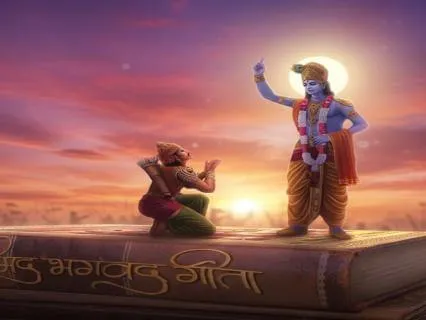
So today we are reading from the Bhagavad Gita,
And this book particularly is a translation by Stephen Mitchell,
But you can use any translation you want,
It doesn't matter.
Our discussion is about the Sutra,
Not so much about the poetry of the interpretation.
So any version that you love is perfect,
And you don't have to have a copy either.
I particularly love anything by Stephen Mitchell,
So I love this one.
Today we're looking at chapter 2,
Verse 24,
And if you're new,
We have a playlist called the Bhagavad Gita under my profile,
And I do highly recommend listening at least to the first one called Introduction,
And it really goes into the battlefield and what it's all about.
But essentially,
If you imagine it in the 3D world,
And most teachers consider the Gita a metaphor,
They consider it a book of spiritual teachings,
Not a literal time where there was a battle in India.
But the way the story goes is there's a kingdom and it's divided between a family.
On the one side it is the good,
We are going to call it,
And on the other side we're going to call it the evil.
And not to get caught up in the judgment of that,
But to imagine that inside of each one of us there are aspects of us that make our life more enjoyable.
Imagine inside we have hope,
And we have love,
And we have kindness,
And we have dreams,
And we have courage.
You know on the days that you really have access to those,
We seem to be able to walk our path.
We seem to be able to feel our dharma.
In Hinduism and Buddhism,
They talk about karma and dharma.
In Buddhism it's kama and dhamma.
When we're caught in karma,
It's like we're driven by our unconscious.
Every day we're just sort of walking through these patterns that we seem to be unable to get out of.
Maybe they're emotional patterns,
Or relationship patterns,
Or social patterns,
Or health patterns.
And we're just caught in these.
And if someone was to say to you,
Well why don't you just make this different choice?
We always have a reason.
We always have an excuse.
Oh well,
I can't because they really depend on me,
Or I can't because I just can't handle the uncertainty of that.
But on those days,
When we feel like that,
When we have an excuse for every reason we can't get out of it,
You know you are stuck in a karmic loop.
And a lot of what life is about,
According to these teachings,
Is having all these multiple lifetimes.
And every lifetime,
It's like we get to play out the same patterns,
But slightly differently.
Like maybe one time you are a woman.
Maybe you're a wealthy woman.
But you're still going to play out these weird karmic patterns,
Even as a wealthy woman.
And then maybe the next lifetime,
You're a man and you're very poor.
But you're still playing out the same patterns.
But by having very different lifetimes,
It's almost like you start to get little clues about things and going,
Wait a minute,
Why am I stuck in this pattern?
I actually really could do this.
And maybe it takes hundreds of different iterations before we slowly start to make changes.
But this is what they talk about,
That we're kind of caught in the cycle of life.
Because we're caught in these karmic patterns of unfinished business or.
.
.
It's almost like you get bit by a dog and you suddenly become terrified of all dogs.
And then you become afraid of all places dogs go.
And then maybe you might even start to be afraid of people who have dogs.
And you start to have this pattern that's now locked in your unconscious.
These karmic patterns didn't come out of nothing.
They're worthy battles.
They're worthy journeys.
We don't have karmic patterns because we're messed up humans or there's something wrong with us.
The world's been a pretty dark place for a few thousand years,
You know.
So we can give ourselves grace about why we're stuck in these patterns.
But the idea is,
And all of us have this,
We have a certain portion of our life that's caught in karmic patterns.
All of us do.
But then there's also like a hint of Dharma.
And Dharma is that straight path that you know you're living your life.
You know that you're actually living according to your highest self.
And not in a weird,
Ah,
I am all great and mighty.
Like not that highest self,
But your true self,
Your pure self,
Your soul.
And it's almost like your soul wanted to experience something and all of a sudden your soul's like,
You know what I love?
I love studying Tantra.
And whenever I dive into my books on Tantra,
My world is clear.
I'm stepping forward,
I'm learning,
I'm expanding.
And as I learn and expand,
I become more loving because I'm happier.
I become healthier because I have less cortisol running through my system.
You know,
Everything just becomes easier and you start to talk to great people like you guys here on Insight Timer,
Because we're all gathering for the same interest,
The same desire.
So it's interesting if you imagine these two aspects of yourself.
The part of you that is truly walking that Dharmic path,
And the part of you over here that is stuck in these loops of karma.
And in many ways,
This is the battlefield of the Gita.
They call it Kurukshetra.
And Kurukshetra is the battlefield of the heart,
The battlefield of the soul.
Where these two armies,
And if you think of yourself as a singular kingdom,
This is where the two sides of yourself have kind of faced off.
The side of you that is walking your Dharma,
This is the five brothers.
It's represented by these five brothers of the righteous king,
Of the true king.
One of them is Arjuna,
Who is the hero of our story.
The other side,
The karmic side,
These are the hundred cousins of Arjuna,
The hundred brothers of the blind king,
Dhrishtarastra,
Who took over the kingdom because the five brothers' father died.
They were brothers.
And they were all raised together,
All the good,
Powerful,
Light sides of ourselves,
And all the,
Not only our own karmic problems,
But even the stuff we inherited from our ancestors,
The stuff we learned from our parents,
The stuff we learned from the society we were raised in.
So all of a sudden,
Arjuna is like your soul,
Or maybe your ego,
In the best way.
And he's in the middle of the battlefield,
And Krishna is his teacher.
Krishna is sort of like a wise old uncle to the family,
In sort of the physical realm.
But eventually,
He also recognizes that he is Lord Krishna.
And within each of us,
Lord Krishna is your spark of divinity.
It's your highest self.
It's not a god out there.
It's you.
So Arjuna says to Krishna,
Drive me into the center of the battlefield so that I can look around at everything.
So they drive into the middle of the battlefield.
He looks around,
And he sees family on all sides.
He sees people that he's very familiar with,
People he respects,
People that have got him through hard times.
And he says,
I can't fight.
I can't kill these people.
And when you think about what that is inside of your psyche,
Very often,
Let's say we've been through hard times,
And so therefore,
We built callousness in our heart.
We built a wall to keep people out so that I'm not hurt again.
This was important.
This served us well.
It saved us,
Maybe for decades,
But it doesn't serve us anymore.
It's time to let it go,
But it's so familiar.
The idea of letting it go,
It feels like I'm letting go of a friend.
Maybe it's cynicism.
Maybe it's anger.
Maybe it's you're angry at your family or angry at the world or angry at whoever.
Maybe there was a time that this really helped you be discerning.
Maybe it helped you leave a difficult situation,
But now it's just causing trouble.
And this is where Arjun is just like,
I don't want to fight,
And he withdraws.
And how often do we all just withdraw from the fight?
I don't want to look at it.
But the problem is,
If we don't engage,
If we don't pay attention,
If we don't engage,
Like it's the best word,
Guess who wins?
We just get swooped up in that karmic tidal wave,
And all of a sudden everything just gets worse.
So this is the path of the soul.
This is what they call yoga.
Yoga is embracing your divine self and engaging in life without fear,
Knowing that this is your path.
This is what you're supposed to be doing.
This is why you incarnated here.
You didn't come here to be swept up in pain and suffering and inability and lack of agency.
You came here to engage.
So engage.
This is Krishna's message to Arjuna.
And so now Krishna is teaching Arjuna a whole different way of looking at the world.
So I am going to turn to our passage today.
I'm going to go back a little bit,
But what he's talking about is the eternal self,
Your true soul,
Your Atman,
Your true divinity.
So anytime I say the word self,
Imagine that it is capitalized.
Your self never was born,
Coming to be,
It will never not be,
Birthless,
Primordial.
It does not die when the body dies.
Knowing that it is eternal,
Unborn,
Beyond destruction,
How could you ever kill and whom could you kill,
Arjuna?
Just as you throw out used clothes and put on other clothes,
New ones,
The self discards its used bodies and puts on others that are new.
The sharpest sword will not pierce it.
The hottest flame will not singe it.
Water will not make it moist.
Wind will not cause it to wither.
It cannot be pierced or singed,
Moistened or withered.
It is vast,
Perfect,
And all pervading,
Calm,
Immovable,
Timeless.
So this is the verse that we're going to look at today.
It cannot be pierced or singed,
Moistened or withered.
It is vast,
Perfect,
And all pervading,
Calm,
Immovable,
And timeless.
I'm going to read you the interpretation of Maharishi Mahesh Yogi.
He is uncleavable.
He cannot be burned.
He cannot be wetted,
Nor yet can he be dried.
He is eternal,
All pervading,
Stable,
Immovable,
Ever the same.
And then I'm going to read you Paramahansa Yogananda's version.
The soul is uncleavable.
It cannot be burnt or wetted or dried.
The soul is immutable,
All permeating,
Ever calm and immovable,
Eternally the same.
What does that bring up for you when you hear that?
Like how does it make you feel or what thoughts roll through your mind?
Safe,
Steadfastness,
Untouchable,
Infinite,
Indestructible,
Liberation,
Fearless,
Omnipotent.
So in the last stanza,
The one before this,
Let's see what Maharishi said about that one.
The last one,
Verse 23 said,
Weapons cannot cleave him,
Nor fire burn him,
Water cannot wet him,
Nor wind dry him away.
So that one,
This is where they start talking about the physical body being made of the four elements.
Cleaving is like grabbing and pulling,
You know.
So this is all about how the physical body can be touched,
You know,
And can be pulled,
And it can be burned,
Or it can be wetted,
Or it can be dried.
It can be,
The physical body can be affected by the elements because it's made of the elements.
So the last stanza was all about,
You cannot burn my soul,
You cannot blow my soul away.
Maybe my body,
You know,
My body's always changing,
But you can't do this to me,
The world can't do this to my soul.
This stanza turns it around and goes inside and says,
You are not burnable.
Like it's not about other people,
It's not about the world.
You cannot be wetted,
You cannot be dried,
Because you are eternal,
Which is different.
Like it's a different feeling,
It's very empowering from the inside,
Without defense.
There's no,
You cannot hurt me,
I'm not hurtable.
Can you hear the difference in that?
Like that's such a different sense,
Like you're just standing.
When in doubt,
Go to the unchangeable place inside.
Totally.
Sovereign,
Courageous,
Yeah.
Gives me goosebumps,
Almost like a precursor to feel courage.
Like that unstruck chord,
Exactly,
Exactly.
And what's really interesting is the second part of it,
When it says,
He is eternal,
All-pervading,
Stable,
Immovable,
And ever the same.
The order of the words is really important here,
Because basically,
If you imagine your eternal self,
Just close your eyes for a moment.
Imagine your soul.
Now your soul is eternal.
Because your soul is eternal,
It is all-pervading.
It is everywhere.
It's in the grasses,
The trees,
The air,
The mountains,
The water.
Your soul is everywhere.
Because your soul is all-pervading,
It is stable.
Because your soul is stable,
It is immovable.
And because your soul is immovable,
It is ever the same.
What does that feel like?
I mean,
It might just be all the same things you guys just said.
That we,
Every single one of us,
Is eternal,
All-pervading,
Stable,
Immovable,
And ever the same.
It's like taking our power back,
Totally.
I love that so much.
Our soul is not inside of us,
But all around us.
Exactly.
Why fear?
That's the thought that came in.
This morning I am finding a trickster taunting my eternal soul.
I laugh at it.
The funniest thing about trickster energy is trickster energy is always for our better life.
It's always there to taunt us so that we rise.
So it's brilliant,
Robin.
Thinking the shadow ego is thinking that we are separate.
Exactly.
Thank you for that brilliant segue.
So I think it was last week we talked about what they call the three bodies.
And this is similar if you study yoga.
You might have heard of the sheaths,
The koshas,
Manamaya kosha,
Ananamaya kosha,
Things like that.
This is similar to that,
It's just a different teaching.
And we talked about the physical body,
The astral body,
And the causal body.
So the physical body is literally our physical body that's made of earth,
Air,
Wind,
Fire,
And ether.
It's our hair,
It's our organs,
It's everything.
It's our blood.
Now the physical body is affected by the world around us.
It's affected by the food we eat.
If someone grabs my arm roughly,
You know,
I could bruise.
That could happen.
I could burn my hand on a hot element.
You know,
I can get drenched in a rain.
You know,
That can happen.
So my physical body is very susceptible to the elements and the world around me.
It can be changed,
And it changes every day.
Like it's always changing,
It's always growing and shifting.
My physical body is very different today than when I was six years old.
Neither one is wrong,
They're just different,
Always changing.
And this is a big thing we've talked about in past verses,
That they talk a lot about that,
That because it's always changing,
It isn't real.
And again,
It doesn't mean it doesn't matter or anything like that.
But when you really want to close your eyes and focus on what's real,
You don't want to focus on things that are always changing,
Because then we grasp and we're afraid of things changing.
We don't want that.
So we go inside to the soul instead.
And then there's the astral body,
The energy body.
Now the astral body,
It's not astral out there.
It's astral in here,
In our brain.
It's our thoughts.
It's our emotions.
It's all of our fears and worries and concerns and our joys and our preferences and all that.
So this is essentially,
It's just our day-to-day thinking.
And then we have the causal body.
And the causal body is,
It's like imagine you have a great hard drive of all the lifetimes you've ever had.
All the patterns,
All the samskaras,
They'll call them,
The imprints from various lifetimes,
You know,
All the karmic issues,
All the fears,
All the joys,
All the everything that you've ever experienced,
Are sitting in this causal body.
So it's almost like if you imagine that the causal body comes first,
And then based on what's going on in the causal body,
We have thoughts and emotions.
This is why everybody here right now,
We could go and have an experience.
We could all attend a fair.
We could go to a concert.
We could witness a tragedy.
We could have an experience together.
But every single one of our experience will be entirely different because our experience is first defined by our thoughts and emotions that are triggered by the experience,
Positive or negative.
But the reason our mind and emotion go to those places is because of our causal body.
And because we all have unique causal bodies,
We each have different thoughts and emotions,
And therefore we all have different experiences of things.
Now the causal body,
So they say that the causal body has seeds in it,
Little seeds.
And the seeds can be all kinds of things.
The seeds could be what they call aversion,
Maybe in a past life,
Or maybe earlier in this life,
If you're not into past lives.
Something bad happened.
You have these things,
Something bad happened.
And it gets like,
You can almost feel it in your conscious mind,
Like there's this,
I hate that,
I hate that thing.
It's like a push pin in the board.
And so then now it's sitting there in the board.
It's not necessarily in your conscious thoughts,
But it's in your memory.
It's there.
And then all of a sudden,
You're just flowing through life and blah,
Blah,
Blah.
And all of a sudden,
Something like that happens.
And instantly your mind goes,
I hate that.
Someone else is like,
Well,
We haven't even tried it.
No,
I hate it.
Don't like it.
Don't want to do it.
Don't want to do it.
That's a seed.
And when those happen over many,
Many,
Many lifetimes,
They sit in the causal body.
So you can imagine how powerful these seeds are in our unconscious,
Always driving our thoughts,
Always driving our emotions.
And of course,
We think we're right.
If we are angry at that person or frustrated with this,
Or afraid of that thing over there,
Or concerned about that,
Or we have attachment to this over there,
There's a reason we have attachment to that.
There's a reason we're afraid of it.
And it has nothing to do with the thing in front of us.
It's all coming from this causal body.
How do we know that?
Because not everyone would be afraid of that thing.
If there's a bull raging and running down the street,
Everyone's going to get out of the way.
This is dangerous for everybody.
This isn't coming from the causal body.
This isn't coming from some samskara.
This is a big thing.
Car goes raging off the road.
Everyone's going to run out of the way.
But in life,
It's not like that.
One person loses a job,
And they fall into a deep depression.
Another person loses the same job,
And they're like,
You know what?
Never liked that job anyway.
I want to do something else.
Theoretically,
On the surface,
Same experience.
Why is it so different?
Because in the causal body,
There's an attachment.
There's something that says,
If I don't have this job,
I won't be a success.
If I don't have this partner,
I am a loser.
If I don't do this thing,
Then there's something wrong with me.
And that's interesting.
And so the journey becomes about actually going,
The meditation journey becomes about going deep inside and finding those seeds and letting them go.
Let's say you sit.
Let's just do this for a minute.
Everybody just close your eyes.
Just breathe deeply.
And just notice some thought that's rolling through your mind.
A negative thought,
A worry,
A concern,
Something that's rolling around in your life.
That thought is part of your astral body.
The emotions that are part of that are in your astral body.
So just allow that thought to kind of live in the air.
Just let it live in the air in front of you.
Breathe deeply and feel your whole body become a little heavier,
A little deeper into the deeper into the earth.
And ask yourself,
What's under this worry?
What is the deeper concern?
What is the deeper belief that's driving this worry?
That's the causal body.
What did you guys discover?
I'd love to know just for a moment if there was anything in that causal body that made sense to you.
That I failed myself.
That's a big one.
That the pain will remain.
That I'm helpless.
Not enough.
Being alone and not being able to make it by myself.
I'm divorced,
But I am succeeding.
That I'm an imposter.
I got we might not make it.
Humanity might not survive this war.
That I'm not an equal.
My brother died in August from a car accident.
Something that I've been dealing with my life is a huge driving phobia,
Wondering if there's any correlation.
Unworthy of love from my parents means I'm unworthy of love from anyone.
Thank you guys so much for sharing that.
So you can kind of feel how deep those are.
Sometimes there is no solution.
That I will not be helpful.
And what's interesting is all of your examples are so perfect.
Because they all come back to some of these,
They call them these root causes,
These root seeds.
Like for example,
One of them they call it attachment,
Right?
They call it raga in Sanskrit.
And it basically means incompleteness.
That I'm not enough.
That I am not complete.
I am not whole in some way.
Fear.
You know that like people were mentioning that it's not going to work out.
There's something you know.
But that's where all of these causes,
This is where this teaching of our eternal self helps to heal our consciousness.
Because when we know that we are eternal,
That we are all pervading,
We are whole,
And it's always,
We're always enough in our soul.
And this is a big part of this teaching because those three bodies are all changeable.
None of those are the soul.
There is still a deeper part of you beyond the causal body that is observing you feeling this.
That is observing you having these thoughts.
That is observing you taking action.
This is where like all three of those levels can all be changed.
They can all be healed.
But there is also an eternal part of you.
A part of you that can never be damaged,
Harmed,
Anything.
And that's where imagine sitting in meditation and deeply connecting with that.
And you can do this even using this little process we did in the meditation.
Imagine it like a four-step and you sit down and you just start to breathe.
And you slowly withdraw the senses.
You know they call this pratyahara.
You withdraw the senses,
You close your eyes,
You let any sounds just become background.
You release any connection to your body,
Which is why you have to make sure you're sitting very comfortably.
Don't sit cross-legged if it's not comfortable.
Make sure you're very comfortable because you want to let go of the body.
So then you slowly let go of the physical body.
And by letting go of the physical body,
You're able to see your astral body.
You're able to see your thoughts and emotions.
And you can watch them.
And if one is particularly big,
Then let it float in front of you and go under it and go into the causal body.
Say,
What is driving this?
What is driving the emotional response to this?
And then you have an answer just like everybody here gave.
And then allow that to float in the room,
Right?
Allow that seed to float in the room.
And then go even deeper into your soul,
Into your eternal self.
And ask yourself,
Is it true?
And don't even wait for an answer.
Just breathe.
Just spend time in that eternal self.
Just spend time in that beautiful void.
And you can keep playing with it.
If all of a sudden you're distracted or a thought pops in,
Then go back up to that thought.
And again,
Let it honor it.
It's a clue.
Like you are literally undoing karma.
You are healing.
You are solving perhaps lifetimes of patterns right now.
This is really good work.
So here you are,
And another thought rises up,
And you let it float.
Then you ask what is beneath this?
And to not intellectualize,
Allow the answer to float up from your consciousness and go,
I feel like an imposter.
And then let that float up.
And then settle into the one observing this whole journey.
And what this does is beyond our understanding.
Sometimes I feel it's like,
Imagine you have two buckets.
And imagine the one bucket is your physical life.
The physical world where we feel separate from each other.
It's our job,
It's our relationships,
It's our body,
It's our health,
It's our money,
It's our everything.
And let's imagine that you have a hundred pebbles in that bucket.
And a hundred is whole,
A hundred is everything.
And then all of a sudden you have an experience.
It could be anything.
Like it could be sitting watching a sunrise,
And something in you touches that eternal self.
Just touches it.
And then all of a sudden one pebble moves from the physical into the eternal self bucket.
So now you have 99 pebbles in the physical bucket,
And you have one pebble in the eternal bucket.
And then that one pebble is like the seed.
And you're like,
I think there's more going on here.
And maybe you read a book,
And this book inspires you.
And at some point you read a passage,
And you just kind of stop for a minute.
You put the book down,
And you close your eyes,
And you take a few deep breaths.
And some dials change inside,
And another pebble goes into the eternal bucket.
Now you're 98 to 2.
And then maybe you start to meditate,
And you say,
You know what,
I'm gonna,
I'm gonna start meditating every day.
Not with any intention.
I just want to sit and feel that eternal self again.
So with no attachment to how it works out,
You just sit,
And you breathe,
And you relax.
And slowly those pebbles start moving over.
Or maybe your meditation is sitting by the sea.
Or maybe it's walking in nature.
Who knows what it is.
But every time you do it,
The balance shifts slightly.
And that's really the goal.
And that's what he's saying here.
This is our passage.
The soul is uncleavable.
It cannot be burnt,
Or wetted,
Or dried.
The soul is immutable,
All permeating,
Ever,
Ever calm,
And immovable,
Eternally the same.
And that's really the teachings here.
Even if every day you can sit and just do something that brings you closer,
And it doesn't,
Yoga can be anything.
It doesn't have to be meditation.
It could be cooking.
It could be painting.
It could be writing poetry.
It could be a brilliant cup of coffee.
And I really mean this.
Bliss is bliss is bliss is bliss.
Because it's not about the coffee.
It's about you experiencing happiness.
It's about you.
And this is the last thing I want to say.
Because I know we're over time.
We talk about these seeds in the causal body.
And we only talked about the negative ones.
And they call those ones the iron seeds.
But there are also golden seeds.
There are moments of joy in your life that are also attached to that causal body.
And the more we cultivate beauty,
And joy,
And calmness,
And kindness,
And love,
And devotion in our lives,
We can fill our causal body with golden seeds.
And this is also one way to heal the negative ones,
The scared ones.
It's like the more gold that's there,
They slowly just disappear.
They're kind of just crowded out.
And they say that even if your mind is filled with golden ones,
Eventually,
We let those go,
Too.
But in the meantime,
There's two ways.
We sit.
We quietly.
We do our yoga.
We meditate.
We do Kriya Yoga,
Whatever you do.
And you find those seeds.
You be courageous.
Get in there.
Find them.
Heal them.
Release them.
Find new thoughts.
Correct them.
Because none of them are true.
We notice everything we talked here,
None of them are actually true in this life.
But they're very real in there.
So that's the one thing.
Courageously engage with them.
And the other is to cultivate golden seeds.
Every day,
Do something that truly brings you joy.
It doesn't all have to be battle.
I found both negative seeds and golden seeds.
What a beautiful thank you for sharing that.
What a wonderful exercise to sit down and consciously write down or think about the negative seeds and the golden ones.
Awesome.
Thanks,
Everybody.
We'll see you soon.