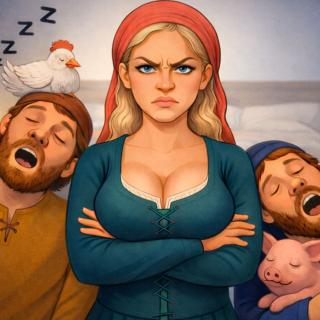
Hey guys.
Tonight's story starts with a rock falling on your head,
A torch that smells suspiciously like goat,
And the distinct sound of a drawbridge locking behind you,
Forever.
You've been sent to the castle,
Not for honor or glory,
But because your cousin said you were expendable and the Lord needed someone to chase rats out of the pantry.
The halls are cold,
The walls are damp,
And everyone keeps whispering about ghosts,
Fire,
And something called murder holes.
You thought castles were majestic.
Turns out,
They're a labyrinth of poor decisions and stone-based anxiety.
Now get comfortable,
Let the day melt away,
And we'll drift back together into the quiet corners of the past.
It starts with a cartwheel snapping and a turnip rolling directly under your foot.
You fall,
Of course.
Not dramatically.
Just enough to twist something important in your ankle and land in something that smells like it once aspired to be soup but got distracted halfway through.
A man with three teeth and a mustache like a misplaced squirrel grunts as he pulls you upright and announces,
To no one in particular,
Fresh meats arrived.
No one looks,
No one cares.
You dust yourself off with what dignity remains and stare up at Castle Greyweather.
It looms,
Not in the poetic way of songs or legends,
But in the hunched,
Mildew-streaked way of a place that knows too many secrets and has never aired them out.
The walls are stone,
But not majestic.
They look tired.
Moss clings to the cracks like it's worried the whole thing might collapse if left unsupported.
A flag hangs limply from the highest tower,
More whole than cloth,
And whatever animal it used to depict now just looks confused.
You're told,
Loudly and by someone who clearly has a sinus problem,
That it is an honor to be assigned here,
That Castle Greyweather is a post of importance,
A gateway of strategy,
A jewel of tactical brilliance.
Then a knight stumbles past,
Throws up into a bucket,
And wipes his mouth on your sleeve.
You consider the implications.
The bucket wasn't his,
The sleeve was yours.
No one reacts.
You're handed a broom,
A cloak with one sleeve longer than the other,
And a map.
The map is hand-drawn,
Slightly damp,
And has two suspicious stains labeled,
Do Not Lick.
You're told your room is in the south tower,
Third floor,
Above the latrines.
Someone laughs.
You hope they're joking.
They are not.
The path to your new quarters takes you through a corridor that smells of mildew and onions,
Down a hall where someone is screaming at a tapestry for Lying Again,
And up a staircase that narrows halfway through,
Like it's trying to decide whether to be a tunnel or a trap.
You duck instinctively as a chunk of ceiling crumbles beside you.
It lands with a plop in what might be stew,
Might be soap.
You decide not to ask.
The door to your room is crooked.
So is the key.
When it finally creaks open,
You are greeted by a draft,
A single straw mattress,
And a view of a wall.
Not a scenic wall.
Just wall.
Gray.
Close.
Moist.
A small window lets in exactly enough light to remind you that you are still indoors,
And possibly underground,
Even though you're three floors up.
The latrines below waft their presence upward in gentle waves of betrayal.
Someone had cabbage last night.
You know this intimately now.
You sit.
The bed crunches.
You don't ask why.
The ceiling is low and has a crack shaped suspiciously like a snake mid-scream.
You wonder if it's symbolic.
It probably isn't.
The broom you've been given leans against the wall like it has already given up on you.
You name it,
Thomas.
Thomas is the only one who hasn't insulted you yet.
Outside,
A horn blares.
It cuts off halfway through,
Followed by a shout and something that sounds like a goose being arrested.
You hear armored feet clank down the hall,
Then up again,
Then stop outside your door.
You hold your breath.
They move on.
You exhale.
The silence that then follows is somehow worse.
A scroll has been nailed to the inside of your door.
It lists your duties.
It is very long.
Tasks include torch maintenance,
Rat discouragement,
Moat observation,
Liquid containment,
Don't ask,
And chamber pot diplomacy.
You are not sure which of these is worse,
But don't ask doesn't inspire confidence.
You try to settle in.
The cloak smells like cheese.
The floor tilts slightly toward the door,
Which you assume is either a structural issue or a design meant to encourage evacuation.
The single candle in the wall sconce flickers in a way that suggests it's trying to blink in Morse code.
It may be spelling RUN.
The broom falls over.
You thank Thomas for trying.
There is a knock on the door.
You open it to find a boy no older than ten holding a helmet filled with something that sloshes.
Dinner,
He says,
Handing it over.
You peer inside.
The contents shift uneasily.
You nod,
Close the door,
And decide you're not that hungry.
Later,
As you lie in bed,
Wrapped in a cloak that might once have been a curtain,
You listen to the sounds of the castle.
Wind in the stones.
Distant footsteps.
A thud.
A scream.
Something whispering in Latin from the floorboards.
You close your eyes.
Welcome to Castle Greyweather.
You are handed the bucket with the same reverence usually reserved for holy relics or chamber pots with suspicious steam.
It's wooden,
Slightly cracked,
And still damp from whatever it last carried,
Which you hope was water and not pickled eel brine again.
The guard who gives it to you is missing two fingers and a tooth and says only,
Top Tower.
No spills.
Or he'll know.
He doesn't say who he is.
You don't ask.
Some mysteries are safer that way.
The staircase starts innocent.
The first two steps are normal,
Which is to say they exist and don't immediately attempt murder.
But then the third step tilts slightly to the left.
The fourth has a nail sticking out of it that might be sentient.
And the fifth is actually just missing.
You leap it like someone who's only mostly sure they won't die.
The bucket sloshes in protest.
A wet drip lands on your boot.
You ignore it.
By the eighth step,
You're sweating.
Not from exertion,
But from the realization that the staircase isn't just steep.
It spirals so tightly it feels like it's trying to fold back into itself.
The stone walls press close,
Cold and uneven,
And the torch you were given earlier flickers like it's reconsidering its contract.
You bump your elbow,
Then your head,
Then your dignity,
Which you'd been trying to keep upright.
The bucket knocks against the wall.
You whisper an apology.
To the wall or the bucket,
You're not sure.
Step twelve is too short.
Step thirteen is too tall.
Step fourteen appears to be made of different stone entirely and smells vaguely of old cabbage and fear.
Someone has scratched something into it.
You squint.
Turn back,
It says.
Underneath,
In smaller letters,
Seriously.
You press on.
Because you're brave.
Or you're very bad at quitting.
Or maybe you just haven't figured out how to say no to anyone with a sword.
The ceiling begins to lower the higher you climb.
It hunches over you like an old woman ready to offer unsolicited advice.
You bend slightly,
Then more,
Until you're nearly folded in half,
Bucket tucked awkwardly to your chest like a terrified badger.
Your legs burn.
Your arms ache.
The stairs narrow again.
The air is thick with dust and mildew and the unmistakable scent of someone else's regret.
Something brushes your ankle.
You freeze.
There is no breeze.
No explanation.
Just a soft,
Deliberate touch that feels like fingertips made of cobweb and malice.
You jerk your foot upward.
The bucket shifts.
You reach out.
Grab the wall.
Miss.
Your hand finds only air.
Your foot finds betrayal.
And you tumble.
The fall is not dramatic.
There is no slow-motion scream or cinematic music.
It is clumsy,
Fast,
And full of knees.
You bounce off the curve of the stairwell like a particularly unlucky potato in a funnel.
The bucket sailing ahead of you,
Gleefully emptying its contents in a chaotic arc of splash and shame.
When you finally land,
It is in a pile of straw that was definitely not there earlier and smells strongly of goat.
A head pokes out from a nearby doorway.
It is small,
Old,
And covered in flour.
Told you not to look up,
It says,
Then disappears again.
Your elbow throbs.
Your pride is leaking slightly from your left boot.
The bucket has landed upside down,
Wedged between two steps like it's sulking.
You retrieve it slowly,
Eyes flicking upward toward the staircase,
Which now looks even steeper and somehow smug.
You try again.
Slower this time.
You keep your head down.
You count the steps as if that will help.
Twenty-seven.
Twenty-eight.
Twenty-nine.
That is actually just a hole.
You skirt around it.
You don't ask what's in the hole.
Something gurgles from within.
You speed up slightly.
Eventually,
You reach the top.
You emerge into a narrow corridor that's colder than logic and darker than your childhood fear of soup night.
You're wet,
Sore,
And trembling slightly from the knees.
But the bucket,
Somehow,
Is still mostly full.
A guard nods as you hand it off.
He doesn't say thank you.
He doesn't even look at you.
He just takes it,
Disappears,
And leaves you alone with the stairs.
You look down them.
They look back.
You take a breath,
And you descend.
The first night is survivable,
In the way a very minor shipwreck might be.
You lie on the straw mattress,
Which makes sounds no natural bedding should make,
And stare at the ceiling,
Where a crack has formed the vague shape of a duck in mid-judgment.
It watches you,
Silently,
As though it's not impressed with your posture.
You shift.
The straw rustles.
Something in it rustles back.
You hold your breath.
It stops.
You tell yourself it was nothing.
The duck disagrees.
The walls creak,
Not like a building settling,
Or wood stretching,
Or anything people whisper about in kindly tones.
No.
These are long,
Slow,
Open-throated groans,
Like the stones are having second thoughts about being architecture.
The sound starts near the baseboard,
And rises in a warbling crescendo,
Until it fades into a high-pitched whine,
Just below the range of dignity.
You sit up.
The walls do it again.
Louder.
You throw your blanket at them.
They are not moved.
You consider sleeping in the hallway.
But the hallway has its own problems.
Mostly rats.
Possibly cults.
Once,
During your first hour in the castle,
You saw a man walk into that hallway,
Carrying a chicken and a candle.
And he hasn't come back out yet.
So you stay.
At some point,
You fall asleep.
Briefly.
You wake up to the feeling of breath on your face.
But when you open your eyes,
There's nothing there.
Just darkness,
And the quiet sound of something shifting in the corner that wasn't shifting before.
You light the stub of your candle.
The corner is empty,
Except for your bucket.
The bucket is facing the other direction now.
You lie back down.
The mattress crunches again.
There's a very real possibility it is housing an entire ecological system beneath the surface,
And you are the invasive species.
You roll to the side.
The wall moans.
This time,
It almost says your name,
Or something that rhymes with it.
You can't decide which is worse.
By the second night,
You try to talk to it.
Not in a dramatic,
Mystical,
Summoning sort of way.
More like bargaining with a bad roommate.
You apologize for kicking the door.
You compliment the moss.
You offer it a piece of hard cheese that's only slightly cursed.
Nothing responds.
You feel stupid.
Then,
As you blow out your candle,
A voice whispers,
Not a scream,
Not a threat,
Just like it's thinking about it,
Like it's evaluating your performance.
You sit,
Bolt upright.
The voice doesn't return.
The duck in the ceiling has now turned into a lopsided goose,
Which feels like an omen.
You ask a passing,
Servant the next day if anyone else hears it.
She says,
Oh,
That room.
Then she makes a gesture that might be warding off evil,
Or just fanning a fart.
Hard to say.
She advises sleeping with salt under your tongue and a clove of garlic between your toes.
You try both.
You wake up smelling like soup and covered in sweat,
With your blanket halfway across the room and a new crack in the wall shaped like a sneer.
By the third night,
You've stopped trying to sleep.
You just sit in the corner with your back to the most stable-looking wall and hum very softly to yourself.
The air is cold and tastes slightly of mildew and old bread.
Something paces in the wall.
You name it,
Beatrice.
It seems to appreciate the formality.
Sometimes you hear words,
Not whole ones,
Just fragments,
Down,
No,
Mine.
One night it says,
Look,
And you do,
Even though you know you shouldn't.
There's nothing,
But your candle's gone out and your water bucket is upside down and humming.
You begin to leave notes,
Little ones,
Just to see what happens.
Good evening.
Do you want anything?
Sorry for the cheese.
In the morning,
The notes are still there,
But the handwriting has changed.
The loops are sharper,
More annoyed.
One just reads,
No more singing,
You obey.
At some point,
You stop wondering if the room is haunted.
Haunted implies a singular entity,
A spirit,
A ghost,
Maybe a very passive-aggressive poltergeist.
This is different.
The room doesn't have a ghost.
The room is the ghost,
And you're just renting space in it.
With poor ventilation and judgmental ceilings,
The first thing they tell you is,
Don't touch anything.
The second thing they tell you is,
Watch the oil.
There is no third thing,
Because the guard trailing you trips over a chicken and dislocates his knee,
Leaving you alone at the top of the battlements with a stick,
A torch,
And a smoldering sense of responsibility that you absolutely did not ask for.
The battlements are impressive.
In the same way,
An angry cow is impressive,
Large,
Vaguely dangerous,
And liable to cause injury if startled.
The wind is sharp,
The stones slick,
And the view panoramic in the way that makes you feel small and very droppable.
You keep to the middle,
Close to the warmth of a brazier that may or may not be actively on fire.
Someone has hung a pair of damp socks above it.
They steam ominously.
You're supposed to be watching for bandits,
Or raiders,
Or invaders.
Honestly,
The details were vague and interrupted by a man trying to extract a pigeon from his hood.
But you nod dutifully at every noise and try to look brave,
Even though your boots are two sizes too large and your cloak smells like smoked eel.
That's when you find it.
The vat.
It sits in a corner behind a curtain that seems to be repurposed from an old tent in a poor life choice.
The vat is massive,
Round,
And slightly crusted at the edges.
The label on the side has worn away,
But someone scratched the word HOT into the rim.
There are ashes around it,
Possibly bones,
Possibly lunch.
A ladle rests across the top.
You peer inside.
It's dark.
It's thick.
It bubbles gently,
Like it knows things and wants to keep them to itself.
You dip the ladle in,
Raise it slowly,
And immediately gag.
The smell hits you like a philosophical crisis.
It's halfway between rendered fat and weak old onions,
With a whisper of something that might have once been a mushroom but is now legally a crime.
Then you notice the second vat.
It's smaller,
Squatter,
And positioned beside the first with a kind of casual menace.
A spoon sits in it.
Someone has taken a bite.
You look between the two.
One for defense,
One for lunch.
No one labeled either.
You realize,
With dawning horror,
That these two things are kept exactly 12 inches apart,
And no one seems remotely concerned about this.
You hear the bell tower ring twice.
That's the signal for incoming visitors or dinner is late,
Depending on who you wind.
Ask.
You panic.
You grab the larger ladle.
You hustle to the edge of the battlements,
Lean over,
And prepare to pour as a caravan creaks into view below.
Horses,
Wagons,
People.
You don't wait for confirmation.
You shout,
Halt!
But it's carried away by the wind and possibly mistaken for salt.
You lift the ladle.
A hand grabs your shoulder.
It's Sir Bartholomew,
Defender of the East Wall and wearer of suspiciously shiny greaves.
He stares at the ladle,
At the vat,
At your face,
And then back to the ladle like he's trying to solve a riddle no one asked him.
That's the soup,
He says,
With the slow,
Deliberate patience of a man who's had this conversation before.
You nearly just broth-blasted a spice merchant.
You blink.
You lower the ladle.
The caravan arrives unharmed.
A child waves at you.
You wave back,
Holding the ladle like a torch of shame.
Bartholomew sighs,
Picks up the other ladle,
And gestures toward the larger vat.
That's the oil,
Boiling.
Don't mix them up.
He says it like someone who has cleaned stew off a corpse.
You nod.
You want to disappear.
You settle for staring into the middle distance and questioning every decision that led you here,
Starting with being born and ending with volunteering for lookout duty because you thought it meant naps.
Word spreads fast.
By nightfall,
Three guards have asked if you're the ladle lad.
The cook glares at you every time he stirs the pot,
And the merchant you almost accidentally flambéed leaves you a basket of turnips with a note that just says,
Please don't.
You are banned from upper tower duties.
You are reassigned to rat patrol.
The soup is served lukewarm and lumpy that night.
You don't touch it.
Neither does anyone else.
The vat gurgles in the corner,
Proud and undefeated.
It's not on any map,
Which is your first clue that this door shouldn't exist.
You find it by accident,
Halfway through sweeping the west corridor after someone knocked over the barrel of what may have been oats or may have been a failed potion.
No one's sure,
And the cook refuses to comment.
The door just appears,
Nestled between two uneven sconces and a portrait of someone who clearly died trying to look important.
It looks like every other door in the castle,
Old,
Wooden,
Faintly warped by time and moisture,
With a handle that gives off a vibe of mild contempt.
There's no label,
No sign,
Not even a curse scrawled nearby,
Which,
By castle standards,
Practically screams,
Open me,
So you do.
There's no scream,
No rush of air,
No magic,
Just wall,
Solid,
Blank,
And extremely unmoved by your presence.
You blink,
You step back,
You open it again,
Still wall.
You lean in and knock on it,
Because that's what you do when you're unsure if something's real or just really dedicated performance art.
It answers with a dull thunk,
The kind of sound a bored potato might make if it could speak.
You press your hand against the stone.
It's cold,
A little damp,
And extremely,
Impossibly there.
You close the door and reopen it three more times just to be sure you're not hallucinating.
You aren't.
The wall does not blink.
The wall does not budge.
The wall continues to exist,
Smug and pointless.
You tell Sir Bartram.
He squints,
Which is his default expression,
And shuffles over in his armor like a crab wearing a shed.
Ah,
He says,
Nodding with the solemn gravity of a man who once got stuck in a barrel for three hours and declared it a vision quest.
That's the wall door.
You stare at him.
He gestures vaguely.
Tradition.
You ask if tradition usually involves building a door to nowhere in the middle of a passage used almost exclusively for bucket storage.
He says yes,
But his voice wavers.
You press further.
He coughs and mutters something about ancestral wisdom and legacy construction choices.
When pressed harder,
He says nothing at all,
Because by that point he's slipped on a patch of suspicious moss and fallen backward into the oubliette.
You consider rescuing him.
Then you remember the time he put you on latrine cleaning duty for character development and decide he could probably use the alone time.
You return to the door.
It bothers you.
In a low-key,
Existential way.
Not dramatically.
Not with dread.
Just the constant hum of why scratching at the edge of your thoughts.
You ask three other servants about it.
One laughs and walks away.
One pretends not to hear you.
The third just shakes his head and whispers.
The door dreams too,
Which is not helpful and slightly concerning.
You try peeking under it.
Just more stone.
You knock again.
Nothing.
You press your ear against it.
The wall hums softly,
But that might just be your own thoughts vibrating from suppressed confusion.
Later,
You bring chalk and draw a face on it.
A little nose,
Two uneven eyes,
A wonky smile.
You name it,
Harold.
Harold offers no answers,
But he does seem to scowl more during the colder hours.
At night,
You lie awake thinking about it.
Not in a grand,
Tortured way,
But in the slow,
Chewing silence of someone who has already counted all the cracks in their ceiling and is trying very hard not to give meaning to a pile of shaped timber,
Pretending to have a purpose.
What if the wall used to be a door?
What if the castle just gave up on that part of itself?
What if someone built it like that on purpose?
You try not to fall down that particular mental oubliette.
The next day,
The door is still there,
Still leads to nowhere,
Still a perfect rectangle of invitation and defiance.
You hang a coat on it.
It feels like a small victory.
Harold disapproves.
You wink at him anyway.
The castle says nothing,
But you think the floorboards creak a little louder as you walk away.
It begins with a squelch.
Not the kind you can ignore,
Like stepping on an overripe pear or sitting on bread.
This is the kind of squelch that comes with consequences.
You stop mid-step,
Boots stuck in something viscous,
And a glance down.
Whatever it is,
It's orange,
Steaming slightly,
And appears to be chewing the sole of your shoe.
You backpedal.
It follows,
Slowly,
With the confidence of a substance that knows it has already won.
You ask a passing guard if this is normal.
He shrugs and says,
Could be soup,
Could be warning,
Then keeps walking like you're the odd one for not knowing which category your foot is in.
You wipe the bottom of your boot on a rag you hope wasn't important and continue your new assignment,
Inspecting the northern battlements for structural weaknesses.
No one tells you what to look for.
You're handed a rusty pole and a notebook that's already half burnt.
Instructions include poke gently and scream if necessary.
The hallway narrows near the top,
Ceiling low,
Shadows sharp.
A draft whispers past your ear like it's trying to sell you secrets.
You duck under a beam,
Trip over a bucket,
And land face-first beneath a suspiciously stained opening in the ceiling.
That's when it drips.
First a plop,
Then a cold trail sliding slowly down the back of your neck like it's trying to find your soul.
You freeze.
You do not breathe.
You just tilt your face upward and stare into the stone mouth of what appears to be a very intentional hole in the ceiling.
A drop dangles,
Wobbles,
Falls.
This one hits your lip.
It tastes like old vinegar and vengeance.
You gag.
That's when a voice behind you,
Casual and almost apologetic,
Says,
Ah,
That's the murder hole.
You spin.
Sir Elric,
Chewing something that might be a turnip and might be part of his helmet,
Nods at the ceiling.
For dropping things,
He says,
Gesturing vaguely like it's obvious.
Rocks.
Boiling oil.
Very small goats,
Once.
You ask why it's dripping.
He shrugs.
Sometimes it does that.
You ask what it is.
He chews.
Swallows.
Best not to know.
You stare at the hole.
It stares back.
It's not a large hole,
Maybe the size of a clenched fist,
But the way it's carved smooth,
Deliberate,
And slightly tilted suggests it was designed by someone with strong opinions about gravity.
The stone around it is stained,
Layered in the soft palette of bad decisions.
Brown,
Black,
And a shade of red you don't want to name.
You step away.
Elric pats your shoulder.
His hand is damp.
You don't ask why.
Later,
You read about murder holes in one of the castle's many questionably accurate scrolls.
They're for defense,
Apparently.
Strategic architecture.
Pour hot substances or sharp objects upon enemies.
It says this with all the enthusiasm of someone describing tea service.
It doesn't say anything about the dripping.
You ask the cook if it might be a leak from the kitchen.
He scoffs and says none of his broth has teeth.
You try not to unpack that.
You stop eating stew for a week.
One night,
You pass under it again,
Just for a moment,
Just to check.
It's dark,
And the air smells faintly of old metal and wet parchment.
You hear a drip.
You move.
It misses.
You think that should make you feel better.
It doesn't.
You start dreaming about the hole.
Not in a nightmare way,
Just inconveniently.
It appears in odd places.
The ceiling of the great hall.
Inside your boot.
Once,
On the face of a merchant.
You wake up itchy and slightly damp.
Eventually,
You learn to avoid that section of hallway.
Everyone does.
Even the rats detour around it.
No one seals it.
No one talks about it.
It just exists.
Waiting.
Watching.
Dripping.
The day begins with a knock.
Not a polite knock,
Or a knock you want to hear first thing in the morning.
It's the kind of knock that says someone has very bad news and would like to hand it to you personally.
You open the door.
A bucket is placed into your hands.
No explanation.
Just the bucket,
A very long stick,
And a grim nod from the steward who mutters something about blockage duty before disappearing with the speed of a man escaping his past.
You stare at the items in your hands.
The stick is alarmingly thin.
The bucket is not empty.
You are already unhappy.
You are led to the tower's rear wall,
Where a small wooden hatch sits crooked in the stone like an afterthought.
A cold draft slips through the edges.
A rat watches you with interest and judgment.
The steward points to the hatch and says,
It's the waste chute.
Then he gestures to the stick,
Unblock it.
You ask how,
He says,
Gently,
Which feels like the wrong word for anything related to medieval plumbing.
The hatch opens with the sound of wood giving up on life.
Inside is a vertical shaft that stretches far below into darkness and far above into mystery.
The smell is immediate.
It does not creep up on you.
It punches you in the nose and takes your name.
You reel back,
Eyes watering,
Soul questioning every choice you've made since birth.
Still,
You lean in,
Because you're supposed to be useful now.
You poke the stick down into the abyss.
It taps something.
You prod harder.
The stick bends.
You prod even harder,
With the enthusiasm of someone who has decided this will be over quickly,
Or not at all.
The stick snaps.
The top half vanishes into the shaft with a wet thud that echoes back like laughter.
You stare at your remaining half.
You want to throw it.
You want to throw yourself.
You settle for whimpering softly,
While the smell continues to unpack its emotional baggage.
Then you hear the voice.
Not from the steward.
Not from above.
From inside the shaft.
Try turning it clockwise,
It says.
You freeze.
You lean forward.
The voice continues.
No wait.
Counterclockwise.
Unless you want a backsplash.
You stare into the dark.
Who's there?
Used to be Edgar.
The voice replies.
Now I just help out when I can.
You ask if he's a ghost.
He hums thoughtfully.
Sort of.
Let's say I'm what's left after a series of very poor ventilation decisions.
You ask if he has any helpful advice.
He does.
None of it is good.
Try.
Singing,
He says.
Sometimes the chute responds to music.
Gregorian chants are nice.
Have you tried apologizing to it?
You could offer a sacrifice.
A rat,
Maybe.
Not that one,
Though.
He owes me money.
At some point,
You stop listening and start gagging.
Your nose has declared independence.
Your eyes are doing their best impression of fountains.
You jab the remains of the stick back into the chute with a vengeance born of desperation.
Something shifts.
There's a slurp.
Then a sucking pop.
It clears.
The air changes slightly.
Not better.
Just less angry.
You close the hatch.
You collapse to the floor,
Still holding the bottom half of the stick like a relic of a battle no one will believe.
The rat gives you a slow nod of respect.
You nod back.
The steward returns,
Sees you,
Sees the stick,
Says,
Oh,
You're still conscious.
Nice.
You don't reply.
You just hand him the bucket and walk away,
Slowly,
Like someone who's seen things.
Behind you,
The hatch creaks.
A soft voice drifts out.
Come back any time.
Tuesdays are quiet.
You do not respond.
You do not look back.
You just find the nearest well and dunk your entire head in it.
Twice.
The pantry is colder than you expect.
Cold and dry and lined with shelves that look like they've seen at least three collapses,
Two fires,
And one very determined goat.
You're given a list of tasks.
Take inventory,
Reorganize the sacks of barley,
And watch for movement,
Which is vague until it isn't.
The moment you open the second crate of turnips and something squeaks at you with the confidence of royalty,
It becomes clear.
The rats live here.
Not just one or two.
Not the occasional sad,
Lonely rat you could guilt trip into leaving.
No.
This is a full colony.
A network.
Possibly a government.
You find a tunnel near the back wall,
Artfully carved behind a crate of moldy onions,
Complete with little scratch marks and what might be a warning sign in rodent.
At first,
Things are manageable.
You leave the bottom shelf alone,
And they don't touch the cheese.
Mutual respect.
A fragile peace until the bread goes missing.
You set it down one small round loaf,
Still warm from the oven,
Gifted to you by the cook after you accidentally helped him fix the soup faucet.
You turn your back for less than a minute.
When you look again,
It's gone.
In its place.
A single walnut and a piece of string.
You do not see this as a fair trade.
The cook blames natural pantry shrinkage.
You blame Gerald.
You don't know for sure that's his name,
But it fits.
Gerald is the one you catch later that day,
Standing on the edge of the flour sack like he owns it.
Grooming himself with slow,
Theatrical strokes.
He stares at you.
You stare back.
He doesn't flinch.
Doesn't run.
He yawns.
The audacity.
You declare war.
Your first counterattack is crude.
A line of vinegar-soaked rags across their most trafficked path.
They chew through it like it's an appetizer.
You escalate.
A barricade of tin plates and old ladles.
They tunnel beneath it and leave you a cherry pit on top as a message.
You install bells.
They go silent.
One morning you wake to find a pile of dried beans arranged in the shape of a middle finger.
You start naming them.
Gerald is the leader.
Obviously.
He's fat,
Gray,
And has a nicked ear that makes him look like he's survived at least three tavern brawls.
Marla is the fast one.
She zips through gaps you didn't know existed and has a taste for salted cod.
Bernard appears only at night and only when your back is turned.
You think he might be a ghost,
But the claw marks on your apples say otherwise.
You lose sleep.
You start keeping a notebook.
A tiny war journal.
Day six.
They breach the oat sacks.
Day seven.
Tripped over a trap that I didn't set.
Day eight.
Found a rat-sized helmet made of walnut shell.
Your sanity frays.
You begin muttering in corners.
You develop a sixth sense for rodent movement.
The steward asks if you've considered a new posting.
You hiss in response.
The turning point comes when you construct the maze,
A cardboard labyrinth made from old wine crates and desperation.
At the center,
A piece of honey cake.
You wait.
You watch.
Hours pass.
Just as you're about to give up,
Gerald enters.
Cautious.
Clever.
He pauses at each turn like he's reading your thoughts.
He reaches the center.
He takes the cake.
Then he looks up,
Winks,
And leaves through an exit you didn't build.
You collapse.
The next morning,
You find the honey cake on your pillow.
A peace offering or a warning.
You're not sure which.
You accept it anyway.
The truce is reinstated for now.
You stick to the top shelves.
They stick to the bottom.
But sometimes you hear the soft pitter-patter of pause in the night and know Gerald is watching,
Planning,
Waiting for his moment.
The door to the cold room sticks.
It always sticks.
You've been told to use your shoulder,
Not your hands,
And never to ask why it was sealed with rope last winter.
You press against it like you're trying to win a wrestling match with the wall.
It groans.
You groan.
There's a pop,
A thud,
And suddenly the door gives way and you're inside.
It is not cold.
It is in fact aggressively warm.
The kind of warmth that clings to your clothes and seeps into your pores like a damp wool blanket that's been hugged by a stranger too many times.
The smell is immediate,
Overwhelming,
And oddly philosophical.
It forces you to question whether meat can suffer emotionally.
You gag softly into your sleeve.
Shelves line the room,
Some lean,
Some buckle.
A few have fully surrendered and now resemble sleeping drunks.
Cured meats hang from hooks,
Though the word cured feels generous.
One of the hams is growing something that appears to have developed a sense of humor.
A cheese wheel winks at you.
You blink.
It winks again.
There is moisture,
Not condensation moisture,
Suspended in the air.
It's like breathing through stew.
You take a step forward and your foot squelches on something that crunches and gives,
Which seems impossible but is now your reality.
This is where food goes to die.
You're here to fetch a joint of mutton.
That's all.
In.
Grab.
Out.
You repeat this like a prayer.
In.
Grab.
Out.
The steward says it's on the far wall,
Behind the barrels labeled,
Definitely not pickles.
You pass a basket of eggs that have clearly evolved past chicken.
One of them moves.
You pretend it didn't.
Then you see it.
The sausage.
It sits on a shelf by itself,
Wrapped in twine that has long since given up,
Glistening with a sheen of something that isn't quite mold,
But definitely isn't seasoning.
It's long,
Slightly curved,
And has the posture of someone about to throw a punch.
You reach for the mutton,
Keeping your eyes on it.
It twitches.
You freeze.
Your hand hovers over the mutton like a thief caught mid-heist.
The sausage does not move again.
Maybe it didn't move at all.
Maybe your brain is just trying to escape through hallucinations.
Then it shifts again.
Subtle.
Calculated.
A lean to the left,
As if lining up a target.
You take a step back.
It follows.
You do not scream because you are brave and heroic,
And also because your throat has sealed itself shut in self-preservation.
You back toward the door,
Slow,
Careful,
Eyes locked on the ancient meat like it owes you money.
A drip lands on your forehead.
You do not check where it came from.
You know better now.
The sausage drops to the floor with a wet slap,
And begins to roll.
Not fast.
Not wildly.
Just enough to let you know this is no longer a matter of storage.
This is a duel.
You grab a broom.
It's not much of a weapon,
But it's all you have.
The sausage stops rolling,
As if offended.
You swing.
It bounces off the wall,
Lands in a puddle of its own age,
And spins once before coming to rest with a hiss that might be steam or rage.
You don't wait to find out.
You drop the broom,
Grab the mutton,
And sprint for the door like you're escaping a demon with seasoning.
Behind you,
The sausage makes one final lurch,
Smacks into a barrel,
And disappears behind a curtain of drying herbs.
You slam the door.
You wedge it shut with the nearest chair.
You mark it with chalk.
You say nothing to anyone.
The steward takes the mutton without comment.
Later,
You see the cook inspecting a sausage on the grill,
Poking it with the edge of his blade like it might retaliate.
You turn and walk away.
From now on,
If anyone wants something from the cold room,
They can go themselves.
You've seen what lives there,
And it saw you back.
It starts,
As most disasters do,
With a lie.
Just a little drip,
The steward says,
Pointing to a faint trail of water crawling down the north tower wall like it's late to a party.
You nod.
Because that's what you do now,
Nod,
Carry things,
And pretend your cloak doesn't smell like mildew and roasted turnip.
You press your fingers to the wall.
It's damp,
Which wouldn't be so alarming if the sky weren't currently clear and the nearest source of water wasn't a stream three days away.
You mention this.
The steward shrugs and says the wall does that sometimes.
You ask if that's a structural problem.
He replies by handing you a cloth and walking away with suspicious speed.
You mop.
The drizzle continues,
Slow,
Sneaky,
Unbothered by your efforts.
You swap the cloth for a bucket.
It fills too fast.
You get another,
Then a third.
You start naming them.
One of them is Gerald,
In honor of your still unresolved rodent feud.
Gerald is the first to overflow.
By noon,
It's a stream.
Not violent,
Just constant.
A polite but relentless invasion.
You attempt to trace the source,
Climbing the stone arch with the grace of a cat made entirely of elbows.
You find the crack a thin,
Jagged line slicing through mortar like a lazy curse.
You poke it.
It leaks more.
Desperate,
You reach for the nearest thing.
A wheel of soft cheese abandoned on a windowsill and already developing a personality.
You cram it into the crack.
It squelches into place like it was always meant for this.
The leak stops.
You do not celebrate.
You stare at it for a long moment,
Unsure if you've solved a problem or created a different one with dairy.
Then you hear the footsteps.
Brother Aldrich,
The castle's most anxious priest,
Rounds the corner humming something that might be a hymn or a warning.
He doesn't see the puddle or the cheese.
His foot finds both in the same second.
There's a slip,
A shriek,
And then silence,
Broken only by the soft splatter of wet robes and holy disappointment.
You rush to help him.
He waves you off and begins muttering Latin that probably isn't real.
You try to explain the cheese.
He blinks at you like you've suggested marriage.
You are told,
In no uncertain terms,
That this is not blessed plumbing protocol.
You are escorted away.
Later,
In the great hall,
The steward announces your new assignment.
Bucket duty,
He says,
With the grim finality of a man assigning someone to shovel snow in the desert.
You try to protest.
He raises a brow and simply says,
Cheese.
And the room nods like that explains everything.
You spend the next six hours ferrying,
Sloshing buckets back and forth,
Up and down,
Like some sort of water-themed punishment deity.
Every time you think it's slowing,
The crack spits out a fresh torrent,
As though personally offended that you tried to outwit it with dairy.
Someone suggests a patch of tar.
Someone else recommends prayer.
You consider both,
And instead try stuffing the crack with leftover oat cakes.
It works for thirteen seconds.
The resulting splash knocks over a lit candle,
A tapestry,
And two arguments about masonry.
By evening,
The wall has stopped leaking.
No one knows why.
The priest says it was divine intervention.
The steward credits structural shifts.
You quietly suspect the cheese reached some kind of agreement with the stone.
You aren't thanked.
You are handed.
Another bucket.
As you slump in the corner,
Your cloak dripping,
Your boots squishing,
You think back to simpler times.
Times when walls didn't ooze and cheese stayed where it belonged.
Times when you weren't a walking mop with trust issues.
You look up.
The crack glistens faintly in the torchlight.
It winks.
The armory smells like sweat and unfulfilled ambition.
You're sent there with a broom,
A rag,
And the vague instruction to make it less haunted.
No one explains what that means,
But you suspect it involves polishing things until they stop glaring at you.
The suits of armor line the walls like judgmental statues.
Some are missing limbs.
One's missing a head.
Another has two.
You don't ask questions.
You just start dusting.
The closet door is wedged halfway open when you find it.
Narrow,
Dark,
And filled to the brim with stacked shields,
Rusty gauntlets,
And a single,
Impressively tall suit of armor standing in the corner like it's in timeout.
You step inside,
Thinking maybe this is the fastest way to get promoted to somewhere without a leaky ceiling.
You're wrong.
The door slams behind you.
At first,
You think it's the wind.
Then you hear the bolt slide.
Then silence.
You push.
The door pushes back.
You are locked in.
With it,
The armor watches you,
Not literally.
No glowing eyes or mystical energy,
But with a kind of stillness that feels deeply personal.
You don't trust it.
You whisper that out loud,
Just in case.
You reach over to move a shield out of the way,
And the whole thing shifts.
The suit of armor leans and falls.
You try to dodge.
You fail spectacularly.
The breastplate lands across your chest,
Like a bear hug made of rage and poor metalwork.
The helmet bounces off your head and settles next to your ear.
There's a thunk,
Then a ringing noise,
Then somehow words.
You're very bad at this,
The helmet whispers.
You freeze.
The room is still.
No footsteps.
No one hiding in the corner.
Just you and a fifty-pound exoskeleton that apparently has opinions.
Can't even sweep properly,
It mutters.
You try to lift it off.
It shifts slightly,
Then rolls to pin your left leg for good measure.
You are now trapped under armor that has taken a vow of passive aggressive commentary.
Minutes pass,
Then more.
You lose track.
You consider yelling for help,
But quickly remember the last time you yelled in this castle.
The rats arrived before the humans.
The helmet continues.
It critiques your posture,
Your diet,
Your conversational skills.
At one point,
It references your failed attempt at making turnip stew three weeks ago,
Which is unsettling on several levels.
You talk back.
Of course you do.
You argue with the helmet about honor,
Personal space,
And why anyone would ever wear something this heavy on purpose.
The helmet insists it once belonged to a great knight named Sir Halric the Relentless,
Who won battles using only his left eyebrow and a mace named Veronica.
You suggest that explains the dent in the chestplate.
The insult is not received well.
Eventually,
Someone hears the clatter and the yelling,
Probably the part where you threaten to smelt the armor into a chamber pot.
The steward opens the door,
Takes one look at the situation,
And sighs like this happens more than it should.
He drags the suit off you,
Pausing only when the helmet hisses.
Watch the joints you oaf.
You limp out.
No one thanks you.
No one acknowledges that the armor spoke.
You are given a new task,
Reorganizing the scroll room,
A demotion wrapped in dusty parchment and passive silence.
Later,
As you pass the armory,
You swear the helmet is turned slightly in your direction,
Watching,
Waiting,
Plotting your next inconvenient reunion.
Dinner is announced with the usual enthusiasm of someone warning a village about a coming flood.
You're summoned to the Great Hall,
Which smells like old wax,
Desperation,
And something that might once have been celery,
Long wooden tables grown under the weight of too many dishes and not enough caution.
The centerpiece is a cauldron blackened,
Dented,
Ominous,
Steaming with a viscous brew the cook proudly calls Victory Stew.
No one asks what victory it's celebrating.
You're handed a bowl before you can fake a limp or sudden religious calling.
The stew sloshes into it with the consistency of wet cement and the sound of regret leaving the body.
It's brown.
Not a rich,
Hearty brown.
Not an earthy,
Appetizing brown.
More like a mystery brown,
The kind you don't question unless you enjoy pain and lawsuits.
Steam curls upward in slow,
Sentient tendrils.
You smell garlic,
Meat,
And something faintly metallic.
Across the table,
A noble picks up his spoon and sniffs it cautiously like it might lunge.
He dips in,
Raises a trembling spoonful to his lips,
And chews once.
Then he slumps to the floor.
No one moves.
It's unclear if this is a dramatic protest or actual poisoning.
The priest walks over,
Pokes him with a candle,
And declares him temporarily unresponsive.
The cook beams.
That's the marrow working.
You take a breath and dip your spoon in.
It does not come out easily.
Something inside resists.
Eventually,
You wrestle a bite.
Free.
You chew.
It crunches.
You pause.
There are not supposed to be crunchy parts in stew.
You chew again,
Slower this time.
Something small and round grinds between your molars.
You spit it into your palm.
It's.
.
.
A button?
A tooth?
Yours?
Someone else's?
You can't tell.
You run your tongue across your teeth and count.
It doesn't help.
You were never good at math under duress.
Someone asks what type of meat is in the stew.
The cook gestures vaguely at the window.
Local.
The dog is next.
He's a three-legged mutt named Rufus who once ate a pigeonhole and kept the feathers.
He sniffs the bowl,
Licks once,
Then whines and backs away like it's cursed.
The room falls silent.
If Rufus won't eat it,
Something is deeply wrong.
You push your bowl.
Aside.
The squire next to you is less wise.
He goes in for seconds.
By the third spoonful,
He's developed a facial twitch and started speaking in rhyming couplets.
A knight starts weeping quietly into a tankard of ale.
Someone throws bread at the cook who dodges it with the speed of a man who's seen worse.
You try to leave.
The steward blocks your path.
Not until everyone's had their fill,
He says,
Eyes wide and haunted.
You nod like you understand.
You do not.
You consider climbing out the window.
But the last person who tried that still walks with a limp and speaks in riddles.
Another noble collapses.
A bowl crashes to the floor.
From inside,
Something scuttles away on too many legs.
You fake a faint.
It's not your best work,
But it buys you five minutes of floor time and a rag soaked in vinegar.
You whisper to the dog,
Who seems to approve.
Together,
You crawl toward the door under the cover of chaos and aggressive digestion.
Once outside,
You don't stop until you're behind the stables.
You breathe the sweet manure-scented air like its fine perfume.
Rufus sits beside you,
Tail thumping.
Inside,
Someone screams,
Is this a spoon or a hinge?
Followed by the sound of vomiting and applause.
The stars blink overhead.
You've survived dinner.
Barely.
The hallway is called Ember Lane,
Which sounds poetic until you realize it's mostly because people tend to burst into tears halfway down it.
Your task tonight is simple.
Relight the wall torches.
That's it.
Light.
Walk.
Don't listen to the noises.
Pretend the shadows aren't moving.
Definitely ignore the fact that the hallway is also referred to by some of the staff as the whisper spine and where hope goes to gasp.
You're handed a torch stub,
A flint,
And a nod of pity.
No one offers to come with you.
The steward merely gestures toward the dark stretch of stone and says,
Stay to the middle.
That's not comforting.
You step in.
The floor is uneven in that special medieval way,
Where every flagstone is a slightly different shape and half of them seem to resent your ankles.
The air is cold,
Not crisp,
But damp,
Like the breath of someone who eats nothing but raw onions and moral decay.
The first torch bracket is easy enough.
You strike the flint,
Catch a spark,
And the flame blooms to life.
The hallway doesn't like it.
You move to the next.
Light.
Step.
Light.
Step.
So far,
So not cursed.
Then the door breathes.
You don't even realize it's a door at first,
Just a seam in the wall.
Then you hear it low,
Rhythmic,
Wet.
Something behind that slab of wood is inhaling,
Slowly,
Intentionally,
As if smelling your thoughts.
You pause mid-strike.
The torch sputters in your hand,
Catching the light in the carved lion face just above the handle.
Its eyes seem deeper than they were a moment ago.
You light the torch anyway and take a step back.
The breathing continues.
You walk faster.
The next torch flickers as you pass.
You turn to light it,
But the previous one,
Your safety torch,
Your progress marker,
Goes out behind you.
Not a puff,
Not a slow death,
Just gone.
You freeze.
Then you tell yourself it's fine.
Drafty hallway.
Old castle.
Definitely not a hallway with preferences and a grudge.
You relight the torch,
Pretending your hand isn't shaking.
You don't look back.
You should not have looked back.
The door has opened a crack.
Just enough to show blackness,
Not darkness.
Blackness.
You can't see through it.
You can't see into it.
You can only see that it exists,
And it is not pleased by your presence.
You hum.
Not a song.
Just noise.
A shaky tuneless melody of desperation and misplaced optimism.
The hallway doesn't respond.
The torches do.
One by one,
They snuff out behind you,
Timing themselves with your heartbeat.
You pick up the pace.
You pass another door.
This one doesn't breathe.
It whispers.
Nonsense syllables.
Too fast to catch.
Too soft to fully ignore.
It sounds like your name and also like a threat and also like your grandmother's recipe for root soup if she'd had a stroke mid-sentence.
You hum louder.
The flame in your hand is dancing now,
Wild and erratic,
Casting warped shadows that jerk and lunge with each step.
You swear you see one detach from the wall.
You do not investigate.
You walk faster,
Then faster still,
Until it's less walking and more a dignified scurry.
There is a final door at the end of the hall.
It's never opened.
You were told that much.
It's sealed with wax and marked with a sigil that looks like someone trying to draw a chicken while falling downstairs.
As you pass it,
The wax bubbles.
The sigil twitches.
You break into a jog.
The last torch bracket greets you like salvation.
You strike the flint.
Nothing.
You strike again.
Still nothing.
The breathing is closer now.
You strike once more and this time it catches bright,
Fierce,
Glorious fire.
You jam it into the bracket and watch the flame roar to life.
Everything goes silent.
You don't look back.
You walk slowly now,
Back down the hallway,
Lighting torches anew.
They stay lit this time.
The doors are closed.
The breathing has stopped.
The whispers retreat,
But as you step out into the open air,
You feel it,
That last little gust of wind.
Not from ahead,
But from behind.
Cold.
Damp.
Almost like a sigh.
And you realize one door never closed.
The tapestry was always there,
Hanging in the south stairwell like a faded piece of noble gilt,
Woven with dusty reds and suspicious browns,
Frayed at the bottom like it had once been gnawed by something with a grudge and teeth.
You passed it every day without much thought,
Your eyes usually too focused on the steps or the odd ceiling leak or Sir Wulfric's insistence on doing lunges in full armor.
Today,
It speaks.
It starts subtle,
Like a breeze pretending to be words.
You pause mid-step.
The hallway is empty,
Just the tapestry on your left and a chipped statue of Street Elric the alarmingly moist to your right.
You lean in because of course you do.
The whisper comes again.
Your left eyebrow is betraying your face.
You jerk back so hard you nearly tumble down the stairs.
The hallway remains still.
The tapestry sways slightly,
But there's no wind.
You squint at the image.
A noble lady,
Head cocked at an unnatural angle,
Eyes slightly too wide for comfort.
One hand clutches a rose.
The other seems to be reaching just past the border of the fabric like she's been mid-escape for the last hundred years.
You take a cautious step forward.
You smell like fear and old cheese,
She purrs.
You whirl around.
Nothing.
No one.
The statue stares ahead,
Leaking moss from its ears.
You face the tapestry again.
Did you just insult me?
I described you,
She replies,
Voice warm and syrupy like honey stirred with malice.
You consider leaving.
You strongly consider it.
But the stairwell is narrow and your dignity already fragile from last week's incident with the goose.
So you square your shoulders,
Lift your chin,
And say you're a rug.
The silence that follows is frigid.
I'm a lady,
She hisses,
Woven into this prison by a jealous witch with poor taste in suitors and worse taste in wine.
You blink.
And now you heckle people?
I give warnings,
She says,
Her tone suddenly grave,
And fashion advice.
You need both.
You scowl.
What kind of warning?
You'll die before Thursday.
Your scowl deepens.
It's Tuesday.
Exactly.
You look closer.
The lady's face seems slightly different than it did this morning.
Sharper,
More amused.
Her eyes follow your movement with unsettling precision.
You glance away,
Then back.
She winks.
You leap backward,
Colliding with the statue.
Street Elric offers no comfort.
His mossy brow only seems to wrinkle with disappointment.
The tapestry laughs.
It's a dry,
Fluttering sound,
Like silk unraveling.
Oh,
Don't be dramatic,
She coos.
Everyone dies.
Eventually,
I'm just better at guessing when.
You stare at her.
Is this what you do all day?
She sighs.
Once I recited poetry.
Once I sang to knights and whispered encouragement to heroes.
Now I pass the time by commenting on bad posture and predicting doom.
You people give me very little else to work with.
You take a step down the stairs,
Then pause.
You said my hair was uneven.
It is,
She replies without hesitation.
Your left side looks like you trimmed it during a coughing fit.
You storm off before she can mention your boots.
She calls after you.
Tell the cook his soup is trying to ferment itself again,
And Sir Wulfric needs to stop skipping leg day.
You reach the landing and turn back.
The hallway is empty.
The tapestry hangs still.
But you know you'll hear her again.
Probably Thursday.
You're woken by the sound of rain hitting stone like an impatient drummer with boundary issues.
The wind howls.
The shutters rattle.
And you know before your feet even hit the freezing floor that today is going to be one of those days.
The kind where nothing good happens and something terrible definitely tries to touch your ankle.
The steward finds you before breakfast and hands you a bucket.
No words.
Just the bucket and a look that says,
You've wronged me in a past life and now I get to enjoy this.
You don't ask.
You already know.
The latrines are backing up again.
Last time it was a clog.
A chicken if rumors are to be believed.
This time,
The situation is being described by the cook as actively unholy.
You make your way down the narrow steps to the outer wall where the privies dangle off the castle's edge like a terrible architectural afterthought.
Rain lashes sideways.
Wind howls through the cracks.
Your boots squelch with every step and you're pretty sure something inside them just gave up on hope entirely.
The latrine door swings open with a creak that sounds suspiciously like laughter.
You peer in.
It is worse than you imagined.
The hole,
Formerly a simple gravity-assisted solution to human unpleasantness,
Is now a bubbling,
Seething cauldron of consequences.
Rainwater has mixed with waste in a way that defies science,
Nature,
And all forms of emotional stability.
The surface churns ominously.
A splash erupts with such force you instinctively duck only to feel a warm mist graze your ear.
You nearly scream.
Instead,
You whisper no.
The bucket waits in your hand like a taunt.
You step forward.
The floorboards creak under your weight,
Slick with moisture,
And something you will not investigate.
You lean in with the caution of someone defusing an explosive.
You try to see the blockage.
You wish you hadn't.
There is movement.
Something is down there,
Living or recently deceased.
Unclear.
You poke at it with the official Castle Greyweather latrine stick,
Which is just a regular stick someone cursed once in frustration.
The moment it touches the surface,
The splash is immediate and vengeful.
You are hit.
Not directly.
Not fully.
But enough.
Enough to make you consider monastic life.
Enough to make you understand why some monks take vows of silence,
Isolation,
And,
Presumably,
Long-distance plumbing.
You scramble back,
Slipping on the wet stone and crashing into the opposite wall.
The bucket spills.
You sit there,
Dripping,
Defeated,
While rain pours in sideways and the latrine burbles like it's trying to speak.
Then,
As if summoned by your suffering,
The ghost arrives.
Bit of a mess,
It says,
Floating just above the doorway.
You glare at it.
It shrugs.
In my day,
We just lit the whole thing on fire.
You stare into the bubbling hole.
Fire sounds good.
Fire sounds cleansing.
Fire sounds like someone else's problem.
You stand.
You gather your dignity,
What's left of it,
And the bucket,
And you begin the process.
It's not glamorous.
It involves a lot of splashing,
Scooping,
Gagging,
And a moment where you're pretty sure you reach a place.
Level of spiritual awareness no training ever prepared you for.
You hear the ghost humming something that might be a dirge or just an old tavern song about soup.
After an eternity and one additional splash that makes you question every choice that led to this moment,
The blockage shifts.
There's a sucking sound,
A burp,
And then silence.
It's over.
The rain slows.
The wind dies.
Somewhere,
Far off in the castle,
A lute plays softly.
You look up at the sky and wonder if the sun will ever feel warm again.
As you leave,
The ghost pats your shoulder.
You're not the worst apprentice we've had,
He says.
There was once a lad who fell in completely,
Never recovered,
Lives in the well now.
You say nothing.
You just walk,
And the bucket sloshes with every step.
The stone you step on doesn't feel right.
It gives slightly under your boot a trait that stones should never have.
You pause,
Glance down,
And before your brain can translate that's odd into move now,
The floor disappears beneath you with a groan and a puff of ancient dust that smells like mildew and long-forgotten decisions.
You drop.
Not far.
Not enough to break bones or dramatically expire,
But enough to lose every ounce of composure you might have still had after yesterday's incident with the vengeful stew.
You land with a squelch and a splash inside a barrel that was,
Until a moment ago,
Home to a rather expensive vintage of castle wine.
Now it's a cocktail of embarrassment and oak-scented disaster.
You sputter to the surface like a soggy crouton,
Hair plastered to your face,
Robe clinging in ways that should be illegal in polite society.
The room you've dropped into is dimly lit,
Musty,
And filled with rows of barrels,
Each more judgmental than the last.
The trapdoor above creaks ominously,
Then slams shut on its own,
Sealing you into your new fermented prison.
Voices echo from above.
Did something fall?
Probably the apprentice again.
Check the wine.
A moment later,
Someone pokes their head through a side hatch and stares at you,
Wide-eyed.
It's Barnaby,
The cellar boy with the world's most unfortunate mustache and a talent for making every situation worse simply by existing.
You ruin the duke's red,
He says,
Voice cracking with glee.
That was his favorite.
You blink wine out of your eyes,
And yet here I am,
Alive.
Barely.
He disappears,
Presumably to tell everyone.
You attempt to extract yourself,
Which is easier said than done.
The barrel is narrow,
Slippery,
And filled with a now questionable mixture of vintage despair and whatever you had for breakfast.
You manage to flop one leg over the rim,
Then tumble out with the grace of a stunned eel,
Landing hard on the stone floor.
Your dignity,
Already fragile,
Packs its things and leaves the castle.
A priest arrives next,
Because of course he does.
Father Elric,
A man who always smells faintly of incense and aggressively boiled turnips,
Steps into the cellar with the solemnity of a man about to perform a rite.
He surveys the puddle,
The barrel,
And then you,
Sprawled on the stones like a cautionary tale.
It is said,
He begins,
That falling into sacred wine is a sign of rebirth.
You groan and prop yourself on one elbow.
It was a merlot,
Not a miracle.
He smiles in that vague,
Unhelpful way monks specialize in.
Perhaps this is a baptism of sorts,
A cleansing.
You stare at him,
Dripping.
If this is divine intervention,
Your god has a very dark sense of humor.
Elric doesn't deny it.
A crowd gathers,
Because humiliation is a group sport in castle gray weather.
Sir Bartram pokes his head in,
Sees your wine-soaked form,
And mutters something about new traditions.
The cook yells from above that dinner's going to taste like disappointment and raisins if you've ruined all the stock.
No one helps you up.
Eventually,
You drag yourself to your feet,
Clothes clinging,
And boots squelching with every step.
The wine has reached places you didn't know were reachable.
You smell like a noble's hangover.
You try to slink toward the exit,
But the trapdoor decides to open again without warning,
Creaking wide like it's laughing at you.
A rat peeks over the edge,
Considers your state,
And retreats with visible revulsion.
Someone hands you a towel.
It is damp.
Later,
As you sit in the courtyard attempting to dry out next to a fire that refuses to stay lit,
A passing squire raises a cup and grins.
To the blessed one,
He says,
May their next plunge be vintage.
You consider throwing your boot at him.
Instead,
You raise your cup back.
It's water.
Of course it is.
The ghost materializes while you're brushing soot off the main hearth and muttering about the ongoing mildew war in your ceiling corner.
One moment,
It's just you,
A broom,
And the smell of something that probably used to be a roast.
The next,
The air goes cold,
The fire hiccups,
And a translucent man with bad posture floats two feet above the flagstones like that's just something people do now.
He's wearing doublet and hose,
Both of which seem deeply unsure about their own color schemes.
His hair is a wispy suggestion,
And his mustache appears to have taken creative liberties with gravity.
He clears his throat,
Though it's more of a spectral wheeze,
And says,
You wouldn't happen to have a spare coin,
Would you?
You blink at him.
He nods solemnly,
As if he's just asked for a reasonable thing,
And not,
Say,
Trespassed into your life from the after realm to shake you down for pocket change.
You're the ghost,
You say,
Not because it's smart,
But because it's the only sentence your brain can scrape together under pressure.
He sniffs.
Henry,
Actually.
Henry the ghost.
Henry the unjustly executed,
Thank you.
You lean on your broom.
Let me guess.
Died in battle?
Tax evasion.
You stare.
It was one goat,
He mutters,
Glancing off to the side,
And she was elderly.
He begins to drift around the room like a bored librarian haunting an underfunded archive.
I'm bound here,
He explains,
Until my debts are paid or the castle collapses in on itself,
Whichever comes first.
Honestly,
It's a toss-up.
You think back to the murder holes,
The wine cellar disaster,
And the tapestry that whispers fashion critiques.
Castle collapse seems faster.
He stops in front of you and holds out an incorporeal hand.
So,
Coin?
You fish around in your belt pouch,
Which contains exactly one copper piece,
Two crumbs,
And something you hope isn't part of a deceased beetle.
You hold up the coin.
You're not even solid.
How does this.
.
.
He takes it.
The coin vanishes into thin air like it got mugged by reality itself.
You blink again.
Okay,
Where did it go?
Henry grins.
A lopsided thing that makes you question his last five decisions and your own.
That's the mystery,
Isn't it?
Then he winks and evaporates.
Just gone.
No goodbye.
No thanks.
Not even a catch-you-in-the- next-dimension.
You stand there,
Staring at the space he used to occupy,
Feeling profoundly scammed by someone who doesn't have working lungs.
Later,
You ask around.
Sir Bartram says ghosts can't lie but often omit things,
Like morals.
The cook mutters something about Henry,
Owing him three eggs and half a duck.
The priest just sighs and opens his book of sanctified inconveniences,
Flipping to a page titled Ethereal Freeloaders.
You sit by the hearth that evening,
Staring into the fire and wondering if you've just accidentally funded a ghost's supernatural pub crawl.
You consider writing I O U on your next coin to see if that changes anything.
A small breeze brushes past your ear,
And you hear a whisper.
Thanks,
Mate.
Needed that for a toll.
You whip around.
Nothing.
Just you,
The fire,
And the nagging sense that Henry now owes you a favor you'll probably never live to collect.
Unless,
Of course,
You die here,
Which,
Given your track record,
Feels alarmingly plausible.
You wake to shouting,
Which is never ideal unless you're being knighted or chased by bears.
Judging by the shrill pitch and amount of mud already on your boots,
It's neither of those.
You stumble into the courtyard,
Hair a disaster and tunic misbuttoned,
Just in time to see the drawbridge rising.
On the wrong side of it.
Wait!
You yell,
Flailing like a very underqualified windmill.
Sir Bartram squints down from the tower and raises a horn to his lips.
It's not a majestic horn.
It sounds like a goose being sat on.
But the message is clear.
Siege drill.
Siege.
Drill.
You are not briefed.
You are not prepared.
You are,
In fact,
Outside.
The drawbridge slams shut with a theatrical groan and a finality that feels personal.
You hear the heavy thunk of the portcullis locking into place,
Followed by the distant sound of cheering.
For a moment,
You wonder if the cheering is for the drill or because they've locked you out specifically.
You press your ear against the gate.
Somewhere inside,
Someone's yelling about boiling oil.
Someone else is singing a battle chant off-key.
You hear what you hope is a pig squealing in terror,
And not someone impersonating one.
And then come the arrows.
Not real ones,
Thank the questionable training budget,
But blunted practice shafts that whistle through the air and thud against wooden targets and occasionally trees.
And once,
Horrifyingly close your shoulder.
You duck behind a barrel that smells like old turnips and regret.
Another arrow skids off a rock and lands a foot away.
You shout,
Friendly out here,
But all that earns you is a cabbage to the chest.
A cabbage.
It explodes on impact,
Like it's been waiting its whole life for vengeance.
You peek out from the barrel,
Spit out a leaf,
And catch sight of young squire Edwin on the parapets,
Giggling maniacally and loading vegetables into a catapult,
Clearly not rated for produce.
You make a mental note to haunt him if you die.
You try to reason with the guards at the postern gate,
But one of them throws a burlap sack over your head.
Prisoner scenario,
He shouts gleefully.
You inform him this was not part of your morning plan.
He informs you that realism is important.
Then he ties your hands with what feels suspiciously like leftover sausage casing.
By the time the drill ends,
You are mud-soaked,
Slightly concussed from a parsnip,
And your right boot is missing.
No one can tell you where it went.
No one seems particularly concerned.
Sir Bartram pats you on the back with alarming force and declares the siege a rousing success.
You cough out a feather.
That was in the cabbage,
You say.
He doesn't answer.
He's too busy congratulating the cook on the accuracy of his bread toss.
The cook salutes like a man who's found his true calling,
And it involves weaponized sourdough.
You drag yourself back inside as they lower the drawbridge.
The gates groan open like they,
Too,
Are disappointed in your performance.
Someone tries to hand you a certificate of participation.
You consider setting it on fire.
Later,
As you clean turnip stains from your tunic and pick gravel from your ear,
You seriously entertain the idea of leaving it all behind.
The woods can't be worse than this.
You could build a hut,
Befriend a squirrel,
Start over.
Then a second horn blares.
Sir Bartram shouts,
Ambush round.
You dive behind the barrel again.
This time,
The cabbage has back up.
You're halfway to the storage room when it happens.
Left at the broom closet,
Two doors pass the tapestry of St.
Alaric aggressively baptizing a goose and then wall.
Solid,
Cold,
Uninvited stone.
Right where there used to be a perfectly functional hallway.
A hallway you've walked down every day for the last three weeks.
A hallway that led to clean rags,
Old apples,
And an alarming number of thumbtacks.
For some reason,
No one's explained.
Now,
There's just wall.
You stop and stare,
As if your gaze alone might coax it to move aside and admit this is all a mistake.
It doesn't.
It stands there with the smug silence of someone who knows it's winning.
You press a hand to it.
Definitely stone.
Damp.
Like it's been there for centuries.
Which is objectively false,
Because you're positive it wasn't here yesterday.
The last time you came down this hallway,
There was a draft,
A whiff of mildew,
And a rat named Cedric,
Who you've been semi-cordial with since the breadcrumb incident.
Now,
It's all just limestone and betrayal.
You fetch Edwin,
The only person nearby who can read,
And also spell corridor.
He shows up chewing something that looks like it used to be a plum,
And squints at the wall like it insulted his mother.
This was open,
You say,
Pointing.
Edwin nods slowly.
Are you sure it wasn't just another wall that looked like not a wall?
You stare at him.
He stares back.
You go find someone less edible.
Sir Bartram insists the wall has always been there,
And accuses you of daydreaming again.
You mention the thumbtack drawer.
He blinks,
Clearly conflicted.
We had a thumbtack drawer?
You leave before the conversation spirals into theories about furniture sentience again.
Later,
You return alone,
Armed with a candle,
A stick,
And the kind of determination usually reserved for people chasing down last pieces of cake.
The wall remains.
You knock on it in case it's just pretending.
It responds with the dull,
Impenetrable thud of architectural apathy.
You check for seams,
For hinges,
For hidden switches behind the sconces.
Nothing.
Just slightly warped rock,
A faint smell of onions,
And a mild existential crisis.
You press your ear to the stone.
It's warm,
Uncomfortably warm,
Like it's been holding in secrets.
Or cheese.
Then it shifts.
Not much,
Barely a tremble,
But enough that your spine decides to file a formal complaint.
The candle flickers.
A pebble rolls past your foot,
Like it's seen things and is making a quiet exit.
You back away slowly.
The next morning,
The wall is gone.
So is the thumbtack drawer.
So is Cedric.
You bring it up at breakfast.
No one believes you.
The cook accuses you of sleepwalking again,
Which you'd protest if you weren't busy mentally drafting Cedric's eulogy.
The priest pats your head and mutters a vague prayer about those touched by the mystery of stone.
You're starting to think it's not a wall.
Not in the traditional,
Law-abiding,
Non-sentient sense.
Maybe it's the castle.
Maybe it rearranges itself when no one's looking.
Maybe it's playing a very long,
Very slow game of hide-and-seek with its own architecture.
Or maybe,
Just maybe,
It's been trying to digest you this whole time and is currently stuck on the stairs.
You start leaving chalk marks behind you.
Not that it helps.
The chalk vanishes overnight,
Replaced with faint sketches of vegetables wearing shoes.
You find that more upsetting than you'd like to admit.
You avoid that hallway now,
Even when the wall disappears.
Especially when the wall disappears.
The new cook shows up on a Monday,
Which already feels cursed.
He's cheerful in a way that makes everyone uncomfortable.
The kind of cheerful that involves unsolicited whistling and references to positivity jars.
He gives you a toothy smile,
Calls you friend,
And immediately starts reorganizing the spice rack alphabetically.
You've never seen anyone volunteer to clean the flour bin.
But he does,
Humming as he goes.
His name is Dobbins.
You do not trust him.
By midday,
He's made three different stews,
All of them suspiciously edible.
Sir Bartram eats two bowls without insulting anyone.
The priest blesses his ladle.
The ghost lingers in the pantry longer than usual,
Looking genuinely intrigued.
It's unsettling.
Dobbins talks to the kitchen like it's a pet.
He compliments the stone walls,
Polishes the iron stove,
And thanks the floor for supporting him emotionally.
You wonder if he's been hit on the head one too many times,
Or if the soup fumes have gone straight to his brain.
Then he vanishes.
No fanfare.
No note.
No dramatic scream echoing through the halls,
Just gone.
One moment he's chatting with a bag of onions.
The next he's nowhere.
Not in the pantry.
Not in the garden.
Not even in the suspiciously cursed corridor near the tapestry that whispers about your posture.
What you do find is his hat.
A soft green thing,
Still warm,
Lying under the soup table like it gently slid off his head and decided to give up.
You hold it up.
No one says anything.
The other kitchen workers avoid eye contact.
The old scullery maid crosses herself.
The assistant cook mutters something about kitchen moods,
And stirs the stew with increased urgency.
You ask questions.
You receive shrugs,
Mumbles,
And one polite suggestion to stop noticing things.
You try not to panic,
But the longer you look at the soup,
The more suspicious it becomes.
The color's off,
The texture's odd,
And every time you stir it,
It resists.
Not like thick broth or congealed gravy.
No,
This pushes back.
You switch to a longer stick,
Then a longer one.
Eventually,
You're using a broom handle wrapped in cloth,
And even that disappears two inches deeper than it should,
Like the pot is just a suggestion and beneath it lies a simmering void.
You do not mention this.
You simply step back and nod like all is well.
You tell Sir Bartram the cook is missing.
He says Dobbins probably realized this life wasn't for him.
When you bring up the hat,
He tells you to stop being sentimental about accessories.
The priest suggests Dobbins has been taken to a higher kitchen.
You ask if he means heaven.
He says no.
You do not press the issue.
That night,
The soup bubbles without fire.
The spoon dips itself.
You hear soft chewing noises,
Even though no one is eating.
You place the lid on the pot,
Whisper a quick apology,
And leave the room sideways.
The next morning,
The hat is gone.
In its place is a new ladle,
Polished,
Gleaming,
And too heavy.
You pick it up and it hums faintly,
Like it knows things.
You put it down.
You are no longer on kitchen duty.
You do not ask why.
Instead,
You carry your new mop to the courtyard with reverence and mop like your soul depends on it.
You nod politely at the walls.
You thank the floor.
You whistle cautiously,
Just in case,
And when you pass the kitchen door,
You do not look inside,
Not even once.
The boar is named Balthazar,
But you call it that bastard,
Usually with reverence,
Sometimes with fear.
It is,
Technically,
The property of the Lord,
Though you suspect the balance of power has shifted.
Balthazar goes where he pleases,
Eats what he pleases,
And snorts with the kind of authority that suggests a minor deity.
You once saw him chase a squire into a tree and eat half a tapestry.
No one stopped him.
No one even tried.
The first time you meet Balthazar,
You are holding a basket of apples.
He is holding nothing,
Because he is a boar,
And still,
You are the one who loses.
He sizes you up from across the courtyard like a knight considering a duel,
Then charges.
You drop the apples.
He does not care.
He wants your soul.
You dive into the haystack.
Balthazar rams it anyway.
The haystack moves three feet,
And you emerge coated in straw,
Shame,
And something that might be boar spit.
You are told this means he likes you.
You are not convinced.
From that day on,
Your interactions with Balthazar follow a pattern.
You try to avoid him.
He appears anyway.
He lurks in corridors.
He naps in the kitchens.
He once turned up in the chapel and stared down the priest until the sermon ended early.
The priest took it as divine intervention.
You took it as a warning.
You report the boar problem to Sir Bartram.
He sighs and tells you Balthazar has free reign,
As per the Lord's decree.
You ask if the Lord has seen what Balthazar does to doors.
Bartram tells you the Lord hasn't opened his own doors in three years and would likely find it quaint.
You consider becoming a door.
The incident happens on a Thursday,
Which is already the worst day.
You are tasked with inventorying the grain stores.
This is code for sit in a dark room and count sacks while contemplating the futility of existence.
You are halfway through counting when you hear the snort.
You freeze.
Another snort.
You drop your chalk.
You turn and find Balthazar framed in the doorway,
His tusks glinting like prophecy.
You do not scream,
But only because fear has closed your throat.
You attempt diplomacy.
You offer him grain.
You bow.
You curtsy.
Balthazar charges.
You dive into the flower sack.
It is not large enough for dignity.
It is barely large enough for you.
You wedge yourself in and listen as Balthazar snuffles around the room like a pig-shaped curse.
He grunts,
Paws the ground,
And,
After a long pause,
Leaves.
You stay in the sack for an hour.
Someone eventually finds you,
Covered in flower and trauma.
They ask what happened.
You say,
Bore.
They nod like that explains everything,
Because it does.
You go to brush off the flower.
They tell you not to.
Balthazar doesn't attack sacks of flower.
You sleep in the sack that night.
It is uncomfortable,
Undignified,
And oddly comforting.
You begin to understand why hermits live in caves and why some monks stop speaking altogether.
Silence is a shield.
A sack is a fortress.
You add a pillow.
Balthazar doesn't bother you again,
But sometimes you hear him snort outside your new sack home,
Just to remind you who's really in charge.
You never forget.
You assume,
At first,
That someone left a bad log in the hearth.
A damp one,
Maybe.
Or cursed by a vengeful tree spirit.
The smoke curls strangely,
Like it has somewhere better to be.
You fan it with a pan and tell it to behave.
The smoke responds by hissing something that sounds like,
How dare you!
You don't mention it.
You've seen.
What happens to people who report talking objects?
They get put on rat duty,
Or sent to polish Sir Gother's collection of ceremonial undergarments.
You decide to ignore the chimney and its muttering plumes,
Until it asks for licorice.
It's not even subtle about it.
One moment you're stoking the coals,
And the next,
The smoke coils into a snake-like spiral and whispers,
Licorice.
Give me licorice.
You drop the poker and shriek in a way that would disappoint your ancestors.
The stable boy sees this and tells everyone you're afraid of fire.
Now you're flinch for the foreseeable future.
Later that day,
The cook hears it too.
She's peeling turnips when the chimney exhales a voice like a wheezy nobleman and demands sweets.
She throws a ladle at it.
It does not help.
The ladle melts.
By evening,
The entire kitchen staff is aware that the chimney has developed opinions.
It comments on seasoning.
It critiques stew.
It says someone's soul smells overcooked.
Several apprentices consider transferring to monastery life,
Where the worst thing that talks to you is a goat.
No one has licorice.
No one knows why the sprite wants it.
One of the scribes claims licorice roots were used in some ancient soot-banishing ritual,
But the scribe also drinks ink when he's anxious,
So his reliability is questionable.
The chimney sprite,
Undeterred,
Begins its vengeance campaign.
It starts small puffs of ash in the eye,
A persistent singeing of eyebrows.
Then,
It escalates.
Soot explodes out of the flue in celebratory bursts,
Like a birthday gone terribly wrong.
The black powder covers everything.
Someone sneezes,
And it echoes like a funeral bell.
You start coughing on day two.
By day four,
Your lungs feel like they've been charcoal filtered from the inside.
Every breath tastes like burnt toast and melancholy.
You wake up to find soot has been spelled across your wall in a crude message.
Where's my licorice?
The handwriting is aggressively whimsical.
In a rare moment of collaboration,
The entire kitchen holds a seance around the hearth.
Offerings are made sugar cubes,
Honey,
Dried apples,
Even a questionable sweet bun from last week's feast.
The sprite laughs.
It laughs in smoke.
It sounds like a wheeze through a harmonica left in a swamp.
You consider writing a formal complaint,
But then remember that the last person to do that now lives in the Eastern Tower and thinks they're a pigeon.
Eventually,
Someone finds a licorice root.
It's ancient,
Probably medicinal,
And may have once been part of the physician's emergency potion kit.
No one cares.
It is offered to the flames with reverence,
Desperation,
And a tiny plate doily for aesthetic.
The sprite consumes it in silence.
The fire turns green.
The hearth belches a cloud shaped vaguely like a thumbs-up.
You think it's over.
It's not.
That night,
You dream of licorice vines strangling chimney sweeps.
The next morning,
The smoke is quieter,
But it's watching.
You feel it.
It doesn't speak,
But when you burn breakfast,
It writes Amature in soot on your apron.
The coughing continues for a week.
You try scrubbing it out of your throat with vinegar.
The vinegar fights back.
You taste ash and resentment every time you yawn.
Eventually,
The sprite seems appeased.
It stops demanding sweets and settles for passive-aggressive warmth.
The kitchen adjusts.
New rules are posted.
Rule 1.
Do not insult the smoke.
Rule 2.
Always have something sweet on hand just in case.
Rule 3.
If it starts laughing,
Evacuate.
You keep your distance from the hearth now.
You stir stews from the side and speak kindly to the flames.
You nod respectfully to the chimney before lighting anything,
And you never,
Ever say the word peppermint.
Somewhere in the ash,
You're fairly certain it's smiling.
The first bell starts like a hiccup.
You're halfway through pretending to sweep when it chirps once,
Then twice,
Like a nervous pigeon warming up.
You glance toward the chapel tower,
Consider ignoring it,
And then the second bell joins in.
Deep,
Thunderous,
Offended.
A third answers from the inner ward,
The small bell reserved for bread is ready or barn is on fire.
Both feel plausible.
You take three steps toward the courtyard,
Broom tucked beneath your arm like a spear you do not know how to use,
And the fourth bell begins.
Then the fifth.
Then all of them,
Every bell with a rope attached to a very hopeful human or a draft or a ghost with a sense of humor erupt into a choir of metal panic.
The sound hits the stone and ricochets through the castle like a flock of startled geese trapped in a cauldron.
Windows rattle.
Dust falls in delicate indignant clouds.
You flinch as the broom vibrates against your palm.
Somewhere behind you,
A door opens and closes twice without anyone passing through.
The hallway breathes.
You step into the courtyard,
And the air is already shaking.
High bells,
Low bells,
A cracked bell that sings like it's chewing gravel.
The priest,
Pale as cheese in winter,
Lifts his hands to calm the crowd and immediately faints in the pose of an embarrassed starfish.
Two novices attempt to catch him and successfully catch only one of his shoes.
A guard on the south wall begins to cry openly into his helmet and doesn't stop even when it fills like a very small sad bucket.
The cook appears with a ladle held high like a scepter.
Is it feast or fire,
She shouts.
No one answers.
Atop the tower,
Sir Bartram squints into the distance,
Heroic and utterly unhelpful.
He certainly looks like a man who would know what to do,
But the way his mouth forms the word,
Hmm,
For a full thirty seconds betrays him.
A wind gusts through the gatehouse,
And the bells change key.
It's not harmonious.
It is,
However,
Committed.
Children cover their ears and scream at a competing pitch.
Dogs flee in all directions,
Their tails casting rude shadows.
The lord's boar,
Balthazar,
Trots into the square,
Glares,
At the chapel,
And then sits like a judgment.
You try to help.
You do.
You untangle a rope near the buttery and immediately whip yourself in the face.
You shout,
Stop ringing,
At a set of bells that have never cared about your opinion.
You make eye contact with a stable boy who shrugs in a way that suggests he has seen many things and none of them made sense either.
The ground hums.
The bells climb higher.
Someone starts praying.
Someone starts dancing.
Someone else stands perfectly still and announces that they're waiting for instructions from a higher authority,
Then stares intently at a pigeon.
You retreat to the stairwell beside the east wall,
Your favorite stairwell,
The one with a chip shaped like a potato and a draught that smells faintly of wet rope.
It's a narrow stone spine with just enough room for you and your poor choices.
You sit,
Broom across your knees,
And accept that the day has declared itself.
You cannot argue with bells.
You can only endure them.
A shadow flickers at your feet.
You look down.
Gerald steps from the crack under the stair where you've long suspected dreams go to die.
He is fat,
Grey,
Nicked ear regal,
His whiskers carrying the confidence of a creature who has outwitted traps,
Cats,
And you in equal measure.
He pauses,
Listens to the chaos,
And gives you the briefest nod.
Not friendly,
Not hostile.
A professional acknowledgement between two beings who have both seen the inside of the pantry at its worst.
You nod back.
Respect.
The bells keep unraveling the air.
You press your head against the cool stone and count them as a kind of meditation.
The chapel's tenor,
The courtyard's clang,
The tiny bell above the kitchen door that insists on chiming a delirious half-beat late like it's drunk and trying to keep up.
Somewhere above,
The rope slips from a novice's hands and the bell goes rogue,
Tolling itself with manic glee.
Bartram shouts,
Steady!
To no one steady.
The lady in the tapestry chooses this,
The moment to murmur from her stairwell niche,
Her voice carried by the ringing like a leaf on rapids.
Terrible posture,
She says to no one.
Then louder.
This is either omen or opera.
You decide you don't have the energy to heckle fabric.
A monk crawls by on all fours,
Clutching a missile,
Whispering,
Apocalypse,
While trying not to swallow his own sleeve.
The cook wedges her ladle into the kitchen door and announces that if the bells do not stop by the count of fifty,
Everyone is getting dinner cold.
The count reaches seventeen before she loses it and starts thrashing a sack of onions like it owes her money.
Under your stair,
Gerald produces a crumb the size of a coin and chews with ceremonial gravity.
The sound is almost calming.
The bells shift lower.
A few falter,
Tired or embarrassed.
The cracked one hammers stubbornly,
As if determined to ring long enough to be relevant in a story told to grandchildren who will not believe it.
Then,
As sudden as the first hiccup,
Silence.
It collapses over the yard in a soft,
Stunned blanket.
The only sounds are the echo of your heartbeat and a solitary spoon clattering to the flagstones in the far kitchen.
You wait,
Brace for the encore,
And when it doesn't come,
You exhale slowly through clenched teeth and realize your jaw has been working like a rusty hinge for the last ten minutes.
People stand.
People blink.
A novice returns the priest's shoe.
The guard wipes his helmet with the sleeve of someone else's tunic and pretends he had dust in his eye.
Balthazar snorts,
Declares the performance inferior,
And wanders off to menace a barrel.
You sit a moment longer in the stairwell because it feels earned.
Above you,
Daylight resumes pretending to be ordinary.
Gerald gives one last solemn chew,
Then vanishes back into the crack with the self-possession of a magistrate concluding court.
You rise at last,
Broom creaking as if it,
Too,
Just survived something important.
You smooth your tunic,
Straighten your not-quite-straight hair,
And touch the stone the potato chip,
The cool place where the ringing vibrated its way into your bones.
This is fine,
You tell yourself,
Because the alternative requires paperwork and courage.
You step back into the courtyard,
Prepared to nod sagely if anyone asks what happened.
No one does.
And somewhere,
Deep in the castle,
A bell gives one final sleepy clink as if clearing its throat for next time.
You rise before dawn,
Which is unfortunate because you hate mornings,
And you hate rising.
And dawn in castle gray weather is more of a suggestion than an event.
Still,
You're determined.
Today is the day.
Today,
You escape.
You've spent weeks preparing.
Weeks meaning three days of thinking,
Two days of half-hearted scouting,
And one unfortunate day spent mapping the castle using charcoal and a turnip.
The turnip didn't survive.
But your plan is solid.
You'll sneak out through the kitchens,
Slip through the herb garden,
Scale the pig shed,
And drop down behind the compost heap near the outer gate.
Easy,
Elegant,
Glorious.
You whisper goodbye to your straw mattress,
Which pokes you spitefully one last time,
And pocket your remaining crust of bread.
The ghost in the wall tells you this is a bad idea.
You tell him to mind his own spectral business.
He mutters something about ducks.
You ignore him.
The kitchen is dark,
Save for one lonely ember glowing in the hearth like it resents being awake.
You tiptoe past it,
Avoiding the suspiciously sticky spot near the stew cauldron,
And make your way into the garden.
The rosemary brushes your leg like it's trying to grab you.
The basil looks judgmental.
You press on.
You reach the pig shed.
The pigs do not assist you.
They grunt,
Snort,
And watch with theatrical disinterest as you step into a bucket,
Fall into the mud,
And curse creatively.
You scale the roof anyway,
Oinking softly so they know you're one of them now,
For solidarity.
From there,
It's a short jump to the compost heap.
You misjudge the shortness and land in what might once have been cabbage,
Possibly a cabbage with a vendetta.
It squelches in a way that makes your soul recoil.
You wipe yourself off with a leaf and tell yourself you've endured worse.
Then you see the gate.
It stands proud and intimidating,
Flanked by guards who are famously inattentive.
One of them is asleep.
The other is playing a game with pebbles and muttering curses at gravity.
You could do this.
You are so close.
The road stretches beyond it,
A winding path of freedom and questionable life decisions.
You take a breath,
Step forward,
And that's when the duck appears.
It waddles into your path like it owns the dirt.
It's small,
Round,
And inexplicably angry.
You try to step around it.
It moves with you.
You sidestep again.
So does the duck.
It quacks once,
Low and deliberate,
Like a warning.
You attempt diplomacy.
Nice duck,
You whisper.
The duck does not appreciate diplomacy.
It lunges.
You trip,
Not dramatically,
Not heroically,
But like a sack of wet laundry thrown from a cart.
You land flat with the wind knocked from your lungs and a duck standing on your back like it's claimed you as property.
The guards look up.
One of them snorts.
The other claps slowly,
Like you've just performed a mediocre juggling act.
They haul you to your feet,
Ducks still quacking indignantly at your heels.
You're marched back through the courtyard,
Covered in compost,
Duck feathers,
And the remains of your dreams.
Everyone sees you.
Everyone laughs.
Even the tapestry lady whispers something that sounds suspiciously like,
Well,
That was dumb.
You're taken to the head steward,
Who is in the middle of a very serious cheese inventory.
He glances up,
Eyes the mud,
The bruises,
The duck nibbling your boot,
And sighs the sigh of someone who has given up hope entirely.
Another escape attempt?
He asks.
You nod.
He shakes his head and scribbles something on his parchment.
Very well.
You are hereby dubbed Sir Trips A Lot.
Wear the title with pride,
Or shame.
Either is acceptable.
You are dismissed with a wave.
The duck waddles after you a few paces before deciding it has more important things to ruin and veers off toward the chapel.
You don't ask why.
You don't want to know.
You make it back to your chamber.
The straw mattress welcomes you with its usual array of sharp,
Pokey optimism.
You lie down,
Staring at the ceiling,
Listening to the ghost hum something smug.
You've failed.
You've been humiliated.
Your dignity is bruised and so is your knee.
But,
Next time,
You bring bread for the duck.