History is much to teach us about our world and about ourselves.
To gain a fuller understanding of energy and how it impacts our lives and our health,
We can reflect on how energy flows through our mitochondria,
And how mitochondria originally arose,
How they have evolved and affected change,
And how they continue to shape life on earth and in our bodies.
That knowledge may add new depth to your appreciation of energy and perhaps inform your clinical or contemplative practice.
An energetic understanding of life has changed my life,
And I hope it can change yours too.
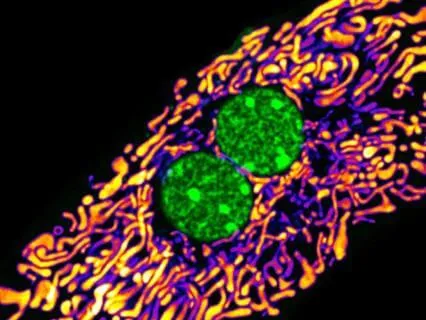
Mitochondria aren't just little machines operating at the background of biology.
Our research is showing that they're active,
Dynamic participants in evolution,
Shaping traits,
Fitness,
Inheritance,
And perhaps even the evolutionary trajectories of species across the tree of life.
The flow of energy through biology has been the driver of evolution for a very long time,
And the central role of mitochondria in all of biology is rooted in deep evolutionary history.
Mitochondrial energy transformation isn't just permissive for life,
It's instructive.
Let's take a closer look at some of the key pieces of the history of mitochondria and how they came to be.
About 1.
5 to 2 billion years ago,
A free-living bacterium likely entered a long-term partnership with another cell.
It first became engulfed by that cell and continued to live inside of it.
Over time,
The partnership became permanent,
Just like a relationship.
The incoming cell was aerobic,
Meaning it could flow and transform energy using oxygen.
The other cell was anaerobic,
Meaning it couldn't use oxygen for energy transformation.
Over time,
Their shared metabolism became integrated and entangled into what we have now in mammalian and human cells.
Most of our cells can do either,
They can respire using their mitochondria,
Or they can ferment substrates from food with glycolysis and spit out the extra electrons as lactate.
The fact that mitochondria still have part of their original bacterial genome all these years later support that theory.
The ancestral genome within our mitochondria is what we know and call mitochondrial DNA or mtDNA.
How this symbiotic event fits into the timeline of the appearance of the first complex cells with membrane-bound organelles,
What we call eukaryotic cell,
Remains an active area of academic debate.
To understand the details of the mitochondrial origin story,
We'll need to do a lot more research to make sense of the complex lineages of those early cells.
We each have a lot of mitochondrial DNA.
The mitochondrial genome is small compared to the genome within the nucleus of our cells.
But each of our cells can contain tens to thousands of mitochondria,
And each mitochondrion can contain multiple copies of mitochondrial DNA.
The mitochondrial DNA,
When you look at it under the microscope,
Is circular,
Just like a bacterial plasmid.
And a funny thing with the mitochondrial genome,
Unlike the nuclear genome,
Is that we only get it from one parent.
We only get the mitochondrial DNA from our mother.
We all have our mom's mitochondria.
How mitochondrial DNA replicates,
Segregates during mitochondrial and cell division,
And accumulates mutations may impact the survival of a mitochondrion and the cell that contains it.
Organisms may have developed ways to filter mitochondrial variants or mutations to protect themselves from harmful mutations while preserving evolutionary flexibility.
These factors,
As well as how mitochondrial DNA is passed down to future generations,
May have broad impact on evolution and on our lives today.
Over the course of evolution,
Mitochondrial DNA has become incorporated into the DNA within the nucleus of cells,
Including ourselves.
Over the course of evolution,
The mitochondrial DNA has become incorporated inside the chromosomes in the DNA of our cells.
These changes may have helped or hindered survival at the scale of individual mitochondria all the way up to the scale of the whole organism and even species.
For example,
We know that pieces of mitochondrial DNA can insert themselves inside the genome,
Changing the genetic code of our cells during our lifetime.
Recently,
We found that having more of those nuclear mitochondrial DNA insertions,
Which are called pneumites,
In certain cells may even increase mortality.
We found that people with more pneumites in their brains had died earlier.
For each pneumite,
We found that on average,
People lost about 5 years of life.
That emphasizes the active and impactful role that mitochondria and mitochondrial DNA can play in biology,
Even on surprisingly short timescales that your life is.
Understanding where the mitochondrial DNA comes from and its foundational role for all of mitochondrial biology helps us think more clearly about how inherited and acquired changes during our lifetime could influence our health.
Interestingly,
Mitochondria and the mitochondrial DNA evolve under the same principles of natural selection that we think about at the whole body level.
Selection for mitochondrial quality may even have contributed to the evolution of different sexes.
For example,
Mitochondrial genomes appear to be affected by environmental factors like temperature.
This could have wide-ranging implications in our changing world where global temperatures are changing.
That could also explain why some people always feel warm while others always feel cold.
Taking a step back,
Mitochondrial genomes are wonderfully complex,
Carefully regulated,
Dynamic and a major contributor to evolution.
This is true in humans as well as in many organisms across the tree of life.
But evolution doesn't only happen at the scale of millennia and species,
It also happens within our own bodies as we differentiate from a single cell into a plurality of cells and organs in the cell collective that the whole body is.
My colleague Anna Munzel has shown for example how a single mitochondria type,
What we call a mitotype,
In the egg of the mother evolves into a beautiful diversity of mitotypes across our organs.
In science,
Mitochondria are now at the center of some very big questions that go well beyond energy transformation and metabolism.
That reminds me that mitochondrial biology is not just a fading remnant of an ancient symbiotic relationship.
Mitochondria are the core design element of the metabolic circuitry that keeps us alive.
Mitochondria are the genome or key players in our biology,
Including in the evolution of life as we know it,
But also in our everyday lives as energy flows and animates our bodies and our minds.
Studying mitochondria is critical for understanding our history,
But also for the future of medicine.
For aging,
For ecology,
And our survival in a rapidly changing world.
Thank you for joining me on this adventure and I'm so happy to welcome you to a growing community of people interested in learning more about mitochondria and the role they play in allowing energy flow and transformation in our health.
Thank you.
And remember,
Every breath is an opportunity to be.