Hello friends,
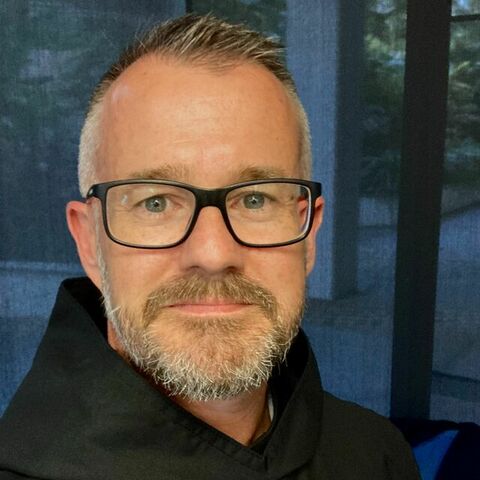
This is Mark Gladman,
Also known as Brother Frederick James,
Your friendly neighbourhood monk in dogs.
Welcome back to our series,
God Is,
Day 3.
Invite you to begin by settling yourself.
Being aware of your breath.
Being aware of your place in space and time.
And being aware as much as you can.
Of the fact that you sit within God and God sits within you.
As we ask the Spirit to open our minds and our hearts and our ears.
To what has spoken to us today.
And today I want to continue holding the phrase that we had at the end of yesterday.
I think we need to think about it a little bit more deeply,
And that is God is more.
So towards the end yesterday,
We were saying that whatever we say about God,
God is more.
If we say God is love,
God is more.
If we say God is grace,
God is more.
God is more.
If we say God is mystery,
God is presence,
God is light,
God is all those things,
But God is more,
And even when what we say is true,
God always exceeds the words we use.
Learning to say God is more,
I think,
Is one of the most important disciplines that we can develop for the spiritual life.
Nice humans.
Are remarkably good at putting things into boxes.
We name things,
We categorize them,
We define them,
We measure them,
We explain them.
Nothing wrong with that.
It's how we make sense of the world.
But the problem comes.
When we assume that what we can say about something is the same as the thing itself.
For example,
We can describe the ocean.
We can measure its depth,
Analyze its chemistry,
Map its currents,
Even photograph it from space.
But none of those things is the ocean.
The description is not the reality.
And if that's true of something as ordinary as the ocean,
Then how much more true is it of God.
We need to understand that our understandings of God are theology.
It's a map.
But God.
.
.
Is the territory.
And no map,
However accurate,
Can contain the landscape.
Here's an example of that.
Consider the sentence,
God is love.
Probably one of the most profound things that Christianity has ever said.
John doesn't merely say that God loves,
He says God is love.
This is in 1 John chapter 4.
Now imagine that we take our human experience of love and use it as a complete definition of God.
Immediately!
We've made God smaller.
Why?
Well,
However beautiful human love can be,
It's also fragile.
It can be possessive and afraid.
It can be conditional.
You can get exhausted loving things.
And it can be mixed with need.
So when we say God is love,
Are we saying that God is like the best version of human romantic love?
No,
Of course not.
We're saying something much deeper than that.
Our experience of love just gives us a glimpse,
A direction,
A window or a picture.
If you will.
But God is more,
Way more.
God's love exceeds our understanding of love.
And this is true of every word we use for God.
And this is the danger of taking our metaphors literally.
Some people can call God Father.
Jesus certainly did.
And it's a beautiful and very deeply intimate way of speaking about God.
But God is not a biological male being.
Some people call God king.
Scripture does.
But God is more.
Than just an earthly monarch sitting on a cosmic throne,
Right?
And likewise,
We call God rock,
And shepherd,
And fire,
And light,
And mother,
And wind,
And breath,
And wisdom.
And each image tells us something,
But none of them tell us anything.
Everything.
And that's why I think the scripture itself,
If you read it through,
Has such an extravagant and diverse range of imagery for God because God is not trapped inside one metaphor.
I mean,
In Scripture itself,
God is burning bush,
A cloud,
Fire,
Wind,
Silence,
A voice,
Wisdom,
Light,
A shepherd,
A mother hen,
A father waiting at the gate,
A vine,
A consuming fire,
A still small voice.
And in Jesus,
A human being.
Scripture teaches us something by refusing to give us only one picture.
Because no single image.
Is big enough.
And even Jesus.
Is not a photograph of God.
That might sound a bit strange to say,
But the incarnation doesn't mean that Jesus makes God completely comprehensible.
Jesus reveals God?
Absolutely.
But revelation isn't the same as an exhaustive explanation.
It's interesting because the Gospel of John says no one has ever seen God and then immediately speaks of the Son making God known.
And I think there's something beautiful.
In that tension.
God can be known and yet God remains beyond.
How Knowing.
You know,
God can be close.
But God also remains infinite,
That God takes on a human face,
But God can't be reduced.
To a human face.
And so,
The mystery didn't disappear when God became flesh,
The mystery just came closer to us.
And Christian spirituality has a word for this way of thinking.
We call it apophatic.
It's an interesting word.
For a very simple idea.
Sometimes we come to know God by recognizing what God is not.
We started off with one of these,
God is not a thing.
We might also say things like God is not limited,
God is not contained,
God is not merely one being among other beings.
We might talk about God not being our projection,
God not being our favorite metaphor,
God not being our theology.
Eventually,
We discover something beautifully freeing in all this.
We don't have to make God fit.
We can just let God be God.
And I think this is one of the reasons.
That I've come to think that I don't know.
Is a beautifully profound Christian prayer and statement.
And by this I mean.
.
.
I don't know.
Because God is more.
And there's a humility.
In that it protects us from confusing our certainty with God's truth.
It allows us to listen.
It allows us to keep learning.
It allows someone else's experience of God to surprise us,
And it leaves us room.
For wonder.
Because once we've completely explained something,
We tend to stop looking.
We stop asking,
We stop noticing,
We stop being astonished and surprised.
But mystery,
Mystery keeps the door open.
And this is not just an intellectual exercise or playing with semantics.
Our image of God shapes our spiritual lives.
If our God is small,
Our spirituality becomes small.
If God's primarily concerned with rules,
We come really preoccupied with rules.
If God's primarily concerned with punishment,
We become afraid.
If God is primarily concerned with winning arguments,
We become argumentative.
But if God is more.
More loving than we can imagine,
More gracious than we can imagine,
More present than we can imagine.
We can imagine,
More generous than we can imagine,
More mysterious than we can imagine,
Then maybe our lives begin to open and our faith becomes less about protecting a picture of God and more about being drawn into God.
And this is the beautiful paradox.
The more we know God,
The more we discover that we don't know because God is infinite.
Think of falling in love with someone.
At first you don't know much,
Right?
And then you discover more.
And the more you discover,
The more you realise that there's still more.
The knowing doesn't destroy the mystery,
The knowing deepens the mystery.
And that's what mature faith looks like.
Maturity moves from a small God we think we understand to a God whose mystery we increasingly trust.
So today I invite you to try this.
Take something you believe about God.
Something that you're completely comfortable saying.
Something like,
God loves me,
Or God is good,
Or God is with me.
And like yesterday,
Say it slowly,
Let yourself believe it,
And then add four words,
And God is more.
God loves me.
And God is more.
God is good and God is more.
God is with me.
And God is more.
The first statement is still true,
But it's not enough.
Remember your words are a doorway.
Don't mistake the doorway for the house.
Your understanding of God's a map.
Don't mistake the map.
For the territory.
And your experience of God,
Friend,
Yes,
Very real.
But don't mistake your experience for the fullness of what you can experience with God.
Your image of God may be beautiful,
But don't mistake that image for the one it points towards.
Because whatever we say about God.
.
.
God is more.
And to be honest,
This entire series is really about becoming comfortable enough with that sentence that we no longer feel the need to finish it.
God is.
God is what?
But we don't need to fill it.
Silence.
God is.
Because maybe the most faithful thing that we can say about God is not another word,
But simply knowing in our hearts that God is more.
And may grace,
Peace and love be with us and stretch us as we sit with this today and always.
Until tomorrow,
Friends.
Bye for now.