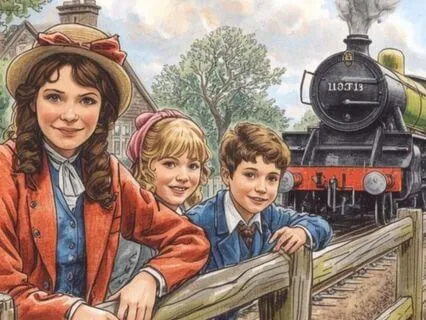
Hello beautiful souls and welcome to today's reading of The Railway Children where we continue our adventures.
Just take in a moment now,
As always,
To arrive in the space you find yourself in.
Become aware of your body,
Of any sounds around you,
Your breath,
Finding a moment to become fully present,
Becoming aware of any lingering thoughts and making an effort to pop down the to-do list until later and allow yourself the pure bliss of relaxation and gift of storytelling today from E.
Nesbitt.
And when you're ready,
We will begin.
Chapter 10.
The Terrible Secret.
When they first went to live at Three Chimneys,
The children had talked a great deal about their father and had asked a great many questions about him and what he was doing and where he was and when he would come home.
Mother always answered their questions as well as she could,
But as the time went on they grew to speak less of him.
Bobby had felt almost from the first that for some strange miserable reason these questions hurt mother and made her sad and little by little the others came to have this feeling too,
Though they could not have put it into words.
One day when mother was working so hard that she could not leave off even for ten minutes,
Bobby carried up her tea to the big bare room that they called Mother's Workshop.
It had hardly any furniture,
Just a table and chair and a rug,
But always big pots of flowers on the windowsill and on the mantelpiece.
The children saw to that.
And from the three long uncurtained windows,
The beautiful stretch of meadow and moorland,
The far violet of the hills,
And the unchanging changefulness of cloud and sky.
Here's your tea,
Mother dear,
Said Bobby.
Do drink it while it's hot.
Mother laid down her pen among the pages that were scattered all over the table,
Pages covered with her writing,
Which was almost as plain as print and much prettier.
She ran her hands into her hair as if she were going to pull it out by handfuls.
Poor dear head,
Said Bobby.
Does it ache,
Mother?
No.
Yes.
Not much,
Bobby,
Said mother.
Bobby,
Do you think Peter and Phil are forgetting father?
No,
Said Bobby indignantly.
Why?
Well,
None of you ever speak of him now.
Bobby stood first on one leg and then on the other.
We often talk about him when we're by ourselves,
She said.
But not to me,
Said mother.
Why?
Bobby did not find it easy to say why.
I,
You,
She said and stopped.
She went over to the window and looked out.
Bobby,
Come here,
Said her mother.
And Bobby came.
Now,
Said mother,
Putting her arm round Bobby and laying her ruffled head against Bobby's shoulder.
Try to tell me,
Dear.
Bobby fidgeted.
Tell mother.
Well,
Then,
Said Bobby.
I thought you were so unhappy about daddy not being here.
It made you worse when I talked about him.
So I stopped doing it.
And the others?
I don't know about the others,
Said Bobby.
I never said anything about that to them.
But I expect they felt the same about it as me.
Bobby,
Dear,
Said mother,
Still leaning her head against her.
Besides parting from father,
He and I have had a great sorrow.
Worse than anything you can think of.
And at first it did hurt to hear you all talking of him,
As if everything were just the same.
But it would be much more terrible if you were to forget him.
That would be worse than anything.
The trouble,
Said Bobby,
In a very quiet voice.
I promised I would never ask you any questions.
And I never have,
Have I?
But the trouble,
It won't last always.
No,
Said mother.
The worst will be over when father comes home to us.
I wish I could comfort you,
Said Bobby.
Oh my dear,
Do you suppose that you don't?
What should I do without you?
You and the others.
Do you think I haven't noticed how good you've all been?
Not quarrelling nearly as much as you used to.
And all the little kind things you do for me.
The flowers,
The cleaning my shoes,
And tearing up to make my bed before I get to do it myself.
Bobby had sometimes wondered whether mother noticed these things.
That's nothing,
Bobby said.
I must get on with my work,
Dear,
Said mother,
Giving Bobby one last squeeze.
Don't say anything to the others.
That evening,
In the hour before bedtime,
Instead of reading to the children,
Mother told them stories of the games she and father used to have when they were children and lived near each other in the country.
Tales of the adventures of father with mother's brothers when they were all boys together.
Funny stories they were,
And the children laughed as they listened.
Uncle Edward died before he was grown up,
Didn't he?
Said Phyllis,
As mother lighted the bedroom candles.
Yes,
Dear,
Said mother,
You would have loved him.
He was such a brave boy and so adventurous,
Always in mischief and yet friends with everybody in spite of it.
And your uncle Reggie's in Ceylon,
Yes,
And father's away,
Too.
But I think they'd all like to think that we'd enjoyed talking about the things that they used to do.
Don't you think so?
Not uncle Edward,
Said Phyllis in a shocked tone.
He's in heaven.
You don't suppose he's forgotten us and all the old times because God has taken him,
Any more than I forget him.
Oh no,
He remembers,
Phyll.
He's only away for a little time.
We shall see him again someday.
And uncle Reggie and father,
Too,
Said Peter.
Yes,
Said mother,
Uncle Reggie and father,
Too.
Good night,
My darlings.
Good night,
Said everyone.
Bobby hugged her mother more closely,
Even than usual,
And whispered in her ear,
Oh I do love you so,
Mummy.
I do,
I do.
When Bobby came to think it all over,
She tried not to wonder what the great trouble was,
But she could not always help it.
Father was not dead,
Like poor uncle Edward.
Mother had said so,
And he was not ill,
Or mother would have been with him.
Being poor wasn't the trouble.
Bobby knew it was something nearer the heart than money could be.
I mustn't try to think what it is,
She told herself.
No,
I mustn't,
I mustn't.
I am glad mother noticed about us not quarrelling so much.
We'll keep that up.
And alas,
That very afternoon,
She and Peter had what Peter called a first-class shindy.
They had not been a week at Three Chimneys before they had asked mother to let them have a piece of garden each for their very own,
And she had agreed.
And the south border under the peach trees had been divided into three pieces,
And they were allowed to plant whatever they liked there.
Phyllis had planted migonette and nasturium and Virginia stock in hers.
The seeds came up,
And though they looked just like weeds,
Phyllis believed that they would bear flowers some day.
The Virginia stock justified her faith quite soon,
And her garden was gay with a band of bright little flowers,
Pink and white and red.
I can't weed for fear I pull up the wrong things,
She used to say.
It saves such a lot of work.
Peter sowed vegetable seeds in his,
Carrots and onions and turnips.
The seed was given to him by the farmer who lived in the nice black and white wood and plaster house just beyond the bridge.
He kept turkeys and guinea fowls and was a most amiable man.
But Peter's vegetables never had much of a chance,
Because he liked to use the earth of his garden for digging canals and making forts and earthworks for his toy soldiers.
And the seeds of vegetables rarely came to much in a soil that is constantly disturbed for the purposes of war and irrigation.
Bobbie planted rose bushes in her garden,
But all the little new leaves of the rose bushes shriveled and withered,
Perhaps because she moved them from the other part of the garden in May,
Which is not at all the right time of the year for moving roses.
But she would not own that they were dead and hoped on against hope until the day when Perks came up to see the garden and told her quite plainly that all her roses were as dead as doornails.
Only good for bonfires miss,
He said.
You just dig them up and burn them and I'll give you some nice fresh roots out of my garden,
Pansies and stalks and sweet willies and forget-me-nots.
I'll bring them along tomorrow if you get the ground ready.
So,
Next day she set to work and that happened to be the day when mother had praised her and the others about not quarrelling.
She moved the rose bushes and carried them to the other end of the garden where the rubbish heap was that they meant to make a bonfire of when Guy Fawkes' day came.
Meanwhile,
Peter had decided to flatten out all his forts and earthworks with a view to making a model of the railway tunnel,
Cutting,
Embankment,
Canal,
Aqueduct,
Bridges and all.
So,
When Bobbie came back from her last thorny journey with the dead rose bushes,
He had got the rake and was using it busily.
I was using the rake,
Peter,
Said Bobbie.
Well,
I'm using it now,
Said Peter.
But I had it first,
Said Bobbie.
Then it's my turn now,
Said Peter.
And that was how the quarrel began.
You're always being disagreeable about nothing,
Said Peter,
After some heated argument.
I had the rake first,
Said Bobbie,
Flushed and defiant,
Holding on to its handle.
Didn't I tell you this morning I meant to have it,
Didn't I,
Phil?
Phyllis said she didn't want to be mixed up in their rows.
And instantly,
Of course,
She was.
If you remember,
You ought to say.
Of course she doesn't remember,
But she might say so.
I wish I'd had a brother instead of two whiny little kiddie sisters,
Said Peter.
This was always recognised as indicating the high watermark of Peter's rage.
Bobbie made the reply she always made to it.
I can't think why little boys were ever even invented.
And just as she said it,
She looked up and saw the three long windows of Mother's workshop flashing in the red rays of the sun.
The sight brought back those words of praise.
You don't quarrel like you used to.
Oh,
Cried Bobbie,
Just as if she had been hit,
Or had caught her finger in a door,
Or had felt the hideous sharp beginning of toothache.
What's the matter,
Bobbie,
Said Phyllis.
Bobbie wanted to say,
Don't let's quarrel.
Mother hates it so.
But though she tried hard,
She couldn't.
Peter was looking too disagreeable and insulting.
Take the horrid rate then,
Was the best that she could manage.
And she suddenly let go her hold on the handle.
Peter had been holding on to it too firmly,
And now that the pull the other way was suddenly stopped,
He staggered and fell over backwards,
The teeth of the rake between his feet.
Serves you right,
Said Bobbie,
Before she could stop herself.
Peter lay still for half a moment,
Long enough to frighten Bobbie a little.
Then he frightened her a little more,
For he sat up,
Screamed,
Turned rather pale,
And then lay back down and began to shriek,
Faintly but steadily.
It sounded exactly like a pig being killed a quarter of a mile off.
Mother put her head out of the window,
And it wasn't half a minute after that that she was in the garden,
Kneeling by the side of Peter,
Who never for an instant ceased to squeal.
What happened,
Bobbie?
Mother asked.
It was the rake,
Said Phyllis.
Peter was pulling at it,
So was Bobbie,
And she let go,
And he went over.
Stop that noise,
Peter,
Said Mother.
Come,
Stop at once.
Peter used up what breath he had left in a last squeal,
And stopped.
Now,
Said Mother,
Are you hurt?
If he was really hurt,
He wouldn't make such a fuss,
Said Bobbie,
Still trembling with fury.
He's not a coward.
I think my foot's broken off,
That's all,
Said Peter,
And sat up.
Then he turned quite white.
Mother put her arm around him.
He is hurt,
She said.
He's fainted.
Here,
Bobbie,
Sit down and take his head on your lap.
Then Mother undid Peter's boots.
As she took the right one off,
Something dripped from his foot onto the ground.
It was blood.
And when the stocking came off,
There were three red wounds in Peter's foot and ankle,
Where the teeth of the rake had bitten him,
And his foot was covered with red smears.
Run,
Run for water,
A basin full of water,
Said Mother,
And Phyllis ran.
She upset most of the water out of the basin in her haste,
And had to fetch more in a jug.
Peter did not open his eyes again until Mother had tied her handkerchief around his foot,
And she and Bobbie had carried him in and laid him on the brown wooden settle in the dining room.
By this time,
Phyllis was halfway to the doctor's.
Mother sat by Peter and bathed his foot and talked to him,
And Bobbie went out and got tea ready and put on the kettle.
It's all I can do,
She told herself.
Oh,
Suppose Peter should die,
Or be a helpless cripple for life,
Or have to walk with crutches,
Or wear a boot with a sole like a log of wood.
She stood by the back door,
Reflecting on these gloomy possibilities,
Her eyes fixed on the waterbutt.
I wish I'd never been born,
She said,
And she said it out loud.
Why,
Look,
And mercy,
What's that for?
Asked a voice,
And Perks stood before her with a wooden truck basket full of green-leaved things and soft,
Loose earth.
Oh,
It's you,
She said.
Peter's hurt his foot with a rake,
Three great gaping wounds like soldiers get,
And it was partly my fault.
That it wasn't,
I'll go bail,
Said Perks.
Has doctor seen him?
Phyllis has gone for the doctor.
He'll be all right,
You see if he isn't.
Why,
My father's second cousin had a hay fork run into him,
Right up into his inside,
And he was right as ever in a few weeks,
All except his being a bit weak in the head afterwards,
And they did say that it was along of his getting a touch of the sun in the hay field,
And not the fork at all.
I remember him well,
A kind-hearted chap,
But soft,
As you might say.
Bobbie tried to let herself be cheered by this heartening reminiscence.
Well,
Said Perks,
You won't want to be bothered with gardening just this minute,
I dare say.
You show me where your garden is,
And I'll pop the bits of stuff in for you,
And I'll hang about,
If I may make so free,
To seek doctor as he comes out and hear what he says.
You cheer up,
Missy.
I'll lay a pound he ain't hurt,
Not to speak of.
But he was.
The doctor came and looked at the foot and bandaged it beautifully,
And said that Peter must not put it to the ground for at least a week.
He won't be lame,
Or have to wear crutches,
Or a lump on his foot,
Will he?
Whispered Bobbie,
Breathlessly,
At the door.
My aunt,
No,
Said Dr Forrest.
He'll be as nimble as ever on his pins in a fortnight.
Don't you worry,
Little mother goose.
It was when mother had gone to the gate with the doctor to take his last instructions,
And Phyllis was filling the kettle for tea,
That Peter and Bobbie found themselves alone.
Oh,
Peter,
I am so sorry,
Said Bobbie,
After a pause.
That's all right,
Said Peter,
Gruffly.
It was all my fault,
Said Bobbie.
Rot,
Said Peter.
If we hadn't quarrelled,
It wouldn't have happened.
I knew it was wrong to quarrel.
I wanted to say so,
But somehow I couldn't.
Don't drivel,
Bobbie,
Said Peter.
I shouldn't have stopped if you had said it,
Not likely.
And besides,
Us rowing hadn't anything to do with it.
I might have caught my foot in the hoe,
Or taken off my fingers in the chaff-cutting machine,
Or blown my nose off with fireworks.
It would have been hurt just the same,
Whether we'd been rowing or not.
But I knew it was wrong to quarrel,
Said Bobbie,
In tears.
And now you're hurt.
Now look here,
Said Peter,
Firmly.
You just dry up.
If you're not careful,
You'll turn into a beastly little Sunday school prig,
So I tell you.
I don't mean to be a prig,
But it's so hard not to be when you're really trying to be good.
It's a jolly good thing it wasn't you was hurt.
I'm glad it was me,
There.
If it had been you,
You'd have been lying on the sofa,
Looking like a suffering angel,
And being the light of the anxious household and all that.
And I couldn't have stood it,
Peter said.
No,
I shouldn't,
Said Bobbie.
Yes,
You would,
Said Peter.
I tell you I shouldn't,
And I tell you you would.
Oh,
Children,
Said Mother's voice at the door,
Quarrelling again,
Already.
We aren't quarrelling,
Mother,
Not really,
Said Peter.
I wish you wouldn't think it's rouse every time that we don't agree.
When Mother had gone out again,
Bobbie broke out.
Peter,
I am sorry you are hurt,
But you are a beast,
To say I'm a prig.
Well,
Said Peter,
Unexpectedly,
Perhaps I am.
You did say I wasn't a coward,
Even when you were in such a wax.
The only thing is,
Don't you be a prig,
That's all.
You keep your eyes open,
And if you feel priggishness coming on,
Just stop in time,
Bobbie.
Peter was tired for many days after that,
And the settle seemed hard and uncomfortable,
In spite of all the pillows,
And bolsters,
And soft folded rugs.
It was terrible not to be able to go out.
They moved the settle to the window,
And from there Peter could see the smoke of the trains winding along the valley,
But he could not see the trains.
At first,
Bobbie found it quite hard to be as nice to him as she wanted to be,
For fear he should think her priggish,
But that soon wore off,
And both she and Phyllis were,
As he observed,
Jolly good sorts.
Mother sat with him when the sisters were out,
And the words,
He's not a coward,
Made Peter determined not to make any fuss about the pain in his foot,
Though it was rather bad,
Especially at night.
Praise helps people very much sometimes.
There were visitors too.
Mrs Perks came up to ask how he was,
And so did the station master,
And several of the village people,
But the time went slowly.
I do wish there was something to read,
Said Peter.
I've read all our books about 50 times over.
I'll go to the doctors,
Said Phyllis.
He's sure to have some.
Only about how to be ill,
And about people's nasty insides I expect,
Said Peter.
Perks has a whole heap of magazines that come out of trains when people are tired of them,
Said Bobbie.
I'll run down and ask him.
So the girls went their two ways.
Bobbie found Perks busy cleaning lamps.
And how's the young gent,
Said he.
Better,
Thanks,
Said Bobbie,
But he's most frightfully bored.
I came to ask if you'd got any magazines you could lend him.
There now,
Said Perks,
Regretfully,
Rubbing his ear with a black and oily lump of cotton waste.
Why didn't I think of that?
I was trying to think of something that would amuse him only this morning,
And I couldn't think of anything better than a guinea pig,
And a young chap I know is going to fetch that over for him this tea time.
Oh,
How lovely,
Perks.
A real live guinea pig.
He will be pleased.
But he'd like the magazines as well.
That's just it,
Said Perks.
I've just sent the pig of them to Snigson's boy.
Him what's just getting over the pneumonia.
But I've lots of illustrated papers left.
He turned to the pile of papers in the corner and took up a heap six inches thick.
There,
He said,
I'll just slip a bit of string and a bit of paper round them.
He pulled an old newspaper from the pile and spread it on the table and made a neat parcel of it.
There,
Said he,
There's lots of pictures.
And if he likes to mess about with them in his paint box or coloured chalks or whatnot,
Why you let him?
I don't want them.
Oh,
You are a dear,
Said Bobby.
And she took the parcel and started out.
The papers were heavy.
And when she had to wait at the level crossing while a train went by,
She rested the parcel on top of the gate.
And idly,
She looked at the printing on the paper that the parcel was wrapped up in.
Suddenly,
She clutched the parcel tighter and bent her head over it.
It seemed like some horrible dream.
She read on.
The bottom of the column was torn off and so she could read no farther.
She never remembered how she got home.
But she went on tiptoe to her room and locked the door.
Then she undid the parcel and read that printed column again,
Sitting on the edge of her bed.
Her hands and feet icy cold and her face burning.
When she had read all there was,
She drew a long,
Uneven breath.
So,
Now I know,
She said.
What she had read was headed,
End of the trial,
Verdict,
Sentence.
The name of the man who had been tried was the name of her father.
The verdict was guilty.
And the sentence was five years penal servitude.
Oh,
Daddy,
She whispered,
Crushing the paper hard.
It's not true.
I don't believe it.
You never did it.
Never,
Never,
Never,
Never.
There was a hammering at the door.
What is it?
Said Bobby.
It's me,
Said the voice of Phyllis.
Tea's ready and a boy's brought Peter a guinea pig.
Come along down,
Bobby.
And so Bobby had to go.