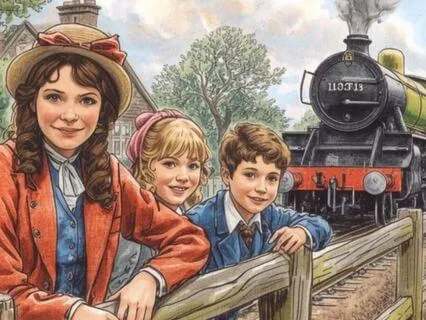
Hello beautiful souls and welcome to today's reading of The Railway Children.
As always,
Just finding a moment to arrive.
Stretching out if you're in bed,
Ready for a story before sleep.
Or if you're just taking a few moments out of your day,
Just finding a moment now to come into your body,
To put down the to-do list and get ready to hear more adventures of The Railway Children.
Chapter 6.
Saviours of the Train The Russian gentleman was better the next day,
And the day after that better still.
And on the third day,
He was well enough to come into the garden.
A basket chair was put for him,
And he sat there,
Dressed in clothes of father's,
Which were too big for him.
But when mother had hemmed up the ends of the sleeves and the trousers,
The clothes did well enough.
He was a kind face now that it was no longer tired and frightened,
And he smiled at the children whenever he saw them.
They wished very much that he could speak English.
Mother wrote several letters to people she thought might know whereabouts in England a Russian gentleman's wife and family might possibly be.
Not to the people she used to know before she came to live at Three Chimneys.
She never wrote to any of them,
But strange people,
Members of parliament and editors of papers and secretaries of societies.
And she did not do much of her story writing,
Only corrected proofs as she sat in the sun near the Russian and talked to him every now and then.
The children wanted very much to show how kindly they felt to this man who had been sent to prison and to Siberia just for writing a beautiful book about poor people.
They could smile at him,
Of course.
They could,
And they did.
But if you smile too constantly,
The smile is apt to get fixed like the smile of the hyena,
And then it no longer looks friendly,
But simply silly.
So they tried other ways and brought him flowers till the place where he sat was surrounded by little fading bunches of clover and roses and Canterbury bells.
And then Phyllis had an idea.
She beckoned mysteriously to the others and drew them into the backyard.
And there,
In a concealed spot between the pump and the water butt,
She said,
You remember Perks promising me the very first strawberries out of his own garden?
Perks,
You will recollect,
Was the porter.
Well,
I think that they should be ripe now.
Let's go down and see.
Mother had been down,
As she had promised,
To tell the stationmaster the story of the Russian prisoner.
But even the charms of the railway had been unable to tear the children away from the neighborhood of the interesting stranger.
So they had not been to the station for three whole days.
They went now.
And to their surprise and distress were very coldly received by Perks.
Highly honored,
I'm sure,
He said,
When they peeped in the door of the porter's room and he went on reading his newspaper.
There was an uncomfortable silence.
Oh dear,
Said Bobby with a sigh,
I do believe your cross.
What,
Me?
Not me,
Said Perks loftily.
It ain't nothing to me.
What ain't nothing to you,
Said Peter,
Too anxious and alarmed to change the form of words.
Nothing ain't nothing.
What happens either here or elsewhere,
If you likes to have your secrets,
Have them and welcome,
That's what I say.
The secret chamber of each heart was rapidly examined during the pulse that followed.
Three heads were shaken.
We haven't got any secrets from you,
Said Bobby at last.
Maybe you have,
Maybe you haven't.
It ain't nothing to me.
And I wish you all a good afternoon.
He held up the paper between him and them and went on reading.
Oh,
Don't,
Said Phyllis in despair.
This is truly dreadful.
Whatever it is,
Do tell us.
We didn't mean to do whatever it was.
No answer.
The paper was refolded and Perks began on another column.
Look here,
Said Peter suddenly.
It's not fair.
Even people who do crimes aren't punished without being told what it's for.
At once they were in Russia.
I don't know nothing about Russia.
Oh yes,
You do.
When mother came down on purpose to tell you a mystical story,
To tell you a Mr Gill's all about our Russian.
Can't you fancy it,
Said Perks indignantly.
Don't you see I'm asking for me is to step in room and take a chair and listen to what a leadership has to say.
Do you mean to say you've not heard?
Not so much as a breath.
I did go as far as to put a question and he shuts me up like a rat trap.
Affairs of state Perks,
Says he.
But I did think one of you would have nipped down to tell me.
You're sharp enough when you want to get anything out of old Perks.
Phyllis flushed purple at the thought of the strawberries.
Information about locomotives or signals or the likes,
Said Perks.
We didn't know that you didn't know.
We thought mother had told you.
We wanted to tell you,
Only we thought it would be stale news.
The three spoke all at once.
Perks said it was all very well and still held up the paper.
Then Phyllis suddenly snatched it away and threw her arms around his neck.
Oh,
Let's kiss and be friends,
She said.
We'll say we're sorry first if you like,
But we really didn't know that you didn't know.
We're so sorry,
Said the others.
And Perks at last consented to accept their apologies.
Then they got him to come out and sit in the sun on the green railway bank,
Where the grass was quite hot to touch.
And there,
Sometimes speaking one at a time and sometimes all together,
They told the porter the story of the Russian prisoner.
Well,
I must say,
Said Perks.
But he did not say it,
Whatever it was.
Yes,
It's pretty awful,
Isn't it?
Said Peter.
And I don't wonder you were curious about who the Russian was.
I wasn't curious,
Not so much as interested,
Said the porter.
Well,
I do think Mr.
Gills might have told you about it.
That was horrid of him.
Just then a signal sounded.
There's the 3.
14 up,
Said Perks.
You lie low till she's through and then we'll go up along to my place and see if there's any of them strawberries right what I told you about.
If there are any ripe and you do give them to me,
Said Phyllis,
You won't mind if I give them to the poor Russian,
Will you?
Perks narrowed his eyes and then raised his eyebrows.
Ah,
So it was them strawberries you came down for this afternoon,
Eh,
Missy?
This was an awkward moment for Phyllis.
To say yes would seem to be a bit too rude and greedy and unkind to Perks.
But she knew if she said no,
She would not be pleased with herself afterwards.
So.
Yes,
She said.
It was.
But we'd have come down the very next day if we'd known you hadn't heard the story,
Phyllis added hastily.
I believe you,
Missy,
Said Perks,
And sprang across the line six feet in front of the advancing train.
The girls hated to see him do this,
But Peter liked it.
It was so exciting.
The Russian gentleman was so delighted with the strawberries that the three racked their brains to find some other surprise for him.
But all the racking did not bring out any idea more novel than wild cherries.
And this idea occurred to them the next morning.
They had seen the blossom on the trees in the spring,
And they knew where to look for wild cherries now that cherry time was here.
The trees grew all up and along the rocky face of the cliff,
Out of which the mouth of the tunnel opened.
There were all sorts of trees there,
Birches and beeches and baby oaks and hazels,
And among them the cherry blossom had shone like snow and silver.
The mouth of the tunnel was some way from three chimneys,
So mother let them take their lunch with them in a basket.
And the basket would do to bring the cherries back in if they found any.
She also lent them her silver watch so that they should not be late for tea.
Peter's waterberry had taken it into its head not to go since the day when Peter dropped it into the water butt.
And they started.
When they got to the top of the cutting,
They leaned over the fence and looked down to where the railway lines lay at the bottom of what,
As Phyllis said,
Was exactly like a mountain gorge.
If it wasn't for the railway at the bottom,
It would be as though the foot of man had never been there,
Wouldn't it?
The sides of the cutting were of grey stone,
Very roughly hewn.
Indeed,
The top part of the cutting had been a little natural glen that had been cut deeper to bring it down to the level of the tunnel's mouth.
Among the rocks,
Grass and flowers grew,
And seeds dropped by birds in the crannies of the stone had taken root and grown into bushes and trees.
Near the tunnel was a flight of steps leading down to the line,
Just wooden bars roughly fixed into the earth,
A very steep and narrow way,
More like a ladder than a stair.
We'd better get down,
Said Peter.
I'm sure the cherries would be quite easy to get from the side of the steps.
You remember,
It was there we picked the cherry blossoms that we put on the rabbit's grave.
So,
They went along the fence towards the little swing gate that is at the top of these stairs.
And they were almost at the gate when Bobby said,
Hush!
Stop!
What's that?
That was a bird.
Hush!
Stop!
What's that?
That was a very odd noise indeed,
A soft noise,
But quite plainly to be heard through the sound of the wind in the branches and the hum and the whirr of the telegraph wires.
It was a sort of rustling,
Whispering sound.
As they listened,
It stopped,
And then it began again.
And this time,
It did not stop,
But it grew louder and more rustling and rumbling.
Look,
Cried Peter suddenly,
The tree over there!
The tree he pointed at was one of those that have rough grey leaves and white flowers.
The berries,
When they come,
Are bright scarlet.
But if you pick them,
They disappoint you by turning black before you get them home.
And,
As Peter pointed,
The tree was moving.
Not just the way trees ought to move when the wind blows through them,
But all in one piece,
As though it were a live creature and were walking down the side of the cutting.
It's moving,
Cried Bobby.
Oh,
Look,
And so are the others.
It's like the woods in Macbeth.
It's magic,
Said Phyllis breathlessly.
I always knew the railway was enchanted.
It really did seem a little like magic,
For all the trees for about 20 yards of the opposite bank seemed to be slowly walking down toward the railway line,
The tree with the grey leaves bringing up the rear.
Like some old shepherd driving a flock of green sheep.
What is it?
Oh,
What is it?
Said Phyllis.
It's too much magic for me.
Let's go home.
But Bobby and Peter clung fast to the rail and watched breathlessly.
And Phyllis made no movement towards going home by herself.
The trees moved on and on.
Some stones and loose earth fell down and rattled on the railway metals far below.
It's all coming down,
Peter tried to say,
But he found there was hardly any voice to say it with.
And indeed,
Just as he spoke,
The great rock on the top of which the walking trees were leaned slowly forward.
The trees,
Seizing to walk,
Stood still and shivered.
Leaning with the rock,
They seemed to hesitate for a moment.
And then rock and trees and grass and bushes with a rushing sound slipped right away.
From the face of the cutting and fell on the line with a blundering crash that could have been heard half a mile away.
A big cloud of dust rose up.
Look what a great mound it's made,
Said Bobby.
Yes,
It's right across the down line,
Said Phyllis.
That'll take some sweeping up,
Said Bobby.
Yes,
Said Peter,
Slowly.
He was still leaning on the fence.
Yes,
He said again,
Still more slowly.
Then he stood upright.
The 1129 down hasn't gone by yet.
We must let them know at the station or there'll be a most frightful accident.
Quick,
Let's run,
Said Bobby and began.
But Peter cried,
Come back and looked at Mother's watch.
He was very prompt and businesslike and his face looked whiter than they had ever seen it.
There's no time,
He said.
It's 10 miles away and it's past 11.
Couldn't we,
Suggested Phyllis breathlessly.
Couldn't we climb up a telegraph post and do something to the wires?
We don't know how,
Said Peter.
They do it in war,
Said Phyllis.
I know,
I've heard of it.
They only cut them,
Silly.
That doesn't do any good.
And we couldn't cut them even if we got up and we couldn't get up.
If we had anything red,
We could go down on the line and wave it.
But the train wouldn't see us until it got around the corner and then it could see the mound just as well as us,
Said Phyllis.
Better,
Because it's much bigger than us.
Oh,
If only we had something red,
Peter repeated.
We could go around the corner and wave to the train.
Well,
We might wave anyway.
They'd only think it was us waving.
We've waved so often before.
If only we had something red.
Anyway,
Let's get down.
They got down the steep stairs.
Bobby was pale and shivering and Peter's face looked thinner than usual.
Phyllis was red-faced and damp with anxiety.
Oh,
How hot I am,
She said.
And I thought it was going to be cold.
I wish we hadn't put on our flannel petticoats.
Bobby turned at the bottom of the stairs.
Yes,
She cried.
They're red.
Let's take them off.
And so they did.
And with the petticoats rolled up under their arms,
They ran along the railway,
Skirting the newly fallen mound of stones and rock and earth and bent crushed twisted trees.
They ran at their best pace.
Peter led,
But the girls were not far behind.
They reached the corner that hid the mound from the straight line of the railway that ran half a mile without curve or corner.
Now,
Peter said,
Taking hold of the largest flannel petticoat.
You are not,
Phyllis faltered.
You're not going to tear them up.
Oh,
Yes,
Said Bobby.
Tear them into little bits if you like.
Don't you see,
Phil,
If we can't stop the train,
There'll be a real life accident with people killed.
Here,
Peter,
You'll never tear it through the band.
She took the red flannel petticoat from him and tore it off an inch from the band.
Then she tore the other in the same way.
There,
Said Peter,
Tearing in his turn.
He divided each petticoat into three pieces.
Now we've got six flags.
He looked at the watch again,
He looked at the watch again,
And we've got seven minutes.
We must have flagstaffs.
The knives given to boys are,
For some odd reason,
Seldom of the kind of steel that keeps sharp.
The young saplings had to be broken off.
Two came up by the roots.
The leaves were stripped from them.
We must cut holes in the flags and run the sticks through the holes,
Said Peter.
And the holes were cut.
The knife was sharp enough to cut flannel with.
Two of the flags were set up in heaps of loose stone beneath the sleepers of the down line.
Then Phyllis and Bobby took each a flag and stood ready to wave it as soon as the train came.
Into sight.
I shall have the other two myself,
Said Peter,
Because it was my idea to wave something red.
They're our petticoats,
Though,
Said Phyllis.
But Bobby interrupted.
Oh,
What does it matter who waves what if only we can save the train?
Perhaps Peter had not rightly calculated the number of minutes it would take the 1129 to get from the station to the place where they were,
Or perhaps the train was late.
Anyway,
It seemed a very long time that they waited.
Phyllis grew impatient.
I expect the watch is wrong and the train's gone by,
She said.
Bobby began to feel sick with suspense.
It seemed to her that they had been standing there for hours and hours,
Holding those silly little red flannel flags that no one would ever notice.
The train wouldn't care.
It would go rushing by them and tear round the corner and go crashing into that awful mound and everyone would be killed.
Her hands grew very cold.
And trembled so that she could hardly hold the flag.
And then came the distant rumble and hum of the metals and a puff of white steam showed far away along the stretch of line.
Stand firm,
Said Peter,
And wave like mad.
When it gets to that big bush,
Step back,
But go on waving.
Don't stand on the line,
Bobby.
The train came rattling along very,
Very fast.
They don't see us.
They won't see us,
Peter.
It's all no good,
Cried Bobby.
The two little flags on the line swayed as the nearing train shook and loosened the heaps of loose stones that held them up.
One of them slowly leaned over and fell on the line.
Bobby jumped forward and caught it up and waved it.
Her hands did not tremble now.
It seemed that the train came on as fast as ever.
It was very near.
Keep off the line,
You silly cuckoo,
Said Peter.
It's no good,
Bobby said again.
Stand back,
Cried Peter,
Suddenly,
And he dragged Phyllis back by the arm.
But Bobby cried,
Not yet,
Not yet,
And waved her two flags right over the line.
The front of the engine looked black and enormous.
Its voice was loud and harsh.
Oh,
Stop,
Stop,
Stop,
Cried Bobby.
Cried Bobby.
No one heard her.
At least Peter and Phyllis didn't,
For the oncoming rush of the train covered the sound of her voice with a mountain of sound.
But afterwards,
She used to wonder whether the engine itself had not heard her.
It seemed almost as though it had,
For it slackened swiftly.
Slackened and stopped,
Not 20 yards from the place where Bobby's two flags waved over the line.
She saw the great black engine stop dead,
But somehow she could not stop waving the flags.
And when the driver and the fireman had got off the engine and Peter and Phyllis had gone to meet them and pour out their excited tale of the awful mound just around the corner,
Bobby still waved the flags,
But more and more feebly and jerkily.
When the others turned towards her,
She was lying across the line with her hands flung forward and still gripping the sticks of the little red flannel flags.
The engine driver picked her up,
Carried her to the train and laid her on the cushions of a first-class carriage.
She's gone right off in a faint,
He said.
Poor little woman.
And no wonder.
I'll just have a look at this ear mound of yours and then we'll run you back to the station and get her seen to.
It was horrible to see Bobby lying so white and quiet.
With her lips blue and parted.
I believe that's what people look like when they're dead,
Whispered Phyllis.
Don't,
Said Peter.
They sat by Bobby on the blue cushions and the train ran back.
Before it reached their station,
Bobby sighed and opened her eyes and rolled herself over and began to cry.
This cheered the others wonderfully.
They had seen her cry before but they had never seen her faint nor anyone else for that matter.
They had not known what to do when she was fainting but now that she was only crying they could thump her on the back and tell her not to just as they always did.
And presently,
When she stopped crying they were able to laugh at her for being such a coward as to faint.
When the station was reached the three were the heroes of an agitated meeting on the platform.
The praises they got for their prompt action,
Their common sense were enough to have turned anybody's head.
Phyllis enjoyed herself thoroughly.
She had never been a real heroine before and the feeling was delicious.
Peter's ears got very red yet he too enjoyed himself.
Only Bobby wished they all wouldn't.
She wanted to get away.
You'll hear from the company about this,
I expect.
You'll hear from the company about this,
I expect said the station master.
Bobby wished she might never hear of it again.
She pulled at Peter's jacket.
Oh,
Come away now,
Peter.
I want to go home,
She said.
And so they went and as they went station master and porter and guards and driver and fireman and passengers sent up a cheer.
Oh,
Listen,
Cried Phyllis.
That's for us.
Yes,
Said Peter.
I say,
I am glad I thought about something red and waving it.
And how lucky that we put on our red flannel petticoats,
Said Phyllis.
Bobby said nothing.
She was thinking of the horrible mound and the trustful train rushing towards it.
And it was us that saved them,
Said Peter.
How dreadful if they had all been killed.
Wouldn't it have been,
Bobby?
We never got any cherries,
Said Bobby.
The others thought her rather heartless.
We never got any cherries,
Said Phyllis.