On the 19th May is Atami Puja,
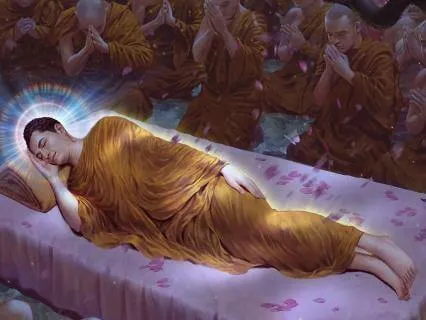
The offering of the cremation fire to the body of the Sama Sambuddha,
The perfectly self-awakened Buddha.
This occurred on the 8th day after the passing of the Buddha's Parinibbana.
It is an important day of the Buddha Sasana,
The dispensation,
Which falls on the 8th day of the waning moon of the 6th lunar month according to the Thai lunar calendar.
And the ceremony of the offering of the cremation fire was led by the King of Malas along with the people in the town of Kushinara.
And the Sangha was led by Venerable Mahakassapa.
And the king of Malas had given the highest homage with fragrances,
Flowers,
Music of all types that was available in the town of Kushinara.
This homage was given for the entire seven days.
And then the eight leaders of the Mala kingdom had bathed,
Dressed in new cloth and carried the body of the Buddha to the east to offer the cremation fire.
And Venerable Ananda had before asked the Sama Sambuddha how to conduct the cremation ceremony of the Buddha.
It was to do it in the same way as they would a wheel-turning monarch that is covering the body of the Buddha with clean cloth then wrapping with carded cotton and wrapping the body like this in 500 pairs of cloth and cotton then enclosing the Buddha in an iron tub of oil then to prepare it with flowers,
Incense of all types and then the four leaders of the Mala Kingdom to light the fire,
To light the funeral pyre of the Buddha,
But it would not light.
They asked Venerable Aniruddha and Venerable Ananda,
Who said the Devas do not yet wish to offer the fire now.
They wanted to wait for Venerable Mahakassapa and the group of 500 monks who were on the way,
So that they could offer their final respects at the feet of the Buddha.
When Venerable Mahakassapa and the 500 monks had arrived,
They paid their respects to the feet of the Buddha and the fire lit by itself.
After offering the cremation fire,
A serious issue arose because the Mala Kingdom leaders took all of the Buddha's relics,
Put them in a golden vessel to enshrine it in Kushinara.
And the Buddha's various requisites were sent to enshrine in different locations.
For example,
The Buddha's robes were enshrined in Mandara province,
The Buddha's alms bowl enshrined in Pataliputra,
And so on.
Here all the kings of the large kingdoms had received the news that the Buddha had passed away into Parinibbana in Kushinara town.
So they sent representatives to ask for the sharing of the Buddha's relics with them so as to enshrine it for worship and as a blessing for their country.
But the king of Malas refused.
Because the Buddha had attained Parinibbana in their country.
Buddha's relics alone.
It was for their city alone.
They wouldn't share with anyone.
And this would be a problem that could lead to an outbreak of war.
No leader of the kingdoms would accept this.
If their relics were not shared with them then there would be war and many would die.
So what were they to do as it was becoming serious?
There was one Brahmin,
Dona Brahman,
Who became the mediator.
Döner Brahmin was skilled at mediating and he was a teacher of all the kings.
They had learned from him.
And he said,
Do you remember me?
I am Döner Brahmin.
The kingdoms remembered that it was their teacher,
So they were silent and listened.
They could acknowledge him and believed Döner Brahmin to be honest.
So he separated the Buddha's relics into eight equal portions,
So that all the kingdoms who received relics could make a stupa.
Like the king of the Licchavis enshrined the relics in a stupa at Vesali.
The king of Sakyas enshrined the relics in a stupa at Kapilavatu.
The king of Bhulas enshrined the relics in a stupa at Alakappa.
The king of the Kauliyas enshrined the relics in a stupa at Ramakama.
The Mahabrahman enshrined the relics in a stupa at Take care.
The king of Malas of Bawa enshrined the relics in a stupa at Bawa.
King Ajatasattu enshrined the relics in a stupa at Rajagaha.
The King of Marlowe's of Kushinara enshrined the relics in a stupa at Kushinara.
And the ones who came late after the sharing of the relics was the king of Moria,
Who took the ashes of the Buddha and made a shrine for the ashes at Pipaliwana.
Here the one who shed out the relics,
Döner Brahmin,
Received no relics but he received the urn that was used to share out the relics and he built a stupa as well to worship.
Here we see of the Dhamma principle that the perfectly self-awakened Buddha was the knowing one,
The awakened one,
The radiant one,
And he was born well.
And he wanted to attain final Nibbana in Kushinara,
Which was a small town.
Venerable Ananda asked the Buddha why he did not go to a big city such as Savatthi or Rajagaha in the Magadaha kingdom.
Buddha said that Kushinara town was in the past a very developed and prosperous city.
It had a wheel turning monarch at that time.
And now time had passed and Kushinara was a small town.
I had the thought that no matter how big a city is at one time,
With time it can change.
And the small town was good in the way that it had no power in terms of its army.
If the Buddha went to a big city like Rajagaha in the Magadhaha kingdom of King Ajatasattu or went to Savatthi city of King Pasenadi with a strong army,
They wouldn't give in to others.
And the killing of many people.
We can see that the Buddha had clear knowing and vision of this.
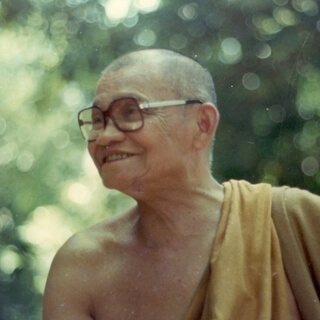
Here I want to talk about when Venerable Ajahn Mun was about to pass away into final Nibbana.
He was in a small place called Banong Phuonanai.
And Venerable Ajahn Mun said,
If he passed away into final Nibbana here,
Many monks and laypeople would come here,
And then many cows,
Buffalo,
Many animals would die for the purpose of his funeral.
So he said to take his body to Sokonokon city which was a big city,
And so as not to create bad karma for the villagers,
So they wouldn't kill the animals.
This was the kindness of our great elder of the Thai forest tradition,
Venerable Ajahn Man.
And here we come back to the perfectly self-awakened Buddha.
The Buddha saw and knew in the way he did and so he went to a small town so that it would avoid a war.
The king of the Mahālas shared the relics of the Buddha.
Can we see that harmony and sharing are important?
These were the perfectly self-awakened Buddha's relics that the people had the highest respect for.
When the Buddha was alive,
They respected him to the highest.
And after he passed away into final nibbāna,
They wanted to give homage to those relics of the Buddha to the highest level.
Have greed.
If each followed their greed,
Then it would lead to war,
And there would be killing.
Humans in the present day fight over resources.
Wars and chaos can arise.
Through the competition over water,
Over oil,
Over resources,
Over all the minerals,
There can be competing all the way over there to the moon.
So war can arise from not sharing.
World are owned by the world.
If we can share,
Then we can live with happiness.
If there was only rich people,
Then the many poor people would resort to stealing,
Because they would be troubled and lack basic necessities.
So we need sharing,
And then society can live with happiness.
So we can see the virtue of Dona Brahman,
Who was intelligent.
He could speak so that the people The representatives of the kingdoms could become peaceful.
They could concede and share.
This was his merit and spiritual development he had made.
He saw that people's lives have value.
War has only death.
And this is not the teachings of the perfectly self-awakened Buddha.
They would be harming one another.
But when the Buddha was alive he taught not to harm one another.
The Buddha had passed into final Nibbana and he wouldn't want them to harm and kill each other.
So they all accepted the wisdom and speech of Drona Brahman.
They could be calmed and could share.
They became considerate and kind to one another.
So they didn't keep the relics to themselves alone.
Here when the Buddha had passed away into final Nibbana there was an amazing occurrence that there was an earthquake and the sound of a great crash of a thunder drum Brahma,
Sakka,
Venerable Aniruddha,
Venerable Ananda,
They spoke a Dhamma verse to praise the Buddha.
Sakka said that conditioned phenomena is not permanent,
Not lasting.
Conditioned phenomena has decay as being normal.
But the monks and laity who had not yet gained Dhamma,
They were in sorrow and grief because they had the highest love for the Buddha.
For those with the highest love,
When there is passing away,
Then their heart breaks.
Attained to the ten strengths,
The perfectly self-awakened one has attained final cessation.
We can see that the body of the perfectly self-awakened Buddha was a conditioned phenomena of the four elements.
But it was the four elements that the Buddha had used and to spread the Dhamma for 45 years.
But it was a conditioned phenomena all the same.
The cells would decay all the same.
And this was the Dhamma that the Buddha had taught regularly.
And Nama,
Mental phenomena,
Is impermanent.
After the Buddha had passed away into final Nibbana Venerable Ananda put forth utmost effort and he attained to Arahantship in the posture when he was about to lay down.
He had been putting in full effort for a long time and this was the last day,
The 90th day and he had not yet attained.
So he would rest a little,
Would lie down and so he laid back and before his head touched the pillow he attained enlightenment.
So it wasn't standing,
Walking,
Sitting,
Or in the lying down posture.
And it was the only monk to attain in this way.
The Venerable Elder Ananda had brightness arise and his spiritual perfections gathered.
Venerable Ananda loved the Buddha greatly.
After offering the cremation fire,
He went back to Savatthi city and saw the dwelling of the Buddha and the Buddha's requisites,
And he was saddened.
He couldn't take it.
He had to leave Savatthi city in order to put forth effort and practice meditation,
And ultimately he attained arahantship.
This was his love,
And he became a monk by ultimate liberation.
Before this,
He was a monk by both convention and liberation for a long time,
Being a sotapanna,
A stream-enterer.
So it's not easy for one who is determined to practice to know and see the Dhamma.
But it's not beyond our ability if we truly set our hearts on it.
And this is also for the laity.
You have the opportunity to see and know the Dhamma as well.
It's not that you need to only ordain as a monk.
If one ordains as a monk but is not truly determined,
They don't truly abandon greed,
Anger,
Delusion,
Then they won't be able to gain the Dhamma,
And even more so being supported by the villagers who support the monk's requisites.
So we must be very careful,
More than the laity.
For monks that are supported in their livelihood by the laity,
It means the monks must not be heedless.
And this follows the Buddha's final teaching,
O bhikkhus,
Monks,
Perfect yourselves in heedfulness.
So this is sufficient for today's teaching.
May you grow in blessings.