The basics of meditation.
To prepare for sitting meditation,
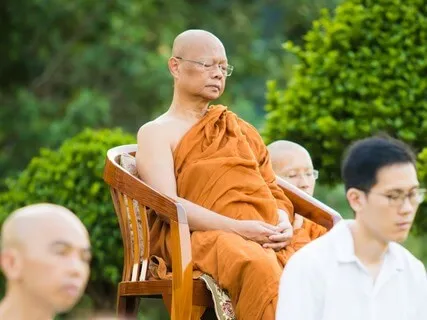
Place the right leg on top of the left leg and the right hand on the left palm.
Sit up straight yet comfortably,
Feeling balanced and relaxed.
If you find this posture isn't suitable,
You can sit in a way that's more comfortable,
Even sitting on a chair if you need to.
Don't lean too far to the left,
To the right,
Front or back.
Don't tilt the head too far back or let it hang down.
Close the eyes just enough so that you don't feel tense or uptight.
Now establish awareness and imagine that you're sitting all alone.
Following and Counting the Breath First,
Focus awareness on following the in-breath as it passes three points,
Beginning at the nose,
Descending through the heart and finishing at the navel.
And secondly,
Following the out-breath in reverse order,
Starting at the navel,
Ascending through the heart and ending at the tip of the nose.
Once mindful of the in- and out-breathing and proficient at focusing awareness on these three points,
Then continue by clearly knowing the in- and out-breaths just at the tip of the nose.
Maintain awareness of the sensation of breathing by focusing only on this one point.
If you find the mind is becoming distracted,
Wandering off to the future,
The past,
Thinking of different things,
Then re-establish awareness and let go of those thoughts.
If the distraction continues,
Then we have to increase our efforts.
One good technique for helping to increase concentration is counting the breath in pairs.
If counting in pairs,
We count one as we breathe in,
And one as we breathe out.
With the next in-breath,
Count two,
And the next out-breath,
Two.
In-in three,
Out three,
In four,
Out four,
In five,
Out five.
Firstly,
We count in pairs up to five.
After the fifth pair,
We start again at one,
And increase the count of the in-and-out-breaths one pair at a time.
We count in-out one,
In-out two,
In-out three,
Up to six.
After counting each pair of in-and-out-breaths,
We start again at one,
And increase the pairs incrementally up till ten.
Using this method,
We'll be aware of whether our mindfulness is with the counting,
Totaling the numbers correctly,
Or lost and distracted.
When competent at counting the breaths,
We'll see that the breathing is perceived with increased clarity.
The rate of counting can now increase in speed as follows.
With the in-breath,
We count one,
Two,
Three,
Four,
Five.
And then with the out-breath,
One,
Two,
Three,
Four,
Five.
When proficient at counting up till five like this,
We can increase the number to six.
Breathing in,
Count one,
Two,
Three,
Four,
Five,
Six.
Then breathing out,
Count one,
Two,
Three,
Four,
Five,
Six.
We can experiment to see whether this is enough to hold our attention or not.
Alternatively,
We can remain simply counting up till five,
Whichever feels more comfortable.
We should count in this way until we become skilled and proficient.
Eventually,
We'll become aware that the mind has let go of the counting all by itself,
And feels comfortable simply knowing the in- and out-breathing at the tip of the nose.
This can be described as a mind brought to peace through the method of counting.
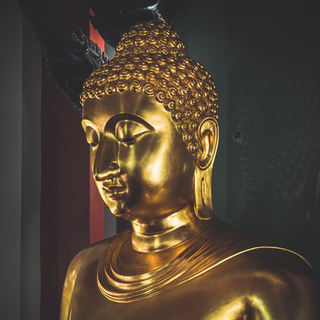
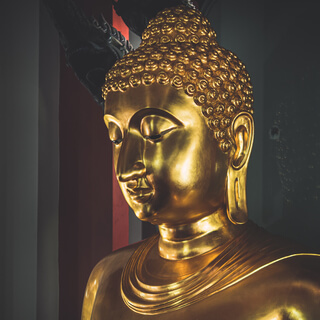
Buddha.
Additionally,
We can use the meditation word Buddha,
The one who knows,
Internally reciting it along with the in- and out-breaths.
Breathing in,
We recite Buddha,
And breathing out,
Buddha.
Or we can recite Buddha with the in-breath,
And do with the out-breath.
Whichever works,
We keep repeating the word continuously in sync with the breathing.
When the mind is calm,
The word will naturally disappear by itself without our knowledge.
We'll simply know the breath as it enters and leaves.
As we get calmer,
The breath becomes more and more refined,
Until it may seem to disappear altogether.
In this case,
We just stay with the knowing,
Fixing it right on the spot where the breath was last felt.
Sometimes,
As we focus on the breathing,
The mind wanders off,
Thinking and fantasizing about the past or the future.
At those times,
We have to put forth effort and come back to the present moment,
The awareness of the breath.
If the mind is wandering so much that we can't focus our awareness,
Then we can breathe in deeply,
Filling the lungs to maximum capacity before exhaling.
We should inhale and exhale deeply like this three times,
And then start breathing normally again.
We can then continue using any of the methods as explained previously.
Walking Meditation Meditation can also be developed through walking.
Stand with composure,
The hands clasped lightly in front,
Right over left.
The head should be neither too high nor hung too low.
The eyes should be focused forward to an even distance and stray neither left nor right,
Neither too close nor too far ahead.
While walking back and forth,
We coordinate the movement of our feet with the meditation word buddho.
As we step forward,
Leading with the right foot,
We internally recite budd,
And with the left foot,
Do.
Ajahn Chah taught that while walking meditation,
We must be aware of the beginning,
Middle,
And end of the path.
By reciting buddho,
We should also fix our mindfulness on knowing our movements in relation to these three points along the path.
Upon reaching the end,
We stop and establish mindfulness anew before turning around and walking back,
Reciting buddho,
Buddho,
Buddho,
As before.
We can adjust our practice according to time and place.
If space allows,
We can establish a walking path 25 paces long.
If there's less room than this,
We can reduce the number of paces and walk more slowly.
While practicing walking meditation,
However,
We should walk neither too fast nor too slow.
Stages of Concentration The essence of meditation is focusing mindfulness solely upon the meditation object.
When mindfulness has been properly established,
Then the heart will be continuously aware of the process of counting,
Or reciting,
Or walking,
Recollecting nothing else.
While endowed with mindfulness,
The heart will be free of the five hindrances of sensual desire,
Ill will,
Dullness,
Restlessness,
And doubt.
Concentration then becomes firmer,
Characterized by a temporary peacefulness of mind called momentary concentration.
If we are focused with continuous mindfulness,
Then sometimes we'll experience rapture.
Rapture is characterized by physical sensations of coolness,
Or surges of energy spreading throughout the body like waves breaking on the shore.
These sensations can cause the body to sway,
Or the hair to stand on end,
And are accompanied by mental perceptions of physical expansiveness.
Sometimes it can seem that our hands and feet have vanished.
Feelings in other areas of the body,
Even the sensations of the whole body itself,
Can likewise disappear from consciousness.
During this period,
When the mind is peaceful,
The mind temporarily lets go of its attachments to the physical body,
And consequently experiences only feelings of lightness and tranquility.
As we sit in meditation,
This tranquility increases,
And it can seem as though we are floating in space,
Giving rise to feelings of happiness and well-being.
At this point we can say that the power of our concentration has deepened to the level of neighborhood concentration.
As concentration deepens further,
The heart experiences even greater rapture and bliss,
Together with feelings of profound inner strength and stability.
All thoughts cease,
And the mind becomes utterly still and one-pointed.
At this stage,
We can't control or direct the meditation.
The mind follows its natural course,
Entering a unified state with only a single object of consciousness.
This is the level of absorption concentration.