Hello,
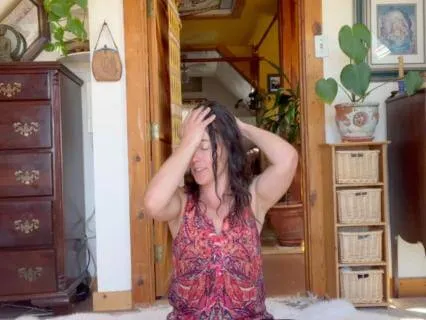
I'm Aspen Moreno,
And this is an embodied movement practice to help you connect to your heart space and to open up what's there.
And I really want you to have that be an invitation of curiosity.
To not force yourself to open your heart.
To really get curious instead about that space and what wants to naturally begin to arise or be felt or be met by you.
As you make contact,
As you bring attention and breath and sound and curiosity to that space.
So,
To begin.
.
.
You'll want some space to move about,
Maybe a yoga mat or a rug,
Just a little bit of room.
We will do some hands and knees movement.
And at any time,
If something doesn't feel good for your body,
Make adjustments.
Everything could be done from seated.
So listen to your body.
Really let that take the lead today.
So you'll start in a comfortable seated position,
Whatever that is for you.
And begin by.
.
.
Finding the breath.
Just noticing what it's like to breathe.
Your eyes can be open,
Closed.
And as you connect to your breath,
Noticing if it wants to deepen or an audible sigh wants to come out.
Already having that invitation and that permission to let the body take the lead.
How does the body want to be breathed?
Seeing if you can drop effort in the face,
The jaw.
Maybe moving the face around for a moment.
And just continuing to follow that breath.
However the breath would like to be right now.
And then we're going to start to tune into the heart.
So if you'd like,
You can bring a hand there.
Maybe just bringing your attention there.
And just notice what that space feels like.
By tuning into physical sensations.
So temperature,
Quality,
Pressure,
Density,
Movements.
That's the language of the body,
And it's a language you can become ever more fluent in.
So just getting curious,
What does the heart space feel like right now?
And try to name it for yourself.
It could feel tight.
Or distant,
Or vacant,
Or numb,
Or heavy,
Or light.
Or warm.
Just noticing and trying to really.
.
.
Name it and land in your starting place.
What does the heart feel like right now?
Softening as best as you can.
Any preferences or shoulds.
Or judgment.
Holding that lens of curiosity.
And then we're going to start with a simple heart-hugging breath.
So you can have your hands on your heart or you can rest them down.
And the invitation is on the inhale to imagine the heart getting a little squeeze.
So as you inhale,
The heart gets a little hugged.
And as you exhale.
It gets to take up a little bit more space.
So feeling into that breath pattern for yourself as you inhale,
Imagining a little squeeze.
And exhale,
Softening,
Letting the heart expand.
Just playing with that breath,
Feeling it for yourself,
Moving at your own pace.
And playing around with the breath.
It might feel nice to have an audible exhale out the mouth.
It might feel nice to extend the inhales and exhales.
Just playing here with this heart-hugging breath for a few more rounds.
And doing one more round,
Taking your time.
Inhale and exhale.
And then we're going to move into some movement.
So first,
You're going to start with just some seated cat cows.
So on the inhale,
Opening the chest.
On the exhale,
Rounding the spine.
And as you play with this movement,
I want you to really focus it on the heart and this container that holds the heart,
The chest,
The upper back.
The mid-bath.
Just feeling opening up this area.
Allowing that breath to be nice and big.
Couple more rounds.
Ah.
And then sitting up nice and tall,
Changing the crossing of your feet if your legs are crossed.
And we're going to start to wake up a little bit more fire in the heart by doing some fire breaths.
With some movement.
So you're starting with your arms out like goalposts and with each exhale you're switching.
And have the exhale be audible out the mouth if possible.
We're not going to be here long,
Like 30 seconds,
Just to build a little bit of fire.
Once again,
Make adjustments if you need to for your body.
And here we go.
Ha!
Ha!
Ha!
10 more seconds.
And release the arms.
Feel the chest.
If you got a little dizzy,
You might bring a hand to either side of the head.
Ah.
And feel the chest And then bringing some circles to the rib cage in one direction.
Continuing to bring attention and curiosity to the chest,
To the heart.
Maybe letting out an audible sound.
Sound is such a fantastic way to move energy in the body.
So anytime your body wants to make a sound,
Please.
You have all the permission in the world.
Then switch the direction of your circles.
Hmm.
And then we're going to build some fire one more time with that same kind of breath.
But this time we're going to bring the arms in.
So we want to engage the chest muscles.
Like we want this to be fiery.
Fiery is muscles in the body.
So bring some oomph to it.
Bring some breath.
Remember,
We're only doing it for 30 seconds.
So when you're ready,
Same kind of breath.
Good job.
10 more seconds,
Maybe bringing a little bit more muscle to the chest.
And release the arms,
Feel the chest,
Feel the shoulders.
Ahhhh.
Notice what's waking up.
As far as physical sensations,
How we feel the movements of life inside the body.
Temperatures,
Tingles,
Flows,
Density shifts,
Qualities.
Really continue to keep putting attention on what's happening in this area,
The chest,
The heart.
Hmm.
And if emotions arise,
If things arise as we open up the body,
Please hear this permission and invitation to follow it,
To move,
To sound.
This is always a space here when you're watching me of permission and of saying yes.
So often we are saying no to our experience,
No to our bodies,
No,
No,
No.
So continue that invitation of yes,
Yes.
Not yes,
Oh I love this grief,
Give me more of it,
But yes,
An honest acknowledgement.
My heart is heavy and I'm going to agree to let it be heavy.
So moving into a few more movements here.
So if you need to switch your legs or shake them out,
Go for it.
We're only going to do one more seated and then we're moving to hands and knees.
So for this one,
You're inhaling both arms up and your exhale,
Reaching over.
You may have done this one in a yoga class.
So just following your breath,
Inhale,
Lift.
Exhale reach and with this we're opening up the sides of the heart the sides of the ribs Once again,
Letting that breath be nice and generous.
Hmm.
And the next time you come to one side,
You're going to hang out there and do little movements.
You can do little tilts up and down.
That can be a nice heart opener.
Or you might explore just moving that hand around,
Doing whatever helps you get into that side of the rib cage.
Dropping effort in the face,
The forehead,
The jaw.
And then making your way to the other side,
Same exploration,
Just moving the ribs.
Opening up the chest.
Hmm.
Thank you.
And then coming back up.
And releasing the hands,
Doing a couple big shoulder rolls back.
Sigh.
And then moving to hands and knees.
So we're going to be doing cat cows,
But we're going to be doing them very specifically.
So I want you to pin your hips so that the hips don't move.
So the cat cow movement is really focused on the shoulders and the chest.
And so it might be a smaller range of motion.
So on the inhale,
Opening up the chest.
Exhale,
Rounding the spine.
And just moving with your own breath.
And finding a rhythm.
We want this to be a movement you can drop into.
And really just focusing on the chest,
The upper back.
We're going to do this for a while,
So I want you to really drop the attention into the movement,
Into the chest.
Really trying to make contact with your heart space.
Ah.
A few more rounds of breath,
Deepening the attention.
What does this feel like in the chest?
Doing one more.
And then pressing back either into child's pose or down dog and just taking a few breaths.
And then coming up,
Noticing the heart,
Noticing the chest.
Feeling what's happening in that area.
We have a few more moves.
So the next one you can sit.
On your knees or if that's uncomfortable you can find another place to sit like open up the knees or find a cushion to sit on we won't be here long but the movement is opening up the arms on the inhale,
Lifting the heart.
Exhale,
Rounding as you wrap your arms around,
Giving yourself a little hug.
So the movement can be as big as feels good for your body.
And as you wrap you can change the crossing of the arms.
Using the breath,
Inhale,
Open.
Exhale,
Wrap.
And as you're doing this,
Noticing which of these positions might feel.
.
.
More natural today.
And if one feels nice to hang out in for an extra breath,
You can.
Ah.
Opening up the heart and the arms,
Which are an extension of the heart.
Feeling the chest lift,
The antlers of the heart lifting towards the sky.
One more round.
Hmm.
And then just pausing and feeling,
Noticing how the heart's feeling,
Noticing how you are feeling.
Hmm.
And then moving on to our backs,
Laying down.
So once.
So once you get to your back,
You're going to lay your arms out in a T.
Your feet can be hips distance.
The knees can be knocked together.
We just want the legs to be relaxed.
So whatever position does that for you.
And this is called bellows breathing.
And we're going to do it with sound.
So if sound is not an option for you today,
You might just imagine making sound,
Opening up your mouth,
Hearing my sound.
But I really encourage you to make sound because the reverberations in the chest really help open things up.
So the movement is on the inhale,
The arms are out in a T.
And as you exhale,
You bring your arms all the way up until your hands touch.
And on that exhale,
You're making an ah sound.
A,
A,
A,
A,
A,
A,
A.
So inhale,
Open.
Bye.
And really let that awe be as big,
As vibrational,
Like you can find different registers.
We want it to try to vibrate the body.
So explore different.
Ways of doing that with that ah sound and you're moving at your own pace doing it in your own time you don't have to do at the same speed I do it we're just going to do it maybe five or six times putting attention on the chest Ah.
Do one more wherever you are taking your time.
Whenever you finish,
You're just going to notice.
Bring attention to the chest,
The heart.
Notice physical sensations,
Qualities of energy,
Emotions.
Just feel that space.
Hmm.
And then ever so gently you're going to start to make your way back up to seated.
Taking your time to get there.
And continue that noticing.
What does the heart space feel like?
What has woken up or shifted or changed?
Even if it's subtle.
Get curious about what that space feels like now.
And for just a few seconds I want you to bring any kind of.
.
.
Intuitive,
Continuous movement that might want to happen.
Of course you can be still.
I think we are more still than we should be these days.
So if there is any way that the body wants to move,
If you were to really meet your heart and let the body lead for just a few breaths,
Maybe letting out sound.
Moving in any way that the body is calling for,
Meeting what's here on your heart,
In your heart as a body.
Ah.
Sigh.
If this is feeling really good,
You can pause the recording.
You can put on music.
You can just keep moving.
But if you're ready to start to allow this practice to come to a close,
I want you to come back to where we started,
Maybe bringing hands to the heart or just the focus there.
And feel that space one last time.
And if there is inequalities that are waking up.
That you would like to encourage.
See if you can do that through attention,
Through breath.
Through sound,
Through movement.
Ah.
If you're not sure just see where you can drop effort around the heart.
Maybe the shoulders can soften.
The ribs can relax.
Ah.
And just pause here and listen to the heart.
Giving space to perhaps hear,
Feel,
Sense,
See.
Anything that's important right now.
And then taking one more really intentional deep breath into the heart.
You can hang here for as long as you want.
You can journal.
You can move.
You can rest.
But the invitation is to continue to be close.
Close to your heart,
Close to you,
Close to your experience.
To keep being a body.
And know that you can come back to this practice or any of these moves that felt good in the body at any time.
Thank you.