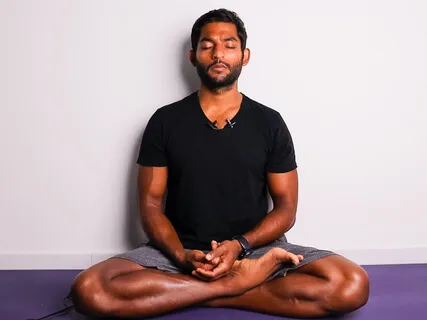
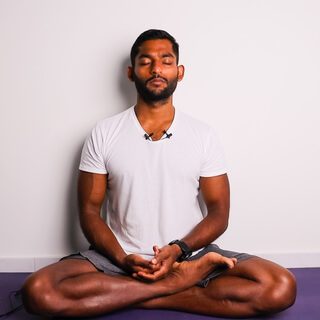
Namaste and a very warm welcome to all of you in this daily live meditation session with me,
D'Anse.
This body,
Mind,
Heart,
Spirit,
This construct that we are given is so amazing.
It can go and climb the Mount Everest,
It can go to the moon,
It can do all sorts of unimaginable things.
And at the same time,
It just falls,
It trips over a stone,
And a thorn in the feet becomes a pain which you cannot walk further if you see this body,
Mind,
Heart,
Spirit.
How amazing it is that it lives on this spectrum of both impossibilities,
On the impossibility to achieve things which we can never imagine,
And it can also fall into another impossibility where we ask ourselves,
Are we so fragile,
Are we so weak?
So on this spectrum of from weak to strong,
How is it that we stay somewhere,
How is it that our body,
Mind,
Heart,
Spirit is somehow experiencing the entire spectrum,
And how it is that it decides or it is capable of maintaining a certain equilibrium on this spectrum?
The answer is very simple,
Training.
This body,
Mind,
Heart,
Spirit,
This construct that we have is capable of doing anything and everything,
All impossibilities from the negative to the positive.
It is all a matter of how we train ourselves.
What is the training?
Is that just the physical training?
Is that some kind of psychological training?
What is the training that decides at what equilibrium the experience of our life will be constructed?
Will it be positive?
Will it be negative?
How do we come to that training?
What is the training?
Is that the education that we get in our school?
That is simply to just keep the economics of our life running.
What is the training?
Is that in our culture?
Is that in our society?
That allows us to understand our body,
Our mind,
Our heart,
Our spirit,
And this entire construct that the equilibrium it has to maintain to have the best experiences of life.
How do we get to that?
What is the training?
Yoga has an answer to that.
Yoga is one of those trainings,
Is one of those disciplines where if you follow the entire process,
If you follow the entire methodology,
It allows you to maintain that equilibrium on this spectrum of the negative to the positive.
You can see yourself moving from the negative to positive and thereby understand yourself.
How can you maintain at a certain point of the equilibrium?
How can you reach to the highest?
How can you unfold yourself to the highest potentials?
Yoga is that methodology.
Yoga is that process of not only understanding,
But actually living and creating your own experience of life.
We are currently going through yoga sutras of Patanjali,
Where we are at a milestone opening the Ashtanga yoga.
Ashtanga yoga is a structured eight limb framework to bring and integrate the practice of yoga in one's life.
What are these eight limbs?
These eight limbs according to Patanjali are Yama,
The abstinence or the self-restraint,
The Niyama,
The rules,
The Asana,
The meditative postures,
The Pranayama,
Breath control,
Pratyahara,
Sense withdrawal,
Tharana,
Dhyanasamadhi,
These three different states of concentration,
Meditation and trance.
Patanjali talks about the first Yama in the following sutra.
He says,
Yama consists of non-violence,
Truthfulness,
Non-stealing,
Continence and non-greed.
He says,
Yama,
The self-restraint.
Yesterday,
I was mentioning what is the self-restraint.
This is as if you have energies flowing in the wrong channels,
In the wrong pockets in your life,
For whatever reason,
While going through life,
While having different events in life,
Things happen and the energies start to flow in negative directions.
So Yama is to stop those energy leakages,
To stop these wasteful energies and then allowing them to redirect in the right direction.
So here Patanjali gives five of these Yamas,
Five of these self-restraints.
He says,
The first is non-violence,
Ahimsa,
That means not giving anybody pain.
The way we live,
We somehow accept things the way they are.
We overlook things because we just say,
This is the way things are.
If somebody else is giving pain to you and you're passing on that pain to somebody else,
We just let that be and we accept the way things are and not try to change,
Not try to see the source of the misery and this passing on the misery that we give from one person to another.
Ahimsa is that conscious decision to be nonviolent,
To not pass on the pain,
To not give anybody else the pain.
As much as you can in your consciousness,
In your awareness,
You can be alert about that.
Second,
Satya,
Truthfulness.
What that means is remaining true to yourself,
Remaining true to your true nature and that is only possible if you are aware.
Without awareness,
There is no truthfulness possible because what is true and what is false,
How do you judge?
The only way to judge and remain truthful is to remain aware,
To remain rooted,
To remain grounded in oneself.
Non-stealing.
This is another behavioral training that we have to go through that what belongs to us,
Belongs to us.
What does not belong to us does not belong to us and that line,
That fine line does not have to be written somewhere.
You know it yourself.
You,
No matter,
Nobody else is seeing,
But if you still,
You know it.
You,
If you still,
That remains in you,
Not just in the moments of stealing that remains with you throughout your life.
This is a burden which you don't want to carry in your life.
So have this conscious decision,
Have this vow of non-stealing in life as well.
Brahmacharya,
Continents.
This is something that has been misunderstood as celibacy.
Brahmacharya is not celibacy.
It does not mean necessarily that you are abstaining from sex completely.
You are abstaining from any kind of sexual activity.
It means that you understand what is sex.
It means that you understand what is this sexual activity and how do you control that.
This power of brahmacharya is another secret that yogis are bringing into their life and becoming very very powerful just based on the understanding of what brahmacharya is and how to utilize this energy which we know as sex energy.
If we do not understand this energy,
Which is the sex energy,
It only flows in sex.
It only flows in a certain process where it is more of just a relief,
More of just overcoming an unrest in oneself.
But if we understand that,
We utilize that sex energy when it rises above the sex center and reaches to the heart,
Reaches to the Agnya chakra and so on,
That energy becomes the reason of unfoldment that becomes the power of unfoldment of the entire human possibilities,
Not just of sex.
So celibacy is not necessarily the understanding of brahmacharya.
It means that you understand this sex energy and you learn to direct this energy further up beyond just the compulsions that you have.
And the last one is non-greed,
Non-grasping.
It is that attitude that you are not constantly driven by your greed,
By you wanting to grab this,
You wanting to possess this or that.
If you see these five yamas which Patanjali brings here,
These five yamas,
You can think of them as philosophies on one hand,
But you can also see these are states of mind.
These are states of psyche.
These are states of being.
If you have,
If you practice these five states of being,
They have an implication on your entire life.
So practice these five states of mind,
Which is to have non-violence,
To not become pain for anybody,
To be truthful,
To have non-stealing,
To have continence and non-greed in life.
Let us take these five attitudes in our silence,
In our meditative awareness,
So that we bring them as deep as possible in ourselves.
Please close your eyes.
Make sure your body is relaxed in a posture which is easy for you.
At best your back is straight,
Your head relaxed.
Take a nice deep breath.
Inhale from the nose and exhale from the nose.
And with every breath,
Body at rest,
Moving towards stillness,
Your mind settling.
And your awareness inwards in your inner space.
Becoming aware of your inner space.
In this awareness of oneself,
Tune in to ahimsa,
Non-violence.
All your energies become aware of not causing pain for anyone.
Your body,
Your mind,
Your heart,
Your spirit,
Becoming aware of ahimsa,
Being non-violent.
Let us take these five attitudes in our silence.
Allowing your energies to rest.
As you tune into non-violence and being truthful to yourself in this moment.
Simply remaining aware of your body,
Of your mind,
Of your mind,
Of your mind,
Of your mind,
Of your inner space.
Being truthful to this moment,
To yourself.
Let us take these five attitudes in our silence.
Tuning into non-stealing.
What belongs to you,
Belongs to you.
What does not belong to you,
Let that be non-stealing,
Non-greed.
Let us take these five attitudes in our silence.
With every breath,
Move more and more in silence.
And awareness of yourself,
Tuning into non-stealing,
Non-greed,
Non-violence towards truthfulness and Thank you.
Sitting silently,
Practicing these five states,
And slowly letting go of the practice.
The only awareness of your inner space remains.
Only silence in this moment remains.
You are not alone.
You are not alone.
You are not alone.
Don't try to change anything.
Simply rest in this moment,
In this awareness,
In the harmony that arises in these five states of your being.
You are not alone.
You are not alone.
Maintain the stillness,
The silence,
And awareness,
As long as you like.
Continue in this meditative state.
Or very gently and slowly,
You may open your eyes with me.
Noticing the stillness,
The centeredness,
The stability that arises out of these five states of mind,
Being,
And practicing these in your daily life.
I will see you tomorrow at 7 am Central European Time.
Namaste.