It is with great pleasure that I share with you the story of this fantastic walk.
It is a turning point in the history of humanity.
If I'm wrong,
It doesn't matter.
It is one for me.
I learned about this initiative on social media.
Like millions of people around the world,
I was able to follow the walk almost step by step.
I listened to the messages of the leader,
Bhikkhu Paniyakara.
I watched with fascination the calm and gentleness of Aloka,
The dog who walked with them.
I saw the crowd grow little by little along the way.
But before celebrating their return to the Fort Knox Monastery in Texas,
Some context is needed.
First,
Who is Bhikkhu Paniyakara,
The leader of this walk?
Born in Vietnam in 1981,
He is now 44 years old.
He immigrated to the United States with his parents in 1997.
They choose to settle in Texas.
Bhikkhu Paniyakara continued his studies,
Earning a degree in IT engineering from the University of Arlington,
And then landed a job at Motorola.
He led a life modeled on the American way,
But his spirituality was not fulfilled.
He thought long and hard about his decision,
And in 2007,
He decided to leave his job to enter a monastery.
A Buddhist,
He chose the path of Theravada,
The most austere form of Buddhism and the closest to the teachings of Buddha.
He learned and respected the rules of Dutanga,
Which included eating only once a day before noon from offerings,
Walking barefoot,
Sleeping on the ground,
Often in a sitting position,
And wearing the same robe,
Mending it as needed.
These practices may seem austere to us,
But their purpose is to reinforce detachment from modern comforts while creating more space for meditation and mindfulness.
After three years of study,
He received his monk's robe and began his humanitarian work.
He participated in several missions around the world.
He and his team provided moral support as well as drinking water and food to communities affected by natural disasters around the globe.
During these trips,
He witnessed the extent of human suffering.
Back at his monastery,
The Huong Dao Vipassana Bhavana Center in Fort Worth,
He continued his work and reflections.
But in 2020,
The pandemic struck the world.
His neighbors and compatriots were now experiencing the distress.
He set up a foundation,
Huong Tu Loving Kindness Foundation,
Which distributed food for 750 families for two years.
It was during the pandemic,
In the face of widespread suffering,
That the idea of the Walk for Peace,
A pilgrimage to Washington,
D.
C.
,
Really took shape.
He developed and presented his project to his teacher,
The Venerable Rattanaguna,
The abbot of the monastery and one of the leading figures in Vietnamese Buddhism.
It was he who gave his blessing for the Walk to begin.
But first,
The Venerable Bhikkhu Panyakara sets off with other monks on a 112-day pilgrimage in India,
Covering nearly 3,
000 kilometers on foot,
Starting from Calcutta and traveling north to the Nepalese border.
On the sixth day of their journey,
A stray dog began to follow them.
At first,
The travelers paid no attention to him,
Nor to the other dogs that followed in their footsteps for a few hours.
But this one did not abandon them.
As the day passed,
Despite illness and an accident in which he was hit by a car,
He remained with them.
Impressed by his loyalty and his peaceful and gentle nature,
Bhikkhu Panyakara decided to adopt him and give him a name.
He named him Aloka,
Which means Light or the Enlightened One in Sanskrit.
At the end of this adventure,
Which served for physical and spiritual training for the future Walk,
He contacted his monastery and,
With the help of donors,
Raised the $15,
000 needed to fly Aloka to the United States,
Pay for his veterinary care,
And cover the mandatory quarantine upon his arrival.
It was also during this walk that he found his walking stick.
It is a bamboo pole with a curved top.
He began using it when his feet were so swollen that he could no longer walk without support.
The symbolism gathered during this pilgrimage is extremely powerful.
A stray dog rejected by everyone becomes the embodiment of peace in motion,
And a bamboo stalk represents resilience,
Flexibility,
Humility,
And simplicity,
While also signifying divine support.
He will spend the next three years after his return from India planning and gathering the necessary resources to begin the Walk for Peace.
The goals of this mission,
Which took place in simplicity,
Without banners or a million-dollar budget,
Are to promote peace and healing through the practice of mindfulness.
Venerable Panyakara emphasized the awakening of inner peace that lives within each of us,
Practices of loving-kindness in the face of hatred and social divisions through acts of compassion,
Nonviolence,
And mutual understanding,
Regardless of color,
Sex,
Religion,
Or culture.
He later told reporters that he never imagined he would attract so much attention.
Along the way,
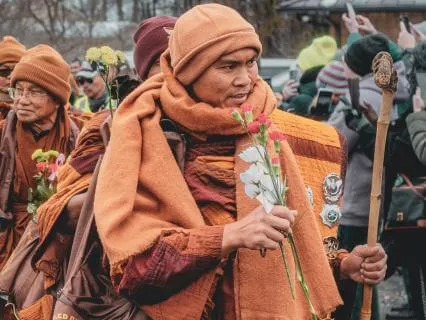
People waited for hours to see them pass by and perhaps receive their blessing or a bracelet.
Thousands gathered to hear him deliver his message,
And millions joined the Walk virtually through social media.
It began on October 26,
2025.
The first few days passed in near anonymity.
The monks slept in cemeteries,
Each one in a tent,
Accompanied by a light police escort and no one on the roadside.
The Texas heat burned their feet,
And in the evening they made a fire and welcomed a few curious people who came to listen to their message.
On November 19,
A tragic road accident had serious consequences.
A pickup truck crashed into the rear of the escort vehicle,
Which was then thrown onto two of them.
One suffered minor injuries,
But the second,
Venerable Phra Maha Dam Pomasan,
Was seriously injured and had to be transported to the hospital by helicopter.
Instead of undergoing multiple painful operations to save his leg,
He chose to have it partially amputated.
From his hospital bed,
He declared that losing his leg was a sacrifice he was willing to make to promote the message of peace and compassion.
He never expressed any resentment,
Forgiving the driver who caused the accident.
He rejoined the monks for the conclusion of the Walk,
Which he completed in a wheelchair.
The police,
Fire department,
And municipalities became more involved,
Offering their badges and pins,
Which they proudly pinned to Bhikkhu Paniyakara's robe.
Thanks to the passage of the group of about 20 monks,
The police and sheriffs became true agents of peace.
Every day,
They walk between 32 and 48 kilometers,
Many barefoot,
Carrying their alms bowls.
As word of their mission spreads,
Dozens,
Then hundreds,
And later thousands of people gather along the route.
They slow down to accept flowers,
Fruit,
Or water,
And stop to tie a bracelet around the wrist of a child or vulnerable person.
Each time,
They gather and chant a mantra of protection and well-being for the person receiving their blessing.
These are powerful moments that are captured in photos and later in videos on social media.
Everywhere,
Tears flow and people are touched to the core of their being.
They are now invited to eat and rest in churches and community centers.
Restaurators offer meals free of charge,
And every day,
The monks invite the population to visit them.
This is an opportunity for the venerable Bhikkhu Paniyakara to speak and explain in simple terms how to achieve mindfulness through breathing,
How to cultivate peace within each of us in order to change the world we live in.
Everywhere he goes,
He invites people to perform a simple ritual when they wake up.
First,
They make their bed neatly and then write the following words on a piece of paper.
Today is going to be my peaceful day.
After writing it down,
He invites people to read it aloud to call the universe to help us remain at peace no matter what happens.
He emphasizes the importance of detaching ourselves from our lover,
Our cell phone,
And advocates a return to a simpler life,
Keeping our minds free and clear through meditation.
Every day,
Despite the cold,
Rain and snow,
He speaks to respectful and silent crowds.
The last week of the journey will test the group of monks.
Some,
Coming from Thailand or Myanmar,
Have never seen snow or experienced sub-freezing temperatures.
Despite the gusty winds and ice,
Despite the flu that has infected several of them,
Including venerable Paniyakara,
They walk tirelessly toward Washington.
After 108 days of traveling across the United States,
On February 10,
2026,
They reached their destination.
They are now stars,
With major media outlets reporting on them and Bhikkhu Paniyakara once again giving interviews.
They spend two days in the U.
S.
Capitol.
A peace ceremony is held at the Lincoln Memorial on the 11th to honor them and reflect on peace.
They receive gratitude and admiration from the Dalai Lama,
The Bishop of the Diocese,
Numerous politicians,
And law enforcement officials.
In front of thousands of people gathered,
The Sangha,
Composed of the walkers and many monks who had come for the occasion,
Is on stage to receive honors.
Of course,
Aloka steals the show during the ceremony.
They return home by bus.
The journey takes two days.
Their entrance into the monastery is extremely moving,
Leading the group for the last time.
Venerable Bhikkhu Paniyakara walks slowly with Aloka through the crowd.
In front of him,
To welcome him,
Stands his master,
The Venerable Ratanaguna.
Emotions run high,
And before his guru,
Bhikkhu Paniyakara prostrates himself,
Takes his feet,
And weeps.
The mission is complete.
The Sangha is back home.
Now that the walk is over,
It is our turn to go within ourselves.
As long as we wish,
The Venerable Bhikkhu Paniyakara and the entire Buddhist community will be there to support us in our effort to ensure that each day is a day filled with peace for everyone and for all living beings.