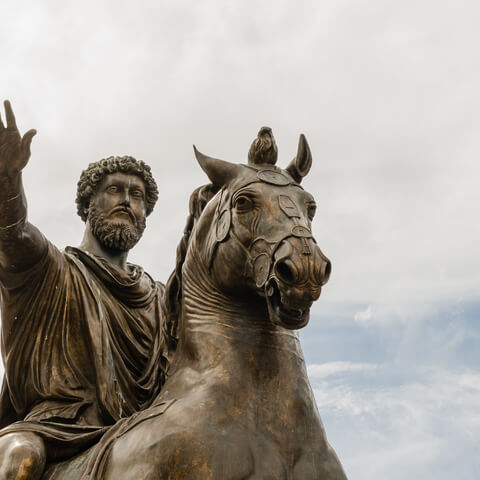
Marcus Aurelius is the most quoted philosopher on the internet.
You can find him on t-shirts,
Mugs,
Instagram reels,
Wherever you look,
You can find quotes from Marcus Aurelius.
He is the poster boy for stoic mastery and discipline and temperance.
And yet,
He was terrible at stoicism.
The meditations of marcus aurelius it's a book that i have right here.
It's the book that everyone quotes,
But it was never meant to be published.
It is a private journal created by Marcus Aurelius,
Where he's thinking out loud,
Talking to himself,
Mulling over different ideas,
And when you read it,
Something uncomfortable becomes quickly obvious.
The Meditations is not Marcus recording his own profound wisdom.
It's a book consisting of Marcus Aurelius reminding himself of lessons he continues to fail to learn.
And that says something about Stoicism,
Actually,
Not just Marcus,
And about how we should approach it.
Okay,
First of all,
Marcus Aurelius could not get out of that.
This is a very relatable passage in the meditations.
Book 5,
Chapter 1,
The Emperor of Rome,
A person who had every luxury imaginable at the time,
Struggled to get out of bed.
He wrote,
At dawn,
When you have trouble getting out of bed,
Tell yourself,
I have to go to work as a human being.
And here's the part that a lot of people leave out.
He actually gives the counter argument from the perspective of his lazy self.
He says that it's nicer here.
And then he argues back,
So you were born to feel nice instead of doing things and experiencing things.
He's literally having a full debate with his self,
Or the two different parts of himself in that situation,
While still in bed under the covers.
And then in book eight,
Years later,
He has a similar thing come up in meditations.
When you have trouble getting out of bed in the morning,
Remember that your defining characteristic is to work with others.
He's still having the same argument.
The lesson that you think he accomplished in Book 5 is still showing up again in Book 8.
He's not a perfected human being.
Which is great,
And I think that's what makes the meditations so awesome.
And also Marcus couldn't control his temper.
In book 2 chapter 1 he writes When you wake up in the morning,
Tell yourself,
The people I deal with today will be meddling,
Ungrateful,
Arrogant,
Dishonest,
Jealous,
And surly.
Six types of terrible people listed out clearly for Marcus to remind himself about every single morning.
A perfect stoic sage wouldn't have to psych themselves up to deal with other human beings and their colleagues before they get out of bed and approach the day.
Then it actually gets worse.
By book 11,
Chapter 18,
Marcus has compiled a list of 10 anger management strategies.
Donald Robertson calls these the gifts from the muses,
10 strategies that you can employ when you're about to lose your temper.
Not one little tip,
Not three different strategies,
Ten.
This is not the toolkit of a man who has anger under complete control.
This is the toolkit of a man who struggles to control their temper.
And And the passage ends with Marcus writing something to himself,
And I really want you to feel the weight of this.
He says,
While there's still life in you,
Begin at last to be a man.
After decades of practice.
Years of dedication.
Writing in this journal for a long period of time,
Having mentors and teachers.
He's telling himself he hasn't even started yet.
And he also couldn't stop caring about what other people thought.
In Book 12,
Chapter 4,
Near the end of the journal and towards the end of his life,
He writes,
It never ceases to amaze me,
We all love ourselves more than other people,
But care more about their opinion than our own.
The phrase never ceases to amaze me means he's still baffled by this,
Like he still experiences it and it still surprises him.
And in Book 2,
Chapter 6,
The self-talk is brutal.
Here's what he says.
Yes,
Keep on degrading yourself so,
But soon your chance at dignity will be gone.
Everyone gets one life.
Yours is almost used up,
And instead of treating yourself with respect,
You have entrusted your own happiness to the souls of others.
He uses the word keep,
Which means that it's a repeating pattern.
It's not a one-off.
This is something that he's struggling with and can't break.
And he also procrastinated with some things for years.
In Book 2 Chapter 4 he said Think of your many years of procrastination,
How the gods have repeatedly granted you further periods of grace,
Of which you have taken no advantage.
He's not talking about hours or days or weeks or months,
He's talking about years.
And the gods kept giving him more and he kept on wasting it.
By book ten,
He distills this into six words which are extremely powerful and we all love them.
He said,
Waste no more time arguing about what a good man should be.
Be one.
And in Book Eight,
Chapter One,
There's a devastating confession that most Stoicism channels don't read out.
In the George Long translation,
It reads as follows.
It is no longer in your power to have lived your whole life,
Or at least your life from your youth upwards,
Like a philosopher.
Both to many others and to yourself,
It is plain that you are far from philosophy.
Far from philosophy.
One of the most famous,
Most quoted,
Stoic philosophers of all time.
Is saying that he's far from the thing that he spent decades studying.
And here's the thing that changed how I read the meditations.
It's not that Marcus struggled.
Of course,
Everyone struggles.
He's a human being.
But what's fascinating for me is that he struggled with the same things over and over again.
So on the theme of don't be angry with others,
He writes about this in the books 2,
5,
6,
7,
9,
10,
And 11.
That's at least eight separate passages on anger in about a decade.
Remember you will die.
Remember you will die at least 15 passages across 12 bucks.
Stop caring about fame comes up in at least seven books including the very last one.
Stop procrastinating on virtue appears in five books.
If Marcus had truly internalized these ideas,
As we often assume that he did,
He wouldn't need to keep writing about them.
The translator Gregory Hayes puts this plainly in his introduction.
He says that the meditations show Not a mind recording new perceptions but one obsessively repeating and reframing ideas long familiar,
But imperfectly,
That's all.
Imperfectly absorbed.
That's the key phrase.
Not mastered,
Not embodied,
But imperfectly absorbed after decades of practice.
And I really want to be careful here because I don't want to cancel Marcus Aurelius.
He lived in the second century where culture and the times were so different.
It's hard to truly judge them by modern standards and it's not fair to do that.
But it's still worth looking at the contradictions between the meditations and the way that he showed up as emperor.
I think it's useful.
Let's talk about Commodus.
You may have seen Commodus in the movie Gladiator as the one who fights Russell Crowe.
It's massively fictionalized,
But there's a grain of truth in there.
Marcus Rebellius's son Commodus was chosen by Marcus to be emperor after Marcus's death and this actually broke a long line And this actually broke a tradition where typically emperors would choose the most capable successors rather than just their biological sons.
And when Commodus became emperor after Marcus's death,
It was catastrophic.
Within months of Marcus's death.
Commodus renamed Rome after himself,
Fought publicly in gladiatorial games.
He abandoned the wars that Marcus had fought hard on.
He identified himself with Hercules and was eventually strangled in his bath.
The Roman historian Cassius Dio wrote.
Our history now descends from a kingdom of gold to one of iron and rust.
Historians do defend Marcus' choice,
Largely,
Because previous emperors might not have had sons,
And Marcus Aurelius was trying to prevent civil war.
But considering he talked a lot about the.
But for someone who talked a lot about duty over personal attachment,
He chose personal attachment when it mattered most.
The gladiatorial games is also interesting.
Marcus disliked these games.
He introduced safety nets for performers,
Had them use blended instruments,
Read documents during the games.
But he continued to fund them,
He continued to attend them,
And he also drafted some of the gladiators as soldiers.
But the point remains,
He wrote a lot about dignity,
And yet he still kind of endorsed these games that reduced people.
These reforms did make them less deadly,
But it didn't fully challenge them.
All this to say,
And this is the most important part of the video,
The Stoics had two terms for practitioners.
They had Sophos,
Which was the perfected sage,
And they had Propticon,
Which was the Stoic in training.
The sage is largely theoretical.
Seneca compared the sage to an Egyptian phoenix that would appear every 500 years.
Epictetus said the idea of being faultless is impractical.
The goal was never really perfection,
But just continued progress.
Marcus was a Procopton.
In his own words,
He admitted to it.
In Book IX,
Chapter 29,
He said,
Don't go expecting Plato's Republic be satisfied with even the smallest progress.
He knew he was not aiming for perfection.
To be a sage,
He just wanted a slightly better day today than yesterday.
This is what the meditations actually is.
It's not a book just full of this perfect wisdom.
It's a book written by someone who's practicing trying to be more wise,
While being an emperor,
Having obligations,
Burying his children,
Dealing with people he couldn't stand,
Sometimes failing,
Sometimes succeeding,
But never giving up.
Pierre Hadot,
One of the most important scholars of ancient philosophy,
Said about the meditations that he was witnessing,
Someone in the process of training himself to be a human being.
Not someone who is completed,
But someone who is in the process.
I think the most powerful passage in the Meditations is Book 5,
Chapter 9,
Where Marcus says,
Not to feel exasperated or defeated or despondent because your day is unpacked with wise or moral actions,
But to get back up when you fail,
To celebrate behaving like a human,
However imperfectly,
And fully embrace the pursuit.
That's it,
That's the philosophy.
Show up,
Practice,
Fail,
Get back up and try again.
Marcus Aurelius was terrible at being a stoic.
He lost his temper.
He procrastinated on virtue for years.
He cared a lot about what other people thought.
He struggled to get out of bed in the morning.
He wrote himself reminders over and over and over again for years.
And this is why The Meditations is the most important book in all of Stoic philosophy.
It's not a record of someone who got it right,
It's a record of someone who kept trying to.
As Marcus wrote himself,
Celebrate behaving like a human being,
However imperfectly.
And I appreciate you watching and sticking with me to the end.
I'll see you in the next episode.