Hello.
Thank you for joining me today for this talk about dementia and the present moment.
In this talk,
I'd like to suggest a new school of meditation teachers.
They can be found in every community,
Perhaps even in your own home,
Your own family.
Sometimes they live together,
Separated from the so-called normal population and so-called memory care settings.
I'm referring to people living with dementia who have a gift to share in their natural capacity to live in the present moment.
If being here now is the goal of meditation,
Or even if you think of presence as a form of meditation,
Which does not need any kind of outcome,
Let's meet some people who naturally live in the moment.
I'm sharing these thoughts with you from the vantage point of early autumn 2020,
When my community in California is six months into what is alternatively called quarantine or lockdown due to the global coronavirus crisis.
It's been six months since I've been able to do the work that had been the main part of my routine before the pandemic.
I worked as program coordinator of an adult daycare center for dependent elders.
It was not a residential program,
And it was also not a medical program,
Although almost all of the clients had multiple health diagnoses.
The purpose of the center,
As I'll call it,
Was to provide caregiver respite along with socialization for people who would otherwise be isolated or unstimulated at home.
Today,
It is not only that part of the population that is isolated.
All of us have been affected.
And so it has been six months since I've seen any of my teachers.
They continue to teach me,
Though,
And I thought to share some of the lessons in this format where I've been spending so much time.
Despite so much distance between us now,
I hope you'll agree that with the right tools,
The current situation can foster new forms of connection into being.
In case you have stumbled upon this recording the way I often stumble upon talks on Insight Timer,
I would like to state that I share these teachings not as a doctor or an expert of any kind.
I studied the brain from the perspective of language disorders relatively late in life.
As part of my thesis preparation,
I arranged an internship at a prestigious lab for Alzheimer's research in New York.
During those months,
I was fortunate enough to observe a part of the data collection process,
Which had always seemed so abstract to me as I read scientific journal articles.
But it wasn't long before I realized I am not made for a career in a research lab.
I was much too interested in the stories behind the fascinating answers given during neuropsychological exams of people being tested for cognitive impairment.
For example,
There is a question in many cognitive test batteries that asks participants to name as many words as possible that start with a given letter.
One day,
A woman who was there being tested was given the letter S.
She was asked to name all the S words she could think of in a short amount of time.
She spoke in Spanish and said the word for son,
Sol.
And then,
A long,
Long list of saints.
San Antonio,
Santa Maria,
San Juan,
Santa Rosa,
San Francisco.
To my colleague recording the woman's responses,
That very interesting reply amounted to a number.
A number among numbers on a score sheet.
And in that moment,
I stopped thinking of test batteries as the right way to measure memory.
And that's how I found myself working with people instead of data.
In today's talk,
I'll introduce you to two of my beloved teachers,
Mrs.
K and Mr.
D.
Mrs.
K is from India,
And Mr.
D was born in Palestine.
As you may know,
The population of the Bay Area of Northern California is beautifully diverse.
Ethnically and culturally,
Linguistically,
Religiously.
Many of the elders who would gather at the center were born abroad,
And the room was a colorful cacophony of languages with laughter as the lingua franca.
Mrs.
K is a petite woman of almost 90 years,
Who always arrived at the center with a hired care attendant who helped her to walk without falling,
To drink her chai without spilling too much of it,
And made sure she was not only safe and clean,
But that she could express her unique style.
Usually dressed in impossibly soft cashmere sweaters and oversized sunglasses protecting her eyes from the California sun,
She had a glamorous air about her and was dubbed the First Lady of India by one of our volunteers.
When she and her attendant appeared at the door in the morning,
Her arrival would be announced with happy fanfare.
And to this,
She would smile and give a polite wave to her adoring fans.
Because of her poor eyesight and the cognitive challenges of dementia,
Mrs.
K had trouble participating in table games,
But I loved her artistic and musical efforts.
No one could sing K Sarasara as quietly as sweetly.
She was a generous conversationalist,
And would have made the best possible ambassador for the center with her appreciation for everyone's differences.
She often remarked,
The whole world is in this room.
And she was right about that.
One of my favorite things about the days when she was at the center was the way she would stop whatever was happening around 2.
30 to ask who wanted tea and who wanted coffee,
As if we were all in her living room.
And we were in a way.
And then closer to three o'clock,
It would be time to say goodbye.
With her attendant at her side,
She would turn and give another wave of her gloved hand,
Blessing us for our friendship and wishing everyone a cheerful,
Happy New Year.
Mr.
D was a dapper 93 year old who had spent most of his life in Chicago.
His favorite topic was peace in the Middle East,
And he bemoaned the absence of brotherly love in the world.
He liked to wear tweed caps,
Wool sweaters over button down shirts,
Polished shoes,
And running pants.
One morning,
Mr.
D entered the center through the back door,
Leaned on his cane,
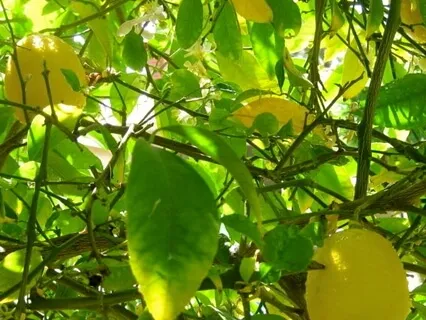
And proudly announced to the room full of friends that the basket of lemons his son was holding was full of things that had come from their backyard tree.
Anyone who wanted some could take them home.
I put two on my desk,
And we carried on with the day.
At lunchtime,
I watched as Mr.
D poured his milk from its small green carton all over his vegetables.
That day it was peas and carrots.
I considered intervening,
But I waited and watched as he picked up his spoon and ate it all,
Like breakfast cereal.
He even lifted the black plastic tray to his mouth and drank the remaining milk.
A volunteer seated near him at the table had noticed too,
And we looked at each other and smiled.
At the end of that day,
Mr.
D and I sat together,
Looking out the window,
Waiting for his wife.
The basket that had been full in the morning sat empty on the table.
I touched his hand and said,
Thanks for the lemons.
And that's when he turned toward me and confided,
Almost in a whisper,
You can even use them as lemons.
Well,
No one had ever given me that exact advice before.
Using round yellow things as lemons.
As a linguist and a student of poetry,
It was one of the things I loved most about those days at the center.
The unexpected beauty that arises in presence with someone who thinks differently,
Freed from any so-called right way to speak.
The lemon advice,
Certainly.
And the daily New Year wishes,
Too.
And so,
If meditation is meant to bring us fully into this present moment,
To allow whatever is to simply be,
We can learn something from the person with memory impairment.
Not only for Mrs.
K,
But for all of us,
Each day is the beginning of a new year.
Truly,
What a gift,
Especially now,
The pure potential of a new year.
And not only for Mr.
D,
But for all of us,
That yellow round thing in the fruit bowl,
It can be used as a lemon.
Another gift.
Every time we choose to consider what and who is in our midst.
Thank you for spending these minutes with me.
I hope you enjoyed meeting two of my teachers,
Mrs.
K and Mr.
D.
And I invite you to share something about this topic with others in your life.
We never know who among us is suffering in silence because they are afraid to talk about taboo topics like dementia.
Or maybe they are reluctant to ask for emotional support.
If that describes you as a caregiver,
You have my deepest respect and appreciation.
I want to believe that even now,
There are ways we can help each other with our small gestures of care,
Connection,
And curiosity.
In the words of another of my beloved teachers,
Paramahansa Yogananda,
Seek to do brave and lovely things that are left undone by the majority of people.
Give gifts of love and peace to those whom others pass by.
Namaste.