So we are studying the Bhagavad Gita.
The book that I'm going to read the passage from is the interpretation by Stephen Mitchell,
But you don't have to have this book.
It's just a lovely I Just Love Everything by Stephen Mitchell.
All versions of the Gita are lovely.
The Gita,
It's a metaphor for life and the story in the Gita.
And if you want to go back,
We have a playlist called the Bhagavad Gita under my profile.
And you can go right to the beginning where I talk about the battlefield and how it all fits and everything and stepping through it all.
Even if you've never,
If you don't want to do the whole playlist,
At least listen to the first one,
The introduction.
It really,
Really helps.
But the battlefield is within a kingdom.
Even within a family.
On the one side,
We have Arjuna,
Who is our hero,
And his four brothers and himself,
And half the kingdom is kind of on one side.
And they are seen as,
And I'm going to say it this way,
The good.
But they are the bright,
The light inside of all of us.
They are our courage,
Our connection to our soul,
Our loving selves,
Our connected selves,
The parts of us that allow us to truly live our dharma,
Our true path.
On the other side of the battlefield are Arjuna's hundred evil cousins.
And the evil cousin's dad,
Dhrishtarashtra,
He was the blind king,
And it's very telling that he was blind.
Because those hundred cousins are all the aspects of us that pull us off our path.
That for some reason,
You know,
It could be that questioning of self or that lack of confidence.
It could be karma.
It could be old patterns,
And not karma like a punishment,
Karma like an old pattern that I'm still trying to figure out.
Just some old thing that I'm still working on.
It can be anger,
Malice,
Jealousy,
All those emotions that if they get into us,
It's like we just can't get them out of us.
And then we're completely off path and we make all kinds of choices.
And then if we ever get a chance to get out of them,
We kind of are sitting there looking at the aftermath of what happened.
And whether the aftermath is other people or something from work,
Or it's just our own self.
It could be having just sat down and just completely gorged ourselves on who knows what,
You know,
We desperately wanted to quit smoking and something in us snapped and we went and bought a whole pack of cigarettes and smoked it all.
Or whatever,
Whatever it is,
Or we were really trying to be kind and we just lost it on someone,
You know,
And then we had all this damage because now they don't trust us.
And now we've,
You know,
We've burned bridges.
That's the problem with these,
The dark,
The hundred evil cousins,
Because they kind of wreak havoc in our life.
So the battlefield represents a very real place in our heart,
Where these forces within us are always kind of at odds with each other.
There's that part of us that really wants to live the life that deep down we know is ours.
And yet something comes in.
Jealousy comes in.
And jealousy could be anything.
It could be that whole coveting your neighbor's whatever.
It could just be anything.
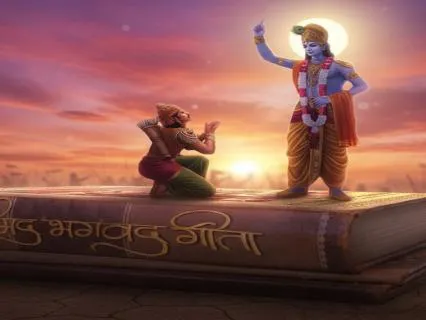
So Arjuna is sitting in the middle of this battlefield with Krishna,
And Krishna is his friend,
But also Lord Krishna.
He is all-knowing consciousness.
And Arjuna is us.
Arjuna is you.
And Krishna is your highest self.
This is that whisper of the divine within that's always there if we're willing to listen.
And as the story goes,
Arjuna asks Krishna,
Drive me into the center of the battlefield so that I can look around.
And he looks around,
And he decides that he can't fight.
He doesn't want to.
And this is us,
When the truth is,
We're tired.
We're tired of all this self-improvement.
We're tired of battling the family.
We're tired of fighting for our rights.
We're tired of always trying to lose weight or make money.
We're just exhausted.
We're just done.
And what happens is,
Unfortunately,
When we give up,
Guess who wins?
It's like those hundred cousins just move in.
They just take over.
So Arjuna is,
He's just said to,
And he's in the chariot,
And he just says to Krishna,
He says,
I don't want to fight.
I can't do it.
I don't want to.
And he sort of slumps down.
And then Krishna says,
You must fight.
And he doesn't,
I know we've talked a lot in past classes about we don't like this word fight.
And I'm with you,
Because I,
In my heart,
I love the idea of pacifism.
I love being easygoing.
I love being able to flow with life.
That's what I want.
I just want to choose my path and then flow with it.
That's what I want.
But if you're like me,
Anytime I do that in my heart,
All my old habits rise,
And they win.
And all of a sudden,
I wake up two weeks later,
And I'm just back into all my old patterns,
My old habits.
And what's interesting is this chapter is actually all about yoga.
And it's not about the yoga of the West.
It's not about asana or anything like that.
What they mean by yoga is that you are engaged in whatever you're doing.
You are engaged.
Your mind,
Body,
And soul is 100% doing what is before you.
That's what yoga really is.
We may do all these practices.
We may do pranayama,
Asana,
Flow yoga,
Karma yoga,
Bhakti yoga,
Vipassana.
We do all these practices.
But the point of them,
They are practices.
They are things we do to prepare ourselves for life so that we can actually be fully engaged in being alive.
That's the point.
That's why we are doing all of these yoga practices.
Being able to sit cross-legged or meditate for four hours is of no value to living.
But if it helps us clear the nonsense,
Clear the darkness out so that we can live and actually be happy and engaged,
That's the point.
So at this point in the Gita,
Krishna is explaining to Arjuna that you are an eternal soul.
Even though the world has conditioned us to think that this physical body and this personality that I am inhabiting right now is 100% of who you are.
You know,
Whatever I look like,
That's my self-worth.
Am I intelligent?
That's my self-worth.
Am I married?
That's my self-worth.
Do I have 17 children?
That's my self-worth.
We've been taught that this is it.
And so then all of a sudden we're terrified.
We're terrified if it changes,
What will happen?
Why are we afraid of aging?
But what if I'm not good looking?
What if I can't do the things I want to do?
What if I can't contribute the way I want to do?
You know,
We have this whole thing.
What if I for some reason lose my job and I don't have the same money as I once did?
What's going to happen?
And we get all caught up in this external struggle.
And Krishna's saying,
You are also an eternal being.
You are also all those things.
It isn't about escaping that.
But it's almost like knowing that you are also eternal is like this rope up to the ship,
To the boat,
That when you go deep diving into the experience of being alive,
You always know you have a rope,
A tether to something safe,
To something eternal,
To something that can't be touched.
And all you have to do is give a tug and you're going to get pulled out.
As opposed to kind of just free diving,
Feel scary.
And that's what Arjuna's trying.
That's what Krishna's trying to do.
Isn't it ironic that I keep swapping them today?
I keep swapping Arjuna and Krishna.
I wonder if that's significant for us when we sort of deeply merge with our inner self,
Our highest self,
That maybe it's all the same anyway.
Or I'm just a little tired because of the time change.
Hard to say.
So today we are looking at chapter two,
Verse 23.
And I'm going to just back up and read a couple stanzas beforehand.
When he says self,
The S is capitalized,
Just so you know.
Okay,
So he's not talking about the little self.
He's talking about the big self.
If you think that this self can kill,
Or think that it can be killed,
You do not well understand reality's subtle ways.
It never was born.
Coming to be,
It will never not be.
Birthless,
Primordial,
It does not die when the body dies.
Knowing that it is eternal,
Unborn,
Beyond destruction,
How could you ever kill?
And whom could you kill,
Arjuna?
Just as you throw out used clothes and put on other clothes,
New ones,
The self discards its used bodies and puts on others that are new.
So here is the verse that we're going to look at today.
The sharpest sword will not pierce it.
The hottest flame will not singe it.
Water will not make it moist.
Wind will not cause it to wither.
I'm going to read Maharishi Mahesh Yogi's version of that.
Weapons cannot cleave him,
Nor fire burn him.
Water cannot wet him,
Nor wind dry him away.
And we'll hear Paramahansa Yogananda's.
No weapon can pierce the soul.
No fire can burn it.
No water can moisten it,
Nor can any wind wither it.
Yes,
The four elements.
What do you hear when you hear that?
What do you feel?
How does that make you feel,
Or what does it make you think?
No fire can burn it.
No wind can blow it.
No water can wet it.
No weapon can pierce it.
I am the strength of our soul.
Something safe and trustworthy,
Intangible.
It makes me feel stronger than I sometimes feel.
We are the only ones that can affect it.
Our vision is so small,
Protected,
Almighty.
I feel expansive,
That it's not of this material world.
No matter how you change and reborn,
The soul stays still,
Because it's beyond the physical experience.
You know,
It's funny.
So years ago,
I did a course with,
It's called the Pari Center.
And there,
David Bohm,
One of my favorite quantum physicists,
He was a big part of that center in Italy.
And during the lockdowns,
They did a series of talks that we got to actually chit-chat with his friends and colleagues,
And it was just mind-blowing.
And they're doing a series again right now.
And I attended one of the talks yesterday.
And hearing these guys,
And like,
One,
It was really,
It was really interesting,
Because the guy that was actually the main speaker,
I can't remember what his name was,
But he worked with Stephen Hawking.
This guy's like an insane mathematic,
Mathematician,
Philosopher,
Physicist,
Over at Trinity College in England.
And so these are some,
The people there,
I swear,
The average age is 60.
And they're all these retired professors or something,
Like,
It's really wild.
And the topic was how to bring mind and consciousness into physics.
The first thing that isn't really the point I want to make,
But it was fascinating listening to them talk about how they needed to expand their perception of the world to include consciousness that we hear talk about every day.
It was fascinating to listen to them talk about it from an academic perspective.
And I'm listening to them going,
Wow,
Where they want to get to is where everybody here is starting.
It was fascinating.
They were talking about,
They had this circle of life kind of thing.
And over on the right,
On the left side,
They had quantum physics,
And how quantum physics affects the literally the tiniest quanta within the atom.
And then over here,
They had Einstein's theory of relativity,
You know,
How what governs all of space and time and galaxies and tiny thing,
You know,
Physical things.
And what's amazing in physics is quantum theory.
And the theory of relativity are incompatible,
Incompatible.
And what's fascinating is what I got thinking about while they were talking was,
Sometimes I wonder if that's the same challenge we have,
When we're trying to embrace our consciousness versus the rest of the world.
What if,
And understand,
I just heard this yesterday.
And so this is very raw in my heart that I'm thinking about.
This isn't like a complete thought.
One day,
I'll do a whole talk about it.
But today,
I'm sort of talking out loud with you guys,
Thinking out loud with you guys.
But what if the laws that govern our inner consciousness are not the same as the laws that govern the world around us?
To think that when I hold a particular thought in my heart,
It sends out a signal,
Or it changes the world around me,
Or it changes my landscape,
The power of our consciousness,
The power of our thoughts,
That they define the world around us.
But then where we get in trouble is then our brain hears this,
This discussion in our heart,
And says,
Oh,
Yeah,
But yeah,
But like,
What about rent,
Man?
And like,
What about this?
And what about that?
And are you trying to tell me that,
You know,
This whole thing,
That it tries to take the physical world,
It's like it tries to take the map of the physical world and apply it to consciousness.
And I just wonder if this is where we all get in trouble.
Because what if they're actually incompatible?
Maybe they live side by side,
But we can't use the mapping of the world on the inside.
So it's interesting,
Like the message in this particular sutra is the physical body that we live in,
Even our mind,
This is all made of the,
Of,
Well,
In this instance,
The four elements that they don't talk about ether,
Earth,
Air,
Fire,
And water.
That's what this body is made of.
That's what the trees are made of.
That's what the cars are made of.
That's what the mountains are made of.
That's what the sky is made of.
Everything is made of these elements.
But our consciousness isn't.
Our consciousness is something completely different.
And it does not live according to the same rules.
And that's essentially what this teaching is all about is,
Yes,
I can cut this sweater I'm wearing,
But it has no bearing on my soul.
Cutting,
For example,
Is the earth element.
That's where they say,
No weapon can pierce this.
So let's think about that.
Let's think about all the things that cut us.
And it could be words,
It could be insults.
First,
Let's think about it from the outside world.
Someone can say something to us.
But it has no bearing on our soul.
It might affect our ego,
Or it might affect our how we feel about ourselves.
But it can only affect us if we already think it.
If we've already made space for the fact that that could be us.
I mean,
If someone looks at me and says,
Your purple hair is stupid.
I kind of assume that stupid is in the eye of the beholder.
Because I don't have purple hair.
But if they said something that was hurtful to me that I'm already struggling with,
Oh,
Right,
That hurts.
But it still doesn't touch my soul.
I am still a witness inside observing Katrina Boss being hurt by that insult.
And there is something about developing that witness mind.
To know that,
Let's say that,
Let's say someone hurts you.
And you think,
Wow,
I am so hurting right now.
The first thing we know is,
I am not the one that's in pain.
Because I'm observing the pain.
I'm observing the pain,
Either in my physical body,
Or I'm observing the pain in my heart.
But who is observing the pain?
Who is who is feeling this pain?
And that's the interesting part.
That's where you go,
Well,
Who is that?
That there's a separation.
There's something different animating us than just the pain.
We are not the pain.
It is not everything.
And then they talk about fire.
No fire can burn it.
So where is fire in the world?
Anger.
Frustration.
Jealousy.
Water.
You know how sometimes water,
You know,
Like grief,
Emotions,
Second chakra,
Water.
Sometimes we feel like we're in a fire.
We're just being swept away.
You know,
Just the water of life just,
But that doesn't change the one in the canoe.
Even though we're being swept away,
Who is being swept away?
Who is it?
And then wind.
Do you ever have it,
That it's like there's so much change?
There's so much change blowing in that you almost start to feel hollow.
Like you're just so busy adjusting to everything in your life.
There's almost like there's nothing left.
There is something left.
No matter how much can change,
It's still you.
It's still,
Still you.
And so as much as it's interesting to think about the outside world and how they could,
That they can't harm us.
Nobody out there can harm the true self.
It could hurt our ego and all that,
But can't really harm that eternal self.
The Gita is about the inner battle.
So then the question is,
We look inside and now let's first look at earth.
Let's look at the weapons inside.
Those cousins live inside of us and we must engage with them because we don't want them to win.
So are there aspects inside that have a cutting tongue,
That is hypercritical of you?
That if something happens that beats you down,
You shouldn't feel that.
You should be stronger than that.
What's wrong with you?
How come you can't do it like everybody else can?
This is all from within.
And those bright lights inside,
The five brothers,
Courage,
Love,
Your dharma,
Your truth,
That is who engages with that voice.
You're not alone.
You're not standing in the middle of the field all by yourself.
You have an entire army behind you to help,
To say,
Nothing you say can harm me.
Nothing.
Stop it.
I'm not listening because what you're saying isn't right.
And when we truly can do that,
But we can only do it when we engage with it,
Because what if we don't engage?
What if we just give up and we just listen to it?
My army behind me retreats.
Then those cutting words just,
It's like we're all,
We all do it.
It's just,
It's like,
It circles us until we're on the couch and we're just so depressed that we don't know what to do with ourselves.
This is what Krishna is saying.
Engage,
Bring your army,
Bring all your strength,
Bring all of who you are.
These cousins do not deserve to rule your kingdom.
And this is one of the big shifts in this particular verse is a shift from reactivity to sovereignty.
And by reactivity,
It means that everything out there determines my inner world.
This thing happened,
The circumstances determine my happiness.
This thing,
My health determines my happiness.
My relationship determines my happiness.
The perception of my family determines my happiness.
This is living in a life of reactivity.
And there's no way out of that,
Right?
Like it's just,
It's almost like we've forgotten that we have an army behind us.
We have so much strength and power behind us.
Sovereignty says,
I govern my land.
It doesn't mean I govern you,
Govern you or my family or anyone,
But I am the monarch of my kingdom.
I decide what comes in,
What goes out,
And I also govern the beings inside of me.
You know,
There is a time for criticism.
If I'm writing a book,
I do want to bring up that critical mind inside of me that reads it with a fine tooth comb.
But it has to be healthy.
And we have lived in a very dark world for thousands of years,
Full of criticism and shame and guilt.
And at some point we need to stand in that chariot and say,
No more.
That's enough.
We have things to build.
I have a life to live.
I'm not going to sit here and argue with you.
That's enough.
There's really something about that.
And then we look at fire,
Fire inside.
And again,
I'm not talking about healthy anger or healthy righteousness or anything.
I'm talking about those little monsters inside that are like,
They've been angry for decades,
Decades.
They've been in there sucking your energy,
Draining you to truly look at that and say,
Hey,
You know,
Let's sort this or let it go one way or the other.
But we engage with it.
We engage with it eyes wide open,
Fully conscious and say,
I see you.
I respect you.
Let's look at this.
What if that anger is actually our inner child?
Maybe it's our younger child who went through horrible things,
Or maybe it's us in a previous relationship,
Or maybe it's our experience in the school system,
Our experience in the workplace.
And maybe I'm justifiably angry,
But no one's listened.
Then listen,
Engage,
Spend time with it,
Heal it,
And then let it go.
Because fire consumes.
And if we've got those little guys inside of us,
They are consuming us.
And we're not living anymore.
But we can't turn our back on them.
We have to engage them,
Full flanks,
Full,
All of our friends behind us,
All of our ancestors behind us.
Same as water.
Sometimes we can have old emotions in there that aren't fiery,
But they're sad.
And it's like all of a sudden you kind of,
It's like you get sucked into the undertow.
It can even be,
Think about how fluid habits are.
Things you've done for decades.
You do this one thing,
And then that triggers this,
And then that triggers this,
And then that triggers this.
And now you have a habit.
That is like a river flowing that you can't get out of the flow.
How often do we have that?
How often do we have these old karmas inside of us?
These old patterns that we,
If we don't get out of that slipstream,
We're never going to.
We will repeat that pattern for many,
Many,
Many lives.
Not just this one.
We will continue addictive patterns.
We will continue all kinds of things.
And there's really something that all we need is the awareness.
We just need that witness mind to watch and say,
Well,
That's interesting.
And maybe the witness mind is actually using your critical mind to say,
Why am I stuck in this?
What am I missing?
You know,
It's like they've done a lot of work in addictions where they look at our struggle to connect with others,
Or a lack of love,
Or things like that.
Maybe that's what we need to kind of look at these things and say,
Why am I doing this?
Where did this come from?
Where did this pattern come from?
Am I mimicking someone else?
Is it something I developed?
Where does this come from?
But all we have to do is engage with it and just be aware.
And then there's wind inside.
And wind is like that,
You know,
Like that,
Those things that make us waver.
You know,
Here we are,
We're walking along,
We're walking our path,
We're good to go.
And all of a sudden,
It's like this wind just pushes us off path.
And we're like,
Maybe it's self-doubt.
Maybe it is the opinions of others.
Maybe we are still living in the slipstream of other people.
Wind can also inside feel like,
You know,
When you've been through a lot,
You know,
A lot of change,
Maybe feeling under the thumb of a lot of people.
It's like this happens,
Whoosh,
This happens,
Whoosh,
This happens,
Whoosh.
And you start to feel a little hollowed out,
A little dry.
You know,
Like you don't have any juice left in your system.
Too much wind,
Too much change.
None of this is you.
Even the one standing there hollowed out,
The true self is still whole.
Even if the ego has been hollowed out,
Even if the ego is getting pulled down,
All kinds of emotional trauma and sadness and anger and all kinds of things,
You are still whole.
There's really something about that.
There's something about just standing in that.
So I'd like to do a little meditation with you guys.
So wherever you are,
Unless you're driving,
Just close your eyes.
If you can sit up or stand,
That's ideal.
I know some of you guys are horizontal and enjoying it.
But for this exercise,
It's worth sitting up.
So let's close our eyes.
And I want you to visualize your spine.
Visualize the bottom of your spine and allow it to go all the way down into the earth.
Then travel up your spine to the crown of your head and feel the crown of your head connected to the divine.
Sovereignty often feels like this.
It feels like a vertical channel where the divine dances with the physical world and vice versa.
Between the crown and the earth,
I want you to envision a column of light maybe it's white light,
Maybe it's a golden column.
But I want you to visualize this beautiful column of light.
And this is the indestructible you.
This is your eternal self.
And as you inhale,
I want you to feel light flowing up that channel up to the crown of your head.
And as you exhale,
Feel it going down,
Almost like water flowing down the column.
Every inhale,
Feeling light going up the center.
Every exhale,
Feeling water flowing down.
I'm just going to do that a few times on our own.
And staying in this space to really feel the wholeness of this energy,
This light that you are.
And staying here with your eyes closed,
Become aware of your physical body.
Become aware of the room around you.
You don't have to open your eyes,
Just be aware of the sounds,
The floor,
The chair,
The bed.
And notice the difference between this column of light and the world around you.
No weapon can pierce the soul,
No fire can burn it,
No water can moisten it,
Nor can any wind wither it.
And gently take a deep breath.
Exhale,
And just come back into the group.
And I would love to know where you're at,
How you're feeling.
If there are words rolling through your mind,
What are they?
Or what you want to take into the rest of your day,
Or life from this.
Release,
Feeling so much calm,
Refreshed,
Interesting,
Grounded.
I feel majestic.
At ease.
I'm standing with my army of sovereignty behind me.
Invincible.
Love.
Connected and energized,
Plugged in.
I feel alive and open.
I feel challenged to deal with old habits,
Journal work.
Thoughts of truth from the words you have said today filled my body.
Whole.
Acceptance of what is.
Encouraged by the fact that I'm noticing more and more.
Quiet my inner critic.
Empowering and have a purple waterfall of sparkling light in front of me.
Protective.
Indestructible,
Shiny pillar that can't be affected by others.
Empowered,
Relieved,
Exhaling.
I'm sorry I'm bad at understanding metaphors.
Who is the army behind us?
The army behind us,
So in the battle of the Gita,
There's,
Arjuna is one of five brothers.
I can't remember what they actually stand for right now,
But courage,
Love,
Your spirit,
Your purpose.
And then there's kind of half the kingdom is on that side.
And then the one that we're facing are all those inner habits and things that tear us down.
And kind of the other half of us is over there.
And so this is sort of your truth,
Who you really are.
But you could visualize anything.
You could visualize ancestors,
You could visualize anyone,
Even friends,
People you know,
Teachers,
People you respect.
Imagine them all standing behind you at any time.
Anytime you need help,
Pull in your army,
Pull in your protectors.
Thank you everybody.
Hope you have a wonderful week.
Thank you for being here.
We'll see you later.