This is a fairly dynamic practice.
It involves both mudra with the hands and a mudra with the tongue.
It's a breath and meditative technique.
We'll do it for about three minutes.
You can do it up to 20 minutes.
And if you're experiencing pretty strong anxiety,
Then I would recommend doing it for 11 minutes to really regulate with more efficiency and effectiveness.
This mudra that we do with our mouth really helps to cool the body down and calm us down.
It's also really beneficial for digestion.
And the mudra that we do with our hands it's very good for the heart meridian and it's known as an anti-anxiety remedy.
I've used it myself personally to overcome or to help in the process of overcoming flight anxiety and as I'm pregnant now I've used it a lot to regulate the anxiety that comes with being a parent.
So you're welcome to use just the breath or just the mudra on its own.
But for real added potency,
You can do the combination of the two,
Which we'll do together now.
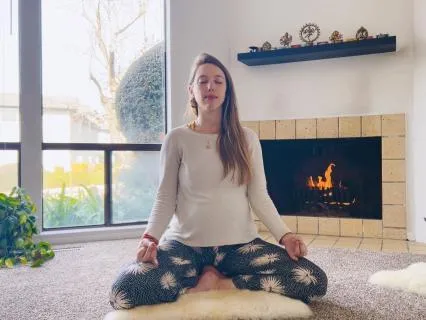
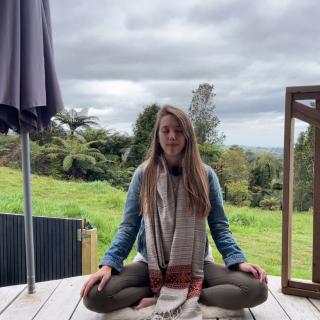
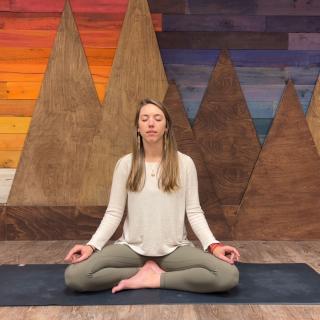
This can be done seated on the ground,
It can be done cross-legged,
It can be done seated on a couch or in a chair,
Wherever.
In another video I shared that you could pull away into a bathroom and do it for three minutes there and it will help to regulate you.
So know that those are available options.
Okay,
So the hand posture.
We're using both hands.
Tuck the pointer finger down into the base of the thumb.
Thumb crosses over the pointer finger.
And connects to both the middle.
And the ring finger tips.
So the pointer finger comes down,
Thumb crosses over.
Middle and ring finger connect to the thumb tip.
Pinkies extend outwards.
This helps to settle our thinking by bringing the pointer finger down.
We stabilize the earth and the ether element with the two middle fingers and then we activate the heart meridian with the pinky extending.
The hands will then come resting down towards your lap.
And that's the mudra with the hands,
Upanivayu.
The mudra with the mouth.
Now,
You might genetically be able to do this first part,
Or you might not.
There's options.
You'll do a taco tongue,
As I like to call it,
Where you roll your tongue together.
And stick it out.
That's the in-breath.
Now if your mouth doesn't do that,
Just place your tongue down on the base of your mouth and breathe in through your mouth like you're sipping in through a straw so you can feel the air cross over your tongue.
That's what's important.
That's the inhale.
The exhale is through the nose,
But the tongue will now move to the roof of the mouth.
It relieves from its taco shape,
Presses up towards the top of the mouth behind teeth or further back.
As you exhale out through the nose.
The inhale happens through the curled tongue.
Exhale through the nose,
Tongue pressing to the top of the mouth,
Lips sealed.
You get the most bang for your buck with a more inward approach,
So I recommend closing your eyes,
But also know you could do this with your gaze down towards the ground or the earth if the eyes closed brings about too much discomfort for whatever reason.
Okay,
So let's do this for three minutes together.
Again,
11 minutes is ideal if you're really going through deeper experiences or grips of anxiety.
20 minutes is the max per sitting.
Point your finger down to the base of the thumb.
Thumb connects to the middle and ring finger.
Pinky extends out.
Rest upon a vayu mudra on your lap.
Curl your tongue,
Eyes closed,
Inhale through your mouth.
Tongue to the roof of the mouth,
Exhale through the nose,
Seal the lips.
Curl tongue into the mouth.
Again,
Maybe just breathing in over the tongue.
Press the tongue to the roof of the mouth,
Seal the lips,
Breathe out through the nose.
Long,
Deep breaths.
As always,
If you ever need a pause or a break,
You're welcome to do so.
Otherwise.
As you increase the duration of the practice,
You increase the potency and the effect of calming yourself.
If you'd like to continue on,
Keep going.
Otherwise,
Release the mudra with the mouth.
Maybe stay with the mudra in the hands a little longer.
Or release the hands and take a few breaths just as you are.
Observing any subtle shifts that may have occurred.
Thank you so much for taking the time to prioritize yourself in this moment.
Namaste.