I cured my anxiety by holding my breath.
We're going to cover why taking big deep breaths can make your anxiety worse and why breathing less air is the breathing key to overcoming anxiety.
I'm going to talk you through this breathing exercise step by step so you can feel the calming benefits and also we'll cover off any common mistakes that people make as well.
And stay tuned to the end of the video for the one minute mindset that I combined with this breathing technique to overcome anxiety for good.
So seven years ago I was really struggling with anxiety and panic attacks.
Years of chronic stress,
Mouth breathing,
Poor posture and generally not looking after myself had led me to a state where I was feeling constantly anxious,
On an edge and whatever I did to try and help my anxiety seemed to make it worse.
I started going to yoga classes and my yoga teacher was telling me to take big deep breaths so that I could get more oxygen.
But every time I did this,
I started to feel quite dizzy.
Started to feel very panicky and I had to leave the yoga studio.
At home I was also trying to do some deep diaphragmatic breathing but that was making me feel worse as well.
I started waking up in the middle of the night having panic attacks when I was gasping for air and I came to the realization that all of this heavy deep breathing was actually making my anxiety worse and not better.
So why does it matter how much air you breathe?
Surely if you breathe more air you would get more oxygen.
Well that's not how it works.
When we breathe too much air because of mouth breathing or chronic stress or illness we lose too much carbon dioxide from our system.
This overexcites our nerve cells and that creates that feeling of being both on edge in your body but also having a restless anxious mind.
So what's the solution?
Well,
In a nutshell,
We need to breathe less air.
We're going to do a breath holding exercise because when we hold our breath for short periods of time,
This gently increases levels of carbon dioxide in our body.
This de-excites our nerve cells,
So it calms our nervous system.
And when we use these breathing exercises on a regular basis,
They start to recalibrate our default breathing setting in our brain and this helps our breathing to be calmer lighter slower and quieter 24-7 so that we feel calmer and more all the time.
Okay,
Let's do this breathing exercise together.
It's called the many small breath holds exercise and it's part of the Botteco breathing method and it'll take about six or seven minutes.
In a nutshell,
What we're going to do,
We're going to be taking a normal breath in and out through the nose.
Then we're going to be holding our breath for about three to five seconds.
Then we'll let a normal in-breath come.
Then we'll breathe normally for 10 to 15 seconds and then we'll just keep repeating that cycle over and over again.
I'll guide you through it every step of the way and I'm going to give you lots of tips as we go.
Okay,
When you're ready let's give it a go.
I want you to take a normal breath in out through your nose.
Pause your breathing for three seconds.
Too.
Letting go and then just breathing normally for the next 10 to 15 seconds.
It's important to know that the breath before the breath hold should be a normal,
Small,
Quiet breath.
Don't take a really big breath before the breath hold.
And likewise,
When you breathe out,
It's a normal out breath.
We're not trying to force all the air out of our body or anything like that.
Okay,
Let's go again.
So normal breath in.
And holding the breath for three.
.
.
Two.
.
.
One.
Letting go and then just breathing normally.
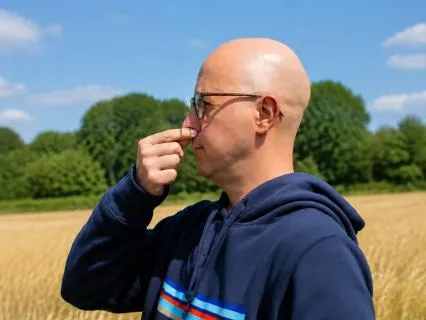
You can hold your breath by gently blocking your nostrils with your fingers or you can just pause the breath.
I wouldn't pinch your nose really tightly because that can just block your nose up.
Our noses are quite sensitive.
Okay,
Let's go again.
So normal breath in.
And holding your breath for three,
Two,
One.
Won.
Letting go and breathing normally.
When you're holding your breath,
Think pause.
And relax.
If you brace up or tense or try and block your breathing.
It's just going to stress your body out.
Let's go again,
So normal breath in.
Out,
This time trying four,
Three,
Two.
.
.
One letting go and then breathing normally.
In between the breath holds you can just forget about your breath.
You don't have to control your breathing in any special way.
Let's try another one,
So normal breath in.
.
.
Out,
Holding the breath Oh.
Letting go and then just breathing normally.
If you feel a mild shortage of air,
That's okay.
It's actually beneficial.
You're getting plenty of oxygen,
So you don't need to worry about it.
Go again so normal breath in and holding your breath.
Four,
Three,
Two.
One,
Letting go and breathing normally.
If you feel an intense shortage of air and it feels really stressful,
Then just drop back down to the three second breath holds.
So you need to adjust the dose for what feels right for your body rather than just focusing on the numbers.
Okay,
Let's go again.
This time if it feels okay,
Maybe trying five.
So normal breath in.
And Anne.
Holding the breath.
Five,
Four,
Three,
Two.
Letting go and then breathing normally.
Once again,
If the 5 second hold feels too strong,
Just drop back down to 4.
Or 3 seconds.
Go again so normal breath in and out holding for five,
Four,
Three,
Two,
One.
Wong,
Letting go.
And breathing normally.
We can listen to our body for feedback.
If you feel a little bit calmer.
Or sleep here.
Or warmer or a bit more clear in your head or more saliva in your mouth.
These are all positive signs.
You won't necessarily get them all,
But any of those is a good sign.
Let's go again.
Normal breath in.
I'm holding for five,
Four,
Three,
Two,
One.
Letting go and breathing normally.
If you start to feel dizzy or lightheaded,
That could mean that you're taking too big a breath before the breath hold.
So if that happens,
Take smaller breaths before the breath hold.
If it keeps making you feel dizzy,
Then don't carry on doing it.
It's obviously not right for your body.
OK,
Let's do another normal breath in.
Out holding for up to five four three two one,
Letting go and then breathing normally.
So you can use this breathing exercise when you feel anxious to calm you down as an SOS.
And if you use it regularly,
Multiple times a day,
It's going to start to change the way that your body breathes,
Start to find that the breath holds become easier and your everyday breathing is calmer and lighter.
And you feel calmer all of the time.
Okay,
Let's do two more.
So normal breath in.
.
.
Um.
.
.
Holding the breath for up to 5,
4,
3,
2.
Letting go and breathing normally.
Noticing how you feel adjusting the length of the breath hold if you need to.
Let's go for one more in your own time,
Guiding yourself through it.
Now earlier in this video I talked about a mindset that goes with this breathing exercise to help you overcome anxiety.
For many people when they feel anxious,
When they experience anxious thoughts and feelings,
Try and block them out,
They try and push them away.
It's very human,
We generally don't like unpleasant experiences,
But it turns out the more you try and push away these thoughts and feelings,
The bigger deal they become in your mind and in your nervous system.
Your nervous system perceives them as threats and starts to look out for them.
So instead,
Next time you experience a difficult thought or emotion,
Use the breathing exercise from today to calm your system,
But then see if you can just let those difficult thoughts and feelings come and go.
And remember this important saying,
What we resist persists.
What we allow.
Compass.
Yeah?
So paradoxically,
The key to overcoming anxiety is to stop trying to get rid of anxiety.
Use a breathing exercise to calm your system and rewire your system for calm,
But at the same time let those difficult thoughts and feelings come and go.
They will eventually pass.
Sometimes they might even give you an important message or insight before they do.
And that's like magic.
Thank you so much for watching today and I wish you all the best.