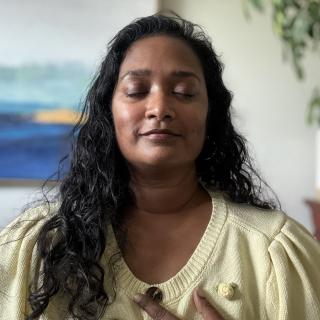
My name is Pamela Pulaski.
I'm a licensed clinical social worker and therapist.
Dissociation is something that we all experience to different degrees.
It's not just you.
It happens to most of us from time to time.
But with understanding and practice,
You can notice it and take steps to reduce dissociation.
A very common occurrence of dissociation is when you're driving.
You might be driving and you find yourself on a route that you didn't plan on taking.
You might have needed to take a left 10 minutes ago.
And you just don't remember what you've been doing in the last 10 minutes.
It might show up when you're having a conversation with someone and they ask you a question.
And then you realize,
I haven't been listening.
I have no idea how to answer this question.
Very commonly,
It can happen in class or during a meeting.
You could be making eye contact with the instructor.
And realize you haven't paid attention to anything they've been saying.
So why do we disassociate?
Oftentimes,
We feel overwhelmed by something that triggers us.
Consciously or subconsciously.
And our mind or human essence in our body feels like escaping,
Almost as if we're leaving our body because it's just too much.
And it can be very subtle things that trigger dissociation.
For children who are experiencing trauma.
Dissociating is very important just to mentally survive those events.
Especially if trauma is reoccurring.
Quite often those children grow into adults.
Who continue to dissociate.
Even if the original threats are gone and the environment is safer.
As I mentioned earlier,
There might be triggers like hearing a song or on the radio.
A smell,
Or seeing something that triggers dissociation.
So what can we do when this happens?
I'm going to guide you through a grounding exercise where we connect with our senses safely.
And then I'll explain how we connect to our senses in everyday situations,
Because there are many opportunities throughout our day where we can be present.
The grounding exercise I'm going to guide you through is called 5-4-3-2-1.
You can do this exercise anytime and anywhere.
Take a deep breath in.
And go ahead and exhale.
Look around you.
Notice five things that you can see around you.
I'll begin.
I can look out my window.
I can see a tree,
A house.
I can see a couch.
I can see a chair.
I can see my camera.
How about you?
Now notice four things that are on your body that you can feel with your skin.
Your muscles.
I can feel this shirt.
I can feel my hair on my shoulders.
I'm sweating a little,
I can feel sweats.
And I'm wiggling my toes in my socks.
I can feel my toes.
How about you?
What are four things you can feel with your body?
Notice three things you can hear.
I can hear my voice.
I can hear a clock ticking in the background.
I can hear my cat scratching something.
How about you,
What can you hear?
Three things.
Notice two things you can smell.
I can smell the house smell.
Every house has a smell.
I can bring my hair.
And smell my shampoo.
You can bring your shirt up.
And smell that.
What are two things you can smell?
Notice one thing you can taste.
I can taste what I ate for lunch.
I can taste the tea I just drank.
If you have something to drink,
You can drink it.
And taste it and notice it as it travels down.
Your esophagus into your belly and where you stop feeling it.
What do you taste?
Notice how you feel now.
You've just connected to all of your senses.
So what we just did was connect with our body.
All of its senses.
Which is the opposite of dissociating.
Remember,
Dissociating is as if we're floating outside of our body.
And doing this grounding exercise helps us get back in.
You can do this exercise anytime you feel spacey or disconnected.
But there are many practical ways we can practice being present in our bodies.
For example,
Eating a meal.
Many of us dissociate when we're eating.
We'll be watching a show or on our phone.
We might be working while we're eating.
I am suggesting that you really tune into your senses when you eat.
Focus on the color of your food.
Focus on the smell of your food.
Course how it tastes in your mouth as you're chewing.
And noticing it as you swallow,
Where it travels.
Until you can't feel it anymore.
Notice your belly filling up with food.
That's the definition of mindful eating.
Another practical application is showering or bathing.
Oftentimes,
In the shower,
We'll be thinking about our day,
Worries,
Imagine conversations we're going to have with our loved one.
When we're showering,
I am encouraging you to be present.
Notice the warm water.
And how it feels on your body.
You can smell the amazing aromas of your shampoo,
Your soap.
Feel the slippery.
Feels on your skin.
Hear the calming stream of water.
It can be a wonderful sensory experience.
Going for a walk can be very engaging.
Looking around you at nature,
At buildings,
At people.
Feeling the air on your skin and hair.
Hearing the sounds around you,
Smelling the air.
If you're in class or in a meeting,
Connecting your senses can make learning and interactions more meaningful.
Feeling connected to your speaker through eye contact.
Hearing and processing what they're saying.
Taking notes with your hands.
Focusing on what your body is doing.
For example,
Maybe touching the tips of your fingers,
Having a fidget in your hand to keep your sense of touch engaged.
Drinking sips of water to keep your sense of taste engaged.
Another way we can reduce dissociation is putting our devices,
Like phones and laptops,
Away.
I know this is hard.
There's a time and a place to be on devices.
But when it's unnecessary,
It's preventing us from connecting to our bodies.
So if you have a break in your day,
Go for a mindful walk.
Connect with the senses outside.
If you have five minutes,
Put your phone down and do some stretching on your chair or on your floor.
If you have a few minutes,
Open the window.
Feel the breeze.
Or enjoy a warm cup of tea.
The more you practice being mindfully present in your everyday moments,
You'll find that you'll gradually dissociate less.
It takes time,
But you can get there.
I hope this helped you understand dissociation a little bit more.
Thanks for listening.
I'm Pamela Polsky.
Take care of yourself.