Welcome to the Mindfulness Meditation Podcast.
I'm your host,
Dawn Eshelman.
Every Wednesday at the Rubin Museum of Art in Chelsea,
We present a meditation session led by a prominent meditation teacher from the New York area.
This podcast is a recording of our weekly practice.
If you would like to join us in person,
Please visit our website at rubinmuseum.
Org slash meditation.
We are proud to be partnering with Sharon Salzberg and teachers from the New York Insight Meditation Center.
The series is supported in part by the Hamera Foundation.
In the description for each episode,
You will find information about the theme for that week's session,
Including an image of a related artwork chosen from the Rubin Museum's permanent collection.
And now please enjoy your practice.
Good afternoon,
Everybody.
Welcome to the Rubin Museum of Art and to our weekly mindfulness meditation practice.
My name is Dawn Eshelman.
Such a full house.
It's great.
Great to have you.
And we're talking this month about story and this idea of narrative at the heart of our collection is Tibetan Buddhist art and oral history and narrative are very important tools in the development of that culture and narrative paintings play a big part in that.
And we've been kind of talking about that throughout this month,
Along with this idea of story as kind of a metaphor or an element in our own meditation practice that is something that when we're aware of it can be helpful and useful as a even a personal development tool.
But if we're not aware,
Can kind of take over and kind of create some ideas and stories that we don't necessarily want to have.
So looking at this idea of story from a few different vantage points.
And today we're looking at an artwork that is not a narrative painting at all,
But certainly has a lot of story going on in it.
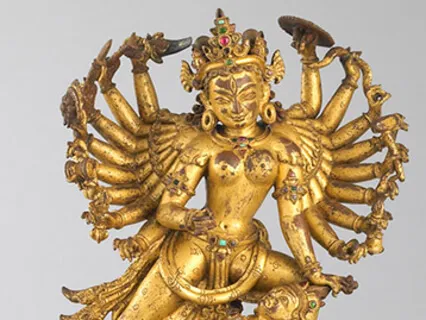
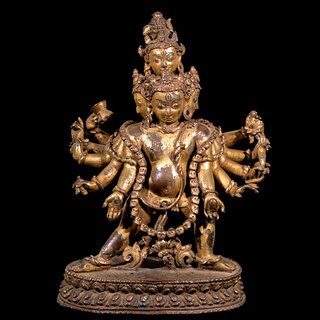
This is the fabulous Durga.
Durga.
And this is the statue.
The sculpture is Durga Slayer of the Demon Mahasa disguised as a giant buffalo.
13th century Nepal,
Gilt copper alloy.
And it's really quite grand here.
You can see that Durga is standing in this pose of a warrior.
So if you're any yogis out there,
Warrior,
Warrior one,
Right?
Ready for action,
Ready to take action there with that stance.
Many,
Many arms with all kinds of different weapons in them.
And the reason for that is that the gods were trying to defeat this terrible demon named Mahisa who set out to terrorize the world.
And the gods could not defeat this demon.
And so they decided to band together and each contribute their strongest weapon.
And through that collaboration,
Durga was formed through their energy.
And she is the feminine embodiment of all the gods power.
We could use a little Durga in our lives right now in this world today.
So this actually,
The sculpture depicts the final dramatic scene of the story where Durga cuts off the head of the buffalo,
Mahisa's current form and pulls him out of the body,
Kind of revealing his true identity,
Taking off the mask.
And it's interesting because the one element that's actually missing from the sculpture that used to be there is the spear,
The spear that Durga is holding in her hand that goes,
You can kind of see a little pierce mark there on the torso of Mahisa.
And so she gets him in the end.
So this is a story of victory.
This is a story of triumph and also of an important kind of collaboration between the gods who weren't strong enough on their own,
But together could change things.
Sharon Salzberg is back here with us.
Great to have you back Sharon.
She is the co-founder of the Insight Meditation Society in Berry,
Massachusetts,
A beloved teacher and author of fabulous books,
Including Real Love.
And you can find many of them upstairs in the shop.
Will you please give her a warm welcome back?
Sharon Salzberg.
Thank you.
She's got so many arms,
Doesn't she?
She's got really a lot of arms.
How are you all?
I was somewhere in the city.
I just got in and I'm on my way out again.
Eventually I'm going to land here for a steadier pace,
Which would be really good.
But I just came in from Sedona,
Arizona.
Yeah,
I'd never been before.
And people talking about story,
People kept talking to me about the vortex.
I still don't know what that is.
But people were sending me emails like,
Oh,
Lucky if you don't emerge with purple hair.
I don't know why I would exactly,
But I guess the vortex does that sometimes.
So when I am given a topic like now,
Like story,
I usually just try to sit with it for a while and feel my way through it and see what emerges and when it emerges,
There's a lot of different things.
So I'll just probably talk about a lot of different things in the time we have together for talking.
So my first series of thoughts were about how within the world of meditation,
Sometimes that term story has this kind of negative connotation.
It's what we get lost in when we are not able to directly see what our experience is.
And the story that I often tell about that is,
There's this word in Pali,
Which is the language of the original Buddhist texts,
The word is Papancha,
Which means proliferation.
And one translator I once heard translated as the imperialistic tendency of mind,
Where something happens and the whole world is taken over.
The story I usually tell about that is,
I was teaching with my friend,
My colleague,
Joseph Goldstein somewhere and he and I were just sitting and having a cup of tea in the kitchen of his place.
And somebody came in and said to him,
I just had a really terrible experience.
So Joseph said,
Well,
What happened?
And he said,
Well,
I was sitting and I felt all this tension in my jaw and I realized how I'm incredibly uptight and I always have been and I always will be.
And Joseph said,
You mean you felt a lot of tension in your jaw?
And he said,
Yes,
And I've never been able to get close to people and that's never going to change.
And Joseph said,
You mean you felt a lot of tension in your jaw?
And it's really interesting for me,
Kind of watching them go back and forth and back and forth.
And finally,
Joseph said something to him like,
Why are you adding a miserable self-image to a painful experience?
It's like painful enough to feel all that tension in our jaw,
But on top of that,
We have now added,
I'm going to be alone for the rest of my life,
Which is like this story,
Right?
So very often that just that word has that connotation and it implies kind of isolation and removal from kind of the intimate acquaintance of what's actually going on and just being lost in this world of abstraction.
It's kind of a lonely world.
It's very,
It's kind of cold,
Right?
Not really being in touch with how things are.
And then in that case,
We have to really look at the nature of our conditioning,
Both our individual conditioning and maybe even our conditioning through evolution.
You know,
Like what if we tend to only see pretty much the negative story?
You know,
What an evolutionary psychology would be kind of believed,
You know,
Largely that we're,
We're wired to look for the threat,
The danger,
You know,
That which might eat us in the jungle and just like,
Whoa,
It actually takes a kind of intentionality to take a more sweeping view of our life and not just to get lost in what they call the negativity bias.
And certainly as an individual,
As a person,
We may well have that kind of conditioning,
Whether it's,
You know,
Long standing or it's from absorbing the stories tell about us,
You know,
And just kind of taking them in and sort of wrapping ourselves around them in some way.
There's so many ways in which we lose touch with some kind of essential truth.
But there's another meaning of story that I think is very positive because we have this narrative making capacity in our minds and it's not going to go away.
Our goal is not to annihilate it,
Although it is awfully nice to be in touch with,
Save attention in your jaw before you're buried under the story.
But,
You know,
So many stories can be onward leading.
And last time I was here in this last month,
I talked about the story of the Buddha and what that has meant to me to see someone who has talked about as a human being coming to a place of tremendous realization and boundless love through the efforts of his own awareness.
It's meant quite a lot to me to have that story or to realize that there's a kind of collective story.
Sometimes we have the strength to do together what we don't really feel we have the strength to do alone.
And we remind ourselves of what's actually possible.
This is what great art will do or literature or music or whatever,
As well as community.
And the ultimate sort of sense of story that came to me really came in the form of that the way we put the pieces of our life together so that there's some sense of a whole,
There's some sense of cohesion,
There is some sense of a thread and there's some sense of meaning,
Which are all really the same thing.
You know,
If you just kind of get through a day and things just happen and they don't relate to one another,
Then that's a pretty fragmented state of being.
And actually,
When I was sitting there,
I just had this memory pop up in my head.
So I and some friends,
Joseph and Jack Cornfield,
Some others established this retreat center,
The Insight Meditation Society in Barry,
Mass.
And that was 1976.
And somewhere in,
I think it was the very early 80s,
This group of people,
Ken Wilbur,
Jack Engler and Dan Brown,
Who were all researchers or psychologists or whatever,
Came to do a study.
I think it might have been the first study of researchers,
Of meditators.
It was the first piece of research ever done on meditators.
That was us.
Those are our minds.
And we had a group of students sitting along retreat.
It was the people teaching and we had one of our own teachers there,
This woman named Deepa Ma,
Who's a Bengali woman and who is extremely accomplished and very highly known in India for her tremendous meditative attainment and her enormous compassion and so on.
And they weren't putting people,
I don't even know if we had FMRIs in so readily,
But it was different kinds of studies because they used what they had,
Including Rorschach tests.
That was actually 1979.
I know exactly when it was.
And so they gave us all Rorschachs and one of the comments later was that Deepa Ma,
My teacher,
Is one of the only people they've ever seen across cultures who linked every inkblot to every other inkblot.
They said,
Great shamans did that,
They've seen that.
And there she was.
She had a story of life and it was all kind of fitting within that.
Isn't that interesting?
So what gives our life meaning?
Is there a thread?
Is there a commitment we have?
So that it's not just,
Oh yeah,
I got on the subway and I got off the subway and then someone asked me for money and then I walked on by and then I bought a bagel and then I decided to be gluten free and then I was like,
So I gave away my bagel,
But then I got to work and it was this really rude person on the phone and I was annoyed and it was just like,
But what if that was all part of a whole and the only place it all connects is in our own hearts?
Right?
So what are the values we want to bring forth whether we're alone or with others,
Whether we're with someone who's delighting us,
Filling us with joy or is really incredibly annoying?
You know,
When I have a very early flight tomorrow,
6,
7 a.
M.
And anybody who knows me knows that I will likely be up all night because I can't get up that early.
I'm just not made that way.
So if you ever do a retreat with me,
You will notice you never see me before breakfast,
Ever.
And if there's a sitting,
I'm not at it.
I'm just not an early morning person so I've been lamenting all week,
You know,
It's like,
I've got to get up and I've got to do this,
You know,
It's like how awful and you know,
Like it's going to be so dreadful and then I got an email this morning from Delta Airlines saying,
Well,
You know,
It's supposed to be bad weather so your flight might well be canceled.
And I thought,
Wait a minute,
I need that flight,
You know,
Like all of a sudden that flight was like really desirable,
You know,
Like I've got to get out of here.
I have to teach 9.
30 the next morning in Sun Valley,
You know,
Like it's so interesting,
Isn't it?
And what if underneath all of that,
There is just this kind of commitment to not lashing out or to being as balanced as we can or pausing before reacting or offering loving kindness in any any kind of situation.
That's the story of our lives,
You know,
And that's what's really up to us.
Instead of just saying,
Okay,
Today I felt this way,
Next day I felt the other way or,
You know,
Oh,
Delta,
You know,
Why did I go on some other airliner or whatever it is,
What do I care about the most in this encounter when I'm sitting alone,
When the food delivery is an hour and a half late.
I mean,
Life is life,
Right.
And it reminds me of a line that I've always found incredibly beautiful from Zen mind beginner's mind.
This book by Suzuki Roshi that came out in the early 70s,
Actually,
Where he says,
Even if the sun should rise in the West,
The Bodhisattva that is the being who's aspiring to enlightenment has only one way.
Even if the sun should rise in the West,
The Bodhisattva has only one way,
Which is that commitment to compassion for oneself for all beings ultimately,
In any situation.
So even if the world turns upside down,
And the bottom falls out,
And we cannot figure out life at all,
Like,
Isn't the sun supposed to rise there?
Maybe it's the vortex,
I don't know.
We have only one way.
And that I found one of the most inspiring teachings of all.
You know,
It's not complicated,
It's not easy to live.
So it demands everything of us,
But it's real.
What do we care about more than anything?
That's the story.
In any situation.
That's what we come back to fundamentally.
That's what's actually most important.
So in that light,
Let's sit together.
See if you can sit comfortably,
You can close your eyes or not.
Let your energy just kind of settle into your body.
Settle on the feeling of your breath.
In this system,
Just the normal natural breath.
Wherever you feel it most distinctly,
The nostrils,
The chest or the abdomen.
Find that place,
Bring your attention there and just rest.
See if you can feel one breath.
And if you find your attention wanders,
You get lost in thought,
Spun out in fantasy,
Or you fall asleep.
See if you can let go gently.
You don't have to judge that.
You don't have to elaborate on it.
You don't have to finish the story even.
Just let go.
Bring your attention back to the feeling of the breath.
So just relax.
Thank you.
Thank you.
Thank you.
Thank you.
Thank you.
Thank you.
Thank you.
Thank you.
Thank you.
Thank you.
Thank you.
Thank you.
Thank you.
Thank you.
May you be happy and well,
And I'll see you in the blink of an eye.
That concludes this week's practice.
If you'd like to attend in person,
Please check out our website,
Rubinmuseum.
Org slash meditation,
To learn more.
Sessions are free to Rubin Museum members,
Just one of the many benefits of membership.
Thank you for listening.
Have a mindful day.