Welcome to the mindfulness meditation podcast.
I'm your host,
Dawn Eshelman.
Every Wednesday at the Rubin Museum of Art in Chelsea,
We present a meditation session led by a prominent meditation teacher from the New York area.
This podcast is a recording of our weekly practice.
If you would like to join us in person,
Please visit our website at rubinmuseum.
Org slash meditation.
So you will find information about the theme for that week's session,
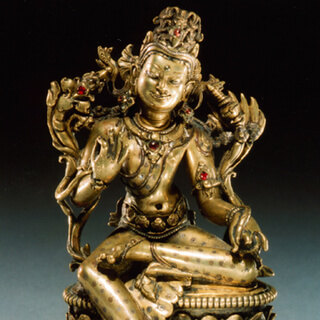
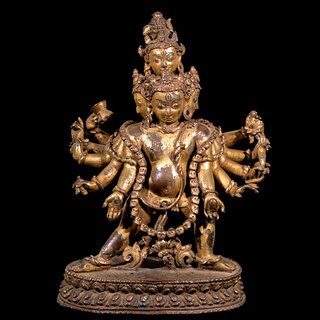
Including an image of a related artwork chosen from the Rubin Museum's permanent collection.
And now,
Please enjoy your practice.
Hi,
Good afternoon,
Everyone.
Welcome to the Rubin.
My name is Dawn Eshelman.
It's so nice to be here with all of you for our weekly mindfulness meditation practice.
And we've been talking this month all about wisdom.
This is within that larger framework of a year-long discussion we're having all about power,
Power within us and between us.
And certainly wisdom plays an important role in the power that we bring to our lives and to any given situation,
Especially through the lens of Buddhism and Tibetan Buddhism.
So we're exploring that this month and taking a look at pieces from our collection that exemplify that,
Like this one right here.
Is it happening?
Yes,
Good.
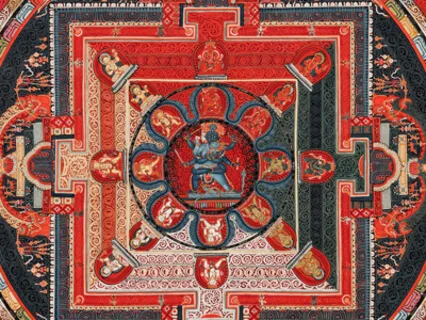
And this is a mandala of Heruka Krishna Yamari.
This is from central Tibet,
15th century,
On the second floor of our collection.
And in fact,
At the very center of this mandala is a being,
Heruka Krishna Yamari,
Who is actually a wrathful emanation of Manjushri,
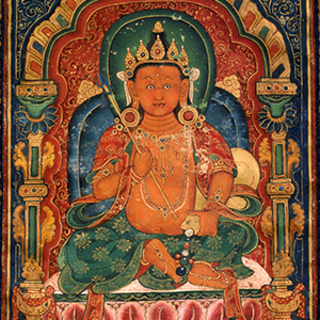
Who if you have come now and then you will have seen Manjushri as a kind of a constant friend in this room.
This is the Bodhisattva of wisdom.
And so this is a wrathful emanation of that.
And in fact,
At the center we see the wrathful Manjushri.
And if you remember,
Manjushri is often pictured with a sword,
Ready to cut through ignorance.
And in fact,
This being with six arms has a couple swords,
Just to be extra effective there,
And is an embrace with his consort there.
And often when we see this representation of a deity and consort,
The sort of overall automatic symbolism there is this union of wisdom and compassion.
And that is,
You know,
This core,
Fundamental core pairing of values that are really the way to enlightenment from the Buddhist perspective.
And I think it's always helpful just to remind ourselves about this,
What a mandala is.
And it is in fact a bird's eye view of a palace.
So we're looking at a kind of landscape here from above of a palace.
You can see that there are four entry points here.
They're called gates here.
And then we can move into each subsequent layer until we reach the very center.
And this is also thought to be a depiction of the cosmos.
There's a lot going on here,
Right?
But in terms of structure and pattern,
That is what is seen.
And often this type of mandala,
And in fact this particular mandala,
Is used by practitioners of a certain level during a meditation practice.
And they can envision themselves moving through these spaces and actually becoming the deity at the center.
We won't do that today,
But we can think about it.
And it's great to learn about the ways in which these pieces are actually utilized.
So we will talk a little bit more about this idea of wisdom and what it has to do with our practice with our wonderful teacher,
Sharon Salzberg,
Who is back with us.
And let's see,
You all know Sharon,
I think,
As just an incredible teacher,
Very beloved author of books like Real Love,
The Art of Mindful Connection,
And Real Happiness,
The Door of Meditation,
Among others.
You can find them in our shop and all over the place.
And it is always a treat to have her back.
So please welcome her back to our stage,
Sharon Salzberg.
Hello.
Wow.
So how many of you are here for the first time?
It's fun to ask that.
I have fun anyway.
How are you?
Hot?
I have friends,
I was just saying earlier,
Who during the blackout,
My apartment is pretty close to here,
So it's below blackout level.
I have all these friends who texted me from everywhere,
Like,
Are you OK?
And I thought,
I think I'm OK.
I didn't know what was going on.
And then I saw it on Twitter,
And I thought,
Oh,
That's what they're talking about.
It was very funny.
So wisdom.
I've just been writing about this very classical construction in meditation,
And in the context of the Buddhist tradition,
Where the language is Pali,
Rather than Sanskrit.
This is the earliest schools of Buddhism.
And in Pali,
There is a word Sati,
Which is usually translated as mindfulness.
And it's actually commonly used as a compound.
It's Sati,
S-A-T-I,
And then the word Sampajanya,
S-A-M-P-A-J-A-N-N-A,
Which means clear comprehension.
And that part hasn't sort of made it to the States very much,
Or to the West altogether.
But as I was learning in India in the early 70s,
It was often the compound that was employed,
Sati,
Sampajanya,
Mindfulness and clear comprehension.
And clear comprehension meant a number of different things.
It was not necessarily discursive,
Because that would just lead to distraction and endless thinking,
And often a lot of anxiety.
If you're thinking,
Oh,
I don't know why I have that thought,
That's really an interesting and nasty thought,
I'm hopeless,
Really.
You know,
What am I going to do?
Well,
There's nothing to do.
But maybe I can see a therapist.
That's different than the sense of clear comprehension.
It's kind of a pretty direct observation,
But it has this quality of analysis to it.
Like you have this tremendous desire that comes up,
And you pay attention to it.
And the mindful part of it has this be with it without being afraid of it,
And without being ashamed of it,
Without judging ourselves,
Which opens the door for a kind of critical look.
Like,
Actions are consequential.
You know,
It's a rush to have the feeling,
But things like this,
Actions like this,
Lead to a lot of suffering.
I know that from my own experience.
I know that from just seeing others.
And it's not as long as that,
But it's a kind of knowing that comes from observation.
And it makes things very interesting,
Because we tend to be fed a lot of myths in our lives,
Through society,
Through family structure,
Certainly,
And cultures.
And there's a certain sense of needing to step back from all of these things just to see for ourselves.
Like,
Is vengefulness really that strong?
Maybe we've been taught that forever.
But you actually take a look at the mind state,
What it's doing in your body,
What it feels like,
How few options it gives you,
How little creativity can exist in that space,
And you think,
I don't think so.
And that's not like punishing yourself for what you feel,
Or saying it's wrong,
Or,
You know,
Chastising yourself endlessly.
It's understanding things from your clear seeing.
Is compassion really that stupid?
You know,
So many of us are brought up,
Or we've absorbed in some way,
That myth and that perspective,
Like,
This will make you weak.
It's being sentimental,
Or generosity is for suckers,
Or whatever it is,
You know,
That it's a dog-eat-dog world.
And you see these different states come up,
And you get the chance to look,
And you think,
Wow,
That's interesting.
Or maybe the nature of the situation,
Of the circumstance,
Is not exactly as you would thought.
So I often use the example,
I'm sure I've used it here many times,
Of sitting and looking at my own fear.
And so one of the things I've observed is that,
In spite of the world's kind of pronouncement that we're afraid of the unknown,
Which of course is also true,
I've seen that I'm much more afraid,
I tend to be much more afraid when I think I do know,
And it's going to be really bad.
It's like,
I'm sure the air conditioner won't work on Sunday.
Like what's going to happen?
You know,
I have these people visiting with a two-year-old,
Like,
It's going to be a disaster.
And it'll be worse in the afternoon,
Even than it is in the morning.
Maybe everything will break down because it's so hot.
Maybe the windows will melt.
And so we can do that kind of thing,
Right?
And I see that when I do that,
When I kind of enter that arc of storytelling,
That's when I get really afraid.
And even in the midst of that,
If I remind myself,
You know what,
You don't know,
I feel relief.
I feel space.
So the insight or the wisdom I got was that,
For me,
It's not so much being afraid of the unknown.
That's actually the relief,
When I remind myself,
You know what,
You don't know.
My recent variant on that,
This last winter,
Was that I'd see my mind kind of catastrophizing in some way.
And I would say to myself,
Why are you rehearsing that?
Like,
I don't know,
Are you going to fall?
It's like,
What?
It's like you say it enough times,
As though you know it's going to happen,
And you're kind of getting ready for it.
And it hopefully will never happen.
And so you've wasted all that time,
And it's miserable.
Right?
So that's a kind of insight or wisdom that's very personal.
You see how things work,
How they feel,
Choices we have to make.
We have clear comprehension,
Like,
Oh,
Yeah,
Desire's really strong,
But stealing that thing is not going to feel good.
Or there's a very classic sort of experience people have with any kind of introspection,
I think,
Where we get to see,
Oh,
You know,
I told that lie,
And I blew it off,
And I thought it was nothing.
Or I said that thing behind that person's back,
And I thought it was nothing.
And like all these years later,
It's still there somehow.
And you think,
Oh,
Look at that.
It actually landed somewhere in me.
It didn't disappear.
Actions don't disappear.
They have some kind of effect.
I've been a little bit more afraid or feeling more separate or something.
And so we have a real basis for our own choices in terms of ethics or how we want to be,
Because we can see with clear comprehension,
Oh,
Look at that.
Who would have imagined all these years later that's still rolling around?
So we have all kinds of insights or wisdom on that level of actions are consequential.
Look at how this particular emotion works in me.
Look at how another classic example would be.
Look at how much helplessness is underlying this anger,
This sense of helplessness,
Which is so abhorrent to us and so difficult to be with.
So we reach for anything that we feel would give us a way out of it.
And then,
Of course,
We have wisdom that is more universal.
So let's continue that example for a moment.
You feel a wave of anger as you're sitting.
The mindful part is that you don't fight it.
You don't dive into it like I'm such an angry person and I always will be.
You don't try to push it away,
But you can open to it and be with it.
And that allows the clear comprehension.
Look at this.
Let's see how many feelings are really inside this anger.
Oh,
There's sadness.
There's fear.
There's grief.
There's a sense of helplessness.
And look at that.
They're all coming and going.
This anger,
Which I considered such a solid,
Unremitting,
Oppressive quality,
It's actually like an alive system.
It's moving.
It's changing within itself.
There's space in there inside that.
Look at that.
And that leads to insights into the truth of change,
That everything in our experience is changing.
It's moving.
It's shifting.
There's nothing solid.
There's nothing permanent.
And because every experience,
Internal and external,
Is said to share that characteristic,
It's like a characteristic of life,
We can use any experience to understand something more deeply like the truth of change or other kind of universal characteristics,
But let's say change.
And that's an interesting twist,
Because what that means in terms of meditation practice is that since the ultimate goal is insight or wisdom,
And certainly wisdom about the universal characteristics of life,
Like constant change,
And everything is going to exhibit it if we're looking at it kind of clearly and cleanly,
There's actually not a preference for one object over another,
Right?
It's like we can see the truth of change looking at bliss and looking at sorrow,
Looking at physical pain,
And looking at joy.
Whatever we're observing actually has this characteristic and can be a vehicle for our wisdom or insight.
Now,
I mean,
We're human beings,
Right?
If somebody said to me,
Would you rather have a deep insight coming from into the truth of change,
Coming from looking at bliss or looking at pain,
I'd say,
Bliss.
But since no one gives us a menu,
Hopefully that thinking that way is kind of a relief,
Like,
Oh,
I don't have to trade in my inferior miserable experience for something glorious and better,
And then I can be mindful and learn something.
It's like the learning is all along,
And we don't have to pick and choose and feel bad about what our experience is.
We just have to utilize it in such a way so that we're really present with it,
And we're creating the opportunity for insight or wisdom to arise.
So let's sit together.
If you want to just settle your attention on the feeling of the breath,
The normal natural breath,
See if you can pick up the sensations of the breath.
You don't have to name them,
But if you're with the breath of the nostrils,
It may be tingling,
Vibration,
Warmth,
Coolness.
If you're with the breath of the chest or the abdomen,
It may be moving,
Stretching,
Tension,
Relief.
Again,
It's not to name that whole array,
But to feel it.
Just bring your attention to the place where the breath is strongest for you or clearest for you,
And simply feel it.
If something comes up that's not very strong,
A thought,
Image,
Sensation,
Whatever,
Then you can stay connected to the feeling of the breath.
You can just let whatever it is flow on by your breathing.
Something comes up that is really strong and it pulls you away,
Once you realize it,
Spend a moment just recognizing,
Oh,
This is what's happening right now.
There's just joy.
There's anxiety,
Whatever it is.
No judgment.
It's just recognition.
This is what's happening right now.
And see if you can bring your attention back to the feeling of the breath.
And if you find you're just gone,
You've fallen asleep,
Or you're way lost in thought,
You can use that moment when you realize that as the opportunity to let go and begin again.
Just bring your attention back to the feeling of the breath.
Thank you.
.
.
.
.
.
.
.
.
.
.
.
.
.
.
.
.
.
.
.
.