Welcome to the mindfulness meditation podcast presented by the Rubin Museum of Art.
We are a museum in Chelsea,
New York City that connects visitors to the art and ideas of the Himalayas and serves as a space for reflection and personal transformation.
I'm your host,
Dawn Eshelman.
Every Monday we present a meditation session inspired by a different artwork from the Rubin Museum's collection and led by a prominent meditation teacher from the New York area.
This podcast is a recording of our weekly practice currently held virtually.
In the description for each episode,
You will find information about the theme for that week's session,
Including an image of the related artwork.
Our mindfulness meditation podcast is presented in partnership with Sharon Salzberg and teachers from the New York Insight Meditation Center,
The Interdependence Project,
And Parabola Magazine.
And now,
Please enjoy your practice.
Hello and welcome to mindfulness meditation online everybody with the Rubin Museum of Art and my name is Dawn Eshelman.
We are a museum of Himalayan art and ideas in New York City and so happy to have you all joining us for our weekly meditation program,
Which is where we combine art and meditation online together.
So for today's session,
We will,
As usual,
We'll take a look at a work of art from our collection.
We'll hear from our wonderful teacher who today is,
I'm so happy to have her back,
Kate Johnson.
Then we'll have a short sit guided by Kate about 15-20 minutes.
So let's look at a work of art together and we're talking this month about generosity and this is a time of year where we're thinking about giving a lot and happy Hanukkah to those of you who are celebrating and so much beautiful giving,
So many evenings and gifts in that tradition and the object that we're looking at today is a beautiful,
Intricate,
Small sculpture.
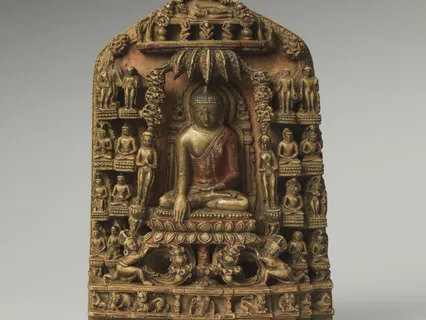
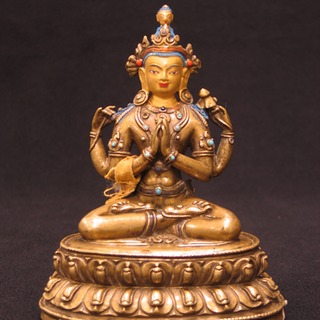
This is the major events of the Buddha's life and this is a sculpture out of stone with pigments painted on it and it's just about six and a half by four and a half inches.
So if you were to take just a regular sheet of paper and fold it in half,
It would be just about that size.
And this piece really takes us to this northeastern Indian village of Budh Gaya,
Which is where the Buddha sat and meditated for many weeks until that very moment where,
As the story goes,
He became enlightened and he touched his hand to the earth as a kind of wish request that the earth would witness him and it was in that very moment that he became enlightened.
That was it,
That moment of connection and many,
Many things that led up to that,
Of course,
But here in the sculpture we're seeing that moment depicted and it's often in this posture,
The seated posture of meditation with one hand turned upwards resting in his lap and his right hand,
His other hand reaching in front of his leg and touching down on the earth.
It's often how we do see the Buddha depicted is this clear reference to this moment in time.
And the sculpture kind of takes us back to this moment because it depicts this moment,
But it takes us back to this place also because we know because of its size and some other elements that this is really a portable sculpture and it's something that helps us remember that this is something that was likely carried back and forth on a pilgrimage and is meant to be carried,
It was meant to be portable.
So in Buddhism,
Practicing generosity is believed to help not only be a good thing,
But also help train the mind in a way that is conducive to attaining enlightenment and by giving away what's valuable,
The opportunity is to let go,
To reduce your attachment and learn to let go.
So let's bring on our teacher today,
Kate Johnson.
Kate works at the intersections of spiritual practice,
Social action and creativity.
Hi Kate.
She's been practicing Buddhist meditation in the Western Insight and Theravada tradition for many years and is empowered to teach through Spirit Rock Meditation Center.
She holds a BFA in dance from the Alvin Ailey School at Fordham University and an MA in performance studies from NYU.
And she's a core faculty member of the MIT Presencing Institute.
And we are so happy to have her here with us today.
Over to you,
Kate.
Thank you.
Gosh,
It's so good to be here.
Yeah,
And it feels like a special time of year,
You know,
As we're moving towards the darkest night of the year.
It's a real natural time for our minds,
Our awareness to start moving inward.
And so I'm glad we have this opportunity to discuss,
You know,
A little bit of the inspiration from this amazing artifact and to meditate on some of those themes.
I would love to just pick up a little bit of what Don was introducing us to in terms of this,
The stories of the Buddha's life and how the Buddha,
The circumstances that led up to awakening and this famous earth touching gesture that's depicted in the image.
So yeah,
As many of you probably know,
The story is that the Buddha was a prince,
A son of a Brahmin.
He had a job as a kind of head of state.
And at some point became,
Even though his life contained all the material pleasures that were possible at that time,
Became kind of dissatisfied with materiality as a source for lasting happiness and was looking for something more intrinsic and deeper,
More true and less fleeting.
And that resulted in a period of many years of wandering the earth.
He dove into ascetic practices that were really about kind of denying the body and the needs of the body in some ways in order to free the spirit to get all kinds of very intense yoga practices.
And at one point he was really close to death,
Actually.
He had taken on a practice of eating very little.
He was surviving on something like one grain of rice a day,
Which certainly wouldn't work for me.
And wasn't getting closer to liberation,
Wasn't getting closer to this intrinsic satisfaction and wellbeing that he had gone out to seek.
And of course you can imagine at this point he might've been feeling a little bit like a failure.
He left a great job,
A family,
All of these riches in order to pursue this dream of freedom.
And here he is,
Six plus years later and he hasn't gotten any closer and he's given up a lot.
So in this moment of,
I imagine feeling like a failure,
He decides,
Someone comes to him,
A young woman comes to him and offers him some rice milk,
Which he decides to take.
And he having had this bit of nourishment,
Sits down and has a spontaneous memory of being a child and sitting under a tree and having a spontaneous meditative experience where he was feeling loved and feeling safe.
And his mind just spontaneously gathered and collected and became protected in a way that he remembered,
In some teachings they call this the platform of joy,
That way back in his childhood,
He had this kind of preview of what was possible through the mind.
And so there's something in him that says,
Let me follow that actually,
Rather than following these dudes that are doing all of this really wild,
Intense,
Sometimes painful practices with our bodies.
What about just,
What about sitting down?
So he,
As Dawn mentioned in the story,
Sits down under a tree in Bogai in India and begins to collect his mind in much the same way he spontaneously did as a child.
And of course he's done all of these years of practices,
Which I'm sure accumulated in a way that made this level of concentration possible for him.
But when he is sitting for several days and getting very close to complete liberation of heart and mind,
Which is also love,
He is visited by a God named Mara.
And Mara is a God who was said to govern the realm of the senses.
And Mara sees that he's about to get enlightened,
Which means he's going to leave his belief that sensory experience and that the material realm holds the key to happiness.
And Mara doesn't want that.
And so he sidles up to the Buddha and the first thing he,
He tries a series of assaults.
Right?
So the first thing he does,
He pretends to be a compassionate person.
He says,
Oh,
Buddha,
Or I'm sorry,
He's not,
He's not the Buddha yet.
He's not enlightened yet.
Oh,
Siddhartha,
You know,
You have been sitting so diligently for so long.
You must be tired.
You can probably take a break.
To which the Buddha just sits,
Right?
He's done all of this training,
This kind of masculine,
Spiritual warrior training.
So he just sits there.
He doesn't even listen to what Mara is saying.
He's like,
Whatever,
Whatever dude.
And then second,
Mara says,
Okay,
Okay,
Well I'm going to send my armies in.
And he starts sending in armies of warriors to try to scare the Buddha off of his seat,
Basically to break his resolve.
And the Buddha again has done all of this training,
All of this aesthetic practices.
He says,
Steady and firm.
And as the arrows of Mara's army come towards him,
They start to turn to flowers and fall at his feet.
So then Mara says,
Okay,
And ups the ante.
And he sends in his daughters who are these beautiful maidens.
They start dancing.
They're trying to seduce the Buddha away from his seat.
And the Buddha is just like,
You know,
He's been working on sublimating all of his physical desires for years.
So he's like,
Not concerned with that at all.
He sits there,
Sits there.
And finally,
Mara says,
Okay,
Well,
You know what?
I'm the one who should be sitting on that seat,
Not you.
I'm a God.
Who are you?
You know,
Really,
Why don't you just give up and let me take it?
You know,
I'm a better candidate for enlightenment anyway,
Basically.
So his last assault is to bring in doubt.
And the Buddha in the story,
You know,
Starts to experience a little bit of a wavering there.
And as you know,
You know,
Those of you who practice and are familiar with these teachings,
Doubt is said to be one of the hardest of the hindrances to overcome because it masquerades as the truth.
And we have a doubtful experience,
Especially doubt about our own capacity,
Doubt about our collective ability to become liberated.
It sounds to us like the truth,
But it's not.
But from within that doubting place,
It's so hard for the mind to see.
So in that moment of almost being shaken from his seat,
The Buddha takes his hand and touches the earth.
And that's how we see this earth touching gesture.
And in my,
You know,
The tradition that I've been trained in,
The Western Theravada tradition,
We say that the earth,
He touches the earth and the earth shakes as a way to witness him,
A testament to his capacity to awaken.
In some other traditions,
It's said that the Buddha touches the earth and the earth actually manifests as a beautiful woman whose hair is long and she creates this torrential rain from her hair that washes away Mara and all of his armies.
So what I want to bring up here is this kind of what Don mentioned is this moment of connection that the Buddha finally,
In order to attain enlightenment,
He can't do it alone.
This whole years he's been away from home,
He's trying to do it all by himself.
And in this moment,
He actually reaches out for partnership with the earth,
Which in every tradition is represented with a feminine principle.
There's actually this moment of reaching out for partnership with the divine feminine in a way that allowed the Buddha to stay long enough to achieve this liberating insight into his own mind and heart and into the nature of freedom and to produce all of these teachings that are still practiced by so many around the world.
So that in a way is this ultimate act of generosity and we see how much the earth is.
The earth is such an embodiment of generosity.
It keeps giving whether we pay attention to it or not,
Although hopefully we'll pay attention a little more in the years to come.
So I wanted to incorporate this story and this image,
This principle of the earth in our meditation today.
Thanks for bearing with me through that story.
I hope it inspires your practice.
The practice will be simple.
We will settle in our bodies.
I'll guide you through that.
I'll invite you to pay attention to the feeling of breathing today.
And I'll invite you to do a practice that's known as noting.
So sometimes we just feel the breath coming and going.
Today I'd really like you to note in your mind what part of the breath you're on.
So when you're breathing in,
You would silently say to yourself,
Just gently breathing in.
And when you breathe out,
You'd silently say to yourself,
Gently breathing out.
And then at the end of the out breath,
I'd like you to note the inner gesture of touching the earth.
So this could actually be that you keep your hands somewhere lower down and you just pay attention to the feeling of your hand touching the ground.
Or it could be the sense of your feet touching the floor.
Or it could just be energetically the sense of kind of dropping down.
So the rhythm of the contemplation will be something like breathing in,
Breathing out,
Earth.
Breathing in,
Breathing out,
Earth.
This is inspired by the Vietnamese son teacher Thich Nhat Hanh who does a similar practice.
So please go ahead and join me in finding a comfortable seat.
You can close your eyes or softly focus them to the space in front of you.
And let's start with just a few deeper breaths to ventilate our experience.
There are a lot of words before we meditated today.
So allowing those words and the stories to kind of dissolve or hang in the background of your mind.
And bringing the present moment sensation of your body into the foreground of your experience.
And before we dive into the meditation instructions,
Just taking a moment to reflect on your own aspirations for freedom.
Very few of us start meditating because we just need something to do and have all this free time.
There's often this wish in our hearts to not suffer,
To be happy,
To be more free and therefore more available for life and service.
So see if as you sit here and start to settle,
You can connect with your own wish for freedom and liberation as in the story the Buddha did.
And to reflect on any moments where you actually have experienced that sense of well-being,
Non-distraction,
Lightness,
Ease,
Comfort,
Love.
So that we remind ourselves that this is actually possible for us and we have actually experienced it in this lifetime,
Even in moments.
And finally,
Take a moment to reflect on the people,
The teachings,
The energies that have supported you,
Partnered with you,
That you've connected with in this seeking for deeper ease and peace.
Who or what has been your Earth in moments of doubt.
And see if it's possible to connect with that energy of what it's like to be supported and held whether by the Earth itself,
By a teacher,
Advocate,
Beloved pet,
Someone we love.
And we'll integrate that principle as the Earth principle,
The generosity of the Earth in our meditation practice.
So I'll invite you now to turn your awareness towards the feeling of breathing,
Which of course you've been doing all this time.
So no need to make it different than it is.
It's already special.
It's already perfect.
And turning our awareness to it as a way to appreciate it and to allow the mind an opportunity to connect with the present moment experience of the body and to rest in it.
And starting to feel what sensations arise when you breathe in.
Sense of cool air,
The sense of fullness,
Opening,
Rising that comes with breathing in,
And the sense of warm air leaving,
Softening,
Emptying out,
Deepening,
Resting that comes from breathing out.
And notice too,
At the end of the out breath,
The rest,
The pause,
On empty before the next breath naturally comes in.
These are parts of the breath that are already happening.
We don't have to make them happen.
The pause may be microscopic or it may be longer.
However long it is is fine.
And I'll invite you to note mentally what's happening as it's happening.
So as you breathe in,
You'll say to yourself silently breathing in.
As you breathe out,
Silently say to yourself breathing out.
And in that moment of pause at the end of the out breath,
Silently say to yourself earth.
And touch into this principle of generosity,
Of witnessing,
Of support and connection that is represented by the earth,
That you may have felt in relationship in your own life.
And then the next breath comes in,
Breathing in,
Breathing out,
Earth.
Breathing in,
Breathing out,
Earth.
I'll let you continue on your own in this way for a few minutes.
Good night.
You you you you you I'm just noticing that even when our mind wanders into thought the Breath and the earth are always still there.
So we just have to turn our mind again to face them and There we are a moment of connection breathing in breathing out earth you you you you you you And now as we move into the last few Minutes of our practice see if you can maintain your meditation seat Maintain your feeling of connection with the earth Opening up your awareness again to be the Generosity you've received in the support For your path of freedom and liberation of peace Whether in the form of a natural Resource like the earth or the ocean the trees the sky Animals Whether the support of other human beings ones you know or ones you don't know You sensing into the great richness that has allowed each of us to have the time and the energy and the intention to sit down today in the middle of our lives Perhaps even difficult circumstances can be seen as a Inspiration in this way And as you feel that sense of heaven received Generously from this earth Any of its beings From this earth any of its beings Notice that there's also a rising you a arising in you a feeling of Desire to reciprocate to give back in some way This relationship between Gratitude for having received much and generosity of wanting to give back And if there's anything arising in you in terms of What you'd like to give or who you'd like to be in service to or how in this place of Liberated activity Just take note of that what's coming up for you What do you feel called to give or who do you feel called to serve?
As a result of all that you've received You you And then letting that question go,
You know,
Whether it generated an answer or not coming back to your feeling of breathing resting on the earth And I'll ring a bell to close our formal practice now You So when you're ready feel free to open your eyes Look around your space stretch your body out Thanks so much for being willing to practice today and Thank you all so much.
Take good care.
Bye that concludes this week's practice If you would like to support the Rubin and this meditation series,
We invite you to become a member Thank you for listening.
You