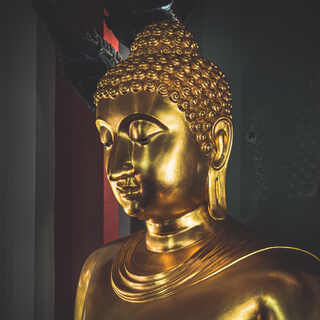
It is Magha Puja Day,
The full moon day of the third lunar month.
It is the day when the Arahant monks,
Ordained by Ehi Bhikkhu Upasampada,
Monks who had been ordained directly by the perfectly self-awakened Buddha,
Gathered together at Veluvana Monastery without prior appointment and assembled to recite the Patimokkha.
The Patimokkha on that day was one of complete purity.
The Buddha presided and all the disciples were Arahants.
More importantly,
The Buddha established the core principles of his teaching.
He laid down the essence of his teaching that would be principles of practice from that time until the present day.
And we have probably memorized it by heart since childhood when we learned the principles of Buddhism.
The non-doing of any evil deed to accomplish what is good and wholesome,
To fully purify the mind,
Which we call the importance principles.
Now let us look at this importance principle of the non-doing of any evil or unwholesome deed.
This means we must refrain,
We must restrain ourselves,
We must abstain from whatever is bad or incorrect.
We first refrain from it.
We restrain the mind.
We must abstain from actions bodily and verbal.
This is called the coarse defilements that arise.
The Buddha directly taught us not to do any evil or unwholesome deed.
The evil or unwholesomeness that arises through body,
Speech,
And mind.
We must abstain from it to endure it patiently.
We must try to abstain,
To refrain from such actions through body,
Speech,
And even when they arise in the mind,
We must try to abandon them.
We must reflect and see the harm in it.
If we don't see the harm in what we do,
What we say,
Or such thoughts that are unwholesome,
If we don't recognize it,
Then we will not be able to restrain ourselves and we will act according to our desires without any forbearance.
To restrain ourselves feels troublesome,
While following our impulses feels more comfortable,
But it brings many harmful consequences later.
If we don't forbear,
If we don't refrain from such actions,
What will happen?
We can probably see that in society today,
Restraint and foregoing are very rare.
Why is that?
Because the mind is not calm,
Not firmly established.
Emotions take the lead and pull or drag the mind to act according to our feelings.
Nowadays there may be new terms like following the voice in our head.
It's not a voice in our ears,
But a voice in the head.
So we say one has lost out to the voice in our head.
The voice in our head is the kind of thoughts that drags our mind downwards,
And we end up losing to that voice in our head.
So we act according to it,
Speak according to it.
We let it think and fabricate in that way.
Then confusion and trouble arises.
Even on the roads,
People driving,
Cutting others off,
And soon there is conflict,
Even to the point of fighting and eventually physical violence.
One person has a weapon,
A knife,
The other has a gun.
In the end,
They destroy each other's lives.
This is losing out to the voice in the head that commands.
That voice in the head refers to delusion.
It orders us to act that way,
And we do not see the harm nor the benefit of having to endure,
To refrain,
To control the bodily actions and speech.
Therefore,
A good person can train in it,
But for an ordinary person it is difficult because they will not train at all.
If one keeps acting like this more and more,
It will be no different from the delusion of animals who have no forbearance towards their emotions.
For a human being to become more excellent and better,
One must be different from animals in general.
The difference lies in being able to endure,
In using mindfulness and wisdom to reflect and to see the harm and to see the benefit of that forbearance and restraint.
So we try to refrain from what we do,
Preventing ourselves from acting on it.
Thus it is said to be an ideal of life or a goal of our life that we must train in.
Even though we study a lot,
Study academic subjects to pursue various professions,
But we must also study another subject as well,
So that our heart has a good ideal and a clear goal,
Not running after the voice in our head.
This is called having forbearance.
This forbearance in the present day has become even more difficult and more demanding than in the past.
We have to be able to forbear.
This is our austerity to burn away the mental defilements.
Forbearance is a virtue.
It is a quality of practitioners,
Ascetics and meditators.
They must have this austerity,
Which is restraining oneself against sensory objects,
Against greed,
Anger and delusion,
Which arise easily.
Because we receive more sensory input than before,
Now we have communication,
Devices,
Smartphones and many other things in there.
Information is known worldwide and we receive it all.
And as research has shown,
Concentration has become shorter.
Those who keep their focus on their phones a lot,
Who stay in the online world a lot,
It causes their concentration to become shorter.
Nowadays it becomes even shorter.
Intelligence decreases,
IQ decreases,
Because people no longer think for themselves.
When they cannot think of something,
They go and ask AI.
When they cannot think of something,
They go and ask chatGBT and so on,
To seek the knowledge it has processed.
And in the end,
People admit that it processes better than we do,
So we accept it.
Once we accept it,
We don't have to think much,
And we are even willing to pay money.
Eventually,
Our own mindfulness and wisdom decreases,
Because we lack our own thoughts and reflection.
Forbearance decreases,
Wisdom decreases,
And the inner austerity in the heart also decreases.
Therefore,
Good people must train themselves,
And especially practitioners must forbear the various sense objects and moods that come to make the mind gloomy.
This is done by training in mindfulness,
Training in Dhamma,
Practicing in accordance with the Buddha's teaching to abandon all evil deeds.
When unwholesome actions arise through body and speech,
We train to abandon them.
When unwholesome states arise in the mind,
We must train even harder than before.
This is because we have the highest goal of inner peace and happiness.
In the present moment,
If greed,
Anger,
And delusion arise and cover our mind,
The mind becomes hot.
If the mind is free from greed,
Anger,
And delusion,
Even temporarily,
The mind becomes cool.
That coolness is equivalent to entering Nibbana,
Which means to be cooled.
It is cool right now.
There's no need to wait to reach Nibbana,
Where the mind is pure and completely liberated.
We have not yet reached that point,
But we gradually train ourselves to temporarily abandon greed,
Anger,
And delusion.
Even if it is a temporary Nibbana,
We see the coolness arise,
And we will think that we must train to extinguish this suffering.
If we train to extinguish suffering in this way,
Then all of us can become renunciants.
When we have declared ourselves followers devoted to the Buddha,
Then we are practitioners of merit and wholesomeness,
And then we must not harm anyone,
Must not oppress anyone.
This practice arises from cultivating metta,
Loving-kindness meditation.
The quality of forbearance means having sila,
Moral discipline,
Not harming anyone,
Not speaking badly,
Not wishing harm to anyone.
There is forbearance and restraint,
And having loving-kindness meditation together with moral precepts.
And then what happens?
The summoner,
The renunciant arises.
Calmness arises.
Calm in the body,
Calm in speech.
This is called summoner,
And it arises within our mind.
Do you see?
This is abandoning evil.
And,
If we are to make merit,
Then we must create it.
Earlier we had to restrain and forbear,
And the next point is to accomplish what is good and wholesome,
So we must create it.
Wholesomeness does not just arise by itself.
Kusala means skillfulness or wholesomeness.
It does not come from staying still and doing nothing,
And then the merit or wholesomeness will arise.
It's not like that.
We must act on it.
We must create it.
As for external things,
Do we need to build them?
We study,
We must build it.
We build mindfulness,
We build wisdom,
And with the foundation of having forbearance and perseverance.
We think that studying was difficult and that our work life will be comfortable,
But working is not comfortable either.
In every profession we must forbear,
To endure again,
To restrain ourselves again.
The higher the salary,
The higher the position,
The greater the burden is and the responsibilities.
One must endure more than others to be able to do it.
One must have mindfulness and wisdom.
That's how it is.
And the same applies to the mind.
If we want our mind to improve,
We must build it.
We build merit,
Build goodness,
Practice generosity,
Uphold morality,
Cultivate meditation,
Make the mind peaceful,
And we help society.
All of this is merit and goodness,
And it brings fullness and joy to the heart.
Sometimes when we make merit,
It does not have to be much,
But once done,
The heart feels full.
Being economical and frugal,
Saving little by little,
This is not the same as being stingy or miserly.
It is different.
A frugal person has wisdom and uses wealth with mindfulness and wisdom.
When wealth is used in that way,
The heart feels full and happy because one has helped those who are suffering,
Those who are lacking,
Who are poor,
Lacking food,
Clothing,
And shelter.
In these various ways,
Even if we do not give much,
The heart can still feel full and happy.
Understand that at the moment of feeling full and joyful,
We have created merit,
We have created wholesomeness,
We've cultivated our heart.
In that moment,
Greed,
Anger,
And delusion cannot arise,
And then the mind becomes bright with wisdom,
And wholesomeness arises.
If we create wholesomeness like this frequently,
To accomplish it fully,
It means practicing meditation,
Practicing mental cultivation.
This is the highest kind of merit.
Giving and feeling this fullness of heart is already meditation.
Keeping precepts and feeling uplifted is already meditation.
Giving,
Keeping precepts bring all kinds of good deeds.
When we recollect them and feel fullness of heart,
That is meditation.
When the mind is peaceful,
It can reflect on it the whole day,
Reflecting on coming to make merit,
And offering alms on every observance day and every Saturday and Sunday.
When we are at home,
We can think of and recollect the goodness,
Feeling fulfilled and happy in the heart.
We must be able to think in this way.
We must think of it often.
When we think of it often,
The feeling of fullness arises often,
And merit arises often.
Our mind will gradually become more complete,
Little by little.
It becomes bright all around.
Because when the mind has defilements,
It becomes dark.
When merit and wholesomeness arises,
It becomes bright,
Brighter and brighter.
When our mind becomes bright all around,
It can become full.
The mind becomes calm,
Reaching momentary concentration and access concentration,
And wisdom arises.
When wisdom arises,
We are aware of the sense and mental objects as they arise in time,
And are not deluded by these sense and mental objects that come to deceive us.
We can forbear.
This forbearance is not only about enduring the weather or external things.
We first endure in the use of our time.
If the way we spend time does not bring much benefit,
We abandon and refrain from those things.
Those things that have value,
We don't let the defilements destroy our time in it.
On Magha Puja Day,
May we recollect this day and practice the Dhamma.
Because the Dhamma,
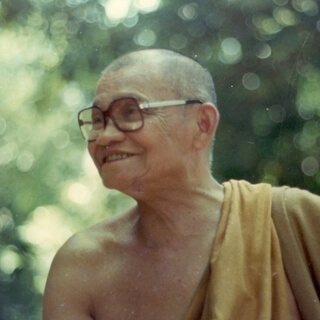
As Venerable Ajahn Chah said,
It is timeless.
The Dhamma does not become outdated.
Even when practiced in the present day,
One will experience the taste of the Dhamma.
All other tastes,
Food,
Do not last long.
Sabba Rasang Dhamma Raso Jinnati The taste of the Dhamma excels all tastes.
Therefore,
We must study and reflect so that the Dhamma arises in our hearts.
The taste of the Dhamma will remain within our hearts.
If we have merit and goodness,
Whether in this life or in the next,
When we hear the Dhamma of the perfectly self-awakened Buddha,
We will attain to stream-entry,
Once-returner,
Non-returner,
Or Arahantship.
May you all grow in Dhamma.
May you all grow in blessings.