There's a huge difference between trying out different practices,
A bit of this and a bit of that,
And actually making a home for your spiritual life in a solid tradition.
And while dabbling here and there might seem more free,
Like not really committing to a relationship,
There is a much deeper freedom that comes from giving up the seeking and coming home to your essence within a committed community and practice.
But to do that,
You need to awaken that level of your being that longs to come home,
That isn't seduced by superficial freedom.
In this episode of the Torah Awakening Jewish Meditation podcast,
We'll practice connecting on this level through parashat Mishpatim,
Followed by a guided meditation on the Hebrew letter Tzadi.
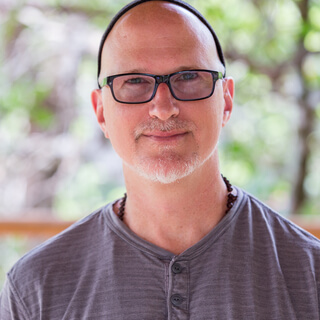
I'm Rabbi Brian Yosef Schachter-Brooks.
Enjoy.
Okay,
So for context,
Here's what's happening in the parasha on the literal level,
Parashat Mishpatim,
Before we get to the deeper level.
The parasha begins with the words,
Ve'elei ha-mishpatim asher tasim lifneihem.
These are the judgments that you shall set before them.
And then it goes on to give various civil laws,
Including laws about slaves,
Which are really indentured servants.
They're not exactly slaves,
But it's sometimes translated as slave.
And also penalties for murder,
Kidnapping,
Assault,
And theft,
Compensation for damages,
Granting of loans,
The responsibilities of the four guardians,
Which is an interesting thing.
The four guardians are different categories for someone who temporarily takes possession of something.
So,
For example,
The unpaid guardian,
Someone who takes something from you to watch it for you,
But you're not paying them.
The paid guardian,
The renter,
And the borrower.
It then continues with the rules governing the conduct of justice by the courts,
And laws warning against the mistreatment of the ger,
Mistreatment of the ger,
The stranger.
And it gives the famous words that are repeated throughout the Torah,
Ki gerim he-yitem be-eretz mitzrayim,
For you who are strangers in the land of Egypt.
It then goes on to ritual laws about the seasonal festivals,
Agricultural gifts to the temple,
The prohibition against cooking meat with milk,
And the mitzvah of prayer.
We also have the special words that we will use in our meditation when the people proclaim,
Na'aseh v'nishmah,
We will do and we will hear.
And here is the verse we're going to look at.
Ki tikneh evedivri,
When you acquire a Hebrew slave,
Sheish shanim ya'avod,
Uva shvi'it yetzeh lechavshi chinam,
Six years they shall serve and in the seventh year they shall go free.
There is a midrash,
An ancient story,
In which the angels come before Hashem with a challenge.
Now that you have given the task of writing down the Torah to Moses,
What is to prevent him from saying that it is he who gives the Torah and not you?
And to that Hashem replied,
Moses would never do such a thing,
But even if he did,
It would be fine.
So the disciples of Rabbi Yitzhak of Vorki,
The Hasidic Rebbe,
Once asked him what this story means,
What does this midrash mean that Hashem says it would be fine if Moses gave the Torah?
And he answered with a parable.
Once there was a merchant who wanted to go on a journey,
So he trained an assistant to work in his shop.
He spent most of his time in an adjoining room from which he could hear everything that the assistant was saying next door.
During the first year,
He sometimes heard his assistant tell the customer,
The master cannot let this go for such a low price.
During this time,
The merchant held back from his journey.
Over the second year,
He occasionally heard his assistant say,
We cannot let it go for such a low price.
But the merchant still postponed his journey.
But in the third year,
He heard his assistant say,
I cannot let this go for such a low price.
It was then that he knew he could leave the shop in his assistant's care and begin his journey.
So what does this all mean?
The merchant's assistant,
Gradually coming to identify with the merchant himself,
Points to an inner transformation.
That is,
From thinking of the divine as something separate,
Thinking of God as something external,
Something separate,
To knowing the divine as the deepest dimension of your own being.
This transformation is similar to going from having a boyfriend or a girlfriend to being married and fully committed.
Before marriage,
There may be some commitment,
But at the end of the day,
You're always free to go to your own separate homes.
In marriage,
That freedom is over,
Right?
There is only one home.
Does that mean that marriage is a permanent state in which the relationship is constant and perfect?
Of course not.
Like all living things,
It is in motion.
It needs attention.
It needs nurturance.
And yet,
There is something that changes completely when two people decide to have one life together,
To be one family.
So let's look again at this verse.
When you acquire a Hebrew slave,
Six years they shall serve.
So the thing to notice here is that the word for slave is evid,
Which also shares the same root with ya'avod,
Which means serve.
And then two verses later,
It says,
If his master gives him a wife,
And she gives birth to children.
So in this verse,
The master of the slave is called an adon,
A lord.
But these two words,
Evid and adon,
Also have a completely different connotation.
God is sometimes called an adon,
And a holy person is called an evid Hashem,
A servant of God,
Or even a slave of God,
You could say.
And the ultimate spiritual goal from a Jewish point of view is to become an evid Hashem,
Meaning that your separate egoic self-sense becomes subordinate to the reality of the One.
In this state,
You no longer live for yourself,
You live for God.
In fact,
You don't really live at all,
Because there is no separate you,
There is only God.
Seen metaphorically then,
The Hebrew evid in the Parsha,
The slave who goes free,
Is like someone who has a spiritual awakening,
Some kind of spiritual experience,
But when the experience is over,
They go free from it,
So to speak.
In other words,
We're talking about a temporary spiritual experience.
But then it says,
Im amor yomar ha-evid,
If the slave declares,
Ahavti et Adoni,
I love my master,
Et ishti,
My wife,
Ve'et banai,
Lo etzei chavshi,
I love my children too,
I do not want to go free.
So when the evid doesn't want to go free,
Then they have to do a very strange ritual.
The evid is brought to a doorpost,
Where he makes this declaration that he wants to remain an evid.
His ear is then pierced against the doorpost,
And he becomes a slave forever.
In a similar way,
To become an evid Hashem means that you commit to the root of all reality,
As your Lord,
As your master,
As your God.
Presence then becomes like your family,
Your home base,
The place where you live,
Not the place you merely visit.
Does that mean that now you are a perfect evid,
A perfect evid Hashem?
Of course not.
Just as in marriage,
You can and must work at it.
You have to get better at it.
You have to handle things as they come up,
Challenges as they arise.
And there's a risk.
There's always the risk that failure is possible.
But you have stepped into marriage with the beloved.
All the rituals,
All the practices of Judaism are really expressions of this basic commitment,
This brit,
This covenant with the divine.
How do you take this step?
He shall be brought to the door or to the doorpost.
Now the word for door is delet,
Like the Hebrew letter dalet,
Which has the shape of a person bowing,
Receiving the moment as a divine gift.
And the word for doorpost is mezuzah,
The same as the ritual scroll traditionally fastened to the doorposts of Jewish homes.
And what is the first word written on the mezuzah?
Shema.
Listen.
Why?
The sense of hearing,
Unlike seeing and tasting,
Is the sense that we cannot shut down.
Our ears are naturally always open.
We can't just shut our ears like we can shut our eyes to escape the sounds around us.
Similarly,
We cannot escape reality because there is nothing but reality everywhere.
To step into reality,
Then,
Is actually the most simple thing.
It means dropping the excess commentary of the mind and being with what is as it is.
It means being an open ear.
And this is the deeper hint within our opening verse.
These are the judgments.
At the deepest level,
There is really only one mishpat,
One judgment to ever make.
Commit or don't commit.
Hear or refuse to hear.
Awaken now from the dream of the mind-created self or live within that dream.
This is the spiritual question ever before us.
Are you ready to commit to reality as it steps up to you in this moment?
Are you ready to give up the false dream of freedom from reality and embrace the true freedom which is surrender as an Eved Hashem,
Attentive in the heart of stillness to the flow of life as it unfolds.
This is the path of tzadi,
Devotion to reality,
To existence,
To being,
To God.
And we can bring forth this power within us,
This power of decision,
Of dedication,
Of commitment,
Dedicating ourselves to this basic truth.
Dedicating ourselves to be like an Eved Hashem,
A servant of God.
Let's chant the affirmation together.
I am dedicating.
I am devoted.
I am devotion.
Chanting and our chant from the Morning Blessings,
Attach us to the desire for goodness.
And it's not just a desire for goodness in general or for goodness externally,
But the desire to be the embodiment of that goodness,
To know what our choice is moment to moment,
That we can serve the light,
We can serve that drive,
That Yetzir towards Tov,
Towards goodness,
Consciousness,
Benevolence,
Light,
Love.
Uv ma'asim tovim.
That's the way we do it.
Ma'asim tovim are deeds of goodness.
And so singing,
And preparing for meditation,
Letting your body be in a comfortable,
Unencumbered,
Alert position,
Conducive to stillness.
And bringing your right hand to your heart,
Taking an attitude of generously offering your attention from the heart to the fullness of reality as it steps up to you right now.
Giving from the heart,
L'cha on a long out breath,
Deep breath in.
And bringing your left hand to your belly,
Feeling awareness dropping down into your body,
Permeating your organs,
Filling your belly with consciousness,
Awareness flowing down through your legs,
Down to your feet,
Seeping down into the floor,
Into the earth.
And rising up,
Chest,
Upper back,
Shoulders and neck.
And spilling down,
Arms,
Hands and fingers.
Connecting back with your heart and belly,
Bringing your attention more deeply into the sensation of the flow of breathing.
Bit more deep,
Bit more slow.
Awareness rising into your face,
Facial muscles,
Brain and nervous system,
Bringing a little smile to your lips.
Being the loving,
Benevolent,
Indwelling presence.
Life in the body,
Na'ase,
Deep breath in,
Bringing your right hand to lightly touch your forehead as awareness opens up into the space around you.
Sensing the room,
The walls,
The sounds vibrating in the air.
And recognizing that all of this outer world as well as the inner world of thoughts and feelings are all arising in this miracle of consciousness,
This field of awareness without boundary or border.
And you are this field.
You are this spaciousness.
Deep breath in.
Kissing your fingers,
Relaxing your hands.
Help us to meditate today deeply,
Powerfully,
Letting go of the inner narration.
Attaching our consciousness to the fullness of what is arising on all levels.
The flow of the breathing,
The feeling of the body,
The sounds in the air,
And anchoring our minds to the tefilah,
Ata hu,
Ata hu,
Or the variations,
Ata hu,
Ata hi.
You who are not separate from anything,
Anyone that we encounter.
You who are not separate from this awareness that we are.
Ata hu,
Ata hu,
You are Hashem.
Coming back from the stillness,
Giving some movement to your body,
Stretching your muscles and joints.
Let us remember this deepest essence to be in service of the reality as a whole,
To be in service of being,
Of existence,
And to know that that's where our sense of value,
Our sense of meaning and worth in our life comes from.
And it's not something we have to construct,
But it's literally given to us,
Always in this moment,
To bring our hearts into that.
Shalom.
I hope you've enjoyed this Torah of Awakening.
I'm Rabbi Brian Yosef Schachter-Brooks.
Until next time,
All blessings.