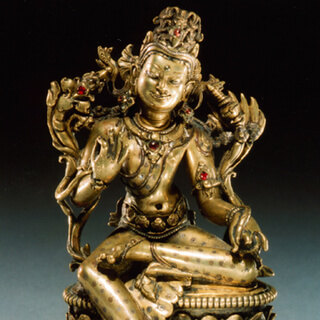
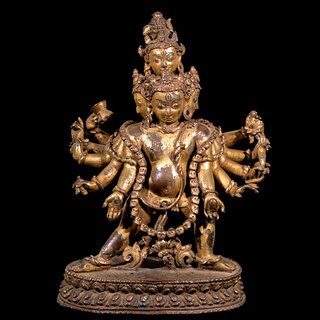
Welcome to the Mindfulness Meditation Podcast presented by the Rubin Museum of Art.
We are a museum in Chelsea,
New York City that connects visitors to the art and ideas of the Himalayas and serves as a space for reflection and personal transformation.
I'm your host,
Tashi Chodron.
Every Thursday,
We present a meditation session inspired by a different artwork from the Rubin Museum's collection and led by a prominent meditation teacher from the New York area.
This podcast is a recording of our weekly in-person practice.
In the description for each episode,
You will find information about the theme for that week's session,
Including an image of the related artwork.
Our Mindfulness Meditation Podcast is presented in partnership with Sharon Salzberg and teachers from the New York Insight Meditation Center,
The Interdependence Project,
And Parabola Magazine,
And supported by the Frederick P.
Lenz Foundation for American Buddhism.
And now,
Please enjoy your practice.
Good afternoon,
Tashi Delek,
And welcome.
Welcome to the return of in-person Mindfulness Meditation with the Rubin Museum of Art.
I'm Tashi Chodron,
Himalayan Programs and Communities Ambassador.
This is only our fourth return of the in-person session.
My goodness,
Right?
And I'm curious to know how many of you have attended the mindfulness session pre-pandemic?
May you raise your hand.
Oh,
Wonderful.
Okay.
And then how many of you had a chance to attend the online for the last three years?
Okay,
That's a good number.
Great.
And how many of you are first time?
Wow.
That's,
Wow,
First-timers beat the rest.
That's wonderful.
So those of you who are first time,
We are a museum of Himalayan art and ideas in New York City,
And we are so glad to have all of you join us for our weekly program where we combine art and meditation.
Inspired from our collection,
We will take a look at work of art from our collection.
We will hear a brief talk from our teacher,
And we are so happy to have Dr.
Rebecca Lee back after three years of being virtual.
And then we will have a short sit,
About 15 to 20 minutes for the meditation guided by her.
So today is actually the third day of Tibetan New Year.
I don't know if you knew about it,
And in Tibetan,
We call it Losar.
That is,
Lo is year and Sar is new.
And I just flew back at 1 a.
M.
Last night to be here with all of you after surprising my mother in San Francisco for the Losar for two days.
So I'm so happy to be here with all of you.
And so let's look at the theme and artwork.
We are still exploring on the theme of loving kindness,
And today is the last session for that.
Each month we have a new theme.
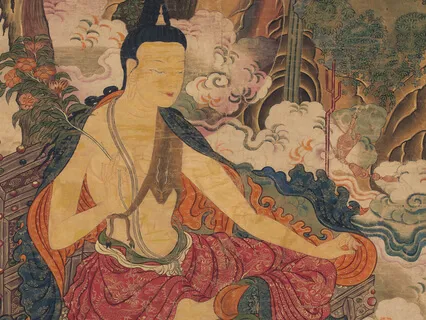
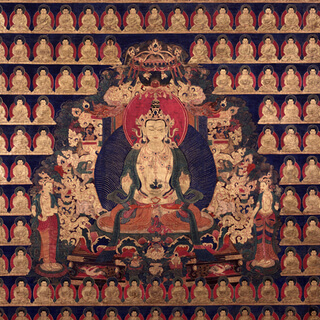
And the art connection for today that our teacher handpicked is this beautiful Thangka painting,
Mineral pigment on cloth,
And this is from eastern Tibet.
And the central figure that you see here is Maitreya Buddha.
Maitreya,
It's a Sanskrit word,
Means friendliness,
Maitreya.
And in Tibetan,
He's known as Champa Gombo,
Which means the great loving protector.
And he's one of the eight Bodhisattvas,
And Maitreya sitting here,
Often he will be depicted standing as well as in sitting posture.
And here he's sitting in his royal ease position,
Left leg folded,
Right leg extended.
The aesthetic here,
Eastern Tibet,
A neighboring country,
Is very close to China.
So you see a lot of Chinese painting inspiration.
And what you can see here is these beautiful rocky mountains,
And these trees,
The longevity,
Long life tree,
And lush greens,
And this very elaborate throne here.
So these are some of the beautiful aesthetic inspiration coming from the Chinese painting,
And the cloud motif as well.
And the Maitreya Buddha is believed to reside in Tushita heaven.
And during,
After this aeon passes and during the degeneration,
Maitreya is believed to appear to appear to teach the Dharma.
So Maitreya stands for loving protector.
And what I wanted to share is that,
You know,
When we feel love and kindness towards others,
It not only makes others feel the love and care,
But it also makes us feel,
You know,
The develop the strength,
The happiness,
And peace,
The inner peace.
And let's bring on our teacher for today.
Our teacher is Dr.
Rebecca Lee,
So happy to have teacher Rebecca back.
Dr.
Rebecca Lee is a Dharma heir in the lineage of Chan Master Shen Yen.
She's the founder and guiding teacher of Chan Dharma community.
Her talks and writings can be found at her website,
Drrebeccalee.
Org.
She's a sociology professor at the College of New Jersey,
Author of Allow Joy into Our Heart,
Chan Practice in Uncertain Time.
Rebecca,
Thank you so much for being here.
Please help me in welcoming Dr.
Rebecca Lee.
I'm so happy.
So happy to be here in person with you.
Welcome.
If this is your first time and just sitting here watching Tashi introduce the artwork for us.
This,
This moment,
It's a miracle.
It has been impossible to do this for the last few years.
And so I'm so happy to be here talking about the practice of loving kindness today.
And today's artwork,
The Buddha Maitreya Bodhisattva,
The story is that he's the future Buddha.
Basically,
We try very hard to preserve the Dharma teaching left to us by Shakyamuni Buddha.
We practice like you're here doing,
Try to share the teaching and do our best to preserve the teaching.
And if somehow our best is not enough,
And the teachings lost,
Maitreya said,
Don't worry,
I'll come back and bring you back the teaching,
No problem.
And so it's very reassuring that that's the compassion expressed by the Buddhas and the Bodhisattvas who this is this kind of unconditional kindness that even if you fail to do what you need to do to preserve the Dharma,
I'll be there.
You still,
You still deserve to be free from suffering,
No problem,
You're not going to be doomed.
And so this compassion is unconditional,
Meaning like you don't even need to be Buddhist.
And even if you have done serious harm,
No problem,
You deserve to be free from suffering.
That's unconditional kindness.
Everyone is worthy of compassion.
And so the question is,
How do we cultivate great compassion,
Like that of the Bodhisattva and Buddha?
We start by cultivating loving kindness,
And learn to be unconditionally kind,
Unconditionally kind.
And oftentimes it's quite difficult,
Right?
We think we can only be kind when we're good,
When we succeed,
When we do what we're supposed to do,
Right?
But it's unconditional.
Doesn't matter.
Doesn't matter,
Even though we've made mistakes.
And very often,
When we talk about the practice of cultivating loving kindness,
We usually assume it is about directing loving kindness,
Compassion to others,
Right?
That's what we usually associate the practice of compassion with.
And so some of you might have heard or even done the practice of loving kindness meditation,
Sometimes called metta meditation.
And you may notice that it involves sending loving kindness to several categories of people.
And oftentimes you start with sending loving kindness to ourselves.
And I have a lot of students who told me that,
Oh yeah,
When I do loving kindness meditation,
I just skip myself,
Or I kind of don't really do it.
Like I resist doing it,
Or I find it quite difficult to send loving kindness to ourselves.
This has to do with often our misguided belief that compassion is for other people.
I cultivate compassion for others.
This is kind of an interesting thought,
Right?
If we vow to cultivate great compassion for everyone,
Everyone,
Then aren't we one of the consenting beings?
Why do we discriminate against ourselves?
Why do we exclude ourselves?
Quite interesting,
Right?
So as I've been looking at writings on the cultivation of loving kindness,
And in a very important treatise called The Path of Purification Visuddhimagga by Avogosha,
He clearly stated this.
I'm going to quote,
Loving kindness should not be developed at first towards the following four kinds of persons,
An antipathetic person,
A very clearly loved friend,
A neutral person,
A hostile person.
First of all,
It should be developed only towards oneself.
We start to cultivate loving kindness only towards ourselves first.
And in that same passage,
It's quoting Buddha saying,
Those who love themselves will never harm another.
So when we can be kind to ourselves unconditionally,
Regardless of what happens,
We can be kind to others,
We will be able to refrain from causing harm to others.
So many of us might have had this experience that we withhold loving kindness from ourselves,
Being very harsh towards ourselves,
Believing that we do not deserve to be well,
We don't deserve to we don't deserve to be happy,
We don't deserve to be at peace.
And we want to kind of punish ourselves for perhaps mistakes we've made,
When we've done that,
Or for disappointing ourselves,
We might not have met our expectation,
We have set for ourselves.
And we believe that because of that,
I don't deserve to be happy,
To want to punish ourselves,
We withhold loving kindness toward ourselves.
That's not unconditional.
We have set these conditions,
Only if you succeed,
Only if you meet your expectation,
Can you be treated with loving kindness towards yourself.
When we do this,
When we withhold loving kindness from ourselves,
Our mind is agitated and tense,
It's like no love for you,
No love for you,
It's a tense state of being.
And in this very agitated,
Tense mind,
There's no clarity,
There's no clarity.
And you might have experienced that,
We're just very upset,
We're like upset,
Very mad at ourselves,
We can't even tell what the matter really is.
We don't really know what is causing our disease.
And so this harshness and aversion to ourselves causes unnecessary suffering.
And it's really unhelpful if you think about it.
It really gets in the way of our being able to see clearly what is going on,
And what can be done.
So for example,
A while ago,
I realized I was not being able to work on a piece of writing,
And I was just unable to be productive at it.
And so,
Well,
You might have experienced that when you're not getting your work done,
Just gets really frustrated,
What's wrong with me and try to work harder,
Punish ourselves,
No rest,
No doing fun things until you get this done.
No loving kindness for ourselves.
How did that work out?
Usually not so good,
It's not like suddenly become productive.
But what happens is that our agitated mind is getting in the way of our being able to see clearly that,
Well,
The body really just needs some rest.
We need to take some time off to clear our mind and get ourselves away from the computer.
So instead of being frustrated,
Just give myself a day,
What Thich Nhat Hanh calls a lazy day,
And just kind of do nothing,
No work,
Just a day.
And I was able to finish a paper that I'm quite happy with after that.
And so the mind's agitated by withholding loving kindness from ourselves.
We are getting in the way of ourselves from being able to see what can be done and just do it without fuss.
And also to be able to recognize clearly what can't be done.
Like,
So like,
There were a few days that my body was fighting an infection.
It was just very tired.
So you just need time for the antibiotic to take effect and accept it.
That is going to be the time that it will be needed.
And also perhaps see clearly what we can do to cultivate the conditions for the future we like.
So if I want to be better at not being getting infection,
Maybe I need to do better at taking care of keeping myself hydrated and everything else.
So that's what I'm doing.
And so when we are causing ourselves unnecessary suffering by being agitated,
That is not wisdom.
And not only that,
When we suffer and the mind is agitated,
You might have the experience,
We are prone to cause harm to others.
We are so upset,
We can take it out on other people,
Usually people we love.
And often also,
What happened is this habit,
This very entrenched habit of being harsh to ourselves,
Withholding loving kindness to ourselves.
We acted out to others.
When we are habituated to being harsh at ourselves,
We can't help but do the same thing when it comes to interacting with others.
And so even though we may aspire to be a compassionate person,
The action that comes out of us is not in accordance with compassion.
And so that's why we cultivate loving kindness to ourselves first.
And I've been sharing this phrase with my students,
Do everyone a favor,
Be kind to ourselves.
When we are kind to ourselves,
We are doing the world a big favor.
So here in the Chan practice,
I'm going to be sharing with you a little bit in the Chan meditation practice.
What we do is to cultivate clear awareness of the moment-to-moment experience of this body-mind sitting in this space.
So when we have a method where we try to,
What we use to settle our mind,
To rest our mind on,
And we notice the mind drifting off,
And our usual habitual reaction is to get frustrated because we think we have failed.
I should be on the method.
I have drifted off.
And we notice this frustration.
And actually,
That's what the mind does.
It kind of wanders.
It's not a problem.
And all we need to do is to come back to the method.
But when we notice this habit of frustration and the urge to tell ourselves,
No,
Love for you,
Because you fail at meditation,
You have drifted off the method,
You see for yourself how entrenched this habit of withholding loving kindness to ourselves when we believe we have disappointed ourselves,
We have failed,
And how that is suffering.
And in meditation,
When the mind drifts off,
We practice remembering that it's not a problem,
Not a problem,
And notice this urge to be frustrated with ourselves,
Frustrated with ourselves for failing to stay on the method,
Believing that we no longer deserve loving kindness.
Then when we notice these frustrations,
These urges,
We remind ourselves,
It's okay.
It's okay.
It's okay.
I love myself anyway.
And even when we get frustrated that we are frustrated,
I can't believe I'm frustrated.
I should not be frustrated.
It's okay.
Not a problem.
Just be kind to myself.
It's okay.
That is actually the process of cultivating loving kindness to ourselves.
And so this process allows the mind to settle and there to be more clarity at how our mind operates.
And at the same time,
We are cultivating unconditional loving kindness for ourselves.
And you might notice thoughts coming in,
There might be thoughts and feelings coming through,
And we might be habituated to telling ourselves that,
Shut up,
You know,
This thought should not be here.
I'm trying to meditate.
I'm trying to have a calm mind.
And actually,
In our in-child meditation,
Thoughts are here.
They're not a problem.
That's part of having body and mind.
So there's no problem with having thoughts.
And we allow these thoughts to be here because,
You know,
They will leave.
They don't stay in our mind forever.
And while the thoughts and feelings are with us,
We allow them to be fully heard and seen and felt as they are.
Because guess what?
They are part of ourselves.
When we allow ourselves to be fully heard and seen and experienced,
We are listening to ourselves fully.
Isn't that what we do when we love others,
Be there fully for them,
And really listen?
Whatever it is that they are saying,
They might be complaining,
They might be talking about things that they're worried about,
You just listen.
And you may not be able to do anything,
But they feel better.
They feel loved.
And why don't we do it for ourselves?
In meditation,
That's where we can practice fully listening to ourselves as we are.
And that is the cultivation of unconditional loving kindness to ourselves.
Even though they might be some angry thoughts,
Some thoughts that we believe unacceptable,
We just listen.
Yes,
Yes.
And we find that just allowing ourselves to be heard,
Oftentimes those thoughts and feelings are discharged.
And so when we practice this way,
Treating ourselves with unconditional loving kindness,
Then it becomes very easy for us to also do that when we are with others,
Regardless of what's happening,
Regardless of what they have done.
It does not mean we condone problematic behaviors,
We hold them accountable,
But it does not mean that they no longer deserve loving kindness,
Because we have learned to see that we still deserve unconditional loving kindness,
Even when we have made terrible mistakes.
We have to own up to it,
We have to be responsible for the repercussions,
But we still deserve loving kindness.
So let's practice meditation together so that we can try ourselves how to cultivate loving kindness to ourselves.
So when you're sitting in a chair,
You might find it helpful to sit in the front edge of the chair to allow the body to sit erect.
This allows the skeletal structure to hold up the body.
And I take you through the whole body relaxation and feel the relaxation of the top of the head,
Directly experience the subtle sensations of the scalp relaxing as we allow,
Allow the tension to melt away and feel the relaxation spread to the forehead and feel the relaxation spread to the eyeballs and eye muscles.
We tend to hold a lot of tension in these muscles in our daily life from all the comparing and judging and analyzing.
Right here,
Right now,
We can give these muscles a vacation and allow,
Allow the tension to melt away and feel the relaxation spread to the facial muscles.
Practicing if we hold tension in these muscles by habit,
Perhaps to hold a certain facial expressions for others to see.
Right here,
Right now,
There is no need to do that.
We can give these muscles a vacation and allow,
Allow the tension to melt away and feel the relaxation spread to the entire head and feel the relaxation spread to the neck and shoulder muscles.
Directly experience the subtle sensations of these muscles softening like melting butter as we allow,
Allow the tension to melt away and feel the relaxation spread down the arms and down the forearms and all the way down to the fingertips and feel the relaxation spread to the chest area.
Check to see if we hold tension tension in this area by habit,
Maybe from anxiety,
Sadness,
Grief,
Fear.
Right here,
Right now,
We can give them a rest and allow,
Allow the tension to melt away and feel the relaxation spread down the torso all the way down to the lower abdomen.
We tend to hold a lot of tension in this area by habit.
Trust that the skeletal structure can hold up the body and these muscles do not need to work so hard and can allow,
Allow the tension to melt away and feel the relaxation spread to the upper back.
Directly experience the subtle sensations of these muscles softening softening as we allow,
Allow the tension to melt away and feel the relaxation spread down the back all the way down to the lower back and the buttocks where we feel the sensations of the body sitting on our seat and feel the relaxation spread down to the thigh muscles and down the legs and all the way down to the toes and feel the relaxation of the entire body sitting right here right now with this wakeful clear mind moment after moment and as we do so we'll notice the subtle changing sensations of the body breathing as the diaphragm expand and contract the whole body experiences a subtle movement we can gently rest our attention on the subtle changing sensations as the body breathes to anchor our mind gently to each emerging present moment moment allowing the body to breathe on its own the body knows how to breathe it's been doing so since the moment we were born and we notice the mind drifting off losing contact with the changing sensations of the body breathing not a problem use this as an opportunity to practice remembering remembering to come back to reconnect with the direct experience of the subtle changing sensations of the body breathing it doesn't matter how often or how long the mind drifts off as long as you find your way back you are practicing well and you may notice thoughts coming through and allow them they're here already part of the present moment no need to chase them away no need to talk back at them add to them and allow them to be fully heard and seen and felt and when they are ready to move on allow them to move on moment after moment cultivate this clear awareness of the body and mind in this space you you you you you you maintain this clear awareness as we transition from stillness to motion as we begin to move our hand and fingers we can rotate our body from small circle into bigger and bigger circles and stay with the changing sensations as the body moves and help us transition into motion in opposite direction thank you thank you so much for that beautiful loving session Rebecca that concludes this week's practice to support the Rubin and this meditation series we invite you to become a member at rubinmuseum.
Org membership if you are looking for more inspiring content please check out our other podcast awaken which uses art to explore the dynamic paths to enlightenment and what it means to wake up season 2 hosted by Raveena Arora is out now and explores to transformative power of emotions using a mandala as a guide available wherever you listen to podcasts and to stay up to date with the Rubin Museum's virtual and in-person offerings sign up for a monthly newsletter at rubinmuseum.
Org slash e-news i am Tashi Chodron thank you so much for listening have a mindful day