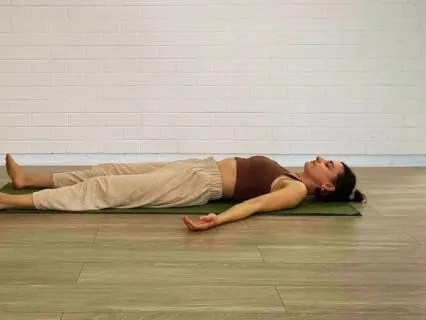
So come down to lie on your back and these exercises are best done without any pillow under your head so that you can really feel the impacts of the movement.
If you would like some padding under your sacrum,
That can be a nice thing to do,
Adding a folded blanket or maybe a little fluffy rug.
And the first thing we're going to do is a scan of your overall body and your soma.
So as you lie here on the ground,
You might have your legs elongated or perhaps you've taken a constructive rest position with the knees bent.
Either way,
Start to settle your awareness into your body.
And imagining that you are lying on sand,
If somebody was to come and scoop you up,
What impression might your body make on the sand based on where the weight is primarily placed in the body?
Perhaps one heel feels like it's digging in a little deeper into the sand.
Maybe there's a shoulder blade that lifts up a little bit more than the other.
Starting to scan with your awareness from head to toe,
Noticing where the weight of your body is placed.
And as you scan,
Also welcome in any feedback from spaces of tension,
Sensations that are here.
Noticing how your limbs are turned,
The arch in the lower back,
Space around the neck and the head,
And even sensing if your head is angled to one side or whether the nose is pointing directly upwards.
And finally,
We'll come to awareness of the shape that your body makes,
As if somebody was drawing an outline around your body,
Or you're a cookie cutter,
Tuning into your shape.
If your legs are elongated,
I'll invite you now to bend the knees so that your feet come flat on the floor.
And finding a distance between the legs where you feel like you can let go of any effort in the legs.
It can be helpful to place the heels in alignment with the sit bones,
But just having a play for yourself what feels like a good position that you can let go of the legs.
We're going to move into a pandiculation called arch and release.
And the majority of the movement will be occurring at the pelvis.
So I'll invite you now to bring the awareness to the pelvis.
Having a few out breaths here to attune to sensation,
Releasing any tension that you might already be aware of in this space.
And on your next inhale,
You will tilt the pelvis so that the tailbone lifts gently towards the back body,
Creating a bigger arch between your lower back and the floor.
And just hold here for a moment so you can keep the breath going,
Allow the breath to flow.
You've brought in a tiny little arch in the lower back.
And with all pandiculations,
You do not need to reach the full range of movement to benefit from them.
So if you feel like you're meeting any strain or you've taken a really big wide arch here,
Know that you can back off and even just 1% is beneficial.
Continue to breathe as you hold this arch in the lower back.
Seeing if you can soften the back body and soften the front body at the same time.
And on your next exhale,
Let everything melt.
Melting like ice cream on a hot tarmac,
Switching all the muscles off.
You might even take another exhale to really switch it off.
So that might seem really simple and it is,
But what's just happened is we activated the muscle groups a little bit more than they already were,
And that helped the brain meet that tissue,
To locate that tissue.
And when we soften and relax,
The brain,
Being aware of that tissue now,
Is actually able to relax those muscles more than it would have been before.
So let's try that again.
Again,
On your inhale,
Tilting the tailbone towards the back body,
Creating a little arch in the lower back.
And holding there for a few breaths,
Continuing to let the breath flow.
And notice if there's been any movement in the chest,
In the upper back,
In the neck.
It's alright if there hasn't been,
But just becoming aware of that for a moment.
And on your next exhale,
Let everything melt.
Switching everything off into a version of neutral.
Have a moment to integrate,
To notice how you feel.
And we are going to move towards that movement again,
But this time I'm going to invite more awareness of the movement through the whole spine.
So if you noticed that that whole movement was primarily located in the lower back and the pelvis,
That's very natural.
But next time when you move into this pendiculation,
Allow the top of the torso and even the head to move in response to that change in the pelvis.
So as you inhale,
Bring on that tilt in the pelvis and let it move through the upper back as well as the neck and the head.
And notice what direction those structures have moved.
You don't need to strain here,
You can still bring softness into this.
But what's happening now is we're inviting a connection between the pelvis and the rest of the spine that may or may not have already been accessible there.
Staying here for a few breaths,
Activating the muscle groups just enough so that the brain can locate those tissues.
Whenever you're ready,
You can exhale,
Release,
Melting everything like butter melting on hot toast,
Finding a sense of neutral,
Noticing how you feel.
So the complementary exercise or pendiculation to the one we just moved through moves in the opposite direction,
So it's called flatten and release.
So whenever you're ready,
Use an exhale to flatten the lower back against the floor.
So you're moving in the opposite direction,
Tucking the tailbone towards the front of the body just enough to activate the muscles more than they were before.
And holding it there with as much ease as you can,
Allowing the breath to flow.
Take another breath or so,
And then you can choose when to relax everything.
Melting,
Melting,
Melting,
Switching everything off,
Releasing any effort.
And whenever you're ready,
You can move into that same pendiculation,
But allow the movement to impact the upper back and the neck as well.
Is there movement through the chest?
Has the head felt the ripple effect from that pelvic movement?
And if not,
That's fine.
Working with your soma as it is now.
It could just be that awareness of that possibility brings it online.
Holding for a few breaths,
Allowing the breath to flow,
Releasing any tension as much as is available.
Whenever you're ready,
You can melt,
Melt,
Melt to a sense of neutral.
There's no need to manually return yourself to the position you were in.
We're thinking of it more as a relaxing,
A melting,
Allowing the body to return to a new version of neutral.
Notice how you feel.
If you want to have a little sway of the knees or a rock and a roll and a stretch,
Go ahead and make any movements that support your body.
And as you're ready,
You can relax and open the eyes.