We're going to start this practice together lying down.
So coming to a comfortable lying down position.
You're welcome to rest with your hands on your belly,
With your elbows on the ground,
Or you may want to have the hands down on the floor.
Your feet a little bit apart toes falling out to the side or of course you're also welcome to rest with your knees up or comfortable for the lower back sometimes to have the knees up.
So just as you like,
Whatever is most comfortable to you.
Allowing your body to rest and soften.
And when we bring the body to stillness,
It gives us an amazing opportunity to really have a sense of what's going on inside.
There's less distraction,
There's less.
.
.
To notice,
All we have is our internal sensors.
And this is the absolute bedrock of our Zen yoga practice.
This attention,
This awareness of what's going on inside.
Bringing the awareness to your body and asking,
How do you feel?
What do you feel?
Maybe your body feels heavy.
Maybe you feel light.
Maybe you feel warm or cool.
Maybe there are certain areas of the body which are jumping into your attention.
Maybe a slight discomfort or ache,
Or maybe anything else.
Remembering that whatever you find,
However you feel,
It's not right or wrong.
It's not the way it should be or shouldn't be.
It's just.
.
.
The way it is.
It's what you feel.
So this bedrock of our practice,
The awareness,
The attention,
Includes an attitude of allowing.
Of non-criticism.
Now we're practicing with this wood element,
Which is connected with our springtime energy.
And The direction of this energy is in the area of creativity and growth.
So we're going to imagine here that we're a small plant.
That we've just about got our roots firmly in the ground and we're going to start to grow up.
Towards the light.
So imagining that you're a small plant,
A small shoot,
And we're going to come all the way up into standing.
So you may want to start by rolling over onto the side.
Traditionally in yoga,
We roll onto our right side.
So perhaps that's the way you want to roll or perhaps a different way.
You want to start to rise up.
Starting to come up into sitting.
And like you're a young chute reaching up into the.
.
.
Into the light,
We're going to start to come up into standing,
Maybe even reaching a hand.
Our leaves unfurling,
Our body unfurling.
We're growing upwards.
We're reaching upwards.
Into the light and we're now a plant that's growing up.
Bringing the palms together,
Chin down towards her chest,
Reaching from the soles of the feet,
Up through the roll of the body into the tips of your fingers.
Nice long reach.
We're reaching up into this light.
And now with palms together,
If we just ease over towards the right side.
So we're bringing into focus the left side of the body.
It doesn't have to be an extreme lean.
It can just be enough to generate a bit of sensation down the side.
We're at the beginning of the class,
So nothing strong.
Just listening to the side of the body.
Listening to the sensations.
And as we breathe here,
You might find your body wants to go just a little bit deeper.
That feels good.
Or maybe we're good where we are.
Maybe just a little bit back and away from the stretch.
Just asking,
Is this good breathing here?
Keeping the elbows lengthening,
Keeping the palms pressed together.
Couple more breaths And then we're going to make our way gently back to upright.
Take a little moment to assess how does that feel.
And then when you're ready,
Coming over to the other side,
Taking it slowly,
Easing over to the side,
Generating the stretch sensation.
Along the side of the body.
And then listening into it and asking to the body,
Is that good?
Does that feel nice?
Do you wanna come a little bit deeper?
The body might say,
Yeah,
Okay.
Or the body might say,
No,
That's good.
So elbows lengthening,
Fingertips.
Reaching away.
Couple more breaths.
Then we're going to come all the way up to upright.
And then floating the hands down.
Just take a little moment to get a sense.
How does the body feel as a response to that movement?
So,
In our springtime,
In our wood element,
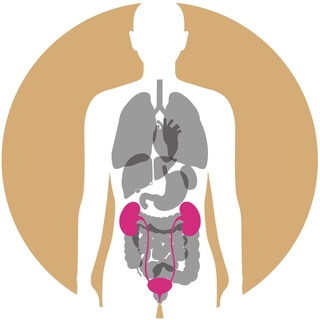
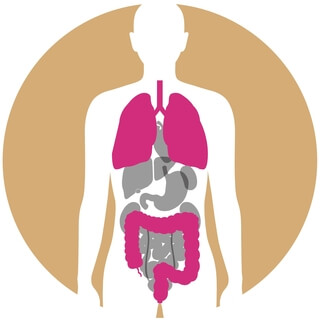
We're working with the organs of the liver and the gallbladder.
Now,
The liver's one of the biggest organs.
It sits just underneath the ribcage here on the right-hand side,
And the gallbladder is just underneath it.
And they're associated with the energy lines.
So let's see if we can trace out the energy lines,
Starting with the gallbladder.
It starts in the corner of the head.
It runs over the back of the ear.
And then it zigzags back towards the forehead.
And then it comes back over the top of the ear.
And it runs down the neck.
It comes in front of the shoulders and then it zigzags down the side of the ribs.
Coming to the side of the hips and then runs down the outside edge of the legs all the way down down and it comes to the fourth toe in the foot.
And then the liver energy line,
Well,
That starts on the inside of the big toe,
Just on the nail there,
Inside of the big toe,
Runs up the inside of the leg.
Inside front of the legs,
Just by the side of the knee,
Comes up the front inside of the thigh,
And then it kind of comes out just underneath the pecs,
Just underneath the breasts,
Just here.
So we're working with the outside of the body,
The lateral lines of the body,
And then just up the front and inside of the legs,
Up the front of the belly.
That's our sort of direction there.
So we're going to be working with the energy of spring,
The energy of this wood element,
And also with the energy lines in these different areas as we work.
Now,
The energy of spring has a real creativity,
Almost like a bounciness to it,
A springiness,
Literal springiness to it.
So let's find some springiness in the body.
So I like to shift weight onto your toes and just begin a little bit of a bounce up and down on your heels.
So the heels are not touching the ground.
They're just coming up and down.
We're just allowing the body to sort of shake around otherwise.
Nice,
Loose through the arms and through the face.
Just shaking up and down.
So finding this springiness.
Now,
The body has inbuilt springs all the way through it.
It's called fascia.
It's the connective tissue.
So the muscles,
Their job is to contract,
But the connective tissue which runs around the muscles and connects in to all of the bones and around the different joints,
That job is to be quite elastic and to allow this kind of springiness.
So what we're doing here is using very minimal muscular effort and bouncing into the fascia,
Which is running down the back of the legs,
Mostly in the calf muscles and around the Achilles tendon into the soles of the feet.
And you'll notice that it's got a resonant frequency to it.
There's an easiness of bouncing at this frequency.
If we try going slower.
.
.
It's much more hard work,
Right?
We have to use muscles.
And if we try going really quick,
Again,
It just feels weird and it feels very effortful.
And you'll find there's a very easy resonant frequency for your body to bounce into.
And that's where we use the least muscles.
And we're working mostly with the bounce.
Yeah,
And this is a really nice way of working.
It's not often taught or thought about in yoga using this bounciness.
So we're going to be focusing a bit on that as well today.
OK,
Now we're bouncing for a little bit of time.
Let's have a little rest.
Bring the heels down and then just standing tall,
Maybe eyes closed for a moment,
Sensing how does that feel?
What's the consequence or effect in your body of that kind of bouncing movement?
OK,
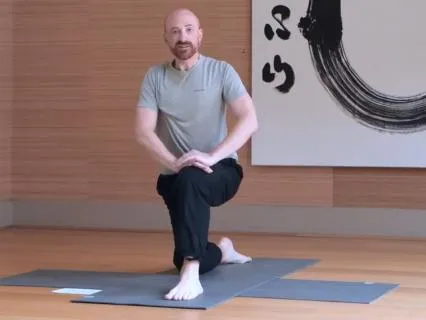
So coming down into all fours.
And I'm just going to turn sideways so it's easier to see.
So we're going to make an alignment so that the hands come directly underneath the shoulders and the knees come directly underneath the hips.
So we're actually in a kind of box shape underneath.
And it's kind of important to make that alignment.
So just making sure that we've got that going on.
And then just very briefly start off by rotating the weight around the wrists.
Just a little gentle warmup of the wrists here.
So circling the weight one way.
And then changing the direction,
Circling back in the other direction.
And then coming back into the center.
Okay,
So let's work a little bit on the sides of the body.
So we're gonna take the right leg up and back.
First of all,
We lift up nice and high,
Just as high as feels comfortable for you.
And then we're going to cross it diagonally behind the body and let the toes come to touch the ground.
And then beginning to turn,
Looking over the shoulder.
See if you can see around towards the foot behind you.
Now as you do that,
You'll notice it brings the side of the body into focus as we get that side stretch.
So do you feel it mostly in the leg or in the hip or in the side of your belly or in the ribs?
There's no right or wrong,
Just inquiring for yourself.
Okay,
Now that long leg,
We're going to lift up,
Bring it around,
See how far around towards the hand you can get it without it touching the ground.
And then swing it around behind back to where it was okay so two more times round towards your hand on the right side and then behind.
One more time.
Without it touching the floor all the way round as far as you can And then behind,
Touch the toes to the ground.
And then again,
Turn,
Look over the shoulder so you can see the toes.
Now we're going to deepen this a bit if you wish,
Taking the right hand and reaching it across the body.
So now we include the shoulder and the upper chest,
Upper ribs,
Maybe the side of your neck as you begin to really twist looking around behind.
Being really aware of what your body is saying,
Never going past what feels like a comfortable stretch.
It's like encouraging the body rather than forcing it to do what your mind thinks it should.
Very important.
One more breath.
Good.
And then release,
Coming back to all fours.
One breath sensing,
How do you feel?
What's the effect?
And then the left leg can lift up.
We're going to lift up nice and high.
And then we're gonna cross it behind the back and drop the toes to the floor.
Let me just rotate 90 degrees so we get a different view.
So the left leg's going to cross behind,
Touching toes to the floor.
Behind you okay and then turning looking over the shoulder to look around towards your foot and now we're bringing attention to the other side Side of the body.
Do you feel the stretch mostly in the leg or the hip?
The belly,
Waist,
Ribs.
Do you feel?
One more breath.
Good.
And then we're going to lift that leg and bring it straight and up off the ground as far around towards the hand as you can.
And then back again.
Okay,
Try not to let it touch the floor two more times,
All the way round as far as you can.
And back again.
And one more time.
All the way around.
And back again.
And then we're going to touch the toes on the ground.
I'm going to take it a little bit further,
Just if you wish.
So this time,
Left hand crosses over.
As you turn around towards the back foot,
And bringing that lengthening.
All the way up into the upper body.
So our gallbladder channel comes from the side of the head Around the shoulder,
Down the side of your ribs,
Outside of the hip,
Down the long leg,
Outside edge.
So we're really starting to bring that into focus.
Bring that into our awareness,
The whole length of it.
One more breath.
Good,
And then we release coming back into all fours.
So we're going to lengthen our all fours slightly.
So maybe you want to step your hands a little bit further forwards or perhaps your knees slightly further back.
We're going to tuck the toes and press backwards and upwards and coming into a down dog position.
So the knees can be a little bit bent,
Just looking down to the space between your knees,
Feet,
Between your feet.
Sending the hands connecting to the mat forwards to send the hips backwards and upwards.
So we're going to bring our attention to the sides of the body by bending one knee and looking underneath the armpit.
Bending the other knee,
Looking under the other armpit.
Now as you bend knee after knee,
Looking side to side,
You'll find your hips swaying.
Side to side so technically this is called sashaying the hips this is the kind of movement you get when you watch someone walk down the catwalk.
It's a very exaggerated swaying of the hips.
And it's a great way to feel into the waist.
Feel into the.
.
.
Sides of the body whilst at the same time pressing the heels one after the other down towards the floor.
Side to side and just kind of enjoying that movement and the flexing into the lateral sides of the body.
Good.
Okay,
And then we come into the center again.
Now take the right foot,
Stepping it between the hands.
And then bringing the back knee to the floor.
We're going to take a little moment just to get our alignment.
So hands on the front knee,
Sinking into a comfortable lunge,
And just making sure the knee ends up being directly above the foot.
That's just a nice,
Good alignment.
Okay,
And then when you're ready,
Hands on the floor,
Tuck your back toes,
And lift the back knee up off the ground.
Now we're letting the hips sink downwards towards the ground,
Towards the front heel.
And just take a few moments here,
Allowing the body to ease into this stretch.
A back leg is strong.
The knee is.
.
.
Moving towards straight.
Okay,
Now taking note of where you are in your comfortable stretch,
Because in the next bit,
We're not going to go any further beyond that.
This is our limit,
Right?
So we're going to come out of the stretch,
So lift the hips up a little bit,
And then we're going to come down into the stretch.
Okay,
So lifting up out of the stretch and down into the stretch.
Okay,
And then we're going to start to set up a little bounce in doing this.
OK,
I'm just going to switch to the side view,
Give you a different perspective on this.
So we come out of the stretch and down into it.
And we set up this bounce.
Now,
The important thing here is,
Safety-wise,
We're not pushing further than our comfortable limit.
We're not pushing into the stretch.
We're bouncing out of the stretch.
Out and in,
Out and in,
Out and in.
And what this is doing is very safely working the stretchiness,
The elastic fibres of the.
.
.
Of the leg.
We're finding that bounciness.
The springiness in the body.
We're working the fascia.
The connective tissue.
So a couple more breaths here.
OK,
And then we're going to come up into a higher lunge.
OK,
So just take a little moment,
Finding your balance,
All your toes facing forwards.
So not letting the back heel drop,
Keeping the heel up.
Now we're going to work with a Qigong move and into a particular energy point.
OK,
So the points we're going to work with is at the very bottom of your rib cage.
Kind of goes into the soft waist that's liver 13 right there and the other energy point is in the webbing of the hand so the root of the index finger this is large intestine 4 and we're going to line a very important energy point here going to line them up like next to each other in this next move.
So we start by holding an imaginary ball in front of you.
Let's start with the left hand on top.
So right leg in front,
Left hand on top.
Now the top hand is going to slide back and we're going to line up our energy points.
Large intestine 4,
Bottom of the index finger with the liver 13,
Side of the rib like this.
The other hand is going to turn palm face front and we're going to press forwards and twist into this.
Now the hand from the side,
From the waist,
Is going to come up and underneath.
So we hold the ball.
Top hand slides down,
Lining up our energy points,
Liver 13.
Turn front palm,
Press forwards and twist,
Looking around to the side.
Hand from your waist comes underneath.
Top hand slides down lining up turn palm press forwards and twist And then backhand comes underneath.
One more time.
Top hand slides down to the waist.
Turn palm,
Pressing forwards and twist.
And then backhand comes underneath.
So now we're going to step forwards,
Bring the back foot forwards and come up.
Let me just turn to the side.
I'm working quite strongly into the hips here,
Finding a balance.
Hands out for helping,
Letting this left knee come up.
Now,
We're going to bring the sole of the foot to the inside of the leg.
It can be low down.
You can have it just touching with the toes.
It can be on the lower leg or it can be higher up as you wish.
Using the hands for balance,
Getting your eyes fixed on the floor.
Focus and concentration.
So here,
This is the tree pose.
Now our young shoot has reached its way into the light,
Has found its kind of flexibility,
Has been moving with the wind and flexing with the seasons.
And now it's grown into a big,
Strong tree.
And the tree is still.
.
.
Quite flexible but now much stronger okay it's matured we've got our roots deep into the earth and we've got this sense of like resilience uprightness uprightness to it to things Taking the hand,
Left hand reaches out sideways,
Right hand reaches up.
And we're going to find what might be like to bend with the wind.
So we lean down towards your bent knee.
Now,
This is quite a challenge to start to tilt the head.
We want to be really focused on our awareness,
On our balance.
And if you need to come close to a piece of furniture or touch the wall,
Please just go right ahead.
See how.
.
.
Far we can lean in whilst maintaining that resilient upright balanced posture If you lose balance,
If you come out of it,
Absolutely no problems.
When you feel ready,
Coming back to upright,
Release hands,
Release leg.
And having a good old shake around.
Quite hard work in the legs that one.
Yeah.
So the shaking around is important because when we really work to part of the body,
We get a kind of sometimes a build up of the chemicals,
Build up of waste products for the muscles that have been working hard,
Which you could see as a kind of energy block.
So as we shake it out,
It's like releasing and flushing out all that stuff,
Allowing the energy to flow.
And sometimes we feel this kind of rush of energy up that's through the body like that,
Sometimes through the energy channel itself.
You Okay,
Eyes lowered,
Moment just a sense.
Good.
And then we'll come back into our down dog.
So hands on the front of the legs,
Sliding down.
Once the fingertips reach the floor,
Stepping back into a downward dog posture,
Looking to the space between the feet.
Backwards and upwards through the hips.
Okay,
Now the left leg is going to step forwards and come in between the hands.
And bringing the back knee down to the ground.
And just take a little moment to establish the alignment.
So hands on the front knee,
Sinking forwards into a lunge.
Checking the knee,
Checking the spacing.
And then when you're ready,
We'll find that bouncy quality.
So hands down on the ground.
Tuck your back toes,
Lift the back knee.
And then letting your hips sink,
You'll feel the stretch starting to lengthen through the front of the hip,
Front of the thigh.
Back knee is strong and lifted.
And just letting the body soften into this.
Stretch here,
Finding your comfortable limit for where your body wants to be right now.
OK,
And remembering that from here,
We don't go beyond this.
We're going to bounce out of the stretch and into it.
Out and in.
And finding the resonant frequency of the bounce for your body.
Something that's going to feel almost effortless and that means we're working with the elastic bouncy stretchy fibers,
The fascia.
The connective tissue.
So one of the reasons why we end up feeling old is because the elastic quality of the body starts to deteriorate.
The stretchiness,
What is often seen as very youthful,
The bounciness of the skin and the muscles and the tissue starts to deteriorate if we don't work with it.
This is a great one for staying youthful,
Finding that bouncy,
Springy,
Creative springtime energy.
So a couple more breaths.
Good.
And then just releasing from the bounce,
I'm going to come up into a high lunge here.
Again,
All the toes facing forwards.
Hips,
Chest,
Or an alignment facing front.
Front knee is bending,
Back leg is nice and strong.
Now we take holding the ball with the right hand on top.
Left leg in front,
Right hand on top.
Top hand is going to slide down.
Going to bring our energy points in alignment.
Side of the ribs.
Turn front palm,
Press forwards and turn.
So lower body stays static,
Upper body twists.
And then the hand from the waist comes underneath.
Top hand slides down to the side of your waist.
Turn palm.
Twist.
And then the hand comes underneath.
Top hand comes down,
Lines up with liver 13.
Turn palm.
Turn.
Now here,
Front knee,
Very easy to let it fall inwards.
Yeah,
We want to keep the knee in alignment facing front,
Even when the upper body is turning.
Back hand comes underneath.
One more time.
Top hand slides down.
Twist.
And then release.
Good.
Releasing the ball.
Back leg steps through.
I'm going to come into a balance here So fixing your eyes on the floor,
Right leg lifts.
Yeah,
Fine to have the handout for balancing help.
Bringing the inside of the leg,
Bringing the sole of the foot to touch the inside of the leg.
Again,
It can be low down,
It can be high up,
Whatever you need,
Whatever is going to be helpful,
Come close to a wall,
Have a piece of furniture nearby,
Something to help,
It's no problems.
It's working with your body.
So we have this grown-up,
Resilient tree.
The tree has its roots strongly,
Firmly in the ground.
So let's just take the standing leg,
Soften it slightly.
And that helps the weight to sink down,
Helps us to find connection with the earth,
With the rooting,
With the ground.
Having said that.
.
.
So losing balance is not a problem.
We just come straight back in.
Taking right hand out to the side,
Like a branch,
Left hand reaches up.
And now we're going to see if we can ease sideways like the wind is blowing,
Blowing our tree into a side bend here.
As you tilt,
Take it really slowly,
Allowing the body time to adjust and to.
.
.
Feel its way into this side bend.
As I say,
Tilting the head.
Makes it extremely difficult.
To maintain the balance.
Couple of breaths.
Strong,
Resilient tree.
And then when you're ready,
Coming back to upright.
Floating the hands,
Releasing the leg.
And again,
Having a good old shake around in that leg,
Releasing the energy,
Allowing it to really flow through the leg.
Again,
Feet hip-width apart,
Standing tall,
Eyes lowered,
Sensing in.
What do you feel?
How do you feel?
A sense of heaviness and connection to the earth.
And also a sense of rising up resilience.
Creative growth into the world.
Eyes lifting.
So we're going to come down into sitting.
Yep.
Great.
OK,
Now we're going to come down into sitting.
So we're going to bring the feet here,
Soles of the feet together.
And to start off with,
We're not going to bring them in very close.
We're going to start with them nice and far apart.
Actually,
Bringing them in close tends to bring us deep into the kidney lines.
But we're working with the liver lines here.
So it's kind of nice to have the legs out in more of a diamond shape,
Maybe more of a 90 degree bend in the knees.
And we're going to find an energy point on the foot.
This is liver three.
If you place your foot flat down,
We've got the big toe.
Liver line starts the inside of the big toe nail,
And it runs up the inside of the big toe,
And then it comes up the valley between your first and second toes.
So if you run a finger up the valley there,
Between your two toes,
Further up here,
Until you reach the top of the valley,
You'll get a sense of what I mean when you move your finger up there.
This is liver three.
So this is the point in between the bones,
It run up above above the toes so soles of the feet together and reaching down see if you can find that point on both feet Just running the finger up between your big toe,
Second toe,
Until you feel like you've got the point.
It doesn't have to be a strong pressure.
In fact,
It kind of works better when we've got a light touch.
Sometimes it's a bit of rubbing,
Circling.
Sometimes it's just a little bit of light pressure.
And just hold that point,
And we're going to ease forward.
So letting the body release down.
Starting off nice and gently,
Softly moving forwards.
We're not pulling,
We're just letting the body release.
So if you find it helpful,
You may want to sit on a block or something to lift your tail to help you to come forwards,
Then that's also helpful.
Maybe just a little bit of holding,
But certainly not pulling.
Just easing into this energy point.
Learning the body release forwards.
So we're helping the energy to flow through the liver energy line nice and freely.
With our finger on this point,
Stimulating our liver energy line.
Running up the inside front of the legs all the way into the front of the body.
So the liver itself is an organ which has many hundreds of different functions in our Western understanding.
Mostly an organ of detox.
Detoxing the solid component of the blood,
The fatty component.
And the liver,
Together with the gallbladder,
Is very concerned with digesting the fatty component of our foods.
So the gallbladder produces bile,
Which gets injected into the intestines,
And bile helps us to digest the fat component of our food.
So the liver itself and the gallbladder very concerned with detox and with fat digestion and removal,
Cleaning.
And we know when the liver and the gallbladder stop functioning or don't function very well,
We have all sorts of knock-on consequences.
They're a very,
Very important system for the body to keep in optimal function and to really look after.
So just a couple more breaths here.
Okay,
And then we're going to release out of that one.
OK,
So we're going to find another energy point on the gallbladder channel this time.
So at the top of the lower leg,
As it comes into the knee joint,
When you bend your knee like this,
You'll find at the top here,
This is the kneecap,
And this is coming down the top of the shin bone here.
But the other bone that comes up to the side,
There's a kind of knobble on the side there,
Just in the joint.
So this gallbladder 34 is just tucked in just behind,
Just underneath this here.
So we're going to find that point here on both sides.
Now this time we can bring the feet in a little bit closer if that feels comfortable.
And if you find that point on both sides,
Then this time we can lean forwards again,
Just tucking the finger in underneath the bone there.
Leaning the body forwards.
So 34,
Gallbladder 34,
A very important point on the gallbladder energy channel.
This channel running all the way down the lateral edges of the body.
You might find,
Depending on your body,
You could perhaps even bring the feet in a little bit closer.
And if you could reach around and hold that point without sort of feeling like you're springing backwards,
Then that's a good place.
You might find it's better off with the feet a little bit further away.
Just reaching around.
Holding forwards.
Two more breaths here.
Good and then releasing and coming up so we're going to take our legs now wide into a wide-legged V shape.
And it can be helpful just to lift the hips,
Press a little bit wider into the feet,
And then drop the body down.
Let me just come back a little bit onto the mat.
Okay,
And then we're going to.
.
.
And we're going to lean into one side.
So if you feel like it's helpful to bend the knees a little bit,
To sitting up more comfortably straight,
Please just go right ahead,
Bend the knees,
As long as the toes and the knees are facing directly upwards,
We're good.
And then we're going to start,
Let's take the right hand,
Lean down the right leg,
And just start to lean the body down along the leg.
So waist comes into the thigh,
Your armpit comes down towards the knee.
And then once you feel like you're reaching down,
The elbow,
If it comes at all to anywhere,
It's coming to the inside of the leg.
And that way we can help to turn the body upwards.
Other hand,
Palm face up,
Just leaning in here,
Turning to look underneath the arm.
And this top hand made us start to want to reach over the top of the body and come as far into this side lean as feels like it's going to work for you.
You might find,
Of course,
The two hands potentially coming to meet each other.
But in any sense,
If we're reaching to touch and it's just a little bit too far,
Then we've gone out of the point of our yoga.
We're reaching to a destination.
It's all about the journey.
Where feels appropriate?
Where feels safe?
Where feels like it's going to be beneficial to my body to lean into this and helping the side of my body to find some length?
Three more breaths here.
Good.
And then we'll gently start to lift up.
Come up into the center.
And then we're going to come down to the other side.
So take your time.
No rush if you need to readjust the legs.
Leaning down left hand reaches down the left leg.
And then we bring side of your waist.
Arm pit down towards.
The knee,
Maybe the elbow comes towards the inside of the knee.
And maybe we can just lean in.
We help that to turn to look up.
Palm face up.
And leaning into the side,
The hand experimentally,
Curiously coming over the top of the body just to see where it's going to work for you.
Breathing into the right side of the body.
You can imagine here the ribs being a bit like blinds,
You know,
The blinds that you twist and open.
So they're starting to open and we've got breath and space flowing into the side of your rib cage,
Down to the waist,
Into the hips.
You may also get a strong sensation down this long leg here just things to notice to be sensitive to three more breaths here.
And then when you're ready,
Breathing in,
Calming up.
Remember that if we're really being sensitive to our body,
Then we can't do anything wrong.
We're not going to injure ourselves.
And it's that,
It's the absolute key to all of this,
To be really,
Really tuned in to what the body is saying.
Okay,
For the next move,
We're going to let the legs flop over to the right side.
So toes come down,
Knees bend,
And we're flopping over to the side.
In a twist,
Look around behind.
So turning,
Turning with the.
.
.
Waste.
Letting your hands help you to twist to look around.
Now the liver is very connected with the eyes.
And in SAE they say that you can really Tell what's going on with the liver when you look into someone's eyes.
So let's include the eyes here.
Let's look around as far around as your eyes can go.
The body is designed to follow the eyes.
So if we start looking around,
The body will follow.
But of course,
Being very aware of what?
Your body feels comfortable.
Now,
The hand in front here,
We can begin to include that by reaching around where your eyes are looking.
So reaching around to the back.
Turning.
Reaching.
Three breaths.
Good,
And then we can release,
Roll back into the center.
Remember our liver line coming up the inside of the leg,
Coming up the front of the body.
Rolling to the center,
And then letting the legs flop over in the other direction.
Knees can be bent.
Beginning that twist,
Turn.
Use your hands,
Helping you to look around.
Use your eyes.
Eyes connected with the liver.
Looking around behind.
Letting the body follow the gaze.
And then when you're ready,
Front hand also reaching around to where your eyes are looking.
See if you can reach and touch the back of the room.
Sensing up the inside front of the leg into the groin.
Up the side of the body,
Our gallbladder channel.
Integrating both allowing energy to flow freely easily through these channels Three more breaths.
Good.
And then we're going to release.
And roll back into the centre.
Two hands underneath the knees,
Bringing the feet in.
And now we're going to come into a meditation posture.
I'm going to finish today with a bit of meditation together.
So coming to a comfortable meditation posture,
You might want to sit on a chair.
It's absolutely no worries to sit on a chair if that's most comfortable to you.
You may want to sit on the ground.
Sometimes kneeling over a cushion or a bench is comfortable.
Sometimes coming into a cross-leg position feels more comfortable.
Just completely up to you what kind of posture you want to choose,
Just depending on your body and what's most easy and accessible to you.
Basically,
Allowing the body to be effortlessly upright is the most important.
Grow up to the crown of the head.
And then as if you're holding a ball in towards the chest,
Just tuck the chin down slightly.
Really lengthens the back of the neck,
Allows the eyes to lower.
We're looking downwards towards the floor.
Either with your eyes slightly open or you can allow them to close fully.
And then just take a moment to soften the rest of the body.
So softening down through your face.
Around the eyes,
The jaw.
The lips and the chin.
Softening your shoulders.
Softening into your belly.
And into your breath,
Allowing the breath to soften.
So we have this sense of the body growing up.
Lifting up.
Having a.
.
.
Presence in the world,
But at the same time a kind of flexibility,
A kind of softness to the body,
Which is embodying our spring energy.
Kind of resilience,
If you like,
In our posture,
A poise,
A gracefulness.
In how you're holding your body.
Now the emotional quality that goes along with the liver and the gallbladder,
If things aren't working so well,
If things are kind of blocked in either the organ or the energy system associated with it,
The emotional quality is frustration and anger.
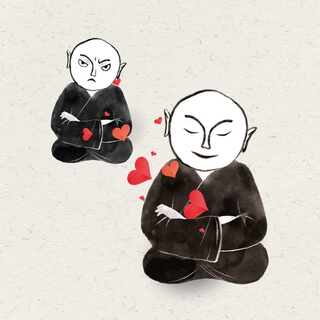
So we have this term in English.
To feel livid.
Livid means to be extra angry and it's a very direct connection with the liver.
Now,
Anger is in no sense wrong or shouldn't feel it or we should judge it in any way.
Anger is a very healthy and normal emotion in response to any particular situations.
But the problem comes when anger is residing under the surface,
When it's not fully acknowledged,
Not fully conscious,
And when we hold on to or wallow in our anger over a longer period.
So anger can end up blocking up the system.
Like our energy is blocked.
We're holding on.
There's a sense of this bubbling anger,
Frustration underneath the surface.
And every now and again it explodes out.
Potentially with harmful consequences.
Now when we bring the liver and the gallbladder system into optimum functioning,
The liver is feeling healthy,
Doing what it needs to,
The energy system is freely flowing and connected,
Then.
.
.
That brings the anger kind of release a little bit.
And it brings us to a place where.
.
.
Our pipes are unblocked.
And when our pipes are unblocked,
We can be creative.
So anger is almost the antithesis of creativity.
Very difficult to be creative when you're really seething with anger.
So this is the energy,
The opposite energy,
If you like,
Of our spring season.
The creativity,
The life force,
The growing.
The developing,
The nurturing.
So as we let go of anger,
So right now,
In our position,
In our posture,
We can just allow the whole body to soften.
And allow any sense of frustration any holding on To kind of just sink into the ground.
The ground in a sense acts like a lightning conductor.
These strong emotions when we touch the ground,
When we are aware of the ground.
Maybe even with your finger,
If you want,
Reaching out,
Touching the ground,
Or just with your inner sense,
Your body touching the ground,
This strong energy can just dissipate,
Can release into the earth.
And we're left here with this openness.
And with a sense of creativity,
Perhaps even fun.
Joyfulness.
We come into contact with our personal idiosyncratic ways that we hold on.
One of the things that yoga is very,
Very good at showing us is how we hold what are our patterns of tension of Um.
.
.
Of kind of like gripping or letting things kind of tighten.
And each of us is very different.
Each of us is very individual in how we hold.
So we can also inquire.
So right now.
Is there anything left over that's holding on in your body?
So we have to hold ourselves upright,
Of course.
There's some muscular tone,
If you like,
To hold our posture.
But what about the other things?
Can we release in the jaw?
Is that somewhere where you typically hold tension?
Can we release in the shoulders?
Is that somewhere that you find tension creeps in?
Sometimes it's the belly.
Sometimes it's the hands or fingers.
Each of us has our own work to do to find those patterns and to listen in to your body.
And those telltale signatures of where things start to tighten up and we begin to get this sense of holding blockage.
It's restricting the flow of energy,
Restricting that creativity,
That growth,
That emergence of joyfulness.
So in Zen we call this the koan of the body.
A koan is a question,
Is a focus point for our meditation around an inquiry.
So when we make our focus of our meditation our body,
In understanding,
Coming to terms with,
In being present with,
And being kind with our body.
This is the koan practice of our body.
So I'm going to be quiet for a little bit of time.
As an opportunity for really.
Inhabiting listening to your body and we've been set up for a little bit of time so if your body says it would rather lie down at this point then please feel free just moving anywhere you need to minimal movements to come to lie down on your mat And if you rather stay sitting,
Also totally fine.
So dropping the attention.
Into the body,
Inhabiting your body.
And inquiring,
What is it like?
Right now.
Making friends with your body.
Developing that relationship.
A relationship that's based on kindness.
And sensitivity.
In knowing that Our body changes moment to moment,
Day by day,
Year by year.
And that change isn't good or bad,
It's just change.
Unblocking the pipes to allow that growth,
The creativity to flow.
And as we come to the end of our practice together,
I'm just going to bring a little bit of movement back to the body.
Maybe deepening the breath a little bit.
Maybe swaying your body side to side if you've been sitting up,
Or if you've been lying down,
Very gently rolling over onto your right side.
No rush.
Maybe a little wiggle into your fingers and toes.
Then from the right side.
Coming up into sitting.
We'll join each other all in sitting position.
Bringing the hands together in front of your forehead.
Bowing to honour your own practice just now.
Coming up here,
Making this diamond shape on top of the head,
We'll lay it down over the crown.
Coming out to the side,
We scoop up a bit of the energy from the space in front of us,
Bring it into the chest,
And bow to this energy we've made together,
Practicing together.
And then here from the chest,
We go forwards and down towards the floor,
Bowing and saying thank you to our teachers.
And all the people in history who have passed things down for us to learn today.
Thank you.