Hi,
Today I'm going to show you that you're breathing in three dimensions.
And how that affects your mood.
The first dimension is when you place a hand like this on your chest.
And you try to push the sternum.
Up towards your hand.
So go ahead,
Try it.
When you inhale,
Your chest is pushing forward,
Right?
And when you exhale,
It's going down.
Let's do two more like this.
So you really have time to feel it by yourself.
Okay,
For every breath I'm suggesting you do,
Try to breathe through the nose.
If your nose is blocked.
.
.
I'll give you a couple of tips to unblock your nose.
Maybe you can check that video.
Otherwise,
Try to breathe only through the nose and try to breathe slowly.
Don't watch this video too in a rush.
Speed 1.
5 or 1 or 2.
0 because you could get lightheaded.
So we agree that your breath goes forward,
Right?
Now let's explore the fact that you're breathing also from the back.
So either you can place a hand like this,
Towards the back or to the front.
Around the back like this.
On your shoulder blade.
You should target the shoulder blades.
If your arms are not reaching there,
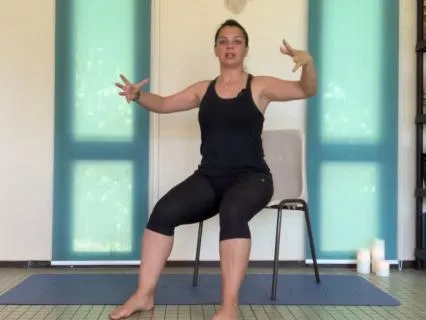
You can also sit like this and press the shoulder blades into the backrest.
Or against the wall.
You can do this and try to feel the pressure of your own body.
You see I'm really leaning against the wall.
I hope you could feel the shoulder blades moving up like this,
Like back,
Actually.
Imagine my hands are behind,
But they move like that.
So evolutionary speaking,
The shoulder blades were the place where the wings would start from.
So imagine if it's still a bit of a struggle to fill those gaps.
Shoulder blades moving up like that.
Imagine that you're really opening up.
Your wings and spreading the wings.
Go ahead,
Try it again because that's usually where most people struggle with.
The rest is easier,
I guarantee.
So go ahead,
Try it.
Maybe with the hands like that.
Maybe pressing against the chair.
So yeah.
If it goes forward and back when you inhale,
Like this.
Let me show you without putting my hands.
Could you see how far my shoulder blades go?
Once you realize it.
.
.
It's amazing how much more lung capacity you get.
So go ahead,
Try it slowly through the nose.
So it's really inflating like this and deflating as well.
So that's the first direction,
Right?
Forward and back.
Then we have to the sides.
So let's.
Put a hand here.
On the ribs,
You have under the armpit,
Either crossing the arm or even like this.
And when you inhale,
You press the ribs out towards the hand.
Can you feel it?
Can you see on me how it looks like?
It's as impressive,
I find,
The inflating than the deflating.
The deflating is also very Spectacular.
On the other side.
To There?
And try to really empty your lungs in between.
You can do a third time to really feel it,
Maybe changing the hand if you want.
It's easier.
Okay,
Now let's combine both.
Ways.
So that's the lateral direction,
Right?
That's the second direction.
Let's go.
Once more.
Okay,
Now let's combine forward and back,
That direction,
With that direction.
Go ahead,
Inhale.
And Excel.
Once more,
Inhale.
And Excel.
Do it once more if you want,
By yourself.
Good.
And now,
What do you think is the third direction?
Maybe you can tell me in the comments.
Although I'm going to share the solution with you right away.
If we have forward and back,
Left and right,
Then we have up and down.
What I usually get is,
Oh,
Then there is the belly breathing.
Which is not wrong.
I'll get to it.
Don't worry.
So what is moving up and down?
The diaphragm,
Yes.
And this is why it's called the belly breathing or diaphragmatic breathing.
Because the diaphragm is this membrane.
It's a muscle that is quite flat.
And large and it's attached to the lower ribs.
And when you inhale,
It spreads and it opens like this.
And it flattens and when you exhale it comes back because it's getting shorter like this and then it comes up like a dome.
Like an umbrella as well.
So when you exhale,
It goes up like this because the lungs get empty.
When you inhale,
The lungs are getting full and it goes down.
It's also calling the air to come in.
And it's also pushing in the belly.
When you exhale,
It goes up.
And there is more space in the belly,
So the belly comes in.
So when you inhale,
The air comes in,
The lungs get full,
The diaphragm goes down and the belly comes out.
And when you exhale,
The belly comes in.
The diaphragm goes up and shrinks and the air comes out.
The lungs get empty.
I hope this is clear.
If it's not,
Feel free to.
.
.
Watch again that explanation.
OK,
So now let's put into practice this diaphragm.
We're going to breathe three times slowly and try to visualize what I explained,
The membrane going up and down.
So it goes up when you exhale and it goes down when you inhale.
So go ahead.
Let's start with the inhale.
And on the Excel,
It goes up.
Release.
The exercise.
And now let's put everything together.
Front,
Back,
Left,
Right,
Up and down.
All together.
So it's really like your whole thoracic cage,
Your whole lungs is like a huge ball and that ball is inflating from everywhere.
Because it's a ball,
So it doesn't choose to go only up,
Down,
Left,
Right,
Forward or back.
It goes everywhere,
Like a.
.
.
Those inflating balloons,
Right?
And on the XL,
It goes down,
Everything shrinks.
Let's try that.
Now,
How do you feel?
Well,
There is no right or wrong answer,
But if you did follow what I said when I said exhale for long through the nose,
Take your time,
Empty your lungs.
You've been exhaling more than you've been inhaling.
And for that,
You feel almost like tired,
Depleted of energy.
And yeah,
You feel like yelling.
So I may be giving it to you.
Um.
.
.
And sometimes it's a good thing,
You know,
Like when you're too high in anger,
Anxiety,
All those what we label negative emotions,
When everything is too much in your life.
Um.
.
.
Breathing in the term of exhaling,
Just Sighing.
Is a good way to release that pressure and to come down,
To lower down this energy that is overwhelming.
Um,
So yeah.
I really advise you to try that when you feel good,
Because the day you feel bad and you actually need to practice that,
Then you'll have the practice and you may remember what I said.
Do practice it right now and feel that all that excelling I mean,
It was three,
Six.
.
.
9,
12,
15,
18.
All together 21,
So in 21 breaths.
Even without trying to focus on slowing down.
That's what actually happens in your body.
20 breaths.
And it's about.
.
.
Well,
It's less than 10 seconds per breath.
So let's say it's about.
Three minutes that it takes.
To really come down,
Even without willing to.
So if you want to really come down,
Less than one minute is possible.
Try it next time.
Next time someone pisses you off.
And next time you feel that it's coming up,
Up,
Up,
You say like,
OK,
You know what?
Let me breathe it out.
All that anger,
You visualize it,
And you you take it out of your system.
Through the breath.
You say,
Like,
I don't want it.
Like,
Stay away from it.
Stay away from me.
Anger.
Whatever is the emotion.
Try it and it's really going to help you process it.
Um and put distance with yourself and that emotion.
So yeah.
But now if you're feeling a bit too like that let's do the opposite okay how do you feel when you're just so lazy and you just feel like yelling,
Watching TV,
Scrolling,
And.
.
.
It's actually time to wake up.
And you've had enough coffee and your stomach is so full of acid that you cannot take another cup of coffee.
Well,
The solution I'm going to give you today is sniff.
Like,
As if you were.
.
.
Holding on to some snot,
Right?
So breathing through the nose,
Fast,
A lot.
And breathe out through the mouth.
Do it,
For real,
Do it right now.
Stop if you feel like it's getting too much for you.
It's actually already too much for me because I'm quite at a high level of energy because I'm shooting for you guys today.
So I don't need to do it much,
But go ahead.
What it does is it's giving me lights.
I don't see well anymore anyways.
It's bringing oxygen to your brain,
So it's sending the signal to watch out.
So it's putting you in the fight or flight mode.
Which I would not recommend you to do on a regular basis because we are already so often stimulated.
By the environment.
And the way society works these days.
Don't push it,
Okay?
But this is good to know that this is an option,
Right?
I do it when I'm driving on the highway and I start to fall asleep,
I feel like,
Okay,
Let me And it helps me to hold it until the next stop.
Even if it's a couple of minutes before I really close my eyes and take a nap if I need to.
So yeah,
This is a safety measure that is worth trying.
Yeah,
Just try it today,
Try it the day you actually need it and see if it works.
Then.
What I want to share with you is the in-between,
Right?
Because life is a question of balance,
Always.
And uh.
.
.
Sometimes we need to go to extremes,
We need to be on high alert because there is danger and we need to be able to respond to it.
And sometimes we need full rest,
We need to dream,
We need to meditate,
We need to be in that state where we don't do anything and that is fine.
But ideally,
We should be even more in this.
Harmony and peaceful state in between that is called sadhvik.
The high energy is Rajasthik,
The low energy is Tamsik,
And Sattvik is like in between.
If you want to know more,
You have the words in the description so you can google them to know exactly the spelling.
So let's practice that.
You have a couple of breaths.
I'll put the pranayama playlist if you want later on,
But basically what you need to remember is Inhale as much as you exhale in order to breathe.
Feel that peaceful energy.
So you have cardiac coherence,
Which is one of the most famous one lately.
You have Nadi Shodhan.
So it's alternate nostril breathing,
Right?
If you inhale as much as you exhale,
This is the condition.
Cardiac coherence is inhale five seconds,
Exhale for five seconds,
For five minutes,
Three times a day.
This is amazing for your nervous system.
If you have never tried it,
Like really do it.
This is one of the best breathwork I have used on a daily basis.
I did it three times a day for six months straight and I could really feel a bonus in my life.
So yeah,
Please,
At least try it.
If you can adopt it,
Even better.
So it's in the primary playlist I'll put at the end.
Then you also have the back spreading.
So it's inhale,
Block,
Exhale,
Block.
And up to you to choose according to your lung capacity,
If it's 1,
2,
5,
6,
8 seconds.
You can also even increase if you want.
And because you work also on the Kumbhaka,
So the retention of the breath,
Then you improve the lung capacity.
So that's another benefit.
All right.
Take care.
Have a nice day and see you next Wednesday.