Welcome.
Today's practice is a part of the Meridian series and this class is devoted to the bladder and kidney meridians.
We're working with the water element,
Inviting resilience,
Restoration and deep inner peace.
In traditional Chinese medicine,
The bladder meridian is the longest energy channel in the body with 67 acupressure points.
And it's known as the guardian of peace.
It runs along the entire back line of the body,
Starting in the inner corners of the eyes,
Covers the head,
Runs either side of the spine,
Through the backs of the legs,
Ending in the little toes.
When balanced,
It supports endurance.
Clarity,
And the sense of feeling supported.
When out of balance,
It may present as overwhelm,
Anxiety,
And fear.
The kidney meridian has 27 acupressure points.
It begins in the soles of the feet,
Runs up the inner legs,
Entering the torso,
Moving through the diaphragm,
The liver,
The lungs,
Up through the throat and ending in the tongue.
When balanced,
It expresses as inner strength,
Courage,
And quiet wisdom.
When depleted,
It may manifest as fatigue,
Anxiety,
Fear and instability.
So because we're working with the water element,
We'll also include Bodhi Mudra today.
Bodhi Mudra is where we connect the tip of the thumb to the tip of the pinky finger.
Pinky finger relates to the water element and also communication.
In Sanskrit,
Bodhi represents perception and intellect.
And inner knowing.
So this module supports clarity,
Intuitive communication,
And emotional balance.
So for this practice,
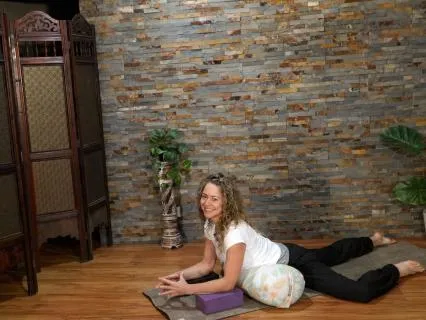
I will be using a yoga bolster.
If you don't have a yoga bolster,
You can improvise with two or three pillows on top of one another or a thick blanket rolled up nice and tight.
We will use the wall,
So do position your mat close to the wall.
And I've also got two yoga blocks.
If you've only got the one block,
Then grab yourself a thick book or a rolled up towel.
If you don't have any blocks,
Then a thick book about that thickness and a rolled up towel nice and tight,
And you'll be able to improvise with those.
So as we move through this practice,
Allow yourself to soften.
Release anything that's heavy.
And reconnect.
With that steady inner peace within.
Before we begin our restorative and yin postures with a little somatic movement,
We will work with two acupressure points.
From the kidney meridian we'll start with kidney number one which is known as bubbling springs.
So this particular point I personally find easiest to find if you point the toe down and then run your finger in between the second and third toes until you find an indent divot.
Just.
.
.
Bottom of the ball of the foot there.
So these indents or little depressions are often quite tender or sensitive.
That's when we know that we're on the spot.
I'm going to stimulate both of these points at the same time.
Feel free to do the same as well.
Now with your stimulation,
You might apply direct pressure,
Maybe a circular movement or even pulsing.
There really is no right or wrong.
And we can stimulate these points really from anywhere from 30 seconds to a couple of minutes.
So if you would like to spend more time with these points during this class,
You can always pause and stay a little longer.
So this point is said to help ground the body and calm the mind.
Said to reduce anxiety and restore depleted energy.
Especially when we're feeling overly mentally active,
When we're all up in our head.
Or we're feeling really disconnected,
This is a wonderful point to massage.
I often find this point quite helpful too,
Coming out of meditation or a deep shavasana.
It just helps you to ground before you move on with your day.
So we'll leave this point here and we'll move on to the bladder meridian now.
We're going to work with point number 10.
This one is known as the heavenly pillar or celestial pillar.
So the easiest way that I find this one is taking your fingertips to the base of the skull in the middle,
Right in the middle there,
And then just slide your pointer or middle fingers out.
Might only be a centimeter or a centimeter and a half.
And again,
You'll feel a tender indent.
And that's where we'll pause and gently stimulate.
So this point helps to release neck and shoulder tension.
Calm the nervous system.
Eases mental strain.
While supporting inner strength and steadiness.
And let's relax there.
Moving into our practice now,
Let's begin.
So first posture using the wall.
We'll take our legs up against the wall.
Make sure you can reach either your blocks or your pillow or bolster.
Sit sideways is the easiest way to come in so you're nice and close to the wall and then lay your shoulders down as you swing those legs up.
Now a little bit of space between hips and the wall is fine especially if you're overly tight in the hamstrings or the I would like us to elevate the hips here.
So if you can,
Place your block or your book.
Underneath the bottom.
Stack the two on top of one another.
Or of course you can use your pillow or your bolsters instead.
Once your props are in place and they feel comfortable,
Then you can straighten and relax the leg.
Alms can come out to the side.
Palms to face the ceiling.
And then connecting the thumb and the pinky fingers.
For Bodhi Mudra.
Let's gently place the tip of the tongue where the teeth meet the roof of the mouth.
Feeling a little space between the top and bottom teeth.
Softening the jaw.
And feeling the breath.
Roll over the back of the throat.
Allow the forehead to soften.
And the eyes to gently roll back into the socket.
Retreating from the external well.
We bring our awareness to the inner landscape.
Inhale smoothly,
Deeply.
And Paul.
The exhalation slowly receives.
A sense as though the breath is moving in a wave-like motion.
Inhaling from the crown of the head.
To the soles of the feet.
Exhaling.
From the soles of the feet.
To the crown of the head And as the body softens,
The mind begins to settle.
This posture gently stimulating.
The bladder meridian.
Along the back side of the body.
When the back side of the body begins to soften,
The nervous system settles.
Let's release this pose now,
Removing the props from underneath you.
As you lower down to the mat,
Let's take those legs out nice and wide.
As wide as they will comfortably go.
If you are able to come down quite far and you need support,
You can always have your blocks underneath those thighs.
So feeling a little sensation here through the inner legs,
Hips and groin.
As we start to tap into the kidney meridian.
Running along the inner leg.
Soften any tension that may have crept into the jaw.
Breathe into the hips.
The leg.
The inner thigh.
Using the hands now to help those legs come back together.
When you do,
Take a hold of your block and place it in between your thighs.
Knees are bent,
Soles of the feet are flat on the wall.
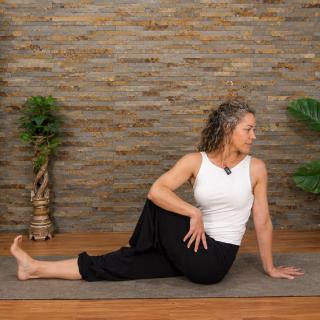
Let's twist.
Bring your legs over to the right side.
Rest your right leg on the floor.
If you need support you can use your second block or your pillow underneath the leg.
Take your right arm out to the side and bring your left palm over to meet the right elbow crease.
As you inhale,
Slowly lift the arm above the head.
Turn the head to the left.
And as you exhale,
Sweep the arm down past the hip.
So we're taking sweeping circles with the left arm.
As we inhale slowly,
The arm is above shoulder line.
And as you exhale,
The arm sweeps down below the shoulder line.
When we move mindfully with the breath.
Becomes a moving meditation.
Whenever you feel ready,
You can come to stillness in your twist.
With the collarbones facing the ceiling.
Taking Bodhi Mudra.
This nourishing twist stimulates both kidney and bladder meridians.
You can deepen your twist by gently deepening the breath.
Breathe into the lower belly,
The lower back.
Feel the body expand and then pause for just a moment.
And exhale for five.
Four.
Three,
2.
One.
Inhale smoothly,
Deeply.
And Paul.
And exhale for 5.
Four.
3 two.
Wow.
Let's prepare to change sides.
Firm the thighs on the block and then bring those legs back up to the wall.
And change slides.
Propping the body if you need to.
And then when you're ready,
Bring your right fingertips over to the left arm.
And then inhale the arm above the head,
Out to the right,
Turn the head to the right.
And exhale to sweep the arm down.
Let it be slow movement,
Slow breath.
And come to stillness when you're ready.
And if the mind wanders,
Simply return to the pulse of the breath.
Moving the body.
Releasing the pose,
Let's remove the block.
Roll onto your left side into the fetal position.
Take rest here for just a moment.
And then bring yourself up to tabletop.
Coming up onto all fours.
And just start to move very slowly through your cat-cow stretches,
Just feeling into your back,
Your hips.
Inhale,
Gentle back bend.
And as you exhale round the spine,
You might like to lift the palms a little and sit back towards child's pose.
As you inhale,
Return to tabletop,
Ground the palms a little backwards.
Exhale,
Scoop the tailbone under,
Sitting back.
Follow the brand.
Well done,
Yogis.
Let's come to seated now.
Preparing for a seated forward fold as we tap into that bladder meridian once again.
Bring those legs out in front.
And then your bolster or your pillows coming on top of the legs.
So we want full contact here,
Pull the bolster in nice and close to the belly.
We will fold forward and allow the back to round.
So you can choose to place one or two blocks on top.
And configure them so that you can support the forehead.
Just allow the palms to face up.
Taking Bodhi Mudra once again.
Awareness to the breath moving the body.
As you inhale and the navel expands,
Feel the navel push the bolster away.
Take a little pause.
And then as you exhale and the navel draws in,
The bolster returns.
The inhalation sends the bolster away.
The exhalation gently guides it back.
And also notice the back side of the body moving with the breath.
It's as though the back is puffing out.
On the inhalation a lingering pause in that spaciousness.
Before you exhale and soften.
Sinky.
Into the shape.
You might like to visualize the bladder meridian here.
Running along the back side of the body.
The guardian of peace.
Gently restores the balance within.
And with your next inhalation,
Gently lift up out of the poem.
Give yourself time.
We can feel a little fragile and a little vulnerable after these long forward bends.
You might like to gently swish those knees from side to side.
Either stay with this movement or if your wrists,
Elbows and shoulders permit,
I reverse tabletop.
Press into the feet,
Squeeze the heels in just a little.
And broaden those collar bones.
And lower down.
Well done,
Yogis.
Let's move back over onto all fours,
Onto hands and knees.
And then just briefly reach the arms out in front for a puppy pose.
We'll take the palms high,
Just your fingertips on the floor.
Forehead can rest on your block or the mat.
We'll only be here for a couple of breaths.
Feeling the upper body expand in all directions.
As you inhale.
A little porn.
And as you exhale,
Soften the heart.
Towards the mat.
Let's walk those hands back,
Bringing yourself up.
Well done,
Yogis.
Bring your bolster now or your pillows over so that they are running parallel to the short side of the mat.
We're going to take a modified sphinx pose.
So come down onto your navel.
It is helpful to have your blocks or your book in front so that you can rest your forearm.
So I've got my lower belly resting on that soft support and you can either stay here with the legs straight or you can bend your left knee out to the side.
And just allow the shoulders to relax.
If you find that your head needs support here,
You can take those hands to the chin.
Frame the jaw.
Or the face.
You might like to bring your awareness here to.
.
.
The kidney meridian.
Along the front side of the body.
Or maybe even the sensation of the kidneys in the back side of the body.
Being gently compressed and massaged.
Water teaches us to soften.
To adapt.
And to endure.
Let's change legs,
Bring the left leg in.
And the right leg out.
Of course,
If there is any pain or discomfort in your low back or your hips,
Then do keep the legs straight.
There's no need to bend the knee.
Always working with your body,
Not against it.
Meet any tension in the body with your breath.
Not with force.
Not with judgment.
And let's release this pose.
Bring the right leg in.
Press yourself back up to tabletop.
You can just slide your bolster or pillows off to the side and the blocks.
And let's just very slowly round the spine,
Lift the palms and just rock back towards child's pose.
Then as you inhale,
Return to tabletop,
But no backbend,
Just be neutral.
Then as you exhale,
Tuck the towel bone under,
Gently sit back.
Inhale return tabletop.
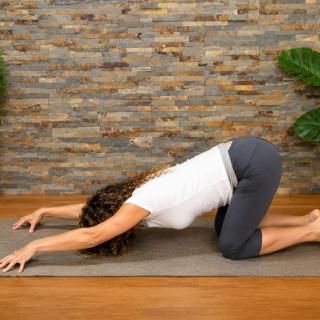
And this time we'll come all the way down into child's pose.
So tucking the tailbone under,
Sitting back to those heels.
Either resting the forehead on the mat or you can bring your block over for support.
You're able to bring your hands next to the feet and make fists with your hands.
We'll do a little self-massage here,
A little pummeling.
Begin to tap.
Those fists along the outer thighs.
And then gently take the hands to the low back.
Moving either side of the spine up to those kidneys and down.
And then resting when you're ready.
Let's press back up.
Next posture will only hold for a short time.
If your knees and hips permit,
Take a wide-legged child's pose.
So big toes to touch,
Knees wide,
And then we'll thread the needle.
So you can bring your right arm underneath and take buddhimudra through the right hand.
Left elbow points up to the ceiling.
This does not feel good for your knees and hips.
You can bring the hips up higher so that you're not sitting back in child's pose and thread the needle.
So take the variation that feels best for your body.
Gently firm down through the right arm and squeeze those shoulder blades together.
Let's change sides.
And bringing yourself up.
Well done.
Coming to sit for me and then recruit your bolster or pillows.
Take them towards the end of the mat.
We'll rest the legs over there.
And then with your two blocks,
We'll have one underneath the shoulders.
One underneath the head.
Go higher underneath the head for me.
Now,
If you don't have the two blocks and you're using a book,
You could improvise with either two books or a rolled up towel and you could take the rolled up towel behind the shoulders instead of the block.
When you're ready,
Bring yourself down so that those legs are resting.
On the bolster.
And then lining up the edge of the block with the base of the skull.
So it's going to be.
.
.
Pretty much in line.
With the heavenly pillar point.
Let's take the arms out to the side,
Palms to face the ceiling.
And taking your Bodhi Mudra once again.
Where there was tension.
Invite space.
Where there was noise.
Invite stillness.
The body knows how to restore.
When it's given space.
Trust.
That quiet,
Intelligent.
Within you.
And then from here,
Let's remove the block from under the shoulders or the towel.
Keep the prop under the head,
If it's the block turn it to the flat side.
Just allow those legs to relax.
And then one last little neck release here.
As you exhale,
Let your head fall to one side.
And as you inhale,
Slowly come back to center.
And exhaling to the other side.
Feeling the meeting points between the head.
And the prowl.
And if you would like a few more repetitions,
Please take it.
Otherwise,
You can come to stillness when you're ready.
Feel free to remove the block from under the head.
As you come into Shavasana.
Gently place the thumb and pinky fingers together for buddhimudra.
Let go of any holding in the mouth.
Allow the eyes to roll back into the sockets once again.
As you completely commit them to rest.
From the external world.
Of looking and seeing.
Let's retreat inward.
To the quiet observer.
To the peaceful present in between the thoughts.
Peace is not something we find.
But something we return to.
Let this feeling of peace flow through you.
Like water.
Smoothing and softening.
The deeper layers within.
Inhale,
Pee.
Exhale.
Relay.