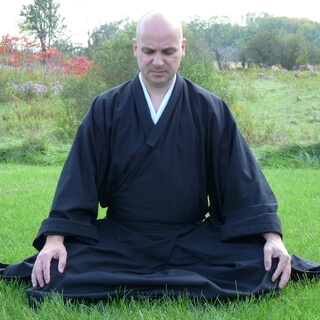
Hello,
It's me,
Joe,
The Autistic Buddhist,
And today I'm going to talk about acceptance.
This session about acceptance is going to be a difficult one for me.
To speak about acceptance,
I'm going to share with you a personal story where acceptance was very challenging for me.
The story starts with my pet dog,
Kenya.
Many years ago,
I got Kenya as a puppy and raised her.
I had once listened to a veterinarian lecturing on the psychology of dogs,
And she said that the most frequent question she was asked from dog owners was,
How does my dog view the relationship between us?
And she answered that from the dog's perspective,
The relationship between a dog and its owner is exactly the same as the relationship between a child and their parent.
The dog being the child,
Views its owner as its parent,
Its mother or father,
Which I found very interesting.
As an autistic person,
My relationship with Kenya was different than my family's relationship with her.
Our bond was very strong.
Although Kenya was not a support dog,
She acted like one in every way,
And she was in many ways my baby.
And through my relationship with Kenya,
I came to understand why autistic people have support dogs and feel very close to them.
It took me a while to understand what the nature of our relationship was.
And although I was the parent and she was the child,
I relied on her a great deal.
Unlike others,
I relied on Kenya for emotional support,
For helping me to cope with life circumstances.
Whenever I was disappointed,
Sad,
Agitated or upset,
I would always go to Kenya and play with her or just sit beside her and pet her.
It always made me feel better.
I felt I could alleviate anxiety or fear much better by being with her than speaking to another person about it.
I know that when many people experience a bad day,
Frustration,
Discomfort,
They seek support from other people,
Whereas I always went to Kenya first.
It wasn't that she did anything special.
It was that she was there,
Listening,
Being close to me,
Always demonstrating some form of affection by putting her paw on me or her head on my lap.
She provided me with no feedback,
Advice or suggestions of how to improve things or the situation.
All she gave me was her attention and love.
So Kenya and I spent a lot of time together.
When I was home,
She was always next to me.
She slept in bed with me,
Sat next to me on the couch while I watched TV,
Lay at my feet when I was reading or eating,
And lay right behind me when I was meditating.
If in meditation I leaned back just slightly,
I could feel her against the small of my back.
It was as if her presence was saying,
I know you are meditating,
But I'm here right behind you.
I had Kenya for 12 years.
And in July 2022,
When Kenya died,
My world fell apart.
Before she died,
I noticed that she was having difficulty walking.
After a while,
She needed help to get on the couch or on the bed.
She lost weight and her appetite.
I was told repeatedly by everyone that she was old and suffering from the ailments of old age.
I was also told that she was so old that it would not be long before she was gone.
Every day when I came home from work,
Kenya would be looking out the window waiting for me.
And when I walked to the house,
I could see her face in the window.
And when I opened the door,
There she was,
Overjoyed that I was home.
I could not imagine a time where I would not see her face at the window.
It was just too difficult to think about.
One night,
I noticed that Kenya could barely walk,
That she was not responding when called and would not eat her favorite treat.
She had a terrible night and the next day when she signaled me to go outside,
I let her out.
It was raining very hard and she did not like the rain,
So I knew she would be back quickly.
I started to notice that she hadn't come back.
She was outside for far too long,
So I went out to check on her.
She was sitting on the lawn,
Completely wet,
Unable to climb the stairs to get back into the house,
So I went out,
Picked her up and carried her in.
I started to get very worried.
I called my partner and explained what happened,
And my partner said you need to take her to the pet hospital right away,
Which I did.
I was sure that she would be examined by a veterinarian,
Given some medication and perhaps a brace and sent home with me.
At worst,
She may have to stay in the pet hospital for a few days until she was better.
That was what I expected to happen.
That is what I wanted to happen.
When I arrived at the pet hospital,
The veterinarian took her in right away.
He and a nurse took her to an examination room and I sat in a waiting room and I waited and waited.
Soon the door to the waiting room opened and the veterinarian walked in.
He said he needed to discuss something with me and I interrupted him and said is she going to be okay.
I could feel my anxiety slowly turning into fear.
At this time I was no longer anxious.
I was afraid.
The veterinarian said that Kenya was very old and that she was in significant pain.
I just looked at him and tears started flowing down my face.
He said she could no longer walk,
Due to her age as her hip bones had deteriorated.
There was an option for an operation,
But when I asked if it would help,
He said that at her age it would likely make no difference and there was a risk that it could even make things worse.
He stated that she would be in constant pain and that pain would affect her ability to eat and drink,
Likely causing her to slowly starve.
I did not want to hear this.
I wanted to scream,
Stop.
I was openly crying now,
Sobbing,
Trying to breathe.
As I wept,
He looked at me and said,
I think it's time to say goodbye to Kenya.
At first,
I was confused.
Say goodbye?
Where was she going?
Were they moving her to another hospital or somewhere else?
Perhaps a specialist?
And in a moment of pause,
I understood what he meant.
The Northwest Indians of North and South Dakota and the United States have a saying that they use when one feels a very deep sense of sadness and despair.
And that saying is,
My heart is on the ground.
And that is exactly how I felt.
I cannot describe to you the deep and unwavering sense of despair I was experiencing.
I told the veterinarian that I agreed that it was time to say goodbye to Kenya and I asked him to see her before she went.
In a very emphatic way,
He said,
Of course.
He told me that Kenya was currently sedated and that he would bring her out with an IV tube attached to her leg.
With a syringe held in his hand,
And when I asked him to,
He would push the plunger of the syringe down and the medicine would quickly flow into Kenya's body and she would instantly pass,
Without any pain or discomfort.
When he returned,
He and a nurse had Kenya with them.
The nurse was helping her walk.
She had a sling wrapped around her stomach to hold her back legs up off the floor.
The veterinarian was holding onto the syringe attached to a long,
Thin plastic tube that was inserted into Kenya's front leg.
When I saw her,
I fell on my knees and I held her.
I held her tightly against my chest and cried.
I could not stop my tears.
My crying was intense.
It was loud.
It was racked with grief.
The veterinarian said to me,
Whenever you are ready,
Let me know.
I held Kenya close to my chest and placed my head on hers.
I could not let her go.
I didn't want to.
I felt her starting to tremble,
As if she was very cold.
And I said,
She's trembling.
Is she in pain?
The veterinarian,
In a soft,
Sad voice,
Said,
Yes.
And with my face streaked with tears,
I held her tighter and said,
Do it now.
The veterinarian injected the medication and Kenya suddenly went limp.
The veterinarian said,
Let's give Mr.
Darosha some time with Kenya,
And he and the nurse left.
I lay Kenya down very gently.
She looked like she was asleep,
And I was beside her,
Bent over,
With my hands over my face,
Feeling the most intense emotional pain that I have ever felt before.
In my entire life,
I have never felt such grief.
I simply could not accept what happened.
I should outline here the difference between what I was experiencing and the concept of denial.
In denial,
A person denies the reality around them.
They adopt a feeling that what happened did not happen.
That was not what I was experiencing.
I was not in denial,
But fully aware that my Kenya was gone,
And that I would never see her again.
What I was experiencing is what I chose to call delayed acceptance.
For me,
Delayed acceptance is not wanting to let go so soon.
It is a period of time where mourning and grief must take place and run its course,
Or any other emotion that needs to take place must run its course.
It is an understanding that I am suffering now,
Because this is where I am,
And this is how I feel.
I often think that denial is like standing in a hole,
About three meters deep,
With no way out,
Refusing to accept your situation,
Refusing to accept the fact that you are in a hole,
And you can't get out of it.
Whereas delayed acceptance is being in the same situation,
Except that there is a ladder in that hole,
And you can climb out any time you want to,
But you are choosing to stay in the hole for a while,
Until you feel it is okay to climb out.
And that was my situation.
I knew that eventually I would come to terms with Kenya being gone,
But I did not want that now.
I once read this story in a Buddhist text.
I can't recall the source.
The story was about a novice Buddhist monk,
Who asks a senior monk,
When will I know when I am enlightened?
And the senior monk says,
When you learn to accept.
The junior monk says,
Accept what?
And the senior monk says,
Accept everything.
Accept everything.
Once I heard Eckhart Tolle say that if you cannot accept the circumstances around you,
Then accept your non-acceptance.
This is what I wanted to do,
Was to submit to my own non-acceptance.
Or more accurately,
Adopt delayed acceptance.
I realized that although acceptance tends to make life less painful,
I was not ready to let go of my pain or my grief.
Not yet.
So I adopted delayed acceptance.
Yes,
One day I will come to terms with this loss.
I have suffered.
But that day is not now.
And when people became aware of my grief and tried to console me with statements like,
You'll get over this.
I answered with,
Yes I will,
But sometime later.
Not now.
This is where I need to be.
The choice to delay my acceptance allowed me to grieve,
Holistically,
Without any anxiety or worry.
I would not accept my loss now,
I would accept it later.
I found that when I shared my delayed acceptance perspective with others,
They demonstrated sincere respect.
My delayed acceptance was a place I chose to be in,
So that I could honor Kenya and my relationship with her.
Delayed acceptance is fundamentally permission.
Permission I had given myself to feel,
To live in my emotion,
And not be ruled by it.
I hope none of you ever suffer that kind of pain.
But life does not work that way.
And I am sure that at some point in your life you will lose something of such value that it will stagger you.
And when that happens,
Give yourself permission.
Permission to cry,
To grieve,
To be vulnerable.
Permission to live with your emotions.
It has been over a year since I lost Kenya.
And when I think back,
I still become sad and miss her.
Even writing this session proved very difficult.
And it's okay.
One day I won't feel as sad as I do now.
But not today.
I hope that this story,
This session,
Has given you some benefit and has been helpful to you.
I thank you very much for taking time to listen to this session.