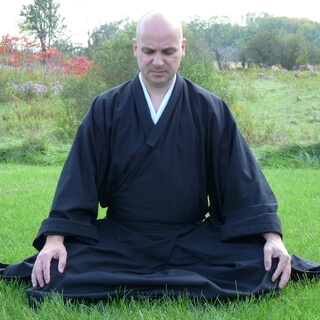
Hello,
It's me,
Joe,
The Autistic Buddhist.
This session is called,
Autism,
Everything the Same,
Buddhism,
Everything Different.
When I first started to learn about Buddhism,
I was introduced to a concept that,
From the beginning,
I knew was going to cause me some challenges.
That concept was that of impermanency.
As many of us know,
Impermanency in Buddhism is the belief that all things change,
And so my frustration between the philosophy of impermanence and my desire for similarity began.
But the world was always there to remind me that impermanence was all around,
Even places where I thought it wasn't.
Shortly after my diagnosis for autism,
A thought emerged in my mind.
Clearly,
There are other people out there who are also autistic.
I felt glad that there were others out there exactly like me.
I was happy when I found and connected with other autistic people,
And then disappointed that the other autistic people were not exactly like me.
They were different.
The way autism presented itself in them differed from the way I experienced autism.
I remember going to a community presentation for autistic people.
At first,
It was uplifting,
As I was with my own people.
But as the event progressed,
And autistic people provided feedback and asked questions,
I started to see that they were unlike me.
A few I could relate to,
Others not at all.
Although autism is a neurological disorder,
It does have a wide range of expressions.
So my people,
At least some of them,
Were not exactly my people.
This presented itself as a periodic annoyance,
And it certainly did not make me happy.
And my immersion into Buddhism emphasized this very point through the philosophy of impermanence.
But I ignored it.
At least,
I thought,
As a Buddhist,
I knew that I shared a common religion,
Philosophy,
And way of life with all other Buddhists everywhere.
As Buddhists,
We,
Fundamentally,
Are all the same.
And this gave me comfort.
Later,
I met a person at work.
I'm not going to use her real name,
So let's call her Laura.
The way I met Laura is that I simply approached her one day and introduced myself.
My eagerness to meet Laura was based on the fact that a work colleague of mine told me she was a Buddhist.
And I thought,
Wonderful,
A Buddhist like me.
Laura and I had several fascinating and informative conversations.
I learned quickly that Laura practiced a different form of Buddhism than I did.
In a later conversation,
She explained some of the practices of her Buddhist tradition.
And one day,
As she explained,
I started to frown.
Laura noticed it right away and mentioned it.
I looked at her seriously and said,
Laura,
Your traditions and practices are very different than mine.
And she smiled at me.
It was a wonderful smile.
I still remember it.
And she said,
Joe,
Did you think we were all the same?
And I replied quickly,
Yes.
And she smiled again.
And I burst out laughing because suddenly I realized,
As if having an epiphany,
How absolutely ridiculous that thought was.
My autism orients me towards sameness.
In my autistic world,
Sameness equals stability.
Stability equals predictability.
And predictability equals safety.
Differences can sometimes be frightening or intimidating.
So the more sameness,
The more comfortable I am.
But I also recognize how limiting that is.
My experiences have shown me,
Through little steps,
That by accepting differences,
Life becomes better,
Not worse.
And the differences that are important to me are not the big universal differences.
They are the smaller differences that surround me.
Trying out a new food,
Listening to a song that I would not normally listen to,
Reading a book outside of my interest,
Or meeting a new person.
It is these kind of differences,
One upon another,
Taken at a slow pace,
That has opened up my world.
For me,
Trying out something new is like learning to walk.
I can't be thrust into it.
The expectations cannot be high.
Or I'll get scared.
So learning new things,
Trying new things,
Requires small steps,
Small encouragements,
Time to think,
And of course,
Patience.
And after a while,
My world grows a little bit bigger.
There are foods that I enjoy today that I would have never thought of trying years ago.
And it is the same for various other things as well.
I had an autistic friend who would not eat anything green.
For many,
That may sound ridiculous.
For this person,
It was very real.
I thought it was odd as well,
But having my own small autistic idiosyncrasies helped me to understand.
My friend though,
Liked pasta.
And he liked pasta a lot.
I enjoyed a dish called gnocchi,
Italian pasta with creamy pesto sauce.
Look up gnocchi on the internet with creamy pesto sauce.
Not only is it green,
But visually,
It looks awful.
I told my friend about it,
As he liked gnocchi too,
And tomato sauce.
And asked him to consider the pesto sauce.
He might like it,
He might not.
But he said,
If you want to try it,
Take it slow.
Try the creamy pesto sauce first,
Just a tiny bit,
And get the taste of it.
He seemed doubtful.
After a long while,
He and I were talking.
And he said,
Oh,
I tried the creamy pesto sauce on my gnocchi.
And?
I asked.
It's delicious,
He said.
I eat it now instead of tomato sauce.
So how did you do it?
I asked.
It took a while,
He said.
And I did not ask him anything else about how he overcame his previous obstacle.
I just understood.
But his world opened up a little bit more.
The idea of paying attention to differences came from my study and practice of Buddhism.
I'm not saying that in order for a person to accept something different in their lives requires them to be a Buddhist.
But for an autistic person like myself,
Where even the smallest changes can seem like a disaster,
Buddhism was very helpful and continues to be.
In Buddhism,
Differences can also be understood as impermanence.
Buddhism helped me to approach change by asking me to consider the change first.
Practice some koan to help me think differently.
If you don't know what a koan is,
I suggest you do a search for it on the internet.
It's spelled k-o-a-n-s,
And it's basically a phrase that causes you to think differently about situations and things.
And also,
Buddhism taught me to be aware of the mental process that occurs when I anticipate differences.
Buddhism taught me how my need for sameness and impermanency can coexist.
That sameness and differences are not two forces in opposition to each other,
But that they can exist within me in harmony.
I still have challenges with differences,
But Buddhism is always there to remind me that whatever challenges I have,
It may result in me being a better person in a better place.
A better place not only for myself,
But for those around me as well.
Thank you for the generous gift of your time in listening to this session.