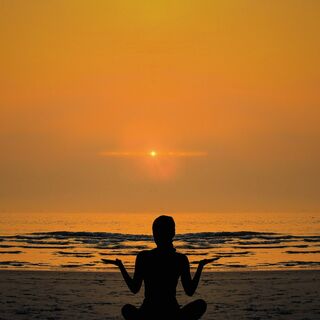
The seven point posture is a posture that's been recommended for centuries in many different traditions including Tibetan Buddhism and the Varachana positions.
The seven points are the space of your legs,
Your back,
Arms,
Shoulders and hands,
The jaw,
Mouth and tongue,
Your eyes and your head.
The practitioner is seated on the ground,
Typically on a cushion which slightly elevates the pelvis and allows the knees to roll forward.
The legs are held in a lotus position with one foot on the thigh of the opposing leg.
I tend to alternate this with half lotus and a cross-leg position so that my feet don't fall asleep and so I'm more focused on the meditation and not on the sleepiness of my feet.
So when sitting on the ground like that,
What you do is you hold your back upright,
Not uptight.
And the way that I do that is I envision a string pulling me up from the center of my head like a marionette which extends my spine and then my shoulders naturally roll back and my arms naturally fall to either side.
I place my hands on my lap or on my knees with the palms facing upward or in a mudra which means that my fingers are touching my thumb,
Touching my middle finger on my knees,
But in such a way that again your arms are naturally being held.
Because my head is held upright and my neck is held upright,
I slightly tuck my chin and that allows my eyes to gaze about three to six feet in front of me in a soft focus and I maintain that view.
Alternatives to this is to close your eyes which can be effective in certain meditative practices,
But the key here is to meditate in such a way in this posture so that you don't become drowsy during the meditation.
The jaws and mouth should be relaxed,
Your teeth are apart,
Your lips lightly together to still allow some breath to enter.
The tip of the tongue lightly touches the palate behind the upper teeth and this demonstrates then the full posture with the head upright,
Natural position,
Eyes slightly open,
Tongue,
Jaw,
Mouth all being relaxed,
Arms,
Shoulders,
Hand opening up the chest and the heart area,
The back being naturally erect and your legs being crossed.
I hope this is helpful and do keep in mind that you can always modify these positions for your physical wellness and for your mental or emotional wellness.