Hi there,
My name is Kayla June Kelly E.
Cooley,
And I am the developer of Somatic Groundwork.
Thank you for choosing to participate in this practice with me.
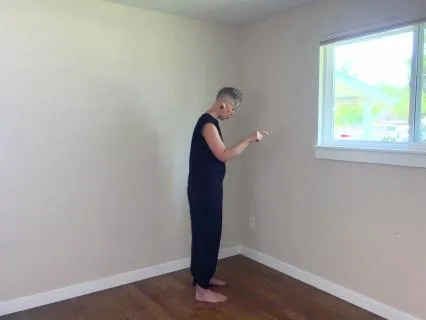
Today I'm going to guide a basic standing yielding practice,
And then we'll do a few movements from there.
Shifting of weight,
Swaying,
Some bouncing,
And spinal rolling.
To begin,
I invite you to take a standing position.
And when you come to standing,
Bring your attention down to where your feet are in contact with the ground.
Notice where you meet the ground beneath you with the soles of your feet.
And with that in the background,
Now begin to take your eyes and look around you.
Allow this to be a sort of curious,
Wandering gaze.
With an interest to see what is in your surroundings.
Letting your eyes move high.
To the right,
To the left.
Down low again to both sides of you.
And if you'd like,
You can look behind you.
So getting a sense of everything that's around you.
And then what is it like to be able to receive the images?
So that your energy isn't working to go out as much as you're allowing energy to move in through your eyes.
Receiving what you're seeing.
And then returning back to the place where you're also meeting the ground with your feet.
Being received down through gravity.
As you're receiving your environment.
And I just had a spontaneous breath change,
So you might notice if there are any kind of subtle effects.
That are occurring for you with these two points of attention interacting.
Sensing with ground and sensing with outer eyes.
And then next,
Allow your body to make any adjustments that it needs to be more comfortable in standing.
So with bringing attention to ground and outer eyes,
You might have a little bit more presence with how your body structure is.
And so allowing yourself to move.
To make adjustments.
In a way,
These kinds of movements or following these impulses is like a check-in.
To the different parts of your body.
And I just had a spontaneous pendiculation,
A body yawn.
So we're just starting to stack some really basic somatic activities here.
So sensing with ground.
Continuing to use your eyes to receive your surroundings.
Making any self adjustments or moving your body in a way that helps you feel more comfortable.
Oh,
And then giving yourself permission to yawn,
Which is kind of a stretchy,
Squeezy,
Whole body action.
Hmm.
And a yawn might come up like it did for me spontaneously or maybe because I'm yawning you might start to yawn or you could even just kind of approximate it like open your mouth start to Breathe in.
.
.
Start to kind of move towards what you know a yawn feels like and then slow that down and let it move through you.
Maybe taking it out to the ends of your fingers.
Oh,
Letting your torso move.
And noticing the ending of the pandiculation.
Okay,
So these are the background of practice,
The sensing with ground,
Sensing with eyes,
Making adjustments and moving around,
Wiggling about whenever you want to,
And then body yawning.
All right,
Returning now to focus on feet,
Let's move into now sinking weight down through the feet.
And as I'm moving towards that felt sense,
I'm allowing my ankles to soften,
My knees to soften.
Allowing my weight to move down actively and I'm bending down into my legs.
To facilitate that or to move towards a sense of sinking.
And then now I'm doing like a little bit of a pulsation with the sinking.
So I'm bending my knees and then I'm pushing the earth away and then I'm bending and pushing the earth away.
And I'm doing this in a very small way,
Pulses.
It's like a soft bouncing that's starting to occur.
And you can use that bouncing and also shift your weight from side to side.
A little bit more weight goes into one leg.
So for me right now,
That's the left.
And then I shift my weight to the right.
And I'm kind of sinking weight and bouncing.
And you can use any of these cues that are working for you.
As a way to meet the ground.
To be received by gravity.
And seeing how much work and effort you can actually kind of just let dissolve,
Like let slough off.
Right.
See if you have actually been holding yourself up against gravity.
And what is it like to say,
Okay,
I don't need to do that.
Like gravity has got me.
The space has me.
Oh,
Where could I reduce some work?
Where can I relax a little bit more?
And then see if you can move more into this bouncing.
Right,
So the bouncing comes because of allowing ourselves to yield down to sink into the ground.
And then from that we have something to push away from.
So it's a moving down and then very small pulsations,
Pushes from the ground out.
It's like a spring.
It's like you're using that sense.
Of yielding and pushing through the feet.
As a spring that then can move through your legs.
So through the lower legs.
Ankles into the knees.
Up into the head.
Letting that easy spring-like bounce now move into the lower back.
Up through your spine.
Into the torso and the shoulder girdle and arms.
That bounce now move all the way up to influence your head and so your head's kind of bobbing around a little bit.
And as you're doing this,
You're still noticing what's around you.
So you're kind of looking around.
Soft gaze.
Oh,
There's a yawn,
So I pause out of the bouncing.
Okay,
So a few intervals like this.
Balancing,
Kind of watching how this kind of soft wave moves through you from the ground.
Finding that just right rhythm.
To where there's actually very little energy that you need to do to maintain it.
It's like it maintains itself as it gets going.
Allowing your breath to move under the bouncing to flow in and out.
If the yawn comes up,
Pause and do the yawn.
If you just want to pause to take a moment of rest.
Then observe the effects from the bouncing.
And then begin bouncing again.
And again,
It's like this is your just right rhythm.
So this could kind of amplify itself and get pretty big if you wanted it to.
Could even move you around your space if you'd like.
And you can see how there's like a lot of movement now in my arms.
And there starts to be kind of like a wiggle shake that comes out of the bounce.
Or you could keep it really small.
Hmm.
Right,
So see what's just the right rhythm for you.
And when you take the pauses in between,
There's that opportunity to check in.
See how your body is moving any way that you'd like.
Continuing to unwind the holding,
The extra holding,
The extra rigidity.
That's not needed.
Moving towards a quality of fluidity.
In softness.
All right,
And the next time that you come to a pause,
Let's go ahead and stay there together.
And now taking your gaze right in front of you.
Are you finding something to look at that you like,
Maybe face a direction?
I'm seeing outside right now.
So I like that.
Returning back to how you're meeting the ground.
Paying attention to the bottoms of your feet.
And the sense of connection into the floor.
And as we allow ourselves to be supported by gravity and we meet that force,
We receive the gift of the ground reaction forces more readily moving through our structure,
Giving us a sort of buoyancy.
Or lift.
So see if that's possible for you right now to sense both of these forces.
Both of these primary environmental forces that we're always in contact with,
We're always immersed within.
But in this moment,
You're choosing to use those forces to meet with them,
Relate with them,
In order to help manage your structure.
In a good way.
So there's both the down and the up.
And if you'd like to now close your eyes.
Go ahead and do that and notice the shift of presence that occurs as you do that.
And allowing now your inner eyes.
To open.
Which is a sense of soaking in to yourself,
Into the landscape of you.
That could be going right back down to where your feet are in contact with the ground.
You might like to start that soaking in from the top of you.
Or there might be a very particular body area that's readily available and you can move your inner eyes there,
Bring your attention there,
And sit.
And soak in that place.
Observing how your body is breathing you.
This primary circulation of air moving in and air moving out.
Which is also a relational exchange with our environment.
So outer eyes and inner eyes.
You always have a choice about which one you want to use.
And choose the one that gives you the most support in the moment.
And it's fine to move back and forth between those two options.
We're going to move into spinal rolling now.
So bringing your attention to the very top of your head,
To the crown.
Okay,
That place where ground reaction forces,
Maybe that's where you visualize the energy moving out through you to help with this spatializing.
So a very kind of subtle lift.
Through the top of the crown.
And then on your next exhale,
Allow that point of the crown to curve forward.
As your eyes move to the floor,
Chin comes towards your chest.
And then draw the crown back up.
So we're going to use this spatial intent of the crown to go up and over as the head moves forward and the eyes go downward.
Okay,
So back and forth like that a few times.
Using this spatial pathway of the art.
And the next time when you're ready that your head is down and chin is towards the chest.
Allow the crown now to have that sinking of weight.
You might consider water pouring out the crown very slowly.
And allow that to move the head down.
Rolling through your spine.
And pausing wherever you'd like to pause.
Sometimes the first place of pause is where some sensory feedback comes through.
So for me,
That'd be right about here.
I'm now kind of in tune with my lower spine.
I'm also feeling the space between my shoulder blades.
And here I'm going to practice letting my arms really hang,
Letting my shoulder blades slide away from the spine.
Allowing my head to be heavy,
Neck,
Jaw,
Tongue soft.
And then a small bend through the ankles and the knees,
And that push that we used earlier as a way to start the returning back to standing.
And when you're ready,
Moving through that again,
Pouring the crown forward.
Rolling down through the spine.
Remember that you can pause wherever you'd like.
Hey,
There's nowhere to get.
There's this exploration now of moving.
Through this shape.
And this time down,
I found myself so that my head is below my hips.
I'm looking through my legs.
I pause here.
And the practice is how to relax here.
And also feel the support through the legs.
Rooting me,
Allowing for stability so that I can hang and rest my spine.
And upper body over the legs.
And then to come up from your role again a little bend in the knees.
Soft through the ankles,
Pushing the ground away.
And let that send energy up through the crown that then orients back to sky.
So as a reminder,
There's somatic activities inside this practice of spinal rolling,
The sensing with ground.
Sensing with outer eyes and or inner eyes,
Depending on what you choose.
Pausing.
Pausing and moving with impulse,
Wiggling around and self-adjusting as you need.
And then allowing yourself to express the body yawning or pandiculations.
And stopping to let the pendiculation move through and shape you as it will.
And then to continue in the spinal rolling.
Okay,
So with that.
Rolling down,
Rolling up.
Maybe rolling all the way down so that you're kind of folded over upper bodies over legs,
Or maybe you're rolling down just a little bit.
And as you do this repetition over repetition,
Notice how you're choosing the tempo.
So you might start to go,
Okay,
I can go a little faster and go slower.
And you're going to find that tempo,
Just like with the bouncing,
The just right rhythm so that this can move towards a quality of fluidity.
Like water.
Soft.
Supple.
The next time you come back to standing,
Take a pause there.
Return to tracking your yielding practice here in standing.
The meeting with ground and gravity and space.
And now if you'd like combining the shaping of spinal rolling and the bouncing we did earlier.
So this might look like this first curve that we took in the spinal roll with the crown moving forward.
Pausing at the end of that and then bouncing there.
You know,
Maybe six,
10 times and then standing up and then curving over.
And bouncing there.
And as you do this very easy bouncing,
Bringing your attention now to the entire back body from sacrum all the way to cranium.
And allow that to be where the elasticity is really coming from for your bounce.
So it's moving from the feet.
And then moving into the thoracolumbar fascia,
Which is this continuity from the sacrum to the cranium.
And allowing that to have the rhythm,
To hold the rhythm.
To be the thing that is doing this elastic recoil.
So there's a soft rounding here in the spine.
To enhance the sense of the thoracolumbar fascia.
And then you could begin to bounce maybe once or twice and come up,
Or bounce once and come up.
You could bounce at different ranges.
You could bounce a little bit lower.
Now each and every person is going to need to kind of really track what's appropriate for them when it comes into this bouncing.
So if you have concerns about,
Hmm,
That might not feel good to me,
Or.
Maybe that's gonna hurt because of like past history of maybe like low back pain or things like that.
Remember that you have all the choice here with how to approach it.
This could start even smaller than I just first cued.
For example,
It could be head hangs over.
And a little bit of bouncing right there.
Or it could be rolling down.
And then rolling up a little bit quicker.
And putting two.
Or more repetitions of the spinal roll together and seeing about how that wave can then move towards that sense of bouncing.
And for this last minute of practice or so,
Taking any of these cues,
Any of these movements.
From the spinal rolling to the bouncing and or back to feet,
Bouncing on feet or shifting weight on feet and or whatever movements come out of that,
Whatever kind of creative play.
You want.
Do you want to improvise on this somehow?
Take this last minute and begin to move.
With this kind of like as the inspiration.
With this as the template from which you're moving from.
Sensing with ground sensing with outer eyes sensing with inner eyes pausing when you want to pause making adjustments when you need to do that.
Moving towards what feels good.
Yawning,
And continuing to move towards this fluid movement.
Relating with ground,
Gravity,
And space.
And then letting your movements slow down.
Bit by bit.
Until you're back to quiet standing.
And from here,
Choosing eyes open or eyes closed.
And bringing your attention to this presence.
Noticing how your body is now.
How is your mind the place of thought?
Of the space inside your chest.
How's your center body,
Your viscera?
And how are you meeting the ground with your feet?
And then noting any part of this pattern that you have right now of standing yielding.
That you want to keep close kind of like as a record or like as a Karen on the trail like you can return here.
On purpose by choice.
But it will be easier to do so if maybe you have this record that you can draw on.
So you're making a mark here.
Maybe you name it something,
Maybe standing yielding works,
Maybe it's something else based on your experience right now.
Maybe there's some other descriptive words or a color or an image or a felt sense quality.
And so now that you have this,
As you move through the rest of your day,
Can you return to this three more times?
Can you intentionally call on this embodiment?
Of standing yielding or whatever it is that you're naming it.
And it's like doing research.
What is it like to intentionally move towards this place of resting and receiving throughout the day?
Thank you so much for joining me for somatic groundwork.