Welcome back friends,
I'm your host Joanne,
And tonight I'll be reading The Good Little Mouse by Madame Denoir,
A classic fairy tale about kindness,
Patience,
And goodness that persists even in difficult circumstances,
And where small acts matter more than power.
Now let's take a moment to settle in.
Allow your body to rest comfortably where it is.
Let your shoulders soften,
Your jaw ease,
And your hands relax.
Take a slow breath in,
And let it go gently.
You might imagine yourself in a warm,
Cozy room,
Looking out through a window.
Inside,
You feel comfortable and at ease.
Outside,
Trees stand quietly in the evening air.
A soft breeze moves through the branches.
Everything feels unhurried and calm.
You're safe where you are,
Simply watching,
Listening,
And resting.
There's no need to focus or follow closely.
The story will unfold at its own pace,
And whenever you're ready,
We'll begin.
Once upon a time,
There lived a king and a queen who loved each other so very,
Very much that they were all in all to each other.
The one always knew what was in the other's mind and heart.
Every day,
They hunted hares and stags in the forest,
Fished for souls and carps in the river,
Or went to balls and danced,
Or to grand banquets where they ate roast meats and sugar plums,
Or to the play and the opera.
They laughed and sang,
And invented all kinds of games to amuse themselves.
In short,
Never were any two people so happy.
And their subjects followed their example,
And each man was merrier than his fellow.
For all these reasons,
This kingdom was called the Land of Joy.
Now,
King Joyous had a neighbor who lived in a very different way.
He disliked laughter and pleasure,
And seemed to take comfort only in anger and conflict.
A constant scowl darkened his face.
His beard was long,
His eyes sunken,
And he dressed always in black.
His hair was unkempt,
And his whole appearance made people uneasy in his presence.
He ruled through fear rather than kindness,
And those who crossed his path often came to sorrow.
Punishments were harsh,
And mercy was seldom shown.
Wherever he ruled,
People lived in constant distress,
And even families who loved one another were not spared his cruelty.
For these reasons,
His country was known as the Land of Tears.
The fame of King Joyous' happiness came to the ears of the Wicked King,
Who was very envious,
And who made up his mind to levy a great army and go and fight his neighbor and press him hard,
Till he should be dead or seriously wounded.
From all parts he gathered recruits.
He collected arms,
And ordered cannons to be made.
Then everybody was terrified,
And said,
Whosoever this Wicked King attacks,
He will give no quarter to.
When all his preparations were made,
He marched towards King Joyful's country,
Who,
Hearing the evil tidings,
Immediately set about defending himself.
The Queen nearly died of fright.
Sire,
She said,
Weeping,
We must flee.
Get all the money you can,
And we shall go away to the other end of the world.
But the King answered,
Madam,
I have too much courage for that.
I would rather die than be a coward.
So gathering his men round him,
He bade the Queen a tender farewell,
And,
Mounting his beautiful steed,
Rode away.
When he was lost to her sight,
She began to weep sadly,
And clasping her hands,
She said,
Alas,
For the child that is to be born to me,
If the King is killed in the wars,
I shall be a widow and a prisoner,
And the Wicked King will harm me in every possible way.
So for this thought,
She could neither eat nor sleep.
The King used to write to her every day,
But one morning,
When she was looking over the battlements,
She saw a courier riding at full speed.
Ho,
Courier,
She called.
What news?
The King is dead,
He cried.
The battle is lost,
And the Wicked King will be here in a moment.
The poor Queen fell down in a swoon.
They bore her away and laid her on her bed,
While all her women stood round.
Here one weeping for her father,
There another for her son.
It was the saddest of all sights.
And then,
All at once,
Sounds of chaos and alarm rose through the city.
The Wicked King had arrived with his followers,
And fear spread quickly wherever they went.
Confusion and distress filled the streets,
And no one felt safe.
The King made his way into the palace,
And went straight to the Queen's chamber.
When she saw him enter,
She was overcome with fear,
And hid herself upon her bed,
Drawing the coverlet clothes around her.
He called to her more than once,
But she did not answer.
Growing impatient,
He spoke angrily,
Boasting of his power and threatening her fate.
Discovering where she lay,
He seized her and carried her away from the palace.
Though she pleaded for mercy,
He showed none,
Mocking her distress as he bore her off on his dark horse to his own land.
He carried the Queen away to his own country,
Speaking darkly of her fate,
But those around him urged restraint,
Reminding him that she was soon to give birth.
Hearing this,
He began to consider how the child might one day serve his own purposes.
If the baby were a daughter,
He thought,
She might be bound to his family instead.
Wanting to know what the child would be,
He sent for a fairy who lived near the borders of his kingdom.
When she arrived,
He treated her with an unusual show of courtesy and led her up into a high tower where the poor Queen was kept.
There in a small and sparsely furnished room,
The Queen passed her days in sorrow.
Her bed was nothing more than a thin mattress laid upon the floor,
And she wept often in her loneliness.
When the fairy saw her,
She was deeply moved.
Bowing respectfully,
She embraced the Queen and whispered softly,
Take courage,
Madam.
Your troubles will not last forever.
I hope to be of help to you.
Comforted by her kindness,
The Queen thanked her and spoke of how quickly her former happiness had been taken away.
They were still speaking when the King interrupted impatiently,
Asking the fairy to tell him whether the child would be a boy or a girl.
The fairy replied that it would be a girl and that she would grow into a princess of rare beauty and grace.
She then bestowed her blessing upon the unborn child,
Wishing her many gifts and honors.
The King responded harshly,
Declaring that his favor would depend upon whether the child fulfilled his expectations.
With that,
He turned away and left,
Without once looking back at the sorrowful Queen.
Left alone,
The Queen wept and said to herself,
What shall I do?
If my child pleases him,
She will be claimed for his family.
If not,
I fear for us both.
Is there no way I might hide her so that he may never find her?
The time of the little princess' birth was drawing near,
And the anxieties of the Queen grew worse every day.
She had no one to share her grief with or to console her.
The jailer who guarded her only gave her three peas cooked in water the whole day long,
With a little morsel of black bread.
She became thinner,
Till she was nothing but skin and bone.
One evening,
While she was spinning for the wicked King,
Who was a great miser and made her work day and night,
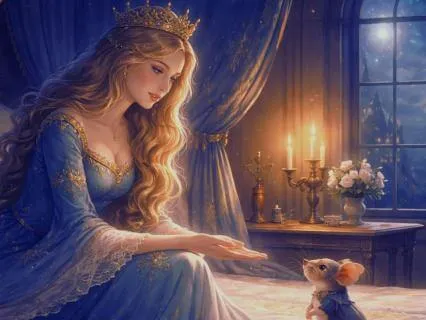
She saw a very pretty little mouse come in through a hole.
Alas,
Little one,
She said,
What are you seeking here?
I have only three peas for my food all day long,
So if you don't like fasting,
Run away.
The little mouse ran here and there,
Dancing and cutting capers like a little monkey,
And the Queen was so amused that she gave it the only pea she had left for her supper.
Here,
Little one,
She said,
Eat this.
I have no more,
But I give it to you with a goodwill.
As soon as she had done this,
She saw on the table an excellent partridge,
Exquisitely cooked,
And two pots of jam.
In truth,
She said,
The good one does is never lost.
She ate a little,
But her appetite had gone through long fasting.
She threw some sweets to the mouse,
And it munched them up,
And then began to jump about in a livelier way than it had done before supper.
Next morning,
Early,
The jailer brought the Queen's three peas,
Having put them in a large dish just to mock her.
The little mouse came softly and ate them all up,
And the bread too.
When the Queen wished to dine,
She found nothing left,
And she was very angry with the mouse.
It is a naughty little beast,
She said,
And if it goes on doing this,
I shall die of hunger.
When she went to cover up the large dish which was empty,
She found in it all kinds of good things to eat.
But while she was eating,
The thought came to her that in two or three days,
Perhaps,
The wicked king would put her child to death,
And she rose from the table to weep.
Then,
Lifting her eyes to heaven,
She said,
Are there no means of escape?
As she said this,
She saw the little mouse playing with long pieces of straw.
Picking them up,
She began to work.
If I have straw enough,
She said,
I shall make a covered basket to put my little girl in,
And I will give her through the window to the first charitable person who will take care of her.
She set to work,
Therefore,
With a good heart.
She had plenty of straw,
For the mouse was always dragging some into the room and jumping about all the while.
At mealtimes,
The queen gave it her three peas,
And found in exchange all sorts of dishes.
This astonished her very much,
And she never stopped wondering who could be sending her such excellent things.
The queen was looking through the window one day,
To see how long the cord should be which she must fasten to the basket to let it down,
When,
Below,
She saw a little old woman leaning on a staff,
Who said to her,
I know your trouble,
Madam,
And if you like,
I will help you.
Alas,
Dear friend,
Said the queen,
You will do me a great service if you come every evening to the foot of the tower.
I shall let down my poor child to you.
You will feed it,
And I shall try to pay you well if I am ever rich.
I am not fond of money,
The old woman answered,
But I like good things to eat.
There is nothing I care so much for as a fine plump mouse.
If you find any in your garret,
Kill them and throw them down to me.
I shall not be ungrateful,
And your baby will thrive well.
When the queen heard this,
She began to cry,
And did not say a word in reply,
And the old woman,
After waiting for some time,
Asked her why she was weeping.
Because,
She said,
Only one mouse comes to my room,
And it is so pretty and so sweet that I cannot make up my mind to kill it.
What?
Said the old woman angrily.
You care more for a silly little mouse that gnaws at everything than the child that is to be born to you?
Very well,
Madam,
You are not to be pitied.
Remain,
If you wish,
In such good company.
I shall find plenty of mice without you.
I haven't the least doubt about that,
And she went away scolding and muttering.
Although the queen found a nice meal prepared for her,
And the mouse came and danced before her,
She never once lifted her eyes from the ground where she had fixed them,
And the tears ran down her cheeks.
That night,
A princess was born,
A miracle of beauty,
And,
Instead of crying as other children do,
She smiled to her dear mother,
Holding out her little hands as if she understood everything.
The queen caressing kissed her with great tenderness,
Thinking sadly,
Poor darling,
Dear child,
If you fall into the hands of the wicked king,
It is all over with you.
So she put her in the basket,
With a label fastened to her swaddling clothes on which was written,
This unhappy little girl is called Joliet.
And,
When she had left her for a moment without looking at her,
She opened the basket again and found her much prettier still.
Then she kissed her and wept yet more bitterly,
Not knowing what she should do.
But now the little mouse comes and gets into the basket with Joliet.
Ah,
Little creature,
Said the queen,
It has cost me much to save your life,
Perhaps I may lose my dear Joliet,
Anyone else would have killed you and given you over to the old glutton,
But I could not consent.
Do not repent of what you have done,
Madam,
Began the mouse,
I am not so unworthy of your friendship as you may think.
The queen was half dead with fright at hearing the mouse talk,
But her terror grew much worse when she saw its little snout taking the form of a face,
Its paws becoming hands and feet,
And its whole body growing suddenly larger.
At last the queen,
Who hardly dared to look anymore,
Recognized in the mouse the fairy who had come with the wicked king and who had treated her so tenderly.
I wished to test your heart,
Said the fairy,
I know now it is good and that you are capable of friendship.
We fairies,
Though we possess immense treasures and riches,
Seek love as the only consolation in life and we find it rarely.
Is it possible,
Fair lady,
Said the queen,
Embracing her,
Being so rich and powerful as you are,
You have difficulty in finding friends?
Yes,
She answered,
For we are only loved because it is to people's advantage to show us affection and we do not care for that.
But when you loved me in the shape of a little mouse,
You had no selfish motive.
Then I wished to put you to a still harder test,
And so I took the form of an old woman.
It was I who talked to you at the foot of the tower,
And you then,
As always,
Were true to me.
So saying,
She embraced the queen,
Kissed the little princess's red lips three times and said,
My gifts to you,
My daughter,
Are that you be your mother's comfort,
That you be richer than your father,
And that you live for a hundred years,
Ever beautiful,
Never ill,
Never wrinkled,
Never old.
The queen in great delight thanked her and begged her to take Joliet away and care for her,
Adding that she gave her the child for a daughter.
The fairy accepted the gift and thanked the queen.
Putting the little one into the basket,
She let it down,
But she stopped for an instant to change herself into a little mouse again,
And when she went down herself afterwards by the cord,
The child was not to be found.
She mounted again in a great fright.
All is lost,
She said to the queen.
My enemy,
Cankalene,
Has carried off the princess.
You must know that there is a cruel fairy who hates me,
And unhappily,
Being older than I,
She has more power.
I do not know how to get Joliet out of her wicked clutches.
When the queen heard such sad news,
She thought she must die of grief.
She wept bitterly and begged her good friend to do what she could to find the little one again,
At whatever cost.
Meanwhile,
The jailer came to the queen's room and discovered that the child had been born.
He hurried to tell the king,
Who at once demanded to see the baby.
The queen told him that a fairy whose name she did not know had come in the night and taken the child away.
At this,
The wicked king flew into a terrible rage.
Speaking harshly,
He ordered that she be taken away at once.
But just as danger seemed closest,
The good fairy intervened.
She concealed the queen from harm,
And in the confusion that followed,
Led the king astray.
While his attention was turned elsewhere,
The fairy swiftly carried the queen away in a flying car and brought her safely to a beautiful castle where she was cared for with great kindness.
If only Princess Joliet had been with her,
The queen would have been fully comforted.
But no one could discover where the cruel fairy Cankeline had hidden the child,
Though the little mouse searched and tried her very best.
Time went on and softened the queen's great sorrow.
Fifteen years went by,
And during that time,
A strange rumor spread through the land.
The wicked king's son was said to be preparing for a wedding,
And the bride was a simple turkey herd who had no wish at all to become a queen.
Many people found it curious that someone should refuse a crown,
Yet preparations went on all the same.
Fine garments were laid out,
And people came from far and wide,
Eager to witness such an unusual event.
The little mouse went as well,
Hoping to see the turkey herd for herself.
She found her in the poultry house,
Dressed plainly,
Barefoot,
With a simple cloth covering her hair.
Around her lay rich garments of gold and silver,
With pearls,
Ribbons,
And lace scattered about,
Left unattended and forgotten as the turkeys wandered freely among them.
The young girl sat quietly upon a large stone,
While the wicked king's son spoke to her in a harsh and demanding tone,
Insisting that she must agree to the marriage.
But she answered him firmly and without fear,
Saying that she would not marry against her will,
And that she preferred her quiet life among her turkeys to all the riches he offered.
The little mouse watched her with admiration,
For the girl's calm courage only added to her beauty.
When the king's son finally left,
The fairy took the form of an old shepherdess and approached her kindly.
Good day,
My child,
She said.
What fine healthy turkeys you care for here!
The turkey herd looked at the old woman with gentle eyes and replied,
They would have me leave all this behind for a crown I do not want.
What do you think of that?
My little girl,
Said the fairy,
A crown is a very fine thing.
You neither know the value nor the weight of it.
Oh yes I do,
The herd replied promptly,
And for that reason I will never wear it.
But I do not know who I am,
Nor who my father is,
Nor my mother.
I have neither parents nor friends.
You have beauty and goodness,
My child,
Said the wise fairy,
And these are better than ten kingdoms.
Tell me,
I beg you,
Who brought you here,
Since you have neither father,
Mother,
Relations nor friends?
It was a fairy called Cankeline who was the cause of my coming here.
She treated me very unkindly,
Juliet continued,
And I was often frightened without knowing why.
At last,
I could bear it no longer and I ran away.
Not knowing where else to go,
I rested for a time in a quiet wood.
While I was there,
The wicked king's son happened to pass by.
He spoke to me and asked whether I would like to work in his household.
I agreed,
And the care of the turkeys was given to me.
I was content enough with them,
And he would often come to see how they fared.
But though I never encouraged it,
He grew very attached to me,
And now he will not leave me in peace.
The fairy,
Hearing this,
Began to think the turkey herd must be Princess Juliet,
So she said to her,
Tell me your name,
My daughter.
My name is Juliet,
At your service.
Then the fairy no longer doubted,
But that it was she,
And,
Throwing her arms round her neck,
She was like to have eaten her up with caresses.
Thereupon,
She said to her,
Juliet,
I have known you for a long time.
I am glad you are so good and so well-bred,
But I wish you to be cleaner,
For you are a little scullion.
Here,
Take these pretty clothes and put them on.
Juliet,
Who was very obedient,
At once cast away the dirty clothes,
And,
Shaking her head a little,
Her hair which was fair as sunlight and fine as golden threads,
Covered her from head to foot,
Falling in curls to the ground.
Then,
Taking in her delicate hands some water from a stream that ran near the poultry house,
She washed her face,
Which became as fair as an eastern pearl.
It seemed as if roses were blowing on her cheeks and lips,
And her sweet mouth breathed the scent of thyme from the woods and the gardens.
Her figure was straighter than a reed.
In winter you might have taken her skin for snow,
In summer for lilies.
When she was adorned with the diamonds and the beautiful clothes,
The fairy thought her a miracle of beauty and said to her,
What do you think you are,
Dear Juliet?
For you look a very fine lady now.
In truth,
She answered,
I think I am the daughter of some great king.
Would you be very pleased if this were so?
Said the fairy.
Yes,
Good mother,
Replied Juliet,
With a curtsy.
Very well,
Said the fairy.
Be easy in your mind then.
I shall tell you more tomorrow.
In haste,
She repaired to her beautiful castle,
Where the queen was busy spinning silk.
The little mouse called to her,
Your Majesty,
Will you give Rue your distaff and your spindle for the best news you could ever hear?
Alas,
Said the queen,
Since the death of King Joyous and the loss of my Juliet,
I wouldn't give a pin for all the news of the world.
Now,
Now,
Don't go on so,
Said the fairy.
The princess is in the best of health,
I have just seen her,
And she is so beautiful,
So very beautiful,
That she can be a queen if she likes.
And she told her the story from one end to the other.
The queen,
Weeping for joy to know that her daughter was so beautiful,
And for sadness to think that she kept turkeys.
When we were great sovereigns in our kingdom,
She said,
And lived in such magnificence,
My poor husband and myself,
We never could have believed that our child would one day keep turkeys.
It is that cruel Cankalene,
Said the fairy,
Who,
Knowing how I love you,
Just to spite me,
Has reduced her to that condition,
But she will come out of it,
Or I shall burn my books.
I do not wish her to marry the wicked king's son,
Said the queen,
Therefore,
Let us set out tomorrow to fetch her and bring her here.
It happened that the wicked king's son,
Angry and distressed,
Went to sit beneath a tree and wept bitterly.
Hearing him,
His father called out sharply from a window and demanded to know the cause.
Because the turkey herd will not love me,
The son replied.
At this,
The king flew into a rage and ordered that the girl be brought to him at once.
His men went to the poultry yard,
Where they found Joliet,
Dressed in white satin,
Adorned with gold and jewels,
So beautiful that they scarcely dared speak to her.
When they asked for Joliet,
She answered quietly that she was the one they sought.
They led her away to the king and his son.
When the king saw her beauty,
He hesitated for a moment,
But his harsh nature soon returned.
He demanded that she agree to the marriage at once.
Trembling,
The princess knelt and begged for time to consider her fate.
After some discussion,
They resolved not to harm her,
But instead to shut her away in a high tower where she was kept from the light of day.
Just then,
The good fairy came in the flying car with the queen.
When they learned all the news,
The queen began to weep bitterly,
Saying she was ever unfortunate and that she would rather her daughter were dead than that she should marry the wicked king's son.
But the fairy said,
Take heart,
I am going to tire them out so that you will be fully satisfied and revenged.
When the wicked king was going to bed,
The fairy chained herself into a little mouse and hid nearby.
As soon as he tried to sleep,
Strange disturbances began to trouble him.
He grew restless and uneasy,
Turning from side to side and calling for his attendance in great agitation.
At the same time,
Similar confusion arose in the chamber of his son,
Who also complained loudly of being tormented by something unseen.
Servants hurried back and forth,
Searching everywhere,
But could find no cause for the trouble.
The little mouse moved swiftly from room to room,
Leaving behind only disorder and alarm.
Both the king and his son became so unsettled,
So angry and confused that they lost all sense of reason.
In their fury,
They rushed about wildly,
Shouting and accusing one another,
Until at last,
Their own violence turned against them.
By morning,
Their reign of fear was at an end.
The people who had long lived in misery and dread found themselves suddenly free,
No longer bound by fear.
They quietly removed the wicked king and his son from power and rejoiced that their suffering had finally come to an end.
And now that the wicked king was dead and his son too,
The good fairy,
Who knew this,
Fetched the queen and they went together to the black tower where Joliet was imprisoned under forty locks.
At three raps of the fairy's hazel wand,
The great door opened and so did the others.
They found the poor princess very sad and very silent.
The queen threw herself on her neck.
My dearest one,
She said,
I am your mother,
Queen Joyous,
And she told her the story of her life.
When Joliet heard such good news,
She nearly died of joy,
And throwing herself at the queen's feet,
She embraced her knees,
Bathed her hands with her tears,
And kissed her a thousand times.
She caressed the fairy tenderly,
Who had brought for her baskets full of priceless jewels,
Gold,
Diamonds,
Bracelets,
Pearls,
And the portrait of King Joyous,
Surrounded with precious stones,
All of which she placed before her.
But the fairy said,
This is not a time for play.
We must carry out a great revolution in the state.
Let us come and speak to the people in the great hall of the castle.
She went first with a grave and serious face,
The train of her dress sweeping many elves behind her.
The queen followed,
Wearing a blue velvet gown embroidered with gold,
Its train even longer,
For they had brought their finest clothes.
Crowns shone upon their heads like suns.
Princess Joliet came after them,
Beautiful and modest,
A wonder to behold.
They bowed to all they met,
Both great and humble,
And the people followed eagerly,
Wishing to know who these noble ladies might be.
When the great hall was full,
The good fairy spoke to the people,
Telling them she wished to give them as queen the daughter of King Joyous,
Whom they saw before them.
She promised that under Joliet's rule they would live happily,
And that a husband would be found for her,
Who was as kind and joyful as she was herself.
At these words,
The people cried with one voice,
Yes,
Yes we will,
Too long have we been sad.
At once,
Music sounded on every side,
Hands were joined,
And they danced in rings around the queen,
The princess,
And the good fairy,
Singing yes,
Yes we will.
Such was their welcome,
And never was joy greater.
Tables were laid,
And they feasted,
And afterward rested in peace.
When the young princess awoke,
The fairy presented to her a prince of rare beauty,
Whom she had brought in her flying car from the farthest part of the world.
Joliet loved him at once,
And he was no less enchanted by her.
The queen's happiness knew no bounds,
And soon a splendid wedding was celebrated with great rejoicing.
Sweet dreams,
My friend.
Sleep well.