Welcome to the Mindfulness Meditation Podcast presented by the Rubin Museum of Art.
We are a museum in Chelsea,
New York City that connects visitors to the art and ideas of the Himalayas and serves as a space for reflection and personal transformation.
I'm your host,
Tashi Chodron.
Every Monday we present a meditation session inspired by a different artwork from the Rubin Museum's collection and led by a prominent meditation teacher from the New York area.
This podcast is a recording of our weekly practice currently held virtually.
In the description for each episode,
You will find information about the theme for that week's session,
Including an image of the related artwork.
Our Mindfulness Meditation Podcast is presented in partnership with Sharon Salzberg and teachers from the New York Insight Meditation Center,
The Interdependence Project,
And Parabola Magazine,
And supported by the Frederick Lance Foundation for American Buddhism.
And now,
Please enjoy your practice.
Hello,
Tashi Delek,
And welcome.
Welcome.
So nice to see so many of you joining from everywhere.
And may I say,
Shana Tova,
Happy New Year and happy fall.
I guess it's the end of summer now.
And with other than a little bit of rain,
It looks beautiful out there.
I hope it's beautiful weather wherever you are.
Welcome to Mindfulness Meditation Online with Rubin Museum of Art.
I am Tashi Chodron,
And I'm so happy to be your host today.
We are a museum of Himalayan art and ideas in New York City.
And we are so glad to have all of you join us for our weekly program where we combine art and meditation online.
Inspired from our collection,
We will take a look at a work of art from our collection.
We will hear a brief talk from our teacher for today.
It's our wonderful great teacher,
Sharon Salzberg.
And then we will have a short sit,
15 to 20 minutes for the meditation guided by her.
Now,
Let's take a look at today's theme and artwork.
Last session of this month,
We've been following on the perspectives for this month and the art connection for today.
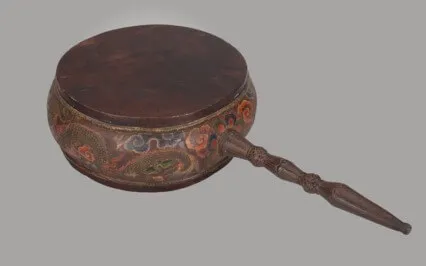
This beautiful drum,
It's a unique drum,
Right?
It's double sided and with a long handle.
For the drum in Tibetan word,
It's called ng,
Like a G silent NGA.
This particular object is origin from Tibet.
And it's a beautiful 19th century.
As you see here,
Wood,
Mineral pigment colors,
Leather and metal here and there.
The sound produced by this ng or this large drum with a long handle,
Double headed form or frame varies according to the type of ritual.
It can be peaceful or fierce,
Wrathful ritual,
Depending on the character of the deity that the practice would like to invoke.
And monks would hold the long handle in the left hand,
Depending on how one practices.
And then they will strike with the middle,
With kind of like a hook like stick using from the right hand,
If it was held on the left,
Of course.
The instrument is used frequently in rituals for mostly fierce,
Wrathful practices,
But also in the processions.
This beautiful drum that is used by the monks in a procession.
So there's the metaphor.
The sound of the drum is often kind of used as the sounds of the dragon.
So therefore,
As you see on the original art connection,
You see the dragons on the sides and then some kind of a cloud formation.
In fact,
You know,
Dragons are some of the mythical animals that you will often see in the Himalayan art.
So now let's bring on our teacher for today.
It's wonderful and great teacher Sharon Salzberg.
So happy to have you back.
Thank you so much.
And Sharon is the co-founder of the Insight Meditation Society in Barre,
Massachusetts,
Has guided meditation retreats worldwide since 1974.
Her latest book is Real Change Mindfulness to Heal Ourselves and the World.
Sharon is also the author of several publications,
Including the New York Times bestseller,
Real Happiness,
The Power of Meditation,
Faith,
Trusting Your Own Deepest Experience,
Loving Kindness,
The Revolutionary Art of Happiness,
And Real Love,
The Art of Mindful Connection,
While running our own podcast,
The Meta Hour,
And interviewing 100 Influential Voices in Meditation and Mindfulness Movements.
Sharon has regularly contributed to many of our on stage conversation here at the Ruben Museum.
Thank you so much for being here,
Sharon.
Well thank you so much.
It's a delight to see you,
To feel the presence of everybody.
I always enjoy so much reading where people are signing in from.
As Tashi just said,
This is Rosh Hashanah,
It's Jewish New Year,
Happy New Year.
And I've often said here,
As well as other places,
That there's something about New Year's.
I know it's just a construct,
It's just a concept we put on a day,
But there's something I'm so gratified by when I think of New Year's.
And as a Jew,
An American,
And a Buddhist,
I get three.
So I get three a year,
Which is really very fortunate.
There's always a chance to see the error of our ways,
To get some perspective,
Which is the theme,
And to have a kind of different understanding,
Even of the same conditions or circumstances.
So I think of perspective actually is very tied to this idea of resilience,
Because difficult things happen and obstacles arise and internal and external suffering arises.
There's no doubt about that.
But how are we with it?
And that becomes the crucial question based a lot on what kind of perspective do we have?
Sometimes as one of my teachers,
A Tibetan teacher,
Sunny Rinpoche,
Would say,
In terms of the meditative experience,
He'd say,
It's not the thoughts that are the problem,
It's the glue.
Something arises,
An emotion,
A thought pattern,
And we glom onto it,
We grab onto it,
We identify with it,
We define ourselves by it.
This is all I'll ever feel.
This is all I'll ever be.
And we're sunk.
And other times,
Maybe that same old thought pattern or same old emotional state arises even intensely,
Fiercely.
But we have some space.
And we have a sense of ease of heart.
We're not completely enmeshed in this state.
We're also not ashamed of it and afraid of it and freaked out about it.
We can allow it to be there,
Let it come and go.
Because after all,
Everything changes anyway,
Right?
And it's an entirely different relationship,
And therefore an entirely different experience,
Even though the same old stuff happens to be coming up.
So perspective is really very important.
Sometimes we remind ourselves,
You know,
There's a way we find,
Maybe we're distant,
Or we're really conflict avoidant.
In John Wellward's great terminology,
Psychotherapist John Wellward,
We're doing a spiritual bypass.
You know,
We're acting as though we have a deep seated recognition that anger,
For example,
That sadness arising within us is contingent,
It's empty,
It's impermanent.
But we don't really actually know that in the moment.
We're just sort of acting on it.
You know,
Like my friend,
Tomi Sheena,
Her husband went to India and studied with a teacher who used Ramana Maharishi's brilliant methodology,
Which was basically asking himself,
Who am I?
Not for an answer,
Because we don't get an answer.
But for the pivot of attention that happens when we're not so engrossed,
We're not so glued on to the particular thing,
But we're kind of turning our attention to who is it that's feeling this?
Who is it that's aware of this?
Who is it that knows this?
So we do that kind of practice just for the turning.
So anyway,
She and her husband had gone to India and studied in that way.
And then they were home and for a while he was driving her crazy because everything became that question.
Like when she asked for the remote control,
He'd say,
Who is it that wants the remote control?
And she'd want to like say me and take it and hit him on the head with it.
You know,
There's a lot of ways we can try to avoid what we're feeling and pretend it's not there and do a kind of spiritual bypass.
So we might do that or we might get so lost in the state that it does define us and we can't imagine responding differently.
But actually we can respond differently if we choose to.
We might be adding all kinds of things to the state that is happening or we might remind ourselves everything changes no matter what.
This is not who I am.
Irredeemably,
Permanently,
Forever.
No change,
No shift.
It's not like that.
And we,
You know,
Maybe reminding ourselves,
Go smaller,
Get immediate,
Like,
Look at a child's smile when you feel a kind of despair about anything ever working out.
Or look at a tree or look at the sky or have a kind of,
Okay,
Right now,
What is happening,
You know,
Very immediate sort of sense,
Something that's digestible because it's just right now,
One day at a time.
Day might be too long,
You know,
Much,
Much smaller than that.
Look at that flower bursting through the sidewalk in New York.
Like,
How can that be?
And sometimes to get perspective,
Of course,
We go big.
It's a cosmos.
Time is the weirdest thing in the world.
You know,
It's like 50 years goes by like nothing.
How can that be?
It's outrageous.
We need New Year's a lot in order to cope.
Because the stress dynamic really is a dynamic depending on not only the stressor,
The pressure,
The circumstance,
The story,
But also the resource with which it's met.
There's endless possibility to be happier,
To be different,
Same stressor,
Because we can't always control life.
But this is like our playground,
You could say.
This is the realm within which we work is how we are responding to what's going on.
So the alternative to being in full blown reaction mode is not being blank.
It's being different.
It's having a kind of openness and tenderness and presence and balance that is really onward leading.
And that's very important to get that kind of perspective.
It's the perspective of wisdom.
Of saying,
Yeah,
This is hard.
And I understand that.
And this is how it is right now.
How am I going to add sort of insults to injury?
How am I going to add a seemingly permanent future to what's so difficult and annoying and irritating right now?
How am I going to be with what is becomes the most important question.
Because it reveals so much about the truth of the moment.
And it reveals so much about where we want to go.
There's another way.
I just want to describe one more way.
We sometimes use imagery or story to try to illustrate just the nature of taking perspective on things.
And I think we also know it,
Before I get to that,
Just in life and time.
That's why when presented with various art elements,
I suggested the drum as a choice to kick off this discussion because we have that experience sometimes in listening to sound.
We hear the faintest of sounds that is almost like the sound of the universe or something happening.
It's not specifically like,
Oh,
That's a coyote or that's a,
You know,
That's a,
That's a,
That's like,
Oh,
Here I am.
This world is really big.
We may,
We hope,
Live another day to learn and keep growing.
Time goes by quickly.
There's a meditation instruction that's sometimes given in Tibetan Buddhism.
And I use it not so much as a meditation instruction,
But really to describe perspective taking in terms of how we always want our compassion,
For example,
To be accompanied by wisdom.
And that is,
I'm sure many of you've heard me using it,
Use it before,
Where they say the instruction as an instruction is,
You should look at the thoughts and feelings that arise in your mind as though they were clouds moving through the sky.
So we have a big open unconfined sky unconstrained.
And within it,
We have all kinds of different clouds coming and going.
Little light fluffy clouds,
Look very inviting,
Much more ominous clouds,
Look kind of threatening,
But they all just come and go and come and go.
If we're going to kind of land our sense of who we are anywhere,
It should be the sky,
Not all these many things that come and go and come and go and come and go.
So that's the meditation instruction.
I would use it,
As I said,
In this whole other context.
Imagine you are quite an elderly person,
The instruction goes on,
Say,
You're quite an elderly person sitting in a playground watching children play.
That's how you are with your thoughts and feelings.
Just kind of watching them play.
No glue.
And taking it into the context in which I use it,
I really liked it a lot because this little kid that's like completely freaking out,
Let's say,
Because he broke a shovel and you want,
You know,
The quiet elderly person,
What does that mean?
It means you've probably seen a lot.
You've probably had to let go of a lot.
You've seen a dose of life.
And you see this kid completely freaking out because they broke a shovel.
You're not all cold and mean and disparaging.
You don't go up to them and say,
Oh kid,
It's just a shovel.
What do you wait to have a real problem?
You're tender,
You're open,
You're caring,
You're compassionate.
And you also don't fall down on the ground sobbing because you know what?
Shovels break.
Everything breaks at some point.
So without going to the extreme of being cold and mean,
Can we bring that kind of presence and wisdom and understanding as we console the child,
As we try to comfort the child?
Because both sides are really important and I come back to that again and again because I know that I as a human being,
If I were seeking help from somebody,
I would want them,
I would want that warmth and tenderness.
And I said I wanted to say it's just a shovel waiting to have a real problem,
You know,
Like a mortgage.
And I want all of that loving,
Loving care.
And I know if somebody fell down on the ground sobbing after I told them my very sad story,
I completely freak out.
I'd be so frightened by that and feel like every door is closed now.
There's no way out of this room.
There's no way out of this box.
It wouldn't be very useful or a good feeling.
And I try to remember that in being in the other position and more like offering.
I know what I want is both.
I want the love,
The loving kindness,
The compassion.
I want that sense of perspective like things break.
We can get through this because we have that capacity.
We can get through anything because everything is workable.
And even if someone's not expressing it verbally,
Just to have that look in their eye,
I really want both.
And I think we do.
And not only that,
We can offer both.
We offer both to others.
We offer to ourselves in the meditation practice,
Which we're about to do.
As we sit together,
We rest our attention on a chosen object,
Like the feeling of the breath.
Many things come and go and come and go and come and go.
It's okay.
We can let that happen.
And when we get caught,
We see if we can let go and come back.
Okay,
So let's sit together.
You can sit comfortably.
See if your back can be straight without being strained or over arched.
You can start by listening to sound,
Whether it's the sound of my voice or other sounds.
Unless you are responsible for responding to the sound,
Just let it wash through you.
And bring your attention to the feeling of your body sitting,
Whatever sensations you discover.
Bring your attention to your hands and see if you can move from the more conceptual level,
Like fingers,
To the world of direct sensation.
Picking up pulsing,
Throbbing,
Pressure,
Whatever it might be.
You don't have to name these things,
But feel them.
And bring your attention to the feeling of your breath.
Just the normal,
Natural breath,
Wherever you feel it most distinctly.
The nostrils,
The chest or the abdomen.
See if you can find that place,
Bring your attention there and just rest.
Feels just one breath without concern for what's already gone by,
Without leaning forward for even the very next breath.
Just this one.
Feel like you can use a quiet mental notation like in,
Out,
Or rising,
Falling to help support the awareness of the breath,
But very quiet.
So your attention is really going to feeling the breath,
One breath at a time.
Various sounds,
Images,
Thoughts,
Emotions arise and pass away.
What do you think can be more like the clouds moving through the sky?
You don't have to fight what comes up,
But you also don't have to follow it.
Just let it come,
Let it pass through.
But if you do get caught,
You get all glued on.
You get submerged in thought or emotional reaction,
Overwhelmed by a fantasy or you fall asleep.
It doesn't matter,
Truly.
What's much more important is the next moment after you've been gone,
After you've,
Let's say lost it.
Can we practice letting go gently?
Can we practice beginning again?
Just letting go of whatever and bringing our attention back to the feeling of the breath.
That's actually the training.
And when you feel ready,
You can open your eyes or lift your gaze and we'll end the meditation.
Thank you.
Thank you so much for that beautiful session.
I think even my birdie,
The parakeet says thank you.
That concludes this week's practice.
If you would like to support the Rubin and this meditation series,
We invite you to become a member of the Rubin.
If you're looking for more inspiring content,
Please check out our other podcast Awaken,
A podcast that uses art to explore the dynamic paths to enlightenment and what it means to wake up,
Available wherever you listen to podcasts.
Thank you for listening.
Have a mindful day.