Welcome to the mindfulness meditation podcast presented by the Rubin Museum of Art.
We are a museum in Chelsea,
New York City that connects visitors to the art and ideas of the Himalayas and serves as a space for reflection and personal transformation.
I'm your host,
Dawn Eshelman.
Every Monday we present a meditation session inspired by a different artwork from the Rubin Museum's collection and led by a prominent meditation teacher from the New York area.
This podcast is a recording of our weekly practice currently held virtually.
In the description for each episode,
You will find information about the theme for that week's session,
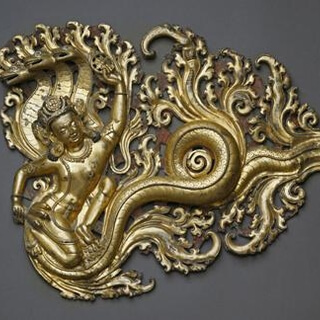
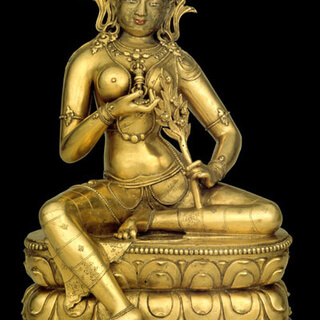
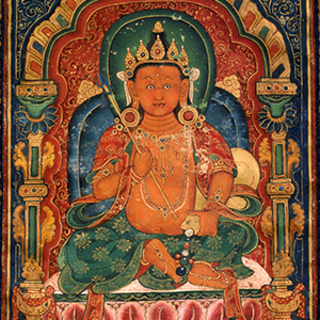
Including an image of the related artwork.
Our mindfulness meditation podcast is presented in partnership with Sharon Salzberg and teachers from the New York Insight Meditation Center,
The Interdependence Project,
And Parabola Magazine.
And now,
Please enjoy your practice.
Hello everybody.
Welcome to mindfulness meditation online with the Rubin Museum of Art.
I'm Dawn Eshelman,
Happy to be your host today.
And for those of you who might be new to the Rubin,
We are a museum of Himalayan art and ideas in New York City.
And coming to you virtually here for about a year and a half now.
Can you believe it?
I'm so proud of this community that's really taken good care of each other,
Even on this virtual platform and so grateful to our teachers.
It's great to have you join us.
This is our weekly program where we combine art and meditation online.
So inspired from our collection,
We'll take a look at a work of art together and we'll hear a brief talk about our theme and how that inspires meditation from our teacher.
Today it is the fabulous Sharon Salzberg,
And then we will have a short sit led by Sharon.
And let's take a look at our artwork for today.
We've been talking for the last,
This is our sixth session on interdependence.
So this is a really central,
Crucial,
Important topic in Buddhism,
Tibetan Buddhism in particular.
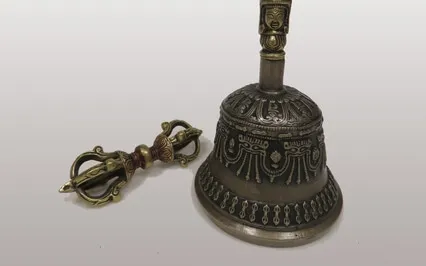
And let me just share the object that we're talking about today.
The Vajra and the Bell.
In fact,
Not one object,
But two and ritual objects in fact.
Let's see here.
This is from Mongolia,
These two objects.
And I'm so glad that we are focusing on them here for our final sort of session on interdependence.
This idea that everything is interconnected and that is the essence of truth and reality.
And these objects,
I think are really wonderful kind of framework to discuss this concept.
And I'm just going to give you a little more information about the objects themselves.
So these are Mongolian late 19th century.
This is made of silver and metal,
And there's a five metal compound that is used to create this metal.
And these are objects that are used in ritual practice by lamas,
Practitioners,
And they represent these two complimentary ideas that function together,
Right?
So the Vajra and the Bell are really representing this idea of method,
That's the Vajra,
And wisdom,
The Bell.
So the thunderbolt,
The Vajra,
Which is also called Dorje,
Vajra is a Sanskrit word and Tibetan is called Dorje.
And this is related to the word for diamond.
And it appears to be similar to this thunderbolt weapon carried by Vedic god Indra and Olympian Zeus.
So a symbol that we can see cross-culturally,
And it destroys both internal and external enemies.
So this kind of all penetrating,
If you think of a thunderbolt kind of cutting through everything,
This symbolizes this indestructible,
All penetrating mind of enlightenment.
Now the Bell calls to mind this empty nature of all things.
So according to the Buddha that nothing can exist independently,
We're all interconnected,
Right?
So the phenomenon are empty of inherent existence.
It's about the connection between them.
And this idea is that by being profoundly aware of the empty nature of all things,
That we can become free of attachment.
So together they symbolize this union of all dualities,
Bliss and emptiness,
Compassion and wisdom,
Even male and female energies within us all.
So with that,
I will bring on our teacher today,
Sharon Salzberg,
And happy almost lunar noon year by the way.
Sharon is a co-founder of the Insight Meditation Society in Bury,
Massachusetts,
And is renowned for her meditation retreat leadership and teaching and writing.
And her latest book is Real Change Mindfulness to Heal Ourselves in the World.
We also love Real Love,
The Art of Mindful Connection,
Many more incredibly useful and uplifting books.
And you can find out more about her at SharonSalzberg.
Com,
Including her Real Happiness Meditation Challenge,
Which starts tomorrow,
28 days of meditation.
Check it out.
Thanks so much for being here,
Sharon.
Thank you so much.
It is almost lunar new year.
It's true.
Well,
I'm calling in from snowy Bury,
Massachusetts,
Joining several of you in the snow days.
It's also been very,
Very chilly.
It's really winter here,
But life is seasonal,
Right?
Because when we talk about dualities or we talk about different aspects of reality,
In the end,
We watch that as Thich Nhat Hanh,
Who just recently died,
Would say the interbeing of these various elements of life,
Because life is just life.
In the end,
It's seamless.
It's our lives.
It's the way we speak to ourselves,
The way we speak to a stranger,
The way we relate to our neighbors.
It's our work.
It's our sense of integrity.
It's our sense of being on a journey,
Perhaps,
Rather than being stagnant.
So all these different aspects of our lives actually come together in almost like this unified field.
They have distinctions and they have maybe different things they call from within us to come forward.
But in the end,
It's all of one piece.
It's just a life.
And that vision of life as a seamless garment is something that figures in a lot of these depictions.
We look at this,
We look at that.
We realize they have to coexist and that they actually have an effect on one another.
It is the body and the mind,
As one example.
And looking at the vajra and bal,
I also thought of what is sometimes not called method,
Although often it is called method,
But it's sometimes called merit and the bal being wisdom.
And one example of that would be merit is a word that's used and you could call it method,
But I think merit is certainly in a country like Burma would be the way it was described.
Merit is the positive energy that is engendered when we act towards the good,
When we're kind,
When we're truthful,
Like it would be awfully easy to tell a lie,
But we don't.
We speak the truth.
When we're generous,
Whether that's material generosity or generosity of the spirit,
We thank somebody,
We appreciate them.
We listen,
We bother to listen to somebody we don't find that scintillating.
That's all generosity.
When we meditate,
Even if the level of concentration we attain is not earth-shattering by any means,
Even if we feel kind of scattered or sleepy,
The fact that we sit down to do it,
That we have that willingness to spend our time that way.
When we study,
We question,
We want to learn,
We want to understand,
All of these kind of have a brightness to them.
All of these actions,
They engender a sort of positive force.
And they're active,
They're about choice,
Even if it's a choice to step back and not say anything in a certain situation or not participate in something that's still an action,
That's still a choice.
And that goes together with wisdom in that if you think about wisdom as the result of paying attention,
You know,
We're not beguiled by the promises of the world.
Like if you only buy one more thing,
You will be perfectly happy forever.
Or if you can seize control over this other person,
You'll be perfectly happy forever.
If you can stop time and stop change,
You will be perfectly happy forever.
It's like we see through that.
We also see through the kind of dictates many of us grow up with,
Like you have to be strong and vengefulness is strong.
Never let go of a grudge or compassion,
Kindness,
That's awfully weak.
It's for people pleasers or people who can't take a stand on anything or stick up for themselves.
Because we get the chance often through meditation,
Although not only through meditation,
Any kind of introspection,
We get a chance to look and see for ourselves,
Like,
Is it really true that my billionth reiteration of this grudge is doing me any good?
Or is it really true that that gesture of kindness left me at a disadvantage?
Is it true?
And the wisdom about where happiness lies,
Where strength lies,
How alone we are,
In fact,
Whether that's a construct or reality in a world of interbeing and interdependence,
We get to see for ourselves.
And what we can call emptiness,
Which is often called emptiness,
The other side of that,
Really the other side of the coin is interrelatedness.
Because the world exists.
We see,
We hear,
We feel,
The world,
All the elements of the world are arising in every moment.
But what are they?
They don't seem very stable.
Doesn't seem like there's a kind of ability to control that arises with all phenomena.
And so wisdom might have us more on the side of,
It's all changing.
I can't control things.
Who am I anyway?
And merit is like this positive replenishment of a force field that allows us to inquire,
That has a sense of resource with which we can inquire.
And they're both necessary.
The other way of saying it is that a practice,
Like a spiritual practice,
Couldn't just be on Sunday morning.
It couldn't just be the mornings when we sit down to meditate.
It kind of contains in that dedicated period.
It's all about everything.
It's all about how we live.
And so the inner work that we do is interdependent with the outer manifestation and the choices we make,
That's the merit.
And the way we live is very connected to what we will experience when we meditate.
It's not like a one-on-one equivalence,
But you can really see the influence of being in some complex moral dilemma,
For example,
And going over it and over it and over it every time you're not engaged in some activity or getting something done that you're responding to and you're just going over and over and over it.
That may herald the advice of maybe step back a moment and decide if you want to keep doing that sort of activity since it's consuming you,
Since you're so worried about it,
Something like that.
We really see the choices we make when we speak to somebody,
When we choose to listen or look right through someone,
Discount them when we care,
Is very tied to our ability to see the truth in a more ultimate way as we go within.
And the work we do within is very tied to how that might manifest in every moment of our lives because every moment really counts.
It's the interweaving of these two that really makes up a path of,
You could say,
Both method and wisdom or both merit and wisdom.
Okay,
So let's sit together some.
You can sit comfortably,
Close your eyes or not,
However you feel most at ease.
You can start by listening to sounds,
The sound of my voice or other sounds.
It's a way of relaxing deep inside,
Allowing our experience to come and go.
You may like certain sounds and not like others,
But with all of them,
We don't need to follow after them to hold on or push away.
This lets the sounds wash through you.
Bring your attention to the feeling of your body sitting,
Whatever sensations you discover.
Bring your attention to your hands.
See if you can move from the more conceptual level to the world of direct sensation,
Picking up warmth,
Pressure,
Coolness,
Whatever it might be as a sensation or a series of sensations.
You don't have to name them,
But feel them.
And bring your attention to the feeling of your breath.
Just the normal,
Natural breath on the same level of picking up sensations.
You may get imagery with the breath,
You may hear the breath,
But we want to center on feeling the breath.
One breath at a time.
And this is just the normal,
Natural breath,
Wherever you feel it most distinctly.
Maybe that's the nostrils,
The chest or the abdomen.
Find that place,
Bring your attention there and just rest.
See if you can feel one breath.
If you like,
You can use a quiet mental notation like in,
Out to help support the awareness of the breath,
But very quiet.
Let your tensions really go into feeling the breath.
One breath at a time.
And as images or sounds or sensations or emotions should arise,
If they're not very strong,
If you can stay connected to the feeling of the breath,
Just let them flow on by your breathing.
If they are strong,
If something comes up,
It pulls you away.
Get lost in thought.
See if you can notice,
Oh,
This is what's happening right now.
There's joy,
There's sorrow,
If something is predominant,
A sensation,
An emotion,
Just to recognize it.
Oh,
This is what's happening right now.
No judgment.
See if you can let go.
Bring your attention back to the feeling of the breath.
And if you get completely lost,
Just like you fall asleep,
You're spun out in a fantasy,
Don't worry about it.
The most important moment is really the next moment after you've been gone to be able to let go gently and return your attention to the feeling of the breath.
You haven't ruined anything.
Nothing's lost.
We just practice letting go and beginning again.
And when you feel ready,
You can open your eyes or lift your gaze and we'll end the meditation.
Thank you so much,
Sharon.
That concludes this week's practice.
If you'd like to support The Rubin and this meditation series,
We invite you to become a member.
If you're looking for more inspiring content,
Please check out our new podcast Awaken,
Hosted by Laurie Anderson.
The 10-part series features personal stories that explore the dynamic path to enlightenment and what it means to wake up.
Now available wherever you listen to podcasts.
Thank you for listening and thank you for practicing with us.