Welcome to the mindfulness meditation podcast presented by the Rubin Museum of Art.
We are a museum in Chelsea,
New York City that connects visitors to the art and ideas of the Himalayas and serves as a space for reflection and personal transformation.
I'm your host,
Dawn Eshelman.
Every Monday we present a meditation session inspired by a different artwork from the Rubin Museum's collection and led by a prominent meditation teacher from the New York area.
This podcast is a recording of our weekly practice currently held virtually.
In the description for each episode,
You will find information about the theme for that week's session,
Including an image of the related artwork.
Our mindfulness meditation podcast is presented in partnership with Sharon Salzberg and teachers from the New York Insight Meditation Center,
The Interdependence Project,
And Parabola Magazine.
And now,
Please enjoy your practice.
Good afternoon,
Everybody.
Welcome to mindfulness meditation online with the Rubin Museum of Art.
My name is Dawn Eshelman.
I'm so happy to be here with you today.
We're a museum of Himalayan art and ideas in New York City,
And we're so,
So glad to have you all joining us here today for our weekly program.
This is where we combine art and meditation online.
And we take inspiration from our collection to take a look at a work of art from our collection,
Which helps us kind of frame our session for the day.
We will then hear a brief talk from our teacher,
Who today is the wonderful Tracy Cochran.
And then we'll have a short sit together,
Just 15 to 20 minutes for the meditation guided by Tracy.
So we are talking this month about this concept of transformation.
And this comes to us,
This concept,
From our exhibition Healing Practices,
Stories from Himalayan Americans.
And it's all about the practices that people use in their healing process.
And healing is a process of transformation,
Right?
So we're taking a closer look at that idea today,
And also considering it within this context of health and vibrancy and well-being.
There it is.
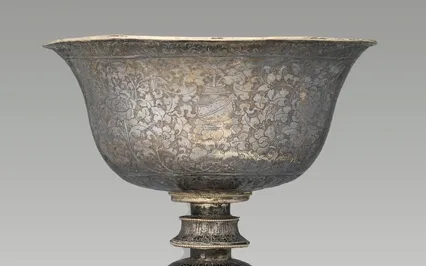
This is a butter lamp from 18th century Tibet.
It is metal,
Silver.
And it's about 11 inches by 7 inches.
So almost the size of like a sheet of standard paper.
And this is a ritual object.
Of course,
An art object as well.
And we thought we'd bring this to you today because it really speaks to this idea of transformation.
You can take kind of some simple materials and transform them through an intricate skill of an artisan,
An artist,
A craftsperson,
Into something quite ornate and special and beautiful.
And also the butter itself is,
On the one hand,
A simple staple.
And utilized in this way as the actual fuel for a candle,
It becomes something very sacred.
And takes on a whole new meaning.
So butter lamps are common features of Tibetan Buddhist temples and monasteries throughout the Himalayas.
And they're traditionally placed on a Buddhist altar as an offering,
Right?
And they're offered during meditation practice or during ceremonies with this wish that all beings be free of suffering and reach enlightenment.
And the lamps traditionally burn a yak butter,
As I mentioned.
Often now they use vegetable oil or ghee.
And the smell of which is all very different,
Right?
Yak butter has a very strong smell.
Butter lamps are meant to also help to focus the mind and aid meditation.
And then they also have this meaning that they are there to banish the darkness and internally to dispel darkness of ignorance in the practitioner.
And the benefits of offering just one butter lamp are said to be immeasurable because kind of linking in to what these butter lamps represent.
They represent this very widely accessible form of offering,
Right?
Throughout the world.
And they serve as a resource to heighten an occasion and represent this physical embodiment of countless prayers and wishes.
So when we see a butter lamp or a butter lamp lit,
We can remember all the other offerings that came before that.
So I am delighted to bring on our teacher today,
The wonderful Tracy Cochran.
Tracy has been a student and teacher of meditation and spiritual practice for decades.
She's the founder of the Hudson River Sangha,
Which is virtual and open to all.
And you can find out all about her appearances and her meditations and all of her work at tracycochran.
Org.
In addition,
Tracy's taught mindfulness meditation and mindful writing at the Rubin and the New York Insight Meditation Center and other schools and corporations as well.
She is a writer and the editorial director of Parabola,
Which is a beautiful quarterly magazine which you can purchase at the shop at the Rubin and in other locations as well.
This quarter,
The theme is ancestors.
And this is a really special magazine that seeks to bring the timeless spiritual wisdom to the burning questions of the day.
So you can find out more about Tracy,
Her writings,
Her podcasts and other details at her website,
Tracycochran.
Org and also parabola.
Org.
Tracy,
Thank you so much for being here.
Oh,
Dawn,
Thank you for being here as well.
I'm delighted to be here at the virtual Rubin.
And especially with such a beautiful lamp as my guiding illustration,
I was really taken with the idea of offering light.
And it led me actually,
First of all,
To the Buddha's last words,
Or next to last words,
To his beloved disciple Ananda,
Be a light unto yourself,
Be an island unto yourself.
Interestingly,
That was the same word,
Deepa.
And it means that we can come home to ourselves.
We can try it right now,
Just without shutting your eyes yet.
Just notice how it feels to give your attention to your experience right now.
And you might be in the middle of a busy day,
It might be the end of the day,
Depending on where you are,
It could be the morning when you're listening to this podcast.
But notice that the first and most simple transformation that we can invite into our lives is to shift our attention from outside back to our own experience,
Without seeking anything from it,
Just bringing our kind attention home.
And I was reminded of a quote from one of my favorite spiritual teachers,
The writer Ant Lamott,
Who said,
A lighthouse doesn't run all over an island looking for ships to save,
It just stands there and shines.
And we notice that the way we're wired,
The way we're conditioned,
We can't help but reach outward,
Yearning for solutions,
Even yearning to help other people.
But the invitation of this practice is to first come home,
To just allow ourselves to settle down.
And that can happen just as we begin to bring kind attention to ourselves,
Not expecting ourselves to be in a perfect collected state,
But just as we are.
To just come home,
To settle down,
To open up and entertain the possibility that there might be a light inside us that shines.
And it's been described as that feeling of going from the heat of the day,
It's starting to get very hot where I live and maybe where you are,
Into the shade,
Into the shade of your own kind attention.
And of course in every culture,
There is a fascination with lamps and the magical,
The transforming power of lamps.
And I was telling Don and some of the others that I looked at a grim fairy tale about a soldier who was just cut free,
He'd been asked to do all this horrible soldier work and at the end of it,
The king just cut him loose and he was left to wander,
Lost,
Without resources,
No pension for him.
And most fairy tales,
Most journeys begin this way with a feeling of not knowing which way to turn.
And to make a long,
Strange tale short,
He came to a cottage in the woods and there was a witch.
You could think of her as a shaman as a teacher,
Although in this case a dark teacher.
And after performing chores for her for days,
He was given the task of descending into a well to retrieve a magical light,
A blue light in this case.
So he obtains this light that has with it a kind of genie,
A magical being that can grant his dearest wishes.
And of course at first his wishes are to feel comfortable,
To have food,
To have some money,
To find rooms and lodging.
We can relate to this because we often first come to practice,
Don't we,
To feel better,
To feel more comfortable,
To find a refuge for ourselves.
And then after that was established,
He began to yearn for revenge against the king who had cut him loose without any thought whatsoever for his welfare after all he'd been through.
And in a sense we can relate to this too.
We don't necessarily use practice as a kind of dark magic to smite our enemies or the boyfriends or girlfriends who rejected us or the employers who have tortured us or tormented us.
We don't do it that explicitly.
But there is a wish in us to use practice to perfect our lives,
To perfect our states.
And this too is very,
Very natural.
But at the end of the fairy tale and at a certain point in our practice we gain,
As a soldier did,
The kingdom,
The real kingdom.
And that real kingdom is this gentle discovery.
And that's in a way what's so amazing about it,
That it's something that dawns on us very quietly.
That one day we can experience something that feels like giving up.
I give up.
I let this be.
We grow tired of our usual machinations,
Even tired of our own stress.
And there's this feeling of,
And it can feel like a quiet act of daring in a way,
I'll just let things just be.
And let life come to me.
And we begin in that moment to turn toward something that is the great gift of practice.
The discovery that inside us is that presence,
That light of awareness that in some traditions they call the beloved.
The love that we seek,
The peace that we seek,
The healing that we seek is right here.
And we begin to touch it when we give up,
When we let go.
Let go of clinging to hope of a particular result.
Just let go.
But not with an angry attitude,
But with something that I like to call softness,
Or in the tradition in some iterations of it they call goodwill,
Friendliness.
And this feeling of just being with what is right now,
Undefended,
Harmless.
We discover within ourselves,
In our own attention,
It's something very direct and very simple and straightforward.
We discover that there is a capacity for kindness,
For compassion,
For love.
And in the end it can be really quite wonderful.
We feel this momentum that can be lifetimes,
At least decades of yearning for something to be given some quality of acceptance,
Of caring,
Of being told that we're completely okay just like this.
And we discover it's right here.
So let's take our seats and bring your wish that you be comfortable,
That you be completely welcome just like this.
Let that be the intention and the wish for the next meditation.
And let your eyes close.
If you're not comfortable with closed eyes you can gaze at the floor,
But it's best if you can close your eyes.
And just notice what's here.
And notice that there is a light of attention that's already here.
And you don't have to think about it and you don't have to bid it do something.
Just let it be here.
Let it go where it needs to go.
There may be tension in some part of your body.
You might be feeling something difficult or thinking,
Let everything happen exactly as it's happening.
And notice that this light of awareness can meet it with an attitude of compassion,
Of acceptance.
And notice how it feels to let everything that arises inside you be of interest.
Letting difficult feelings be met with compassion,
With knowing that they belong.
You might even say to yourself,
This belongs.
Just rest in stillness.
Noticing that stillness means not striving.
Softening.
Noticing how it feels to take off our armor just for ourselves.
To let ourselves be soft,
Undefended.
And completely seen and accepted with compassion.
And when you find yourself straying into thinking or planning or picking up on something,
You are picturing,
Notice this as completely natural,
Completely acceptable of interest.
And let yourself come home to the sensation of sitting here in a body in this moment.
Waking in the light of an attention that doesn't comment or judge,
Just receives,
Just sees.
And notice that this light of awareness,
This attention,
This light of being,
This light of attention,
This attention nurtures us,
Nourishes us,
Not with words but with loving presence.
Now I want you eat that healthier.
Notice that you can begin again.
And any time,
Just notice that you were taken by thinking,
By feeling,
By memory,
And gently come back to the body in the present moment.
Finding complete welcome,
Acceptance,
By a light of awareness that nurtures,
That invites us to be whole,
To be just as we are,
Every part,
Acceptable,
Lovable.
Notice how it feels to be okay with stillness,
With softness,
With letting everything be.
Rebecca?
You and notice as we make this movement of return of coming home to the present moment letting be softening it can feel like we're coming home to our aliveness we're so alive inside you and notice that this aliveness includes softness responsiveness a wish to be here to be part of this life you you notice that this of life has a radiance it shines out of us you notice that there is a light inside us that we share Thank you for being here.
Thank you for being here.
Notice that when we come home to the body,
To the present moment,
We also open to this light of awareness.
So very close to sensation.
And then we open to the light of your own compassionate awareness.
Yes.
Noticing how it feels to be still and to shine.
Yes.
Yes.
Thank you.
Thank you,
Tracy.
That concludes this week's practice.
Thank you.