Welcome to the mindfulness meditation podcast presented by the Rubin Museum of Art.
We are a museum in Chelsea,
New York City that connects visitors to the art and ideas of the Himalayas and serves as a space for reflection and personal transformation.
I'm your host,
Dawn Eshelman.
Every Monday we present a meditation session inspired by a different artwork from the Rubin Museum's collection and led by a prominent meditation teacher from the New York area.
This podcast is a recording of our weekly practice currently held virtually.
In the description for each episode,
You will find information about the theme for that week's session,
Including an image of the related artwork.
Our mindfulness meditation podcast is presented in partnership with Sharon Salzberg and teachers from the New York Insight Meditation Center,
The Interdependence Project,
And Parabola Magazine.
And now,
Please enjoy your practice.
Hello,
Everybody.
Welcome to mindfulness meditation online with the Rubin Museum of Art.
I'm Dawn Eshelman.
Great to be here with you after a little bit of time away.
So nice to be back and practice,
Practice together,
Practice with you all.
For those of you who are new to us,
We are a museum of Himalayan art and ideas in New York City,
And we're so glad to have all of you joining us for our weekly program.
This is where we come together and practice combining art and meditation online.
So we take inspiration from our collection,
And each week we look at a work of art together from our collection that our teachers have helped to select.
And then we'll hear a brief talk from our teacher after that.
Today is the marvelous Tracy Cochran.
And then we'll have a short sit led by Tracy,
15 to 20 minutes.
So each month we select a theme to explore together.
This month we're talking about renewal,
This idea of renewal,
Which is really coming from an exhibition that we have on view right now,
Which is called Healing Practices.
And it's a look through our collection and through the voices and lives of local Himalayan Americans that really weaves tradition and contemporary experiences and really shows us that healing means so many different things to different people.
And renewal is a part of that.
Renewal is an uplifting aspect about healing that comes about when we're in that experience of healing.
And I have a couple of things to share about that from a personal point of view.
One is that I'm just back from a vacation.
So that is a feeling of renewal,
Certainly,
But it was a special one.
When I was a child in California growing up,
My parents were school teachers and in the summer we would drive every year for three and a half days to Grand Teton National Park.
And I would have in my backseat my box of as many books as the library would allow me to check out.
And that was 30 or 40 books.
And I would just read all the way there and we would spend some weeks camping in this incredible place and also Yellowstone,
Which is right next door.
And so this year,
After not having gone there for 20 years,
I got to go meet up with my parents and bring my own family and have such a special,
Meaningful time really kind of renewing my own connection to this grand expression of the natural world.
And also getting a sense of that kind of caretaking and renewal of myself as well is very special.
And in a kind of more of a bittersweet way,
I have some news to share.
A more bittersweet type of renewal or shift is taking place for me,
Which is that after over 12 years,
I am leaving Reuben.
It's been an incredible time here.
I'm so grateful and lucky and really an important and central part of that has been this community and connecting with you all.
And while I'll miss you,
I also plan on not being too much of a stranger.
So don't be surprised if you see my name in the chat now and then.
And I'm so delighted to share that Tashi Chojun,
Who has been such an important part of this community as well,
Will be coming into the role of host as she has done for many times.
And I'm grateful,
Grateful to her for that.
And you will be so expertly guided not only by her skills as a host,
But by her expertise as a practitioner as well.
And so thank you,
Tashi,
For doing that.
And thank you all for these lovely good wishes.
And if you want to stay connected,
You can find me on LinkedIn.
So you'll find my name there under the Reuben or Donna Schulman.
I'd love to be connected with you all.
I hope you'll do that.
And I will put I'll put my email in the chat as well.
So my last session with you all will be August 1st.
OK.
And we'll all experience a kind of renewal in in our own ways there with this program and our relationship to it,
Especially those of you who have come so for so long and so often just want to really acknowledge how important that has been to me,
Too.
So onwards and we'll look at this idea of renewal through the lens of this incredible artwork.
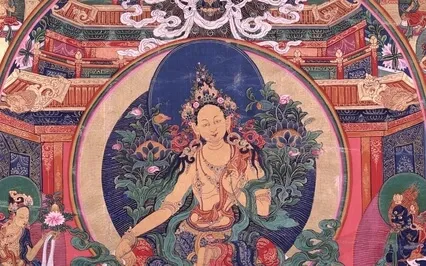
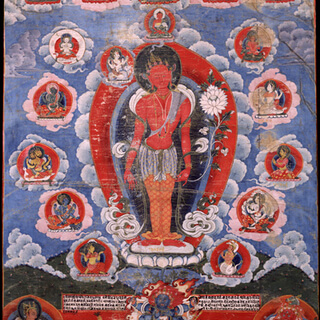
This is Tara in her pure realm.
Here she is.
The beautiful.
This is so detailed and rich.
I'm going to zoom in right away,
Though,
So you can really take in Tara herself.
She's,
Of course,
A female deity,
Female in Bodhisattva here and known as the female Buddha,
Popular for all Tibetan Buddhist traditions and beyond.
And this painting depicts the realm of Tara,
Where she is seated in her palace and surrounded by her twenty one emanations arrayed around her.
Look at that.
So many expressions,
So many renewals.
This is the famous priestess to Tara.
These famous praises to Tara address each Tara by her name.
So each of these Tara's has has their own name and individual qualities and blessings.
And then you'll see figures on the lotuses directly below the central figure.
And these are devotees who aspire to be reborn in her realm.
So any practitioner would easily identify with these figures while reciting this.
The praises to the goddess and Tara and her compassion just allow us to bring renewal every day to our practice as well.
So I am delighted to welcome our wonderful teacher,
Tracy Cochran.
Tracy has been a student and a teacher of meditation and spiritual practice for decades.
She is the founder of the Hudson River Sangha,
Which is virtual and open to all.
And you can actually find it on her website,
Tracy Cochran dot org.
In addition to teaching mindfulness,
Meditation,
Mindful writing at the Rubin and Hudson River,
She's taught writing classes and meditation at New York Insight and other locations,
Schools,
Corporations,
All kinds of places.
She's also the writer and the editorial director of Parabola,
Which right now has the theme of belonging.
And I think Tracy has a special story of her own in that issue as well.
Something about a ghost story.
Parabola,
For those of you who are new to it,
Is an acclaimed quarterly magazine that seeks to bring timeless spiritual wisdom to the burning questions of the day.
Her writings,
Podcasts and other details can be found on her website and on parabola.
Org.
Tracy,
Thank you so much for being here.
Well,
Thank you,
Dawn and everyone who is gathered here.
And I saw a few people make comments about Dawn's departure,
Exclamation point,
Exclamation point.
And that was my response,
That we naturally have a feeling for one another.
It's natural for us to have this feeling.
But it's really interesting to consider that Tara,
The embodiment of compassion,
Also means action,
Empathy,
Our feeling,
Our natural feeling for one another is something a little different than compassion that includes action.
So I wanted to tell a little story that I began to tell to some of you here last night.
And it begins with a man named Michael Bond,
Who created a character and a story called Paddington Bear.
And many of us have seen Paddington Bear,
A teddy bear in a little blue overcoat with a hat carrying a little suitcase and some betrayals.
And he wears a tag around his neck.
And this is the key.
Because Michael Bond,
The creator of Paddington Bear,
Was inspired by the sight of little Jewish children,
Refugees,
Pouring into London from Europe during World War II.
Part of the kinder transport,
The push to save these children.
And he and his wife took in several.
And he would watch them cry at night,
Not knowing what would become of their parents,
Not knowing what would become of their lives.
And this experience stayed with him.
It planted a seed.
And until he created this lovable little character as a reminder and a witness to that.
And the tag around the neck of the bear said,
Please look after this bear.
Thank you.
So hearing that,
If you haven't heard it before,
And some of you just heard it last night,
It's very natural to have tears come to your eyes.
This renewal,
Looking again at some familiar object and seeing it with new depth.
But the piece that I wanted to add today about Tara and her compassion is that there's something more that needs to happen than that welling up of feeling in the heart.
So I remembered years ago having the privilege of spending a date with Oliver Sacks,
The great neurologist and writer.
And he was a littlable boy.
He was a Paddington bear.
He lived in London,
But he and his older brother were sent away from London to escape the Blitz during the war.
He was six.
His brother was 14.
And during that time,
And this is where compassion begins to open,
They were sent to a boarding school where they were treated cruelly.
They weren't looked after like Paddington.
His brother was beaten.
Oliver was younger and escaped some of that corporal punishment.
His brother had to break down and never recovered.
But he said to Oliver,
Oliver told me,
His brother said,
Don't call this a disease.
Don't call this state of psychosis a disease.
This is my struggle.
This is my world and my life.
So what Oliver took from that and from coming back to London during war and noticing things disappearing,
Noticing things,
Landmarks,
Things that he counted on seeming to vanish,
That there was equality in him that came to life.
He began to notice things and record them.
He began to take pictures.
And that desire to document things that might vanish deepened into an interest in memory and perception and deeper still what it means to be human.
So compassion,
As Tara teaches us,
Because she was literally born from sorrow,
Born from a teardrop.
Compassion doesn't appear when times are good,
Steady,
Peaceful,
But often in the midst of the most painful and difficult times.
And we can know for ourselves,
Even before we said that our capacity to understand has been deepened by what we've gone through,
Our own heartaches,
Times of loss and uncertainty.
So Sax became someone who could listen,
Who could see beneath the surface,
Who could see even in his most famous book,
Awakenings,
That there was a living,
Warm hearted human being beneath someone who appeared to be a statue,
Someone who didn't seem to really be fully alive,
That they were in there.
So circling back to Tara and to His Holiness,
The Dalai Lama,
Who is himself regarded as an embodiment of the bodhisattva of compassion,
We recall that the Tibetan people,
Including Tashi,
Who's with us here today,
Were refugees,
Displaced by a military occupation,
Facing incredible hardships and uncertainties.
A story I recently shared,
But share here in just a sentence,
Is that the 16-year-old Dalai Lama,
Just really not far away from being a Paddington beer-like little boy himself,
Fled Tibet to India and had the compassion,
That intelligence,
That wisdom coupled with an intention to take right action,
That led him,
According to an account I read,
To go around to all the monks that had been displaced from their great monasteries,
Many of whom were working on road crews,
Which in the compassionate wisdom of people in India,
They were given that work high up so they could fare better than being in very hot places.
And the Dalai Lama went around and collected monks,
Inviting them to leave their work and gather together and remember what was essential about their tradition,
To remember what was important to the history of the people and what was essential for all of us,
And to let go of what was just decorative.
So again,
I'm not trying to overload us with different facts,
But to offer you the truth,
The compassion blooms in the midst of hardship,
Often in the midst of uncertainty,
In the midst of not having comforting,
You know,
Certainties to cling to.
And that it's not just feeling,
Feeling for displaced refugees.
It is feeling coupled with an intention to take skillful action.
And that skillful action always begins with what we're about to do right now,
With bringing the attention home to our own experience,
What's coming up right now.
And what fear might be coming up or a state of alarm or I don't want on to go or some whatever.
And we see that we can bring this compassionate attention to what's coming up inside ourselves.
And instead of clinging to an idea that our practice can only take place in perfect conditions or our attention is only going to go to the parts of ourselves that we judge to be worthy,
Peaceful,
Not conflicted,
Not sad,
Not angry,
But instead to open it,
To see that every part of ourselves,
Every little child inside deserves our welcoming attention.
And that as we do this,
We begin to discern what wise action might follow from that.
How we can be responsive to one another is by coming home to know our own humanity first.
So let's sit together and then if we have questions,
They can be brought up later.
So we take a comfortable seat and allow that to include keeping the back as straight as comfortably can.
And that is so we can have a more complete experience.
Body,
Heart,
Mind together.
And notice how it feels to be here.
Just allow the attention to take in an impression.
And notice that we can do this without thinking.
There is an awareness inside us that knows,
That sees,
That senses,
Without having to think about it.
And notice that we can bring an attention to everything that appears.
If tension is present in the body,
We can bring the awareness to that and just let it be with that.
Understanding that as we do this sometimes,
That tension begins to soften.
Just let everything happen to you,
Thinking,
Feeling,
Perceiving,
Picturing.
And notice that it's possible to see this without judging and to gently come back again to the experience of sitting in a body,
Breathing in this moment.
Just rest in stillness.
Understanding that stillness means not striving,
Not pushing or cringing.
Just being with.
And notice that when we give up striving,
Expecting and just rest in stillness,
Just a presence opens,
An awareness that's wide like the sky,
And kind.
And notice that you can begin.
Again at any time,
Just come home to the sensation of being in a body,
Opening to a presence that sees,
That receives what arises in you with kindness,
With openness.
Inhales and exhales slowly,
Bristol with pleasure.
Notice how it feels to let everything be touched by this compassionate,
Open awareness.
If pain is present or sorrow appears or some edge of confusion or conflict,
Notice how it feels to let it be seen by an awareness that doesn't comment but sees with caring and openness.
Notice how it feels to let it be seen by an awareness that doesn't comment but sees with caring and openness.
Notice how it feels to let everything be exactly as it is right now.
But accompanied by an awareness that's compassionate.
Notice how it feels to be completely acceptable,
Nothing to reject,
Nothing to correct,
Nothing to exclude in any way.
Notice how things change with acceptance.
Soften,
Open,
Settle,
Reveal.
Notice how it feels to let it be seen by an awareness that doesn't comment but sees with awareness that doesn't comment but sees with awareness that doesn't comment but sees with coming home to the body,
To the present,
Opening to an awareness that accepts with kindness,
With interest.
Notice as you do this you may feel more belonging,
Less loneliness.
Remembering that you belong to life.
You're welcome here.
You're welcome here.
Sinking down into sensation,
Coming home to the body,
Noticing that this brings grounding,
Settling,
Touching the earth of our lives.
Opening to a sky-like awareness that's vast and kind,
Welcoming everything.
Remembering that mindfulness means to remember a presence.
Noticing how it feels to be more collected,
Literally recollected,
Body,
Heart and mind together.
Nothing unwelcome.
Noticing that there are no refugees,
No orphans in this awareness.
Everything welcome,
Acceptable,
Understandable.
Noticing how it feels to settle down and open up and to trust this awareness that's compassionate and fast to lead us to the next right action.
Noticing how it feels to be lovable,
Acceptable,
And at home in awareness.
So thank you.
Now available wherever you listen to podcasts.
Thank you for listening and thank you for practicing with us.