Hello,
Namaste.
Today we're doing a seated yoga class.
You can do this in bed or on the floor.
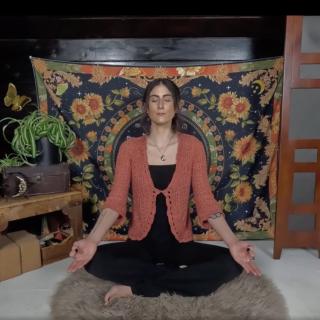
We'll start sitting with the spine tall.
Shoulders over the hips.
You can cross the ankles.
Or you can sit with the legs straight out in front of you.
You can see that I have a bolster underneath my hips.
So I'm sitting up a little bit on a cushion.
This elevates the hips higher than the knees so that they won't fall asleep while we're practicing.
You can sit with your back up against a wall if you feel like you need a little extra support.
The focus of today's class is stimulating the vagus nerve with our yoga practice.
So these poses are going to help to regulate the nervous system,
Promote stress relief,
Pain relief,
And just an overall sense of calm and being present in your body.
Make any adjustments to your posture.
Feel the hips and sacrum get heavy against the surface beneath you.
Shoulders glide down and back,
Chest is open and light.
Let the breath be easy.
And natural in and out through the nose or the mouth,
Whichever is most comfortable.
For now,
Just breathe at your own natural rhythm.
Invite your attention to fully settle.
Into your body.
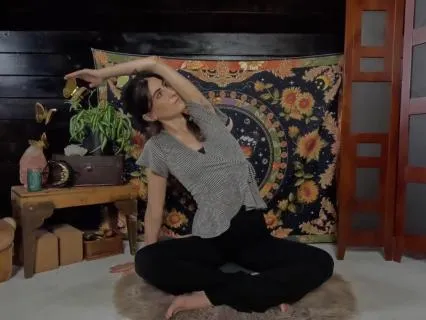
Now plant one hand on the floor beside your hip.
And reach up and over with the opposite arm.
You may feel a sensation of stretch or a sensation of opening in the side of your body.
As you breathe here,
Without straining,
Imagine you could travel your breath.
With the inhale all the way up into your armpit.
And then all the way back down to your hips.
Good,
On your next exhale cartwheel the arms.
And we'll do this on the other side.
So the opposite arm reaches up and over.
Deep breaths,
Inhale all the way up into your armpit.
And exhale all the way down into your hips.
Good.
On your next exhale cartwheel the arms,
Come back to a neutral seated position.
Notice how you feel.
If you're sitting with the ankles crossed,
Change which ankle is in front so the opposite foot comes in front just to keep things balanced.
From here,
Bring the hands together at your heart,
Press the palms together.
Sit up tall so the chest presses into your thumbs.
Big breath in.
And then exhale,
Twist to your right just as far as you comfortably can.
And then let the hands come down to support you.
Breathe normally.
And try to avoid.
Cranking yourself deeper into the twist.
This is supposed to be very light.
Let's take a couple more full breaths here.
Good,
Come back to center.
And bring the hands back together at your heart.
Deep breath in.
Exhale,
Twist to your left.
Very gentle,
Very light.
Spine is tall.
Chest is open.
The vagus nerve branches down into the abdomen and connects with the digestive organ.
So this seated twist is an excellent yoga pose to stimulate the vagus nerve.
Take one more full breath in.
And exhale,
Gently bring it back to center.
Hands gently grasp the knee.
Take a big breath in and arch the spine slowly,
One vertebrae at a time.
Open up the chest.
Look up.
Take a deep inhale here all the way up into the collarbones.
And then on your exhale,
Fold forward over your legs.
You can come down onto the elbows or stay propped up on your hands.
You'll get the benefits either way.
Again,
We're stimulating the vagus nerve as it branches down into the abdomen.
Forward folds like this are really good at down-regulating the nervous system.
So they can help you feel relaxed as long as you feel comfortable and you're able to breathe deeply here.
Very slowly walk yourself up.
To a seated upright position.
If your ankles are crossed,
Change which foot is in front.
Hands find the knees,
Deep breath in,
Open up the chest,
Arch your spine.
And then exhale to fold forward over your legs.
You can stay up on the hands or come down onto your elbows.
Dip the chin ever so slightly to keep the back of your neck long.
So you're looking down at the floor.
Take some easy.
.
.
Full breaths here.
When you're ready,
Bring yourself back up to a seated position.
For this last part of the class,
You can stay seated.
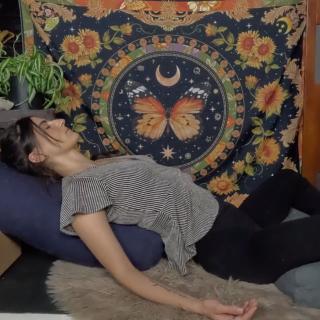
Or you can lie down on your back if that's more comfortable.
We'll finish with an easy breathwork practice to stimulate the vagus nerve.
This can promote relaxation.
Pain relief.
And it can help you feel more energized if you're someone who struggles with fatigue.
For this practice.
You can Breathe in through the nose and out through the nose.
Or you can breathe in through the nose,
Out through the mouth.
The length of your inhale.
Is going to be half as long as the length of your exhale.
Okay,
So the length of your exhale is twice as long.
As the inhale.
So you'll breathe in maybe for a count of three.
Exhale for a count of six.
Or maybe inhale for a count of four.
Exhale for a count of eight.
Just find a pace.
That feels sustainable for you.
Your eyes can stay open or closed.
And we'll keep going like this for about another minute or so.
Breathe at your own pace with the length of your exhale being twice as long as your inhale.
Hmm.
Finish your last cycle of breath.
And then let your breath return to its natural rhythm.
Take a moment to just notice how you feel after this practice.
When you're ready,
Bring the hands together at your heart,
Feel the palms press against one another.
Dip the chin toward your fingertips.
And open your eyes if they were closed.
Thank you so much for practicing with me today.