Welcome to The Open Hand,
A different way of letting go.
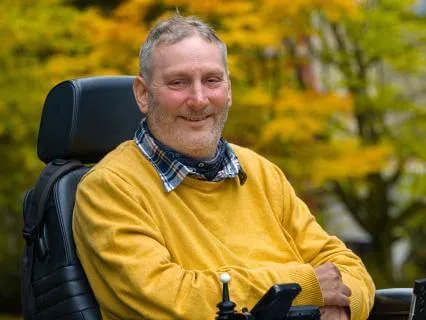
I'm Stephen Webb,
And just allow yourself to become comfortable.
Allow your body to settle in.
You can sit,
Lie down,
Or whatever your body feels like right now.
But I want you to stay quite alert if possible.
There's no perfect position for this.
And your body knows how to relax,
If you just allow the body to relax.
Allow your shoulders,
And your arms,
And your fingers.
And while you're allowing the body to relax,
Just become aware of your breath.
Breathing in calm,
Breathing out relaxed.
You don't need to do anything with your breath.
Your body's got all that in hand.
Just the same as relaxing when we allow the body to do it.
Our only job right now is to be aware of what's happening.
Aware of my voice.
Aware of the room.
Aware of your muscles relaxing.
Just aware that your whole body and your breath is slowly relaxing and slowing down.
And it's doing it all naturally.
You can gently close your eyes if you haven't done already.
Or just soften your gaze a few feet in front of you.
And just before we move into the actual practice,
I just want to talk a little bit,
A little dharma talk about the difference between acceptance and letting go.
But we just treat this as an intro to the meditation.
So just be aware of what I'm saying and your breath.
And there's a phrase that comes up in meditation and in life.
Let go.
Let go of your thoughts.
Let go of your worries.
Let go of your tension.
And I've used it myself in some of the teaching.
But today I want to explore something a little different with you.
Because I think there's a more honest and more helpful way to find this peace that many of us are longing for in this crazy busy world.
And here's what I've noticed.
Both in my own practice and working with many others.
When someone tells you that you've got to let go of something,
What actually happens in your mind?
Your brain has to grab hold of it first.
And the one thing you want to do is get rid of it.
But we have to bring it to mind.
It has to be located.
It has to be focused on.
And when we wonder whether we let go of something,
We have to bring it back into focus to see if we've stopped thinking about it.
It's a bit like telling someone,
Whatever you do,
Don't think of a red balloon.
There you go.
So let's try a small experiment together.
Right now I want you to think of something that's been on your mind recently.
It doesn't have to be the biggest thing in your life to let go.
Just something that's been mingling you.
A worry or a confusion.
A conversation that didn't go well perhaps.
Something quite unresolved.
So when you've got it,
Good.
Now I want you to try to let it go.
Push it away.
Tell yourself,
I'm letting go of this thought.
Really try.
Put some effort into it.
Force it out of your mind completely.
Has it gone?
So how did that go?
And if you're like most people,
The thought is still there.
We have to check in to see whether the thought's gone.
And maybe even more vivid than even before.
The subconscious mind and the body now thinks it's even more important.
And now there's a second layer on top of it.
The frustration of not being able to get rid of it.
You try to let go.
We've done it before and the grip gets tighter.
And just before we move to the practice,
Here's why.
When you think a thought,
Just a few seconds your body responds.
An emotion arises.
Maybe a tightness of the chest.
A knot in your stomach.
A heaviness behind your eyes.
That's not just in your head.
That's a real physical pathway.
And it's been formed every time.
It's chemistry.
It's biology.
It's what the body does.
Trying to force it away is like trying to unring a bell.
So if letting go doesn't quite work,
What does?
Acceptance.
And here's the difference.
Letting go says,
Get rid of this.
Acceptance says,
This is here.
I see you.
You can stay.
It sounds counterintuitive.
Why would you invite an uncomfortable thing to stay?
Remember the moment you stop fighting it?
Something remarkable happens.
The tension around it begins to soften.
Not because you forced it,
But because you stopped adding fuel to it.
The struggle was the fuel.
Take that away and what's left?
Just what is.
And let me show you what I mean.
So bring your attention back to your breath.
Breathing in calm.
Breathing out relax.
Allow your body to relax because by now your shoulders are probably tensed a little.
We don't need to put much effort into this.
We just allow this moment to be.
And now gently I'd like you to bring back that same thought you had for a moment ago.
The niggling thing.
The worry or frustration.
And let it come.
Don't chase it.
Just let it arrive.
Like someone knocking on your door I guess.
And now notice what happens in your body.
Where do you feel it?
Is there a tightness somewhere?
A warmth?
A heaviness?
Maybe it's in your chest.
Maybe your jaw.
Maybe there's a tightening somewhere in your jaw or your shoulders.
Don't judge it.
Don't try to change it.
Just notice.
Now instead of trying to push this feeling away and adding more tension to it,
I want you to just do something different.
I want you to turn towards it.
Just gently.
Like you turn towards a friend who's upset.
Not to fix them,
But just to sit with them.
And say quietly in your mind,
I see you.
You're here.
And that's okay.
Notice what happens.
You might feel the sensation shift slightly.
It might soften.
It might move.
It might stay exactly where it is.
All of that is fine.
You're not trying to change it.
You're just being with it.
Now let's try the other approach again.
Just briefly so you can feel the contrast.
Take that same feeling and try to push it away.
Clench against it.
Tell yourself,
I don't want this.
Go away.
I'm letting go of you.
Can you feel that?
Feel how your body chances up.
Feel how the struggle creates its own power and its own strength.
The tightness isn't coming from the original thought.
It's coming from the resistance.
From that little tug of war that you've declared in your own experience.
It's like you're the one pulling both ends.
Now let that effort go.
Stop pushing.
And come back to the open approach.
Soften your jaw.
Soften your shoulders.
Let your hands relax.
And say again quietly,
This is here.
I see you.
And that's okay.
Now imagine your hands in your mind's eye.
And that just means imagining seeing your hands in your head.
And see them clenched up into tight fists.
That's what the forcing feels like.
All that energy spent gripping,
Holding and pushing.
And now slowly see those fists open.
Those hands open finger by finger.
Until the palms are facing upward.
Open and soft.
Not throwing anything away.
Not clenching anymore.
And this is acceptance.
It's not giving up.
It's not saying the situation is fine.
Or that your feelings don't matter.
It's simply choosing in this moment to stop adding struggle to whatever's here.
And in that choice,
Something loosens.
Something breathes.
Something frees up.
Now let the thought drift into the background.
You don't need to push it.
You don't need to hold it either.
You let your attention gently return to your body.
To the weight of you sitting or lying here.
To your breath,
To moving in and moving out.
Of his own space.
You feel your hands again,
Your real hands.
Wherever they are,
Notice that they've softened during this practice.
You may notice if there's a little more ease in your fingers.
Or your forearms.
Notice your chest or your belly.
Is there a little more space than when you started?
Even just a fraction.
The space wasn't created by force.
It was just an opening to this moment.
An acceptance.
And let's rest together for a moment.
In this stillness.
In this acceptance.
There's nothing to fix,
Nothing to force.
Nothing to let go of.
I will keep an eye on the time.
There is just this.
You.
Breathing.
Being here.
And as I count back from five.
We'll just come back to the room.
So five.
Four.
Just gently shake out your arms,
Wiggle your fingers.
Three.
Just gently open your eyes.
Two.
Look around.
And one.
Just take a little deeper breath.
And feel like you're really present back here now.
So you'll notice the difference between trying to let something go,
Trying to force it and just allowing it to be what it is.
And it takes less control over your body.
It takes less control over you.
It takes a lot less effort.
And eventually your body just lets it go anyway.
That's where the peace lives.
Not in the prisoner way.
In the opening up.
Thank you for practicing with me.
Take care of yourself.
And I'll see you next time on Insight Timer.
Thank you for following and I appreciate your support.