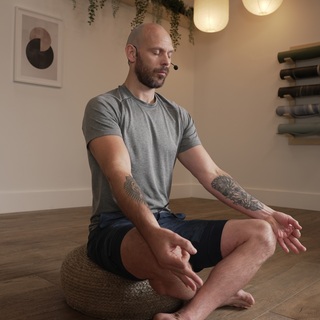
Get into a comfortable seat and begin to breathe in and out through the nose.
Nice and easy,
Nice and relaxed.
Just start to settle in and get comfortable with just breathing in and out and just sitting and relaxing as hard as that may be right now.
Trust me,
You're all okay,
You're in safe hands.
Now as you do that,
I'll just explain a bit about today and a bit about your situation.
Health anxiety or hypochondriitis is actually two different disorders that are lumped together.
Those are somatic symptom illness disorder and illness anxiety disorder.
The first,
Somatic symptom illness disorder,
Is an overwhelming concern about the sensations that we feel and irrationally believing that they're more severe than they are,
Even when there's no evidence to believe it or even when there's actually counter evidence to this fact.
Now illness anxiety disorder is the irrational belief that we are in danger of developing a serious illness.
Today we will be addressing the first type,
Somatic symptom illness disorder.
This idea of interpreting every sensation in our body as something that is dangerous or potentially dangerous.
Our research shows that what we're going to do today is highly impactful in helping this type of illness.
The key to today's practice is going to be observation,
Paying attention to what we feel in a neutral way.
And that is tough,
I know,
Because we're so used to practicing interpreting every sensation as something that is a threat.
And that's why the fix is not to run away from the sensations,
But to reinterpret them.
So your remedy to fear today will be focus and facts.
We're going to do this by using neutral language and that's important.
When we observe,
We're going to be looking at four key anchors,
Objective anchors,
Location,
Movement,
Temperature,
And sensation.
Now just a note,
That last one,
Sensation,
This is an objective anchor in the sense that we know what we feel.
What I don't want you to do is take that further and go,
What does it mean to feel this?
I just want you to focus on what the feeling is.
More will become clear as we do it.
So like I say,
You're in safe hands,
Just follow my lead.
Let's try this out with the breath now.
Just focusing on your breath.
Start with the location.
Where do you notice your breath the most?
Is it in your lungs?
The tip of your nose?
Is it when it goes down your throat at the back of your nose?
Just take a moment to really nail down where you feel your breath.
All right,
Good.
Now I want you to notice any movement that accompanies the breath.
How does the breath start and how does it end?
What is the pathway it takes?
Now think about any parts of the body that facilitate this.
Is there a moving of the ribcage,
The abdomen,
The back,
The chest,
Even the nostrils?
Can you just see all the places that move to allow the breath to itself move?
Okay,
Good job.
Now move on to the temperature.
Can you feel any difference in the temperature of the breath as it comes in and as it goes out?
So you may focus on the breath coming in through the nostril,
Noticing the temperature there just for a few breaths,
And then focusing on the temperature of the breath as it comes out.
Maybe on your top lip.
All right,
Let's move on to the last of our anchors,
The sensations.
So thinking about the breath in a material way,
How it feels right now,
And also in a more abstract way,
How does your body feel while you're breathing?
Looking for any hot feelings,
Cold feelings,
Any itchiness,
Any tingling,
Any lightness,
Any heaviness,
Any coziness,
Throbbing,
Energetic or electric sensations,
Any calm sensations.
No right or wrong,
It's just noticing what you notice with the breath.
Okay,
Great.
We're going to do this all again with some other body parts now.
So let's move on to your torso.
Again,
We're going to just notice when I say torso,
And you focus in this area in the center of your mass,
Where do you feel it the most?
Kind of what is the center of your torso to you?
Do you feel mainly your chest?
Is it your back?
Is it your ribs?
Where's your mind taken to first and what jumps out to you the most?
Okay,
With that dialed in,
Now let's notice what's moving here.
Can you see all the little areas moving?
Is that chest rising and falling?
Are the ribs moving out and in?
Is your abdomen rising up and lowering down?
And is even your back having a little bit of movement with every breath?
You might even feel things inside your torso.
Maybe your heart,
Maybe your lungs.
Next,
Let's have a little temperature check.
Are there parts of your torso that feel different in terms of warmth and coolness?
Is your chest quite warm but your back a little bit cooler?
Just scanning for this little heat map of your torso.
Okay,
Good.
And now,
Checking in with any sensations you feel in this area.
Remember tingling,
A little electricity,
A coziness,
A coldness.
Just anything that you notice.
Remember,
Neutral language,
Not what it means,
Just how it feels.
I currently feel quite full.
My stomach feels nice and content.
My chest feels quite heavy.
Alright,
You're doing great.
Let's shift to one more area of the body.
Well,
It's two areas.
But you get what I mean.
So,
It's going to be your arms and legs.
So,
First off,
With your eyes closed,
Can you feel where these appendages are in space?
Can you almost pinpoint their locality even though you can't see them?
And then,
Can you become aware of which parts of your limbs you feel the most?
Are your arms most notable or are your legs most notable?
Maybe it's your hands,
Maybe it's your feet.
How's the left one compared to the right one?
Just dialing in to where you feel these body parts and how you notice them.
Next,
Checking in with any movement.
Maybe the hands are resting on the belly and they're moving with the breath.
Or maybe they're totally still.
Maybe there's a slight movement in the arms,
Side to side,
As you try to sit up straight.
Maybe you can feel the blood just underneath your skin flowing in and out.
And now,
What about the temperature?
Can you feel different areas of cool and warm?
I can tell you right now that in my shed where I record this,
For some reason my hands stay warm but my feet,
Boy do they get cold.
I'm just noticing the difference and noticing if they change at all.
Which leads us nicely into the last area of our focus.
The sensations.
Tingling,
Itchiness,
Maybe even the pressure of the hands touching one another or the feet crossed or the legs crossed.
How's it feel to have your clothing touch your skin?
Just this open awareness of any sensations that are going on in your arms and legs right now.
Alright,
Great job,
You've cultivated this beautiful awareness of your body.
Finally notice how you're feeling a myriad of sensations at all times,
Just as you hear a myriad of noises at all times.
They're not all warning signs,
They're just your body existing.
They're just your body talking to you.
You listening is opening up a conversation with your body,
Not an alarm system.
And as you have this open awareness of all these different sensations reaching out at you at all times,
All this different movement,
All this different location,
All this different temperature,
Notice how it all changes all the time.
Your mind moves from one to another.
So just be aware that sensations are nothing out of the ordinary.
They're just this conversation with your body.
So as you go through your daily life,
See if you can feel more and fear less.
And if you do start to feel a bit anxious,
Come back to this focus and not the fear.
Good luck out there.