Hi everyone.
Welcome.
Let's take a moment to just settle in.
Deep in Hing and Ex-Hing.
Today I would like us to look at something very ordinary.
Something we all live with every day.
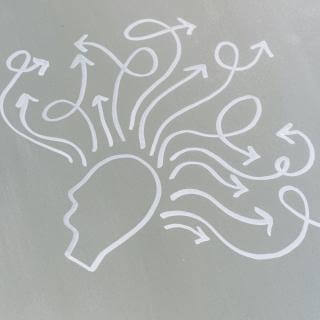
The movement of the mind.
If you pay attention for even a few seconds,
You will notice something interesting.
Even when the body is still,
The mind keeps going.
One thought finishes,
Another begins.
A memory shows up.
A plan forms.
Some random worry appears.
It's almost continuous.
Like background noise,
We stop noticing.
So instead of trying to control the mind,
Let's simply understand what it's doing.
Because once something is understood,
It naturally loosens its grip.
Sage Patanjali uses a very simple image.
Imagine the mind like a lake.
When the water is calm,
You can see clearly to the bottom.
When the water is constantly disturbed,
Everything looks distorted.
Most of us are trying to understand life while the water is always shaking.
So clarity feels rare.
He says the mind moves in certain patterns and these movements are called vrittis.
You can think of a vritti as a mental reef.
A small activity rising and falling.
And he says there are just five main kinds.
Once you see them,
You start recognizing them everywhere.
First is called pramana,
Right knowing.
The first movement,
Patanjali talks about this pramana,
Right or you can say valid knowledge.
This isn't just random information.
It means the ways we decide what is true and what is false.
Traditionally,
There are three ways we know something.
First is direct experience through your senses.
What you see,
What you feel yourself.
You touch fire,
You know it's hot.
Second way is reasoning.
Thinking logically,
Connecting cause and effect like science,
Analysis,
Understanding patterns.
And the third is trusted guidance.
Learning from someone who has already seen clearly.
A teacher,
A lineage or ancient texts that come from deep realization.
So,
Pramana includes study,
Reflection,
Learning,
Inquiry.
All of this is valuable.
It helps us live wisely.
But the subtle part is even when this is still activity in the mind,
Even correct knowledge creates thoughts,
Concepts,
Conclusions,
Comparisons.
You read one book,
Then another,
Listen to one talk and then another.
The mind keeps processing,
Organizing,
Collecting.
So,
The lake is still moving.
Clear thinking is better than confusion,
Of course,
But it's still movement.
And Patanjali's point is very precise.
Freedom doesn't come from knowing more and more.
It comes when the mind learns how to be still.
Knowledge can guide us to the door.
Silence is what lets us walk through.
Now,
Next movement is called viparya.
It means false knowledge.
Seeing something incorrectly and believing it to be true.
It's not simply,
You can say,
Confusion,
But a mistake that feels completely real in the moment.
In the old text,
They give a beautiful example.
Imagine walking at dusk.
You see something long and curved on the ground.
Instantly,
The mind sees a snake.
Fear arises.
Heart starts racing.
Body tightens.
A few seconds later,
You look closely.
It's just a rope.
Snake never existed.
But notice the fear was real.
The body reacted as if danger was real.
This is viparya.
The mind projects something that isn't there and we suffer because of that projection.
And we still do this every day.
Someone says one small sentence and we assume criticism.
Someone stays quiet and we assume rejection.
A small event happens and the mind builds a whole story around it.
Most of the time,
We are reacting to our interpretation,
Not reality.
So suffering doesn't always come from life itself.
It often comes from what the mind adds on top of life.
When this becomes clear,
Something softens.
We start checking our perceptions a little more gently.
Is this actually true or is my mind filling the gaps?
That question alone can save us from a lot of unnecessary pain.
Now the third movement is vikalpa.
This one is very subtle.
Viparya was misseeing something that exists.
Vikalpa is different.
Here there may not be real objects at all.
Only words,
Only ideas,
Only mental constructions.
Patanjali describes it as knowledge created purely from language or thought without something concrete behind it.
For example,
If I say a sky flower or a rabbit's horn,
You immediately understand the words but nothing like that actually exists.
Still the mind can picture it.
That's vikalpa.
The mind has the ability to create entire inner worlds out of concepts alone.
And we live in this more often than we realize.
How will my future look?
What if I fail?
What if something goes wrong?
What will people think about me?
None of this is happening right now yet the body reacts.
Tension builds.
Sleep disappears.
All because of thoughts about something that doesn't even exist yet.
It's like watching a movie inside the head all day.
Very creative but very exhausting.
So vikalpa isn't wrong.
It's the same power that gives us art,
Poetry,
Innovation but when unconscious it becomes worry and overthinking.
The mind keeps producing stories and the lake keeps moving.
The fourth movement is nidra which is known as sleep.
We usually think sleep means the mind has stopped but Patanjali looks more carefully.
He says sleep is also a mental state because even in deep sleep something is experienced.
In the morning if I slept well or I didn't sleep properly which means some form of memory was created.
The mind was still functioning in a very subtle way.
Dreams come.
Images move.
Old impressions get processed.
Sometimes we sleep 8 hours and still wake up tired because the mind has been active the whole night.
This is why true rest feels so rare.
For most of us the mind only shifts modes,
Waking thoughts,
Dreams,
Memories.
But complete stillness almost never happens naturally.
Yoga becomes important exactly here because meditation is the first time we consciously taste that deeper rest.
A rest where the mind isn't chasing anything.
And the last movement is smriti.
Memory.
And this one quietly shapes our entire personality.
Memory isn't just remembering facts.
It's the storing of every experience.
Every hurt.
Every pleasure.
Every success.
Every fear.
All of it leaves a small imprint inside.
In yoga we call these samskaras.
Impressions.
Over time these impressions become tendencies.
And tendencies become this is just how I am.
But if you look closely many of our reactions are simply old memories replaying themselves.
Someone raises their voice today and suddenly you react with fear that actually belongs to something that happened years ago.
The present moment is small.
Past memory is heavy.
So we aren't always responding to life freshly.
We are responding through layers of stored experiences.
Memory keeps pulling us backward and again the lake keeps moving.
If you step back now and observe the whole picture it's quite beautiful.
All day long the mind is moving through these five.
Understanding.
Missing.
Imagining.
Sleeping.
And remembering.
Round and round.
From morning to night.
Very little space in between so the tiredness we feel isn't only physical.
It's a weight of constant mental activity.
The mind simply never learned how to rest.
And this is exactly why Patanjali begins yoga here.
Before changing life.
Before philosophy.
Before spirituality.
First understand the machinery of the mind.
Because once you see these movements clearly something shifts naturally.
You stop believing every thoughts.
A little distance appears and in that small gap there's already quietness.
That quietness is what yoga slowly deepens.
Before we end let's slow this down a little.
Before we end let's slow this down a little.
For a moment you don't need to understand anything.
Just sit comfortably and simply notice your mind.
No control.
No fixing.
Just watching.
Maybe a thought about today shows up.
That's memory.
Maybe something about tomorrow appears.
That's imagination.
The mind starts analyzing what we just discussed.
That's knowledge.
Or maybe it misunderstands something.
That's misperception.
We don't have to stop any of it.
Just recognize.
Label it gently and let it pass.
Just like clouds moving across the sky.
You don't chase the clouds.
You don't fight them.
You just remain in the sky.
For the first time you may notice something simple.
Thoughts are moving but something in you isn't moving.
Thoughts are changing but something is quietly aware of all of it.
That quiet awareness doesn't come and go.
It was here the whole time.
The mind has movements.
Awareness doesn't.
Yoga slowly teaches us to rest there.
Not by force.
Just by seeing clearly.
So as you go back into your day don't try to control the mind.
Just notice its patterns.
The notice in itself begins the stillness.
And that's enough for today.
Thank you for being here.
Have a great day.
God bless you.