Hey guys.
My latest update is based on chapter 12 of a book,
Psycho-Cybernetics,
Maxwell Maltz's chapter on what he calls it,
Do-It-Yourself Tranquilizers.
The core idea is that you can build a mental quiet room inside yourself,
A sanctuary you've imagined so vividly and visited so often,
That when life gets loud,
You can step into it and the noises stay outside.
Maltz argues,
Calm isn't a personality trait,
It's a trained skill.
You build it in stillness,
So it's available in the storm.
What Maltz didn't have,
Writing in the 1960s,
Was the physiological piece.
He had the psychology right,
But not the lever.
The lever is the breath,
Specifically the way you breathe your way through your nose.
When you breathe lightly and slowly through the nose,
Not the chest,
Not the mouth,
You're directly stimulating the vagus nerve,
Building CO2 tolerance and signaling to the nervous system that you're safe.
Mouth breathing,
As we know,
Does the opposite,
Locks the body in distress patterns.
You can't think your way to calm if your breathing is screaming danger.
So here's the pairing.
Maltz gives you the room,
The mental sanctuary,
The sensory detail,
The do not disturb sign.
Nasal breath work gives you the door.
Slow light nasal breath at around five and a half seconds in and five and a half seconds out with a faint air hunger.
That cadence repeated daily becomes the physiological cue that opens the room.
You don't have to find the calm anymore,
The breath fetches it.
This week,
The practice is simple.
Five minutes a day,
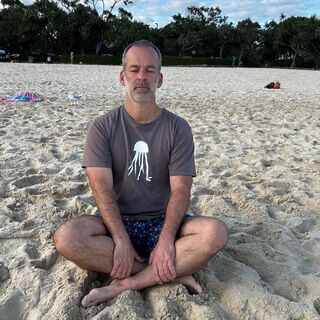
Sit upright,
Mouth closed,
Tongue on the roof of the mouth,
Breathe through the nose,
Belly soft,
Build the room.
Same room,
Every session,
Full sensory detail,
Same chair,
Same light,
Same sound.
Stay there for a few minutes with the breath light enough that you feel a faint air hunger.
End with a soft breath,
Hold on the exhale until the air hunger is moderate,
Not maximum.
Three slow nasal breaths to close.
The reason this works is conditioning.
You're pairing a specific breath pattern with a specific mental state over and over in calm conditions.
Once that pairing is wired in,
The breath becomes a shortcut.
When something hits you in the real world,
The email,
The conversation,
The trigger,
Two or three light nasal breaths and you're at the door of the room.
You don't have to fight your way back to composure,
You step into it.
Maltz's whole bet was that you handle each situation fresh,
Not while still carrying the last one.
The breath is what clears the circuit.
Nasal in,
Nasal out,
Light and slow.
That's the work this week.
Build the room,
Pair it with the breath,
Visit it daily.
By the end of the week,
You'll notice the calm is a few breaths away and that's the start of something you can use for the rest of your life.