Most people try to improve their practice by doing more.
This session takes a different approach.
We'll reduce unnecessary effort so the body becomes more stable and practice requires less energy to maintain.
So when you feel ready,
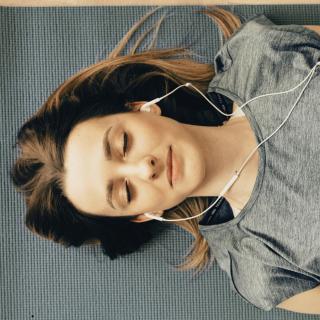
Lie on your back with your knees bent and your feet on the floor.
Take a moment here to notice how you are lying.
Not whether you are relaxed,
But more how much effort is present.
Notice if the jaw is slightly active.
If the shoulders are holding tension.
Or if the abdomen is working when it really doesn't need to.
Without trying to force relaxation,
See if you can just reduce a little of that extra effort.
Encourage the floor to just carry a little more of your weight.
Then begin to notice your breath.
You don't need to alter it or deepen it yet.
Just be aware of it.
And allow it to move on its own for several more breaths.
In a moment,
We're going to add some small movement.
When we do,
Please move in a way that's comfortable for you and rest when you need to.
So when you come to an inhale,
Just slide one heel slowly away from you along the floor.
When you're ready to exhale,
Slide the heel back towards you.
Then repeat on the other side.
Inhaling as the heel slides away.
Exhaling as it returns.
Keep the movement small enough that the breath remains easy.
If at any point the breath becomes louder or strained,
Feel free to reduce the movement.
But just keep working from side to side.
Moving in time with your breath.
Notice what happens when the movement stays within what the breath can comfortably support.
You might notice that effort spreads less through the body.
The movement feels contained rather than effortful.
Completing after your next movement.
Resting both feet on the floor.
And just pausing here.
Observing the breath.
Observing the body.
We're now going to repeat the movement,
But this time we're going to move the heel away a little less.
So the movement's going to be a little bit slower to match it to the length of the breath.
So on an inhale,
The movement begins,
The heel slides away.
On an exhale,
The heel returns back to the start position.
Just working from side to side.
When you've completed your next exhale,
Coming back to the centre,
Feet resting on the floor.
Just noticing how the body feels now.
Maybe a little more organised,
A little more relaxed than at the beginning.
You might have noticed that the same movement seemed to require less effort on the second round.
And then draw the heels in towards the buttocks a little more.
When you come to an inhale,
Press lightly into the feet and allow the pelvis to raise a small amount.
When you're ready to exhale,
Lower yourself back to the ground slowly.
Repeating this movement in time with your own breath.
Inhaling,
Pelvis raising or tilting just a little.
Exhaling,
Lowering back to your start position.
Repeating in time with your own breath.
Keep the lift modest.
If you feel the face tightening or the breath hardening,
Reduce the height.
The purpose is not to work harder,
Not to push more.
It's to feel how much effort the system can manage comfortably.
Continue for several more repetitions.
And then lower your hips back to the ground when you're ready and rest here.
Notice the contact between the body and the floor.
Notice whether the abdomen responds more naturally to the breath now.
In classical yoga language,
Stability in practice depends on developing two capacities.
A parna which provides support and containment and agni,
The ability to process effort without strain.
When these are weak,
Effort spreads through the system and the practice quickly becomes tiring.
When they begin to strengthen though,
Movement feels supported and more sustainable.
The work you have just done is simple,
But it demonstrates this directly.
Remain still here now for several more breaths.
Notice whether the breath settles more easily.
Notice whether the body feels supported rather than worked.
This kind of steadiness is quiet,
But it's what allows practice to continue without depletion of energy.
Take a deeper breath here.
And then whenever you are ready,
Feel free to roll over onto one side and come up into a comfortable seated position slowly.
Before moving on with your day,
Just take the time to notice whether ordinary movements now require slightly less effort.
That change is often small,
But it's the beginning of stability.
Thank you for practicing with me today.