Welcome.
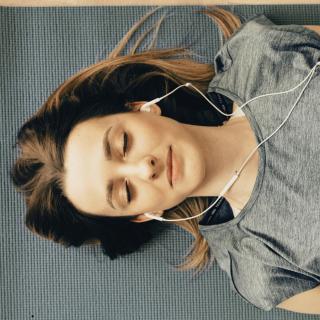
Please find your way to a comfortable position.
This practice is designed for times when the system feels tired but not settled.
Perhaps the body feels heavy but the mind feels active or the breath feels slightly irregular.
This combination of tired but wired is very common when capacity is reduced.
Rather than trying to force the system to relax immediately,
We begin by allowing the breath to become more even.
So take a moment now to notice the natural rhythm of your breathing.
Without changing anything yet,
Simply observe.
Notice whether the inhale feels shorter or longer than the exhale.
Notice whether the breath feels smooth or slightly uneven.
Observe without judgment.
We're now going to start to work a little more with the breath.
So when you feel ready,
Begin to gently introduce a small lengthening of the exhale.
Don't push,
Just lengthen it slightly.
For example,
If the inhale feels comfortable at four,
Perhaps the exhale becomes five or even maybe six.
Only extend the exhale if this remains easy to do.
Allow the breath to remain quiet,
The face to soften slightly.
Continue to work with this slightly longer exhale.
Often when the system is wired,
Small areas of tension appear around the eyes,
The jaw or the throat.
Without needing to change anything dramatically,
Allow these areas to become slightly less effortful.
Continue breathing with a slightly longer exhale.
Allow the rhythm to become predictable.
Predictability often helps the system feel safer.
When the breath is irregular,
The nervous system may remain alert.
When the breath becomes more even,
The system often begins to reduce unnecessary activity.
If it's comfortable,
Allow the hands to rest somewhere supportive,
Perhaps on the abdomen.
Notice the movement of breathing under the hands.
There's no need to make the breath larger.
Simply allow it to continue.
If thoughts are active,
This is not a problem.
The aim is not to eliminate thinking,
But instead to reduce internal urgency.
The thoughts can continue,
But you feel the system become less reactive to them.
Continue here for several more breaths.
Encourage the exhale to remain slightly longer than the inhale,
But always,
Always comfortable.
If the breath becomes effortful,
Reduce the length slightly.
Comfort is more useful than ambition.
As you continue,
Gradually,
You may notice small changes.
The breath may feel smoother.
The forehead may feel less tense.
The sense of pressure may reduce slightly.
These changes may be subtle,
But subtle changes are sufficient.
When you feel ready,
Allow the breath to return to its natural length.
Notice whether the rhythm feels different from when you began.
There's no requirement for dramatic change.
Even a small reduction in internal noise is valuable.