We start today.
With a standing meditation.
So please stand up.
You stand on the floor,
Not on a mat,
The best is on the floor.
If you practice standing meditation,
Outside,
Then you can do it in the grass,
On the ground,
On the earth It doesn't matter wherever you want to do it,
But it is better,
It is not a soft surface like the sitting mat.
Then when you stand be aware that your feet are not close together.
There.
About one food from each other.
Because then the posture is more stable.
So standing is one of the four postures.
The Buddha said we can practice meditation,
We can practice Vipassana and mindfulness in four postures.
That is in standing,
Walking,
Sitting,
Or even while lying on.
And now we try to practice this standing meditation.
You hold one hand,
One wrist in front of you or in the back,
Whatever you feel is more suitable,
More comfortable for you.
And close your eyes gently.
And become aware of yourself in the standing posture.
Move to your body,
You know,
Your head your neck,
Both shoulders.
Both arms.
Hands,
You know how you hold your hands in front or in the back You know your straight body.
Your legs your feet.
If we practice the standing meditation,
The main attention should be in the soles of our feet.
Know whatever sensation is there in the soles of your feet.
What you experience there.
Is there hardness or softness?
Heat or cold?
You know that.
You can even center your attention to the middle of the soles of your feet.
And know what experience you make there and you know you're standing I can make that mental note standing.
Standing.
You're standing since 30 years,
40 years,
However old you may be.
But usually we are not really aware what standing is.
Now you try to really make clear in your mind how it feels like standing.
Standing.
From top of your head down to the soles of your feet.
What is standing?
Here again we practice,
When we do the standing we know when thoughts arise.
We just know them as sinking,
Make a mental note,
Sinking,
Sinking,
Two times or three times,
Just to make clear,
Okay,
This is sinking.
And then let go of the thoughts.
Don't hold on to them,
We don't cling to the thoughts Bring the attention back to the standing posture.
To the feeling,
The experience you have there in the soles of your feet.
If sounds distract you,
You just know it's hearing.
You don't say,
Ah,
It's a dog barking.
That would not be a correct mental note.
You just note,
Hearing,
Hearing.
And let go.
We don't judge what we experience.
It's unpleasant to hear this sound.
Or it's pleasant to hear another sound.
We just know it's hearing.
Stay with a neutral mental note.
Knowing what we really experience there.
It's just hearing.
Again,
We know we have ears.
The ears are healthy.
And there is a sound outside,
It's natural that then hearing consciousness arises That's all.
Now there's hearing,
Hearing and let it go and return to the experience you have in the soles of your feet.
Standing posture is very useful also to heal the body.
We had.
.
.
Some people here who had sicknesses that were very difficult to heal,
Like allergies or something like that.
And they could get rid of it by doing standing meditation.
The cause might be because when you do the standing meditation,
You generate a lot of heat in the soles of your feet.
And this makes the foot reflex zones.
You activate them.
You massage them in a way.
And so it can be really useful also for your health.
But then you have to do the meditation for a long time,
Sometimes even for an hour,
Like we do here in our intensive courses.
We do the standing sometimes for a whole hour.
Just standing meditation.
Now you are standing.
Standing.
Bye bye.
Bye bye.
You Bye bye.
I'm gonna leave you alone.
We'll talk to you in a minute.
Today we also want to practice contemplation of the body.
Restart.
In the standing posture.
Bring your attention to your head.
And we try to contemplate the bones today.
Know your skull now.
Try to see the skull.
Some used to see it in a book or in an anatomy teaching.
In a picture,
A real skeleton,
So you already know how your skeleton looks like.
We take now this knowledge,
This memory,
And try to visualize,
Try to see the skull.
You do not see it outside yourself,
See it within yourself.
You know the skull,
You know the holes.
Where there are the eyes,
The sockets of the eyes You don't know the holes where there's the nose Nodir.
Teeth and jaws.
Now this is a skull Try to see it.
If you cannot see it,
Just know.
You know it's there.
And you know.
The neck,
You know the whole spine from your skull.
Go to each piece of bone there of the spine.
Try to use the memory,
How do these bones look like?
Slowly move from one to the other.
Know what color the bones have.
If you do the standing meditation and you feel dizzy,
Then you can open the eyes.
Until this dizziness disappears.
And then close the eyes again.
Sometimes this can happen because we are not used to stand for a long time.
So when you feel the body is swaying or dizzy open the eyes until it disappears Now bring the attention to your shoulders,
You know,
The bones of your shoulders.
Do you know the big bones,
Upper arm bones?
Maybe you can see how they join to the bones at your shoulders there.
The elbows.
And the two pieces of your lower arms.
Try to see them,
Know them.
Then you see the small bones of your hands.
And fingers.
If you can see them is good,
If not,
Just use your memory drive.
To know them.
Know from within yourself.
It's not an object anywhere outside yourself but it's your own body.
Then move to your ribs and try to see the rib bones chest bone.
And you always know you're standing Standing.
You are meditating in a standing posture.
If you experience heat in the soles of your feet,
That's normal We are not used to stand without moving for a long time.
So it gets quite hot there.
But don't worry,
It's no physical problem,
Just know.
There's heat,
Make a mental note,
Hot,
Hot Try to let go.
Then bring the attention to your hip bone.
Try to see the hip bones.
Nod him.
See how the big bones of your upper leg join to the hip bones.
And the bones of your knees.
Of your lower legs.
Again,
You have two pieces there.
Bones of your feet.
And toes.
You know you're in a standing posture and you know there's a skeleton standing there.
The skeleton is covered with and muscles and veins and.
.
.
With skin,
All the organs And that's what you call yourself.
Your body.
And you are in the standing posture Standing.
Standing.
You know that this body is changing It was different when you were a small child.
It changed when you become a teenager,
You grow up.
And it changes and you grow old It's permanently changing.
You can do this standing meditation,
As I mentioned before,
For a whole hour or even longer.
But we change now slowly the posture.
Before you change,
Make clear again how it feels like to stand.
If there is suffering or pain.
Discomfort,
Know that.
Look in your mind,
How is the mind feeling?
Is it concentrate?
Ah,
Restless Is there a disliking?
No there isn't.
We know,
We practice Vipassana and we try to know what is going on in body and mind.
And then slowly sit down.
Change to the sitting posture.
And while you change the posture,
Watch what is going on.
In the body what is going on in the mind.
See how body and mind is changing.
Arrange your posture,
Try to have a comfortable Sitting posture.
The back should be straight,
The neck should be straight.
And your right hand on top of the left hand on your lap.
If you can.
Right leg on top of the left leg.
If not,
Then however you might sit cross-legged or even if you sit on a chair,
It doesn't matter.
Try to have a comfortable posture.
Close your eyes,
Jen and bring your attention to the posture.
You're sitting in meditation.
Can we move from our head?
To the neck Know both shoulders,
Both arms,
Hands.
Know how you hold them.
Straight back,
Straight neck,
Crossed legs.
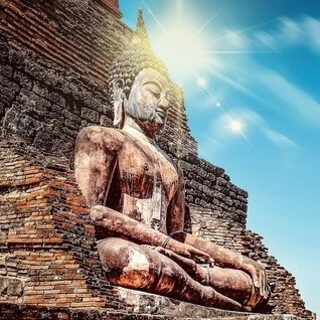
You sit like a Buddha statue.
Make clear that everything you want to know,
All the wisdom and knowledge,
Is in your mind.
It's not anywhere outside yourself.
There is no need to think about anything outside yourself.
You stay within.
Within that body and mind.
And bring your attention to the abdomen,
About two fingers above your navel.
And see how the abdomen is rising and falling.
While you're breathing.
When you breathe in,
See the abdomen is rising.
You make a mental note.
Rising.
When you breathe out,
The abdomen falls and you note falling.
Rising.
Falling.
Try to continuously be with the breath.
Try not to get involved with outside objects.
Thoughts distract you,
Just know,
Thinking,
Thinking,
Dreaming,
Dreaming,
Planning,
Planning,
Whatever you experience,
Note that And then let it go.
And bring the attention back to the abdomen.
And if sounds distract you Don't get involved,
Try not to get upset just now It's hearing,
Hearing Let it go and return to the main object.
Return to the rising and falling.
And check again,
Where is the mind now?
Are you mindful?
Are you with your breath?
Are you with the rising and falling?
That's perfect.
The mind is lost in thoughts and dreams planning whatever,
Then know it,
Note it and bring the attention back to the main object If we concentrate on the breath like that It is still what we call Samatha meditation,
Concentration meditation.
Try to concentrate on that object.
And that is necessary,
Whenever we start the meditation we should practice concentration first.
Because if the mind is not calm,
It's hard too.
Get inside.
So whenever you start your meditation session,
Try to concentrate for a certain time.
Until you feel,
Okay,
Now the mind is calm,
There are not so many thoughts,
There are not so many things that distract me And then you can open.
Up the mind and practice.
Vipassana Insight Meditation Today we try to do that by contemplating.
The body.
Before we did the contemplation.
Of the bones while doing standing meditation.
We go to the five outer meditation objects.
In Pali we call them panca kamatana.
Bring your attention to the hair on top of your head.
Try to see your hair.
See what colour your hair has.
How long or short your hair are.
Try to see how they grow out of the skin on your skull.
It seems there's one hair beside the other,
But if you look closer you can see that there's always a little bit of skin in between each hair.
Try to see that now.
Noted.
If you cannot see the hair,
Never mind,
Just know.
You used to see your hair when you look in the mirror.
When you wash your hair,
Brush it,
You know how it looks like.
No,
Your hair.
We know the hair was different when we were small children.
Was very fine It changed.
We grow up.
And it's changing towards old age.
Changes color,
Become white or gray.
And you lose it,
It's getting less.
So you can see the hair is always changing.
I can see it's changing every day.
If you don't wash it and brush it,
It is.
.
.
It gets greasy.
Smelly.
So you have to take care of it.
You have to brush it,
Clean it,
Wash it.
You know the hair is growing if you want it or not.
It's the nature,
It's changing You cannot ask the hair to grow more quickly or to stop growing because it has its own natural conditions.
So we contemplate the hair that grow on our head.
And slowly move down your forehead to the eyebrows.
Try to see your eyebrows.
See how this hair is growing out of the skin in your face.
What form do the eyebrows have?
What colour?
Try to see your eyebrows.
If you cannot see them,
No problem,
Never mind,
You just know.
Now the eyebrows This is bodily hair.
This body hair is growing all over the body except the palms of your hands and the soles of your feet.
Now the eyebrows,
Try to see them.
And slowly move down to your eyelash.
Try to see.
How the eyelash grow out of the eyelid.
What colour would form the eyelash hair?
Know that,
Try to see it.
Again,
Make clear you see from inside yourself.
From within.
See your own body.
Contemplate your own body.
It's not the thing that you see outside yourself and slowly move down to your nose and feel how A cold wind enters your nose at your nostrils.
And when you breathe out,
Warm wind comes out through your nostrils.
Don't change the press,
Stay with the natural press.
See the in and out breath.
There at your nostrils.
Now you're sitting in meditation try to calm the mind and you try to know your body.
Try to know the true nature of your body and mind.
And slowly move down to your mouth.
Try to see the teeth.
See the teeth that grow in your mouth.
See how they grow out of the gums.
See the pinkish reddish color of your gums and then the teeth.
What color do they have,
White or yellow?
What form?
Go from one tooth to the other.
Try to see their form,
Their color.
Do you know that's teeth?
Cheese.
If you cannot see them.
Just know them.
And now there are these little bones inside your mouth that you use for chewing your food.
And you know they change They are impermanent If you had your first two teeth when you were a small child,
Can they all fell out?
You got your second teeth.
And slowly now,
Dee.
Going to disappear.
Some are already lost,
Some had to have a treatment at a dentist,
Filling a any kind of treatment because they are impermanent.
They change every day,
You have to brush them several times a day.
Clean them.
Because.
.
.
Rests of food collect in between the teeth and if you don't clean them,
That gets foul and you have a bad smell.
Coming from your mouth.
So you have to brush them,
Clean them.
And still even if you take care very well,
They have to change.
Sooner or later when you grow older.
They will fall out.
And you have to get false ones.
You don't want to have toothache,
You don't want to have.
.
.
A painful treatment at a dentist,
But still you can't avoid that.
You have no full control over your teeth.
You have no full control over that body.
Although you may say,
This is my body,
It belongs to me,
This is me.
Actually,
This is not correct,
Because You can't control it.
If it would be really under your control,
If it is really your body.
Than you could say.
It shouldn't grow old.
It shouldn't change.
The teeth should not get holes or fall out.
But you can't.
No one can do that.
Even the Buddha.
Had a physical body and it grew old There are sicknesses in the body.
Pain could arise in the body.
And the body had to die.
That's its true nature.
It has to be like that.
We have to accept that.
If we cannot accept that,
Then.
.
.
We would be foolish.
Now the teeth that grow in your mouth.
Now slowly move out of your mouth and down your chin your neck.
Now both shoulders.
Both upper arms.
Elbows.
Lower arms.
Fingers.
And you can see now that your fingers,
The nails are growing The fingernails grow out of the skin.
There on your fingers.
Try to see the fingernails.
What form do you have?
What color?
It's a pinkish color.
With a small white half moon on the root of the nails.
What substance do the nails have?
It's a soft kind of bone.
See the difference.
Between the nails and the skin.
Again,
You know they change.
They grow if you want it or not.
Dirt collects underneath the nails so you have to clean them.
Cut them.
Take care of them.
They change.
And under your hands are the feet,
Your crossed legs and feet,
And the toes.
Try to see now the toenails.
Go from one toenail to the other.
See each of them.
If you cannot see them,
Know them.
Now how they grow out of the skin What substance they have,
They are a bit more,
They are harder than the fingernails.
Have a different form And again you now You have to take care of them,
You have to cut them,
Clean them,
They grow,
They change Now the toenails.
Now you sit in meditation,
Know your posture,
Be aware And now you contemplate the body right now.
See its nature,
Its true nature.
We know our body,
We see it every day.
But usually we do not contemplate it.
As it really is.
And then we experience a lot of suffering if we see it is changing It is not just healthy and comfortable.
Is pain.
Their sickness and old age.
That's the true nature of that body It's born,
It stays for a while.
Then it has to die.
Now bring the attention to the toes and see how each toe is wrapped into a small bag of skin.
Now the skin covers the soles of your feet.
Back of the feet.
Your lower leg.
Now slowly move up to the knees.
Now the skin covers your upper legs.
Your lower body.
Your upper body.
Your shoulders.
Your upper arms.
Your bowels lower arms.
Hands.
And fingers.
Again move from one finger to the other and see how each finger is wrapped into skin.
And move to your neck,
See how the neck is covered with skin.
And the whole skull.
See how the whole body is.
Covered in skin.
The Buddha compared to skin with a big rubbish bag.
With 9 holes.
And out of those nine holes a lot of dirty stuff is coming out.
Urine and faces and sweat and.
.
.
Fit and pass.
Dirt in your eyes,
In your ears,
Your nose.
Your mouth.
And you know the skin is always changing If you see a small child,
The skin is very smooth and soft changes when you grow up when you're in middle age.
And it gets wrinkles.
When you grow old.
And no one can avoid it.
That's the nature of the body.
It has to change.
You can see how it changes every day You have to wash it every day.
Because You sweat.
And a bad smell comes.
From the body.
Just consider if you ever.
Piece of clothes,
You wash it,
It has a good smell,
It is clean.
Can you wear it?
As soon as it is in contact with your body.
Gets dirty.
The dirt is not coming from the clothes,
But from your body.
You see the true nature of the body.
You contemplate.
The true nature of the body.
And you will see it's actually nothing.
Beautiful.
Nothing that is clean.
It's real.
Rubbish bag.
Filled with all kind of filthy and dirty stuff.
Filled with bones and muscles and with all the organs in destiny.
Brain,
Liver,
Heart,
Kidneys.
It's filled with blood and pus,
With urine and faces There's not one thing that is beautiful.
Not one thing that has a good smell.
If you think of a person that you say okay this woman is very beautiful or that man is very handsome I can imagine them without skin.
You see there is nothing left from the beauty So what we actually see as beautiful is only that skin.
Now you're sitting in meditation Knowing what posture you sit.
And now you're contemplating the body This practice of panca,
Kammatthana,
The five outer objects of the body.
It's a very important practice in Buddhism Every monk,
When he ordains,
When he becomes a monk,
Then this will be the first meditation instruction a monk receives.
He receives it in the ordination ceremony from his preceptor.
The preceptor tells the monk he should go through these five objects,
Hair on your head,
Hair that grows all over your body.
Teeth in your mouth,
Nails of fingers and toes,
And the skin.
The preceptor instructs the monk to go to these five objects forwards and backwards Again and again until.
.
.
He can really see.
These objects.
So whenever you sit down and meditate First try to contemplate,
Try to concentrate.
Try to get some concentration by watching your breath,
Watching the rising and falling of the abdomen.
When you see now,
There is some concentration,
The mind is calm.
Then you can continue with contemplating the body If you do that often,
These objects will become very clear.
If only one of the objects is clear,
That's enough,
You don't have to see all five of them.
If you see only.
For example,
The skin is clear,
Then stay with that.
Try to see the skin.
Contemplate it,
Contemplate its impermanence Look at it again and again and again So now later concentration arises on that object and you can see it very clear.
Then it's not just a memory.
That you use to contemplate but you really see clear.
How skin really is.
Some can see it like under a microscope.
Very sharp,
How the skin really looks like.
For some it can happen that they can see the impermanence very clear you might suddenly see yourself as an old man or old woman And this is then wisdom.
It's not an imagination,
But it arises through wisdom.
That's what we call when the Dhamma is teaching you,
The Dhamma is guiding you.
And you don't have to do anything but just Concentrate on the body and you will see very clear how the body really is.
Seeing the true nature of that body.
There are actually many kind of techniques how we can contemplate the body.
All in all,
The Buddha taught 40 different kinds of meditation techniques.
But it is easier in the beginning to contemplate these five outer objects because we can see them.
We can see them when we look in the mirror,
When we look at our body.
It's more difficult to see the inside objects of the body,
Like the organs.
Bones.
But if naturally,
When you do that practice,
If naturally one of the inner organs or inner things in the body arise,
You can see them clear.
Then you use that object,
That is also okay.
And it is individually different.
What is more clear.
So you have to find out which object is suitable for yourself.
But still in the beginning.
I recommend do this 5 outer objects.
Then the meditation will.
Developed by itself.
Now it's enough for this session.
Come back to your body,
Try to see yourself in the sitting posture.
Know yourself.
In the sitting posture.
Know what clothes you wear,
What colour your clothes have.
Know where you sit.
In which environment.
And look into your mind and Know what's going on there,
Is the mind calm?
And if it is calm and you know why.
What practice did you do to reach this state of calmness?
Keep it in your memory.
So the next time you sit down you know how it feels like to have a calm mind and you will be able to go more quickly to that state of calmness If the mind is not calm then you also know.
You know the mind is not calm and you know why,
What kind of thoughts occupy the mind and what distracts you.
Know that and try to deal with that.
Then bring the attention to your hands and slowly move your right hand to the right knee,
Place it on the right knee Mindfulness knows this movement.
Mindfulness goes with the movement of the hands.
And bring the left hand to the left knee,
Place it on the left knee Lift both hands,
Fold them in front of your heart and we give metta,
Loving kindness.
Share the good we did with the practice with our concentrate mind now.
Think of those beings.
That are important in your life,
Like parents,
Teachers.
Friends,
Relatives,
Those beings you love Then think of those you have a neutral relationship,
You know them,
But there is no special relationship you have And then give it to those that you don't like,
Enemies,
People that make trouble for yourself And in the end,
We share to all beings.
Think,
May all beings be happy,
May all beings be peaceful,
And may all beings be free from suffering.
You can make individual wishes,
Determinations you have,
Because they are more powerful if you do that with a concentrate mind.
And when you're finished,
Then come out of concentration.