Welcome to the mindfulness meditation podcast.
I'm your host,
Dawn Eshelman.
Every Wednesday at the Rubin Museum of Art in Chelsea,
We present a meditation session led by a prominent meditation teacher from the New York area.
This podcast is a recording of our weekly practice.
If you would like to join us in person,
Please visit our website at rubinmuseum.
Org slash meditation.
We are proud to be partnering with Sharon Salzberg.
This series is supported in part by the Hemera Foundation.
In the description for each episode,
You will find information about the theme for that week's session,
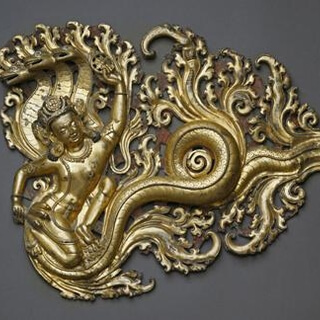
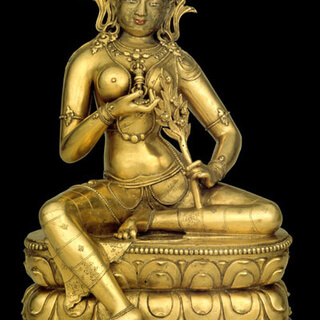
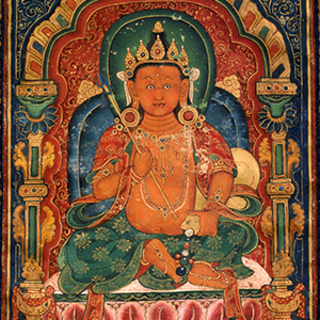
Including an image of a related artwork chosen from the Rubin Museum's permanent collection.
And now,
Please enjoy your practice.
Good afternoon,
Everyone.
To all of you,
Welcome and welcome back.
It's great to present this series to you,
And we always appreciate the support of the Hemera Foundation who helps us do that.
We are talking this month about listening.
And if you have been to the museum before,
Or even if you're coming for the first time,
You will have already noticed some pretty unique experiences.
The landscape of the museum has shifted recently over the last month.
And by that,
I mean the sonic landscape.
We just opened a few weeks ago an exhibition called The World is Sound,
And it takes a look at this concept of sound and what it means to us and how it is a vehicle for transformation through the lens of Tibetan Buddhism,
But also through the lens of contemporary sound artists.
And at the physical center of that exhibition,
Which is throughout the museum but concentrated up on the sixth floor,
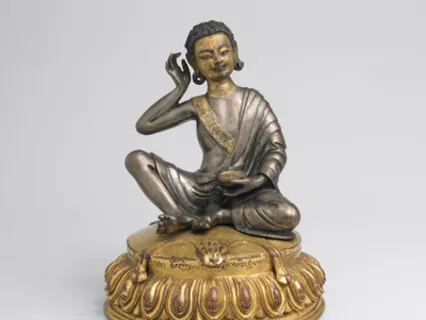
Is this object right here.
This is the beloved Tibetan Saint Milarepa,
Who,
As we can see here,
Is gesturing that he's listening.
And there are many wild and colorful stories about Milarepa,
And if you choose to go on the gallery tour with Jeremy afterwards to see this object in person,
You will hopefully hear a few of those.
But I think for our purposes today,
What's really important to know about Milarepa is that he had a dark time in his life.
There was destruction and hail storms and all kinds of negativity going on,
Thanks to Milarepa.
He had an awakening.
He devoted himself to Buddhism,
And he did a really rare thing,
Which is that he was able to achieve enlightenment in one lifetime.
And part of how he did that was through song.
So he was known to break into,
Burst out spontaneously into song that exclaimed the joys of the Buddha's teachings.
And he's pictured here in this pose,
The listening pose,
Which is a traditional pose for Tibetan singers actually,
Which I think is so interesting,
Right?
They're not necessarily depicted singing,
Although he's got his mouth open a little bit here.
We could imagine there's a little song going on there.
But it's really the emphasis on the listening that marks the singer.
So we'll be hearing a little bit more about Milarepa from our teacher today,
And I'm so delighted we get to welcome her back,
Lama Arya Drolma.
She has been studying and practicing Tibetan Buddhism since 2008,
And is trained in the Dharma Path program,
A progressive stages of meditation and contemplation for serious practitioners offered by the Kagyu Tipton Choling Monastery.
So she comes to us from the Kagyu tradition.
She teaches at the Hindu Samaj Temple and Cultural Center and Jain Temple in Poughkeepsie.
And before she became ordained,
She attended the Mumbai University in India and graduated with a BA degree in sociology.
She is also an active volunteer for several nonprofit organizations,
Including fundraising for breast cancer and HIV AIDS related issues.
And it's a delight to welcome her back.
Please help me do that.
Lama Arya Drolma.
Thank you,
Dawn.
And thank you,
Rubin Museum,
For having me here.
And hello,
Everyone.
Welcome,
And thank you for coming here today.
I'm absolutely delighted to be here with you all.
So today the theme is listening,
And here we have this exquisite sculpture of Milarepa.
And he is in a listening posture with his hands cupped his ears,
Which is symbolic of his meditative experience.
And immersed in this state of enlightened consciousness,
He was able to compose more than thousand songs and poems to his disciples.
And there are stories of celestial beings who would come to receive his teachings,
And he would teach the profound realization of Buddha's wisdom,
Buddhist wisdom through his songs.
So Milarepa was one of the most famous yogis and a revered saint in Tibet.
He's known to have attained mastery to many yogic powers,
So he would levitate at will,
And he could fly through air.
And one of his attainment was he had mastered two more.
And through his meditative experience and meditative concentration,
He was able to generate heat within his body and bliss.
And so as an ascetic,
He only wore cotton robes.
And during the harsh winter months in Tibet,
He would meditate in caves.
And it was the practice of Tummo which kept him alive,
And he survived the harsh winters of Tibet.
The meditative practice of Tummo is still practiced in most of the three and a half year retreat program.
And I was very fortunate to be introduced to the practice in my three and a half year retreat.
And most of the yogis,
When they meditate for long hours,
You will see this ornate band across Milarepa,
And that is a meditative band which keeps them upright when they are meditating.
And Milarepa's greatest achievement was that he became enlightened in one lifetime,
Which is extremely rare.
And achieving enlightenment,
He went through great hardship and through his absolute devotion,
Determination,
Perseverance,
He overcame all these hardships and attained enlightenment in one lifetime.
So he is such a great inspiration to all the spiritual seekers and the Buddhist practitioners that he was just an ordinary man who was able to achieve extraordinary achievement.
So he is inspiration to all of us.
And in most of the Kagyu monasteries and the monastery I come from,
Which is of Kagyu lineage,
We chant his prayers every month on many occasions,
And we invoke his blessings.
Because when you pray with devotions,
Since they are enlightened beings,
The only job is to bless you.
So he's a very inspirational figure in the Tibetan Buddhist tradition.
Milarepa is also one of the founding fathers of the Kagyu lineage,
And the Kagyu lineage is called the oral lineage,
Which means in the Kagyu lineage,
Great importance was given for oral transmission from master to the students.
And there was great emphasize in the importance of listening.
And that's what the Kagyu lineage is,
It's the oral transmission lineage.
And so today's mindful meditation session,
We will focus on listening to sound.
And I see there's a lot of newcomers here.
Welcome,
Thank you for coming.
This is a wonderful meditation session,
Which is very easy to follow.
So when we actually start the meditation,
There are two very important essential points.
The first essential point is your body,
And then the essential point of your mind.
So the essential point of the body is your posture.
So it's very important to have a straight back.
And for any reason,
If someone has any injuries and is unable to sit up straight,
Then sit as comfortably as you can.
So your legs,
While you're sitting,
Should be placed firmly on the ground so that it stabilizes you.
And your hands could be in the meditation mudra,
You can just put your palms on your knees gently like this,
Wherever your hands are placed.
Or this is a wonderful meditation poise,
Which is your right hand,
Or your left hand,
And then your thumbs meet.
And then just drop it on your lap,
Wherever it falls.
And so again,
Your straight back,
And your jaws are relaxed,
And keep your tongue gently on your palate,
Which is naturally held that way.
And your head can be slightly tilted forward.
And in this tradition,
We keep our eyes open with your gaze directed downward,
Like from the tip of your nose,
From four to eight inches,
Just wherever the gaze drops,
Just gently put your gaze downward.
And if this is uncomfortable,
You can close your eyes.
The reason we keep our eyes open is because we want all our senses to be open.
And when you close your eyes,
You may have a tendency to fall asleep.
And the purpose of meditation is to be alert and relaxed.
And your shoulders should be squared,
It shouldn't be slumped.
Keep your back straight.
And the reason your back should be straight is there are wind energies within you.
And when you're straight,
It's easy for your mind to be still.
Now we come back to the essential point of the mind.
The mind is the most important feature here,
Because it's the mind that does the meditation.
Your mind should be relaxed in the present moment of awareness.
When we start the meditation session,
We need the mind to have a focus.
And the reason we need the mind to have a focus is the mind's nature is to jump from one thought to another.
So when we give our mind a focus,
The mind will tend to be still.
So the focus today is on sound.
So all you have to do is just when we use breath as a focus,
We kind of look inward.
And with the sound,
When we use sound as a focus,
We will expand and look outward.
So all you have to do is get on the posture,
The meditative posture,
And simply keep an open and relaxed attitude and just put your attention to any sound that you can hear.
It's just like how you would focus on your breath.
You would now focus on any sound that you may hear.
If there's no sound,
Just listen to the silence around you.
Inhale and exhale.
Breathe normally.
Start by just allowing your mind to rest for a few moments in a relaxed state.
Then gradually allow yourself to become aware of things you hear close to your ear,
Such as your heartbeat or your breath or the sounds that occur naturally around you.
There's no need to try and identify the sound,
Nor is it necessary to focus on any specific sound.
It's easier to let yourself be aware of all the sounds you hear.
I just rest in the present moment of awareness.
Inhale and exhale.
Breathe normally.
I just bring your attention on any sound you may pick up around in the room and rest your mind in the present moment of awareness.
Any time you start thinking,
Just say thinking and then drop it.
Let it go.
Don't follow the thought.
And engage in it.
And return your attention and focus on the sound.
And it can be any sound and keep a relaxed and open mind.
Each time your mind wanders,
Just bring it gently back.
Bring it back to the focus and attention on the sound.
And inhale and exhale.
And breathe normally.
One of the greatest benefits of meditation on sound is that it gradually teaches you to detach from assigning meaning to various sounds you hear.
You learn to listen to what you hear without necessarily responding emotionally to the content.
As you grow accustomed to listening to sounds,
Simply as sounds,
You can apply the same theory to criticism or hurtful words without becoming angry or defensive,
Unable to listen to praise without becoming overly proud or excited.
You can simply listen to whatever people say with a much more relaxed and balanced and open attitude without being carried away by an emotional response.
Inhale and exhale.
Breathe normally.
And as you catch yourself thinking,
Just say thinking,
Drop it,
And bring your attention back to the sounds around you.
Inhale and exhale.
Breathe.
You don't have to try and stop your thoughts,
But merely observe it.
Eventually you begin to feel a tremendous sense of relaxation,
A vast sense of openness within your mind,
Which is in fact your natural mind,
The natural spacious mind.
Inhale and exhale.
Breathe gently and normally.
And bring your attention and focus to the sound around you and just simply relax into it in the present moment of awareness.
By nature,
The essence of your mind is total peace.
Therefore,
Anytime you meditate,
You go back to that peaceful state,
Which is your natural state of mind.
Inhale and exhale.
Breathe normally.
Anytime you start thinking any thoughts,
Just say thinking.
Gently bring your mind back to your focus of attention,
Which is the sound around you.
If you can't hear any sound,
Just relax into the silence and stillness.
So your light is programmes within,
As the music will take place throughout all Double investments,
Which can be plugged into the music and vehicles created by afterwards.
Inhale and exhale.
Breathe normally and gently and just bring your attention back to the sound around you or the stillness or the silence.
Just relax into it.
If we can train ourselves during meditation to simply observe the rising of each thoughts and emotions without grasping at it,
Without clinging to it.
But it's just the temporary play of the mind like waves emerging and dissolving back into the ocean.
And then this habit will make its way into our ordinary lives where we don't have to grasp at every thought and make a meaning out of it.
Inhale and exhale.
Breathe normally.
Let go of all your tension,
Anxiety and stress and just rest in the present moment of awareness.
Let go of all your tension.
Let go of all your tension.
Inhale and exhale.
Breathe normally and rest your mind in the stillness of silence.
Each time you catch yourself thinking,
Just bring your attention back to the sound you've been focusing on.
Let go of all your tension.
By nature,
The essence of your mind is total peace.
Therefore meditation brings you to that peaceful state.
So just inhale and exhale gently.
Breathe normally and rest in that peaceful state,
Letting go of all your stress,
Tension and anxiety.
Let go of all your tension.
Let go of all your tension.
Okay,
Relax,
Stretch a little bit.
You can twist your body a little bit like this,
Just stress.
Thank you.
That concludes this week's practice.
If you'd like to attend in person,
Please check out our website,
Rubinmuseum.
Org slash meditation to learn more.
Sessions are free to Rubin Museum members,
Just one of the many benefits of membership.
Thank you for listening.
Have a mindful day.