Welcome to the Mindfulness Meditation Podcast presented by the Rubin Museum of Art.
We are a museum in Chelsea,
New York City that connects visitors to the art and ideas of the Himalayas and serves as a space for reflection and personal transformation.
I'm your host,
Tashi Chodron.
Every Thursday,
We present a meditation session inspired by a different artwork from the Rubin Museum's collection and led by a prominent meditation teacher from the New York area.
This podcast is a recording of our weekly in-person practice.
In the description for each episode,
You will find information about the theme for that week's session,
Including an image of the related artwork.
Our Mindfulness Meditation Podcast is presented in partnership with Sharon Salzberg and teachers from the New York Insight Meditation Center,
The Interdependence Project and Parabola magazine and supported by the Frederick P.
Lenz Foundation for American Buddhism.
And now,
Please enjoy your practice.
Welcome to Mindfulness Meditation at the Rubin Museum of Art.
I'm Jacqueline Smith,
Manager of Programs and Education,
And I'm delighted to be your host today.
We are a global hub for Himalayan art with a home base here in New York City.
And we are so glad to have all of you join us for our weekly program where we combine art and meditation.
Inspired by our collection,
We will first take a look at a work of art.
We will then hear a brief talk from our teacher,
Kimberly Brown,
And then we will have a short sit,
15 to 20 minutes,
For the meditation guided by her.
Let's take a look at the theme and artwork for today.
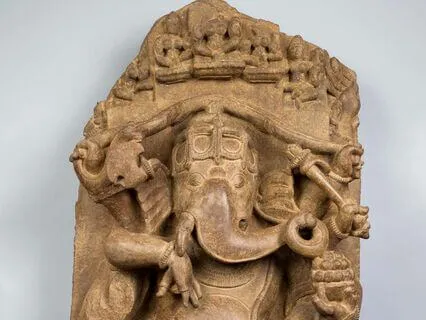
And we are going to be taking a closer look at Ganesha on view on the first floor of the museum.
And our theme for the month of January is New Beginnings.
Ganesha is known as the Lord of New Beginnings.
He is revered as a remover of obstacles.
Individuals often make offerings to Ganesha at the beginning of new endeavors to express appreciation and ensure a smooth path forward.
This rendition of Ganesha has withstood the test of time.
It was made in the 11th century of sandstone.
Ganesha's weathered belly and darkened trunk are the results of centuries of devotees' hands reaching out to him to invoke his blessings.
Ganesha is perpetually in motion,
Dancing to the rhythm of drums played by two small figures on his right.
He is adorned with a crown and triumphantly bears a cobra in his upper pair of arms.
Another snake coils around his chest.
With one of his left hands,
He holds a bowl filled with his favorite Ladoo sweets.
His other hand holds a battle axe and a tool used by elephant drivers.
Everything that he's holding is associated with his role as a remover of obstacles.
As we behold the majesty of Ganesha,
Let's reflect on the obstacles in our own lives and how they can be perceived as opportunities for growth,
Depending on how we look at them.
Now let's bring on our teacher for today,
Kimberly Brown.
Kimberly Brown is a meditation teacher and the author of Navigating Grief and Loss,
25 Buddhist Practices to Keep Your Heart Open to Yourself and Others.
She's also the author of Steady,
Calm,
And Brave.
Kimberly leads classes and retreats that emphasize the power of compassion and kindness meditation to reconnect us to ourselves and others.
Her teachings provide an approachable pathway to personal and collective well-being through effective and modern techniques based on traditional practices.
She studies in both the Tibetan and Insight schools of Buddhism and is a certified mindfulness instructor.
Kimberly,
Thank you so much for being here with us.
Hi everyone.
Thank you for coming out in the cold.
On my way here,
I thought,
Gosh,
Maybe there'll just be a few of us because it's,
You know,
Winter.
So thank you and thank yourselves.
Okay,
So it's January.
New beginnings.
We talk about intentions,
We talk about resolutions.
And it's interesting.
I've been thinking a lot about what does it mean to begin again?
What are we beginning again?
So in the Buddhist tradition,
One of the words for mindfulness is smrti.
It's a Pali word that was the language just after the Buddha was alive,
The language of Pali.
And smrti is translated as mindfulness,
But its literal meaning,
I'm told,
Is to recollect together.
It has a sense of beginning again.
Sometimes it's called remembering.
And that's what it means to begin again,
To come back,
To start over.
Start what over?
Well,
Again,
From this tradition,
What we're starting over is we're coming to the truth of our lives again and again and again and again.
The truth we can only apprehend in this moment.
And that's why the practice is,
Well,
We're going to come back,
We're going to start again.
We're going to bring our attention to what's true.
Light entering your eyes and smell and any of your aches and pains or pleasures of your body.
And also the truth of the thoughts and feelings we have and the stories we have,
That they come and go,
That they are not facts at all.
They are information,
But they aren't the same as something solid.
And when you just,
You know,
If you can get quiet for a little bit,
You'll start to notice that yourself,
Nothing special to notice that.
What happens is,
And what prevents us from beginning again,
Both in our lives and our meditation is that we often cling on to something.
You'll hear terms like clinging and desire and grasping,
Sharon Salzberg lately has been using the word contraction.
All of those point to this sense that there's a story that we have,
Something we want,
Very hard for us to let go of it.
And yet this clinging,
This grasping,
That's what causes very deep suffering.
And so we're encouraged to let go,
Let go of what we're clinging to,
Not because it's a sin or because we'll be good people if we do that.
It's because it frees us from a lot of pain and sorrow.
Now clinging and suffering,
Sometimes you'll hear it called attachment.
It doesn't mean we don't love each other.
We don't have preferences in life.
I want that job.
That's okay.
It only becomes a problem when it's something that we're demanding,
Insisting on,
Okay?
That we believe is true,
Maybe,
And it's not true.
And this often comes up with other people.
You know,
There may be people in your lives who have hurt you,
And a big story may be there.
And it might be very hard for you to let go of that story of who they are.
So from this view,
The suggestion would be to be able to forgive and remember,
To say,
Wow,
It causes me a lot of pain to hold onto this,
And to let go of it so I'm not suffering.
And I'll remember who that person is.
I may shift my relationship with them,
But I'm going to give up this clinging and grasping to this pain,
Going over and over that story.
Now,
Sometimes the person that we have trouble forgiving is ourselves.
Why did I say that?
I should have made different plans.
Why did I go to college there?
I shouldn't have moved to New York 20 years ago.
I should have moved to Rome.
All these ideas we have,
Right?
So starting to notice all of these stories,
All of these ideas,
They're delusions.
They're not true.
If you hold onto them,
I am almost positive you will suffer from them.
You will feel that there's something deficient in you and something that you're lacking.
And all of you here,
No one is lacking anything.
This does not mean you don't have grief and loss and sorrow.
I'm sure you have that,
Or that you have illness,
Right?
These are all truths of being human,
And yet you have everything that you need.
Now both from a ultimate view,
From a Buddhist view,
There's nothing wrong with any of us,
But also from a practical view.
I was saying to my husband the other day,
You know,
The Buddha talked about how this,
He called it dukkha,
Suffering,
Dissatisfaction,
How we all have it,
All humans,
Doesn't matter how rich or poor you are,
You all have it,
You know?
And I was saying to him the other day,
When we were dissatisfied,
We live in New York City,
We never have enough room,
Right?
And I was saying,
My God,
You know,
Just a century or two ago,
We would be,
People would think we were gods.
I can go in the bathroom and take a hot shower anytime I want,
Right?
I have machines to wash my clothes.
We have heat.
There's no problems,
Right?
Amazing.
I go to a grocery store,
Look at all that stuff,
Right?
And yet,
You know,
We take it for granted.
It doesn't mean we're sinners.
It's the nature of the mind,
Unless you start to train it,
Okay?
It's the nature of the mind to not,
To start to not pay attention and to start to go over here to the grasping,
To the what I don't have,
What I think I might need.
Sometimes with practice,
We can turn our attention to what we have,
Right,
With appreciation and gratitude,
And we can start to let go whatever is causing us to grasp and cling and demand and insist that life go the way we would like it to go.
Sometimes it won't.
This doesn't mean that things in life cannot change,
But it does mean that in order for change to happen,
We have to create new causes and conditions.
In order for change to happen,
We have to create new causes and new conditions through our words and our thoughts and our actions,
And it's not all up to us.
We can just contribute,
And that's very freeing,
Too.
The world is not up to you.
Even your own life is not up to you,
Right?
There are some things,
What's up to you is what you say and what you do and what you think,
Right?
The other things,
Lots of other conditions are contributing to it,
And if we collectively use what we can,
Our words and our speech and our actions in ways that are beneficial to ourselves,
In ways that don't harm,
Well,
That is how we create new conditions,
Right?
Over time,
How change happens.
All right?
So we're going to do a little practice,
And in this practice,
We're going to practice maybe letting go,
Okay?
I'm going to guide you.
You don't have to do anything.
You can,
If you'd like,
You can close your eyes.
You can also just let your gaze be lowered with your eyes open,
And that's a good way to do it if you're going to fall asleep right now.
Open your eyes.
Let them gaze lower,
And notice what's the difference between meditating and not meditating.
Notice this moment.
What it is generally is a change in attention,
How we pay attention.
Most of the time,
We're out there grasping at stuff,
The internet,
Conversation,
Opinions,
Other people,
And right now,
Turning your attention to yourself,
Your own beautiful hearts,
Minds,
Placing a hand on your heart and a hand on your belly.
You can feel your own presence here,
And also notice that your body is moving as you breathe.
You're resting all of your attention,
All of your focus and concentration on the palms of your hands.
Maybe you've noticed you've slipped into a story or a plan,
And here's the moment to let go.
Back to your hands,
And you might notice that you're planning or remembering.
You're swept away into a story,
And that's okay.
This is the opportunity to begin again,
Start fresh,
Choose not to follow that arising.
Come back to your hands,
On your hands,
Breath,
You don't have to fix anything,
Anything,
Anything different right now.
You have worries,
Allow yourself to heal them.
You have sadness,
Allow yourself to be with that.
You have happiness,
Allow yourself to be in that.
When you're in a story,
You're not in any of those,
You're just in a story.
Going back to this presence,
To what's arising,
To your hands,
Your belly,
Your being.
Whatever you're doing,
Do less.
You have to work and fix,
Figure out.
Sitting here on your breath,
Your body's breathing for you,
So you don't have to do anything.
Just noticing what's arising for you,
Feel tired,
Or bored,
Or peaceful,
Annoyed,
Happy,
All of that is okay.
Searching for a state,
Being with what is now,
Now is yours,
Bringing your kindness,
Your compassion to your experience,
And as you're connecting with your own heart,
Your own presence,
You can offer yourself some wisdom and kindness,
Reading these metaphrases.
May I be gentle with myself,
May I be peaceful and at ease.
May I be gentle with myself,
May I be peaceful and at ease.
May I be gentle with myself,
Peaceful and at ease.
Just repeating that silently to yourself for one minute,
Maybe imagining one of your dearest friends,
Pets,
Here with you,
Loving person or animal in your life,
And they're sitting here with you,
Give the same wisdom to both of you.
May we be gentle with ourselves,
May we be peaceful and at ease.
May we be gentle with ourselves,
May we be peaceful and at ease.
For a minute,
Offering wisdom to them,
Both of you,
Maybe for a moment,
Including everyone here today,
Be gentle with ourselves,
May we be peaceful and at ease.
All beings everywhere,
Gentle with themselves,
Be peaceful and at ease.
Stop meditating,
Meditate,
Don't not meditate,
Be for a moment,
Heart,
Presence of so many others,
Beautiful hearts.
Fully bring your attention to our conversation,
You can stretch,
You can move,
Thanking yourself and each other.
Thanks everyone.
Thank you.
Thank you.
Thank you so much,
Kimberly.
Thank you,
Jacqueline.
That concludes this week's practice.
To support the Rubin and this meditation series,
We invite you to become a member at rubinmuseum.
Org slash membership.
And to stay up to date with the Rubin Museum's virtual and in-person offerings,
Sign up for a monthly newsletter at rubinmuseum.
Org slash e-news.
I am Tashi Chodron.
Thank you so much for listening.
Have a mindful day.